

Adamo Faiden Guts a Century-Old Buenos Aires House to Build a Veterinary Clinic Around a Courtyard
A corrugated metal facade and open-air passage turn an early 20th-century shell into a pet clinic and community garden in Buenos Aires.


Veterinary clinics rarely get the architectural attention they deserve. They tend to be utilitarian fit-outs in leased commercial space, designed around drainage and tile rather than any real spatial idea. Clínica Veterinaria Guayaquil, completed in 2022 by Buenos Aires studio Adamo Faiden, takes the opposite approach. The architects gutted an early 20th-century residential house on Guayaquil 650, removed its central bay entirely, and replaced it with a semi-covered passage that runs from street to garden. What remains is a veterinary facility organized in two lateral bays flanking a courtyard, a building that treats the threshold between city and clinic as its primary architectural event.
The most interesting move here is structural subtraction. Rather than adding volume to accommodate the program, Adamo Faiden carved out the middle of the existing house, exposing its lateral load-bearing walls and creating a void where the old circulation once lived. That void became a courtyard open to vegetation, pets, and the public. The result is a clinic that breathes, both literally through its ventilated corrugated metal walls and figuratively through its willingness to let the neighborhood in.
A Corrugated Skin Catching Shadows
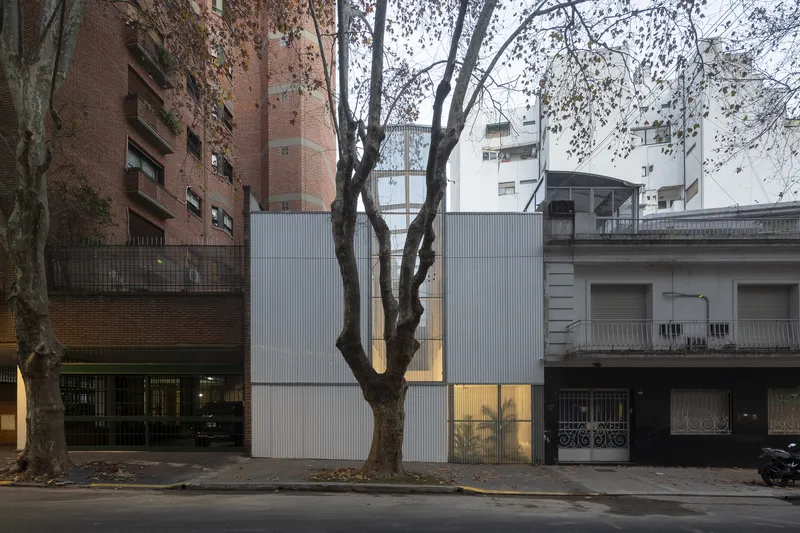
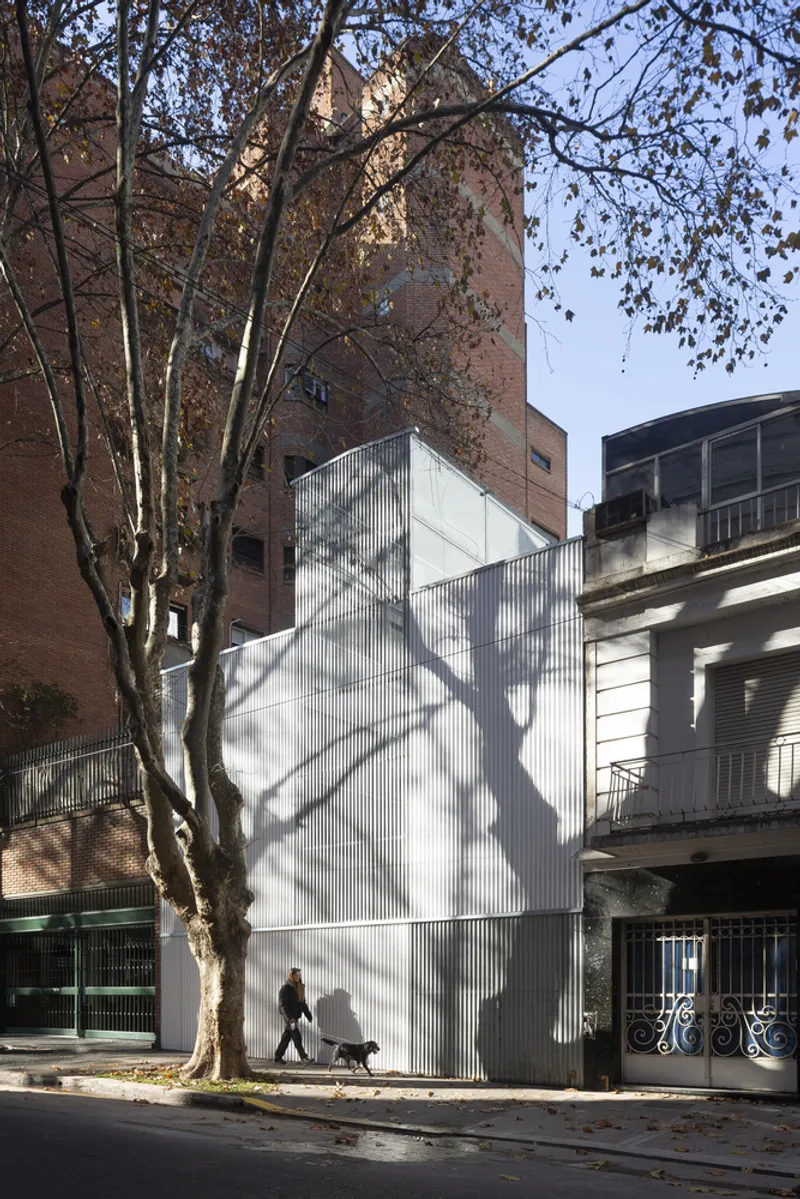
The street facade is a narrow vertical slab of corrugated sheet metal, slotted between two neighboring apartment buildings. It reads as deliberately quiet, almost industrial, until you notice the London Plane tree in front casting a lattice of branch shadows across the ribbed surface. The cladding was applied over the existing front and back walls, creating a ventilated double skin that keeps the interior cool while giving the whole building a unified material identity. It is a respectful renovation strategy: the old masonry does the structural work, while the new metal does the thermal and aesthetic work.
From the sidewalk, the building could be a workshop, a gallery, or a small warehouse. That ambiguity is productive. It invites curiosity without announcing itself, and the corrugated metal gives it a toughness appropriate to a building designed for animals, foot traffic, and Buenos Aires weather.
The Central Passage as Public Room
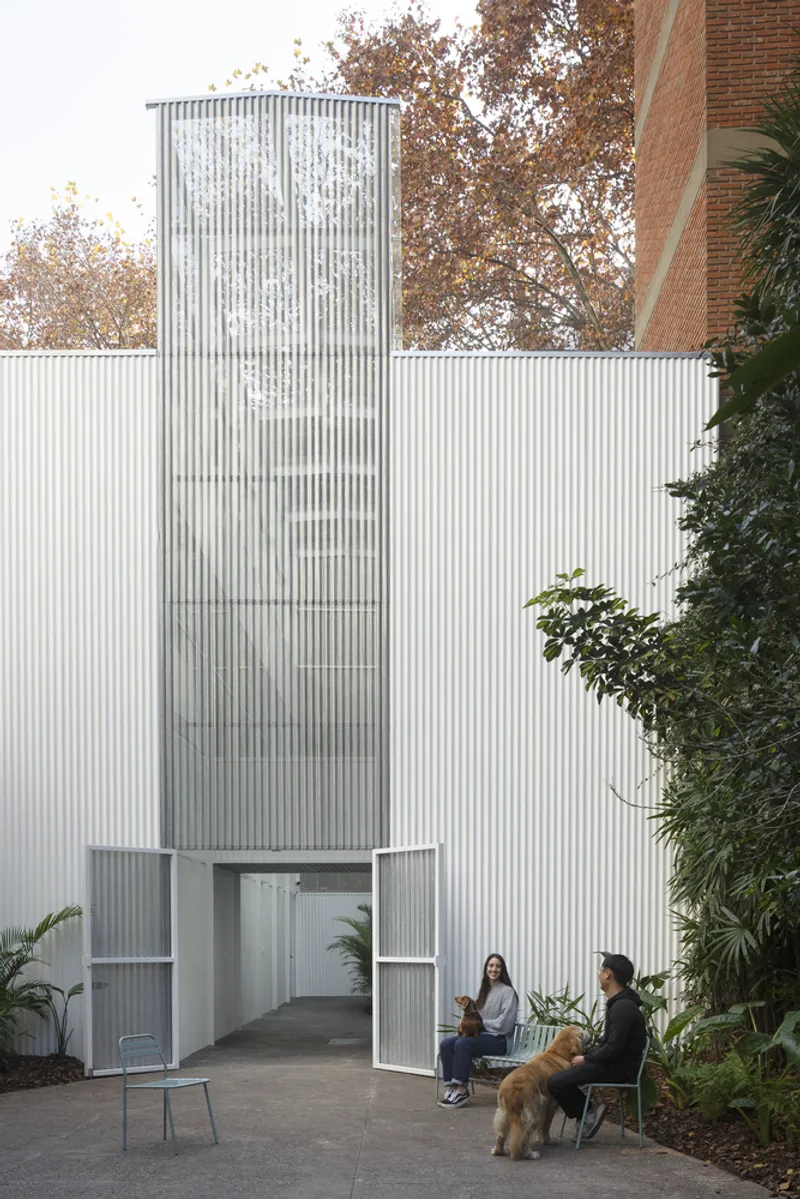
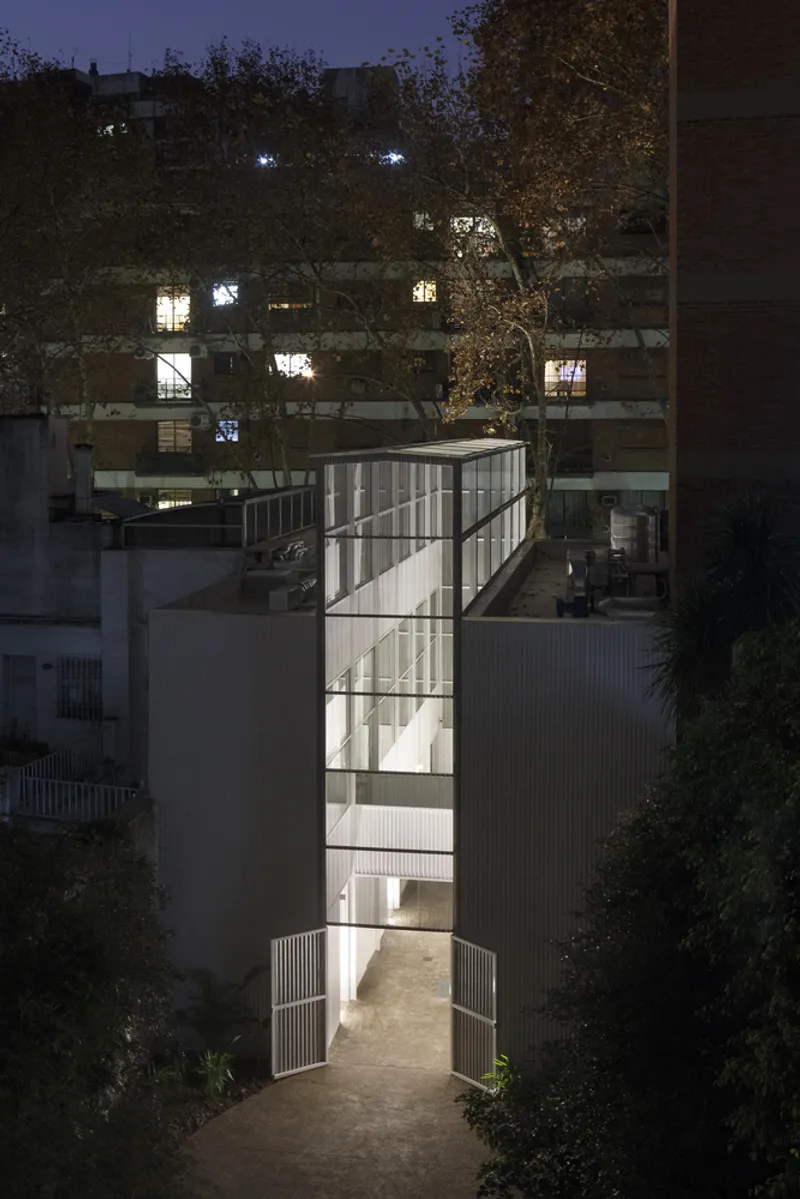
Walk through the entrance and you are in the courtyard, a semi-covered passage where corrugated metal walls rise on both sides and a cylindrical volume anchors the composition. Two people sit on a bench with a dog. This is not a waiting room in the conventional sense; it is an outdoor room threaded between the clinic's functional bays. The passage connects the street directly to a garden at the rear, making the building porous in a way that most medical facilities would never allow.
At night the passage glows, its light spilling out onto the street like a lantern wedged into the block. The surrounding apartment buildings frame it with their own lit windows, and the clinic becomes part of the neighborhood's nocturnal rhythm rather than shutting itself off behind a locked door. This is community architecture in the most literal sense: the building's central space belongs as much to the street as it does to the clinic.
Skylight, Palms, and the Interior Courtyard
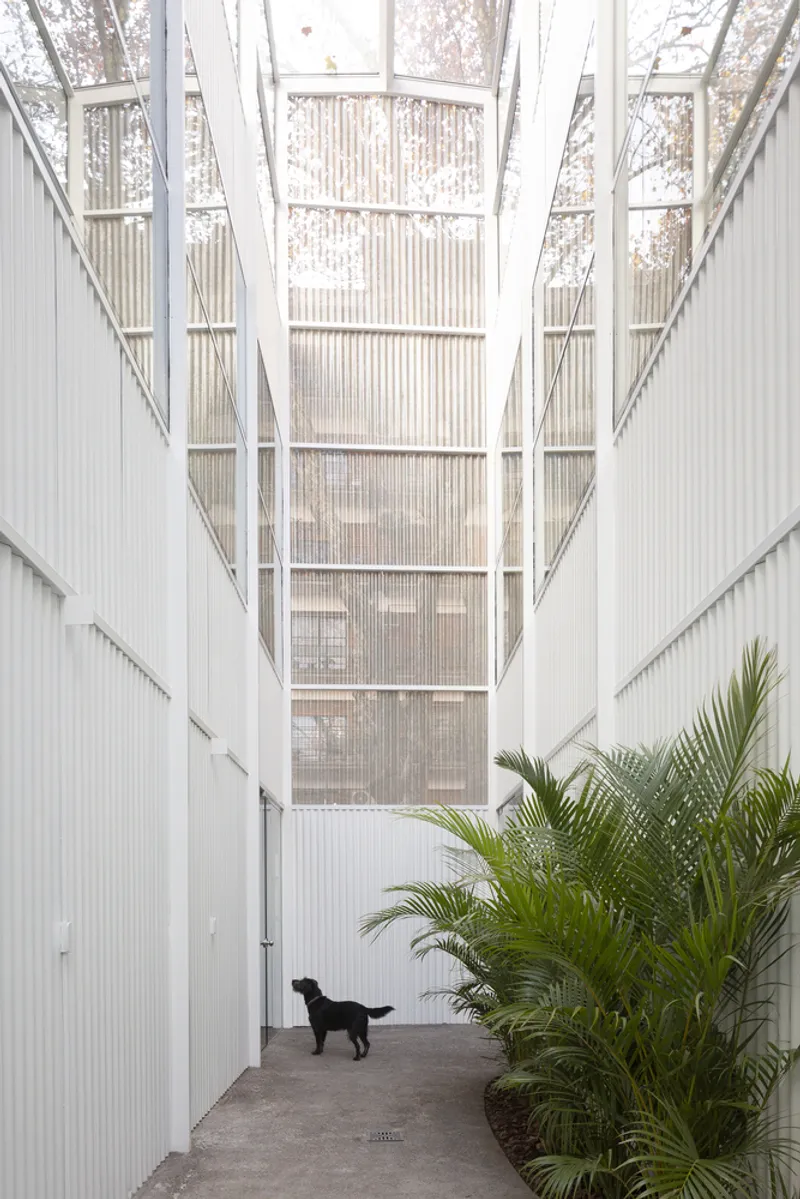
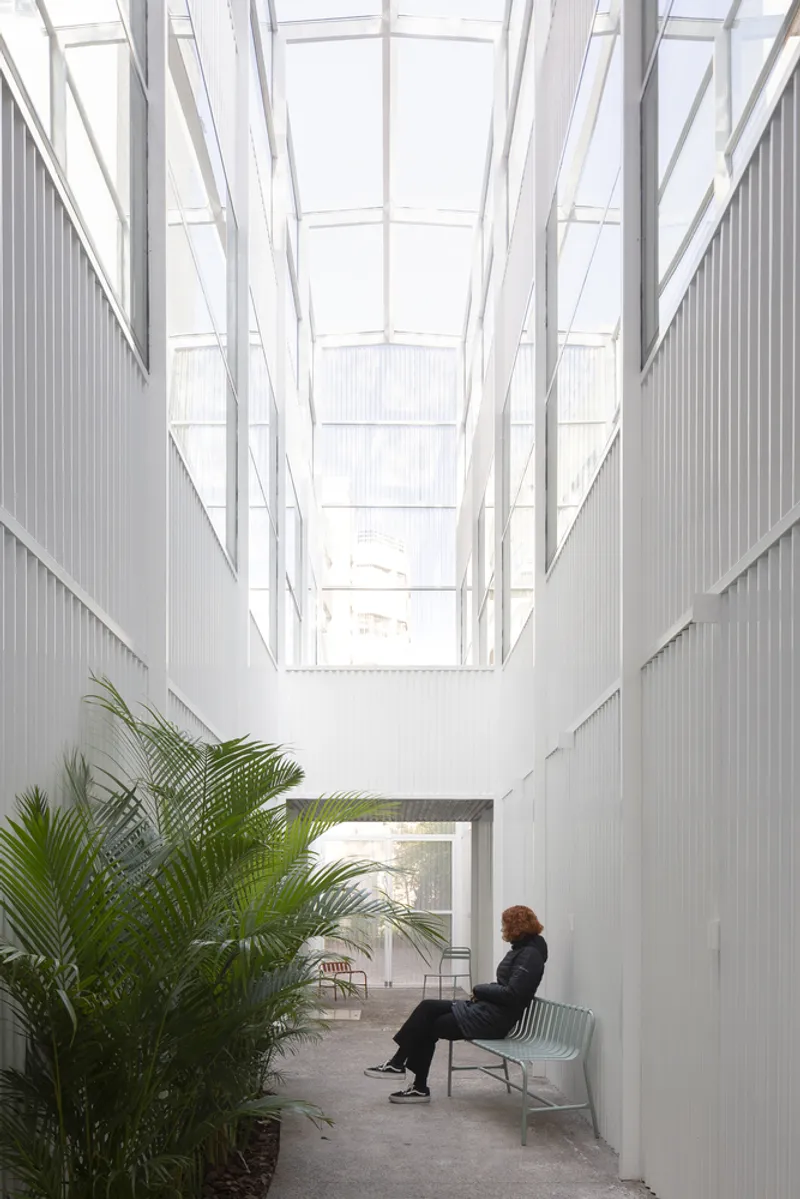
Deeper inside, the courtyard opens up under a full-height glazed roof supported by a white steel frame. Palm fronds push into the space from planters at ground level, and the effect is somewhere between a greenhouse and a covered patio. A dog stands in the middle of the frame in one shot, which feels exactly right: the animal is not an afterthought here but the spatial protagonist.
The concrete floor, finished with exposed stone aggregate, was designed specifically for pets. It is durable, cleanable, and textured enough to give traction to paws. These are small decisions that accumulate into something larger: a building that has genuinely thought about its non-human users rather than treating them as a programmatic footnote. The vegetation and natural light are not decorative. They regulate climate, reduce stress for animals, and connect the interior spaces to the garden beyond.
Stacking Care Above Commerce
The program splits cleanly across two levels. The ground floor houses the pet store and veterinary consultation rooms, the spaces where clients and their animals arrive, browse, and receive initial care. Upstairs, behind the corrugated walls, sit the laboratory, X-ray room, and operating room. This vertical separation is pragmatic: it keeps the noisier, more public functions at street level while isolating the sterile medical spaces above, where controlled environments and reduced foot traffic matter.
Both levels open onto the central passage, which means the courtyard acts as a shared lobby and light well for the entire building. It is a simple organizational diagram, two bays flanking a void, but the proportions and the materiality give it real architectural presence. The side bays feel like rooms carved from the old house's skeleton, which is exactly what they are.
Plans and Drawings
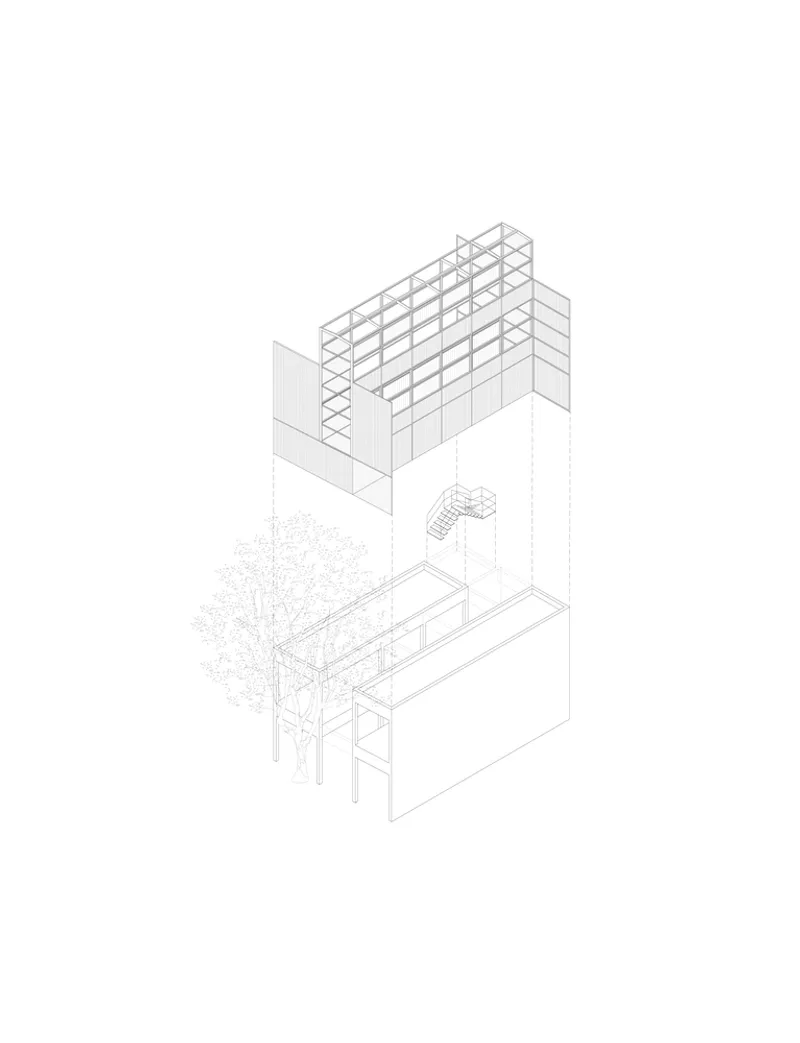
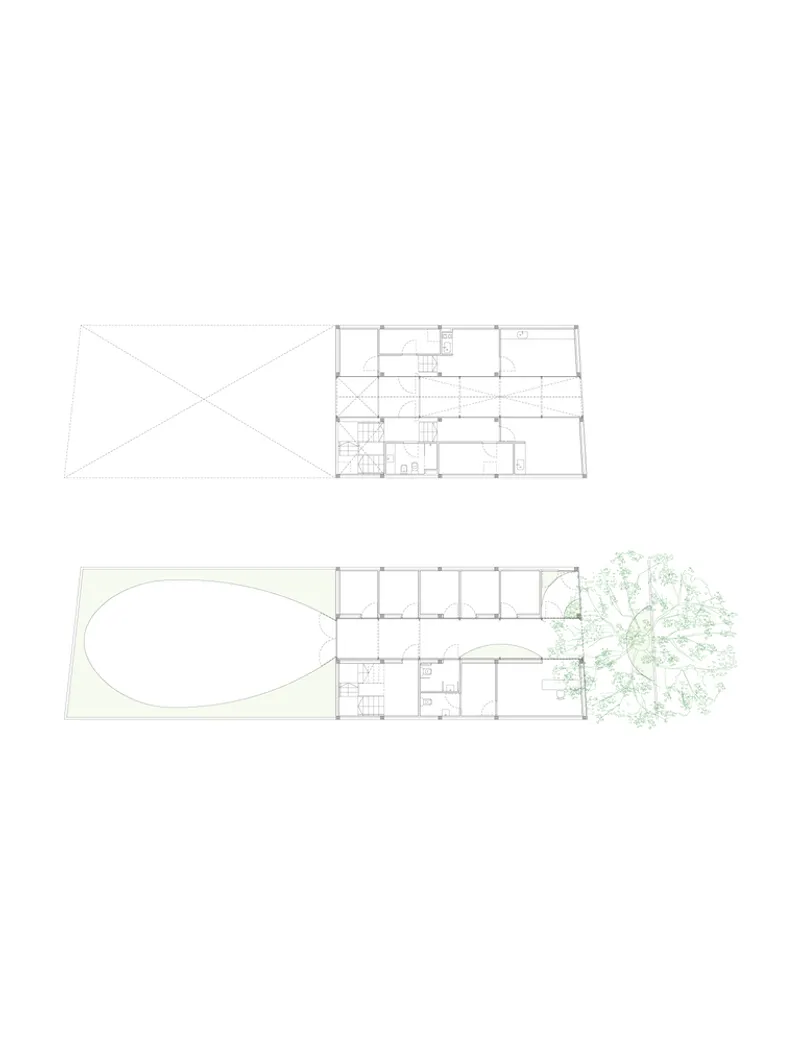
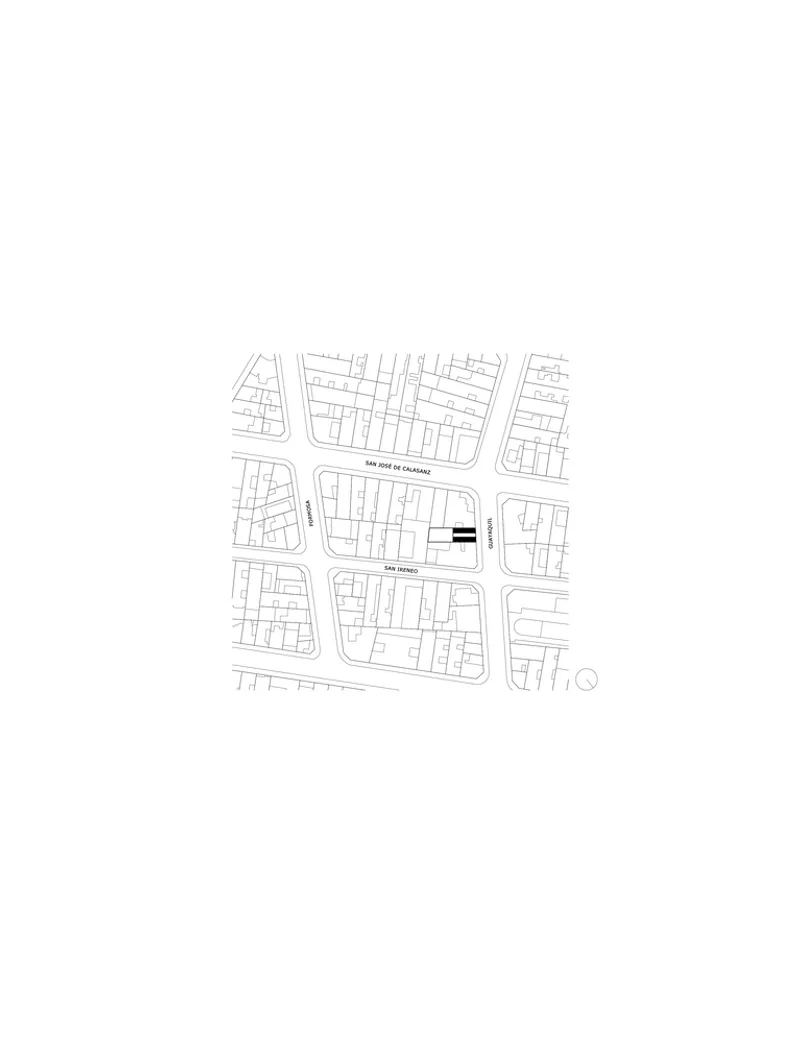
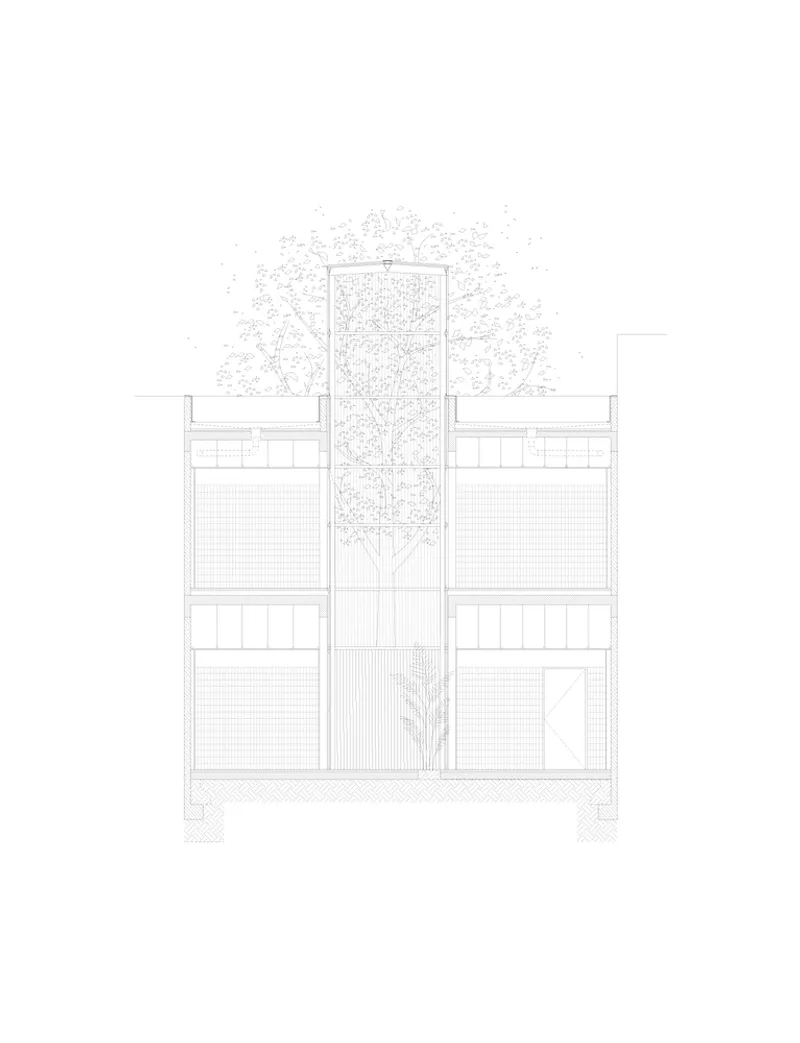
The axonometric drawing reveals the structural logic most clearly: a multi-story frame with a cantilevered volume projecting over the courtyard, and a tree rooted in the void where the old central bay used to be. The floor plans show the oval courtyard as the organizing element, with the two lateral bays wrapping around it on both levels. The site plan places the building within its block, confirming how tightly it sits between party walls and how the garden at the rear connects to a shared interior of the block.
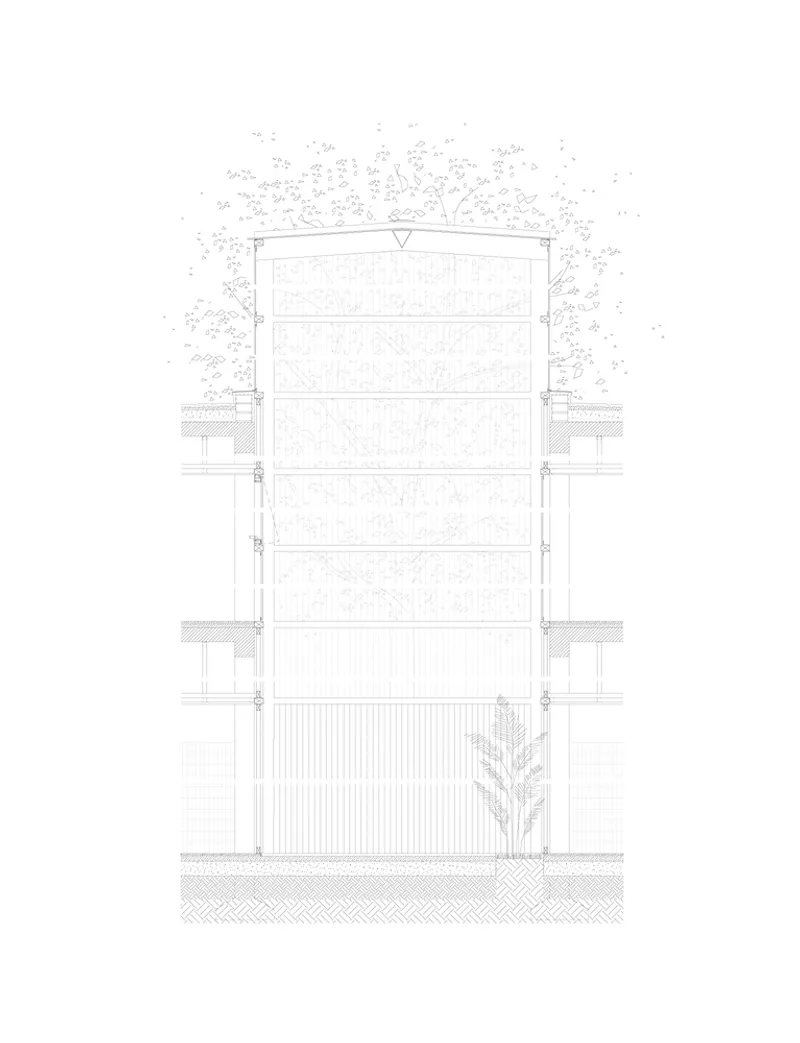
The section drawings are the most revealing. One cuts through the courtyard to show the relationship between the interior floors and the tall canopy tree that rises above the building. The other details the layered facade construction: corrugated metal, perforated screens, planted terraces, and the tree canopy above. This is where you see the ventilated wall strategy at work, with air circulating between the old masonry and the new metal skin. It is a technically modest but environmentally intelligent approach to adaptive reuse in a warm climate.
Why This Project Matters
Clínica Veterinaria Guayaquil matters because it takes a building type that architecture typically ignores and treats it with genuine spatial intelligence. By removing the center of an existing house and replacing it with a courtyard open to the street, Adamo Faiden turned a renovation into a proposition about urban coexistence. The clinic does not just serve pets and their owners; it offers the neighborhood a passage, a garden, and a visible demonstration that adaptive reuse can produce spaces more generous than new construction.
The project also advances a quiet argument about who buildings are for. Adamo Faiden frames the clinic around what they call "diversified coexistence groups," a phrase that sounds academic until you see a dog standing alone in a sunlit courtyard designed for exactly that moment. Architecture's obligation to non-human users is growing alongside the legal and cultural recognition of animal welfare, and this clinic is one of the few built examples that takes that obligation seriously at every scale, from the aggregate in the concrete to the tree in the void.
Clínica Veterinaria Guayaquil by Adamo Faiden. Located at Guayaquil 650, Ciudad Autónoma de Buenos Aires, Argentina. Completed in 2022. Photography by Javier Agustín Rojas.
About the Studio
Share Your Own Work on uni.xyz
If projects like this are the kind of work you want to make, uni.xyz is a place to publish your own, find collaborators, and enter design competitions.


Popular Articles
Popular articles from the community


David Macias Steps a Doorless Stone and Plaster House Down a Tropical Colombian Hillside
In the humid hills of Colombia, Threshold House replaces the front door with an open void and terraces its 850 m² down the slope instead of fighting it.

David Ortega Stacks a Two-Story Mexico City Penthouse Around a Steel Stair and a Pergola-Shaded Roof Terrace
In Colonia Roma, a 300 m² penthouse uses oak joinery, a planted steel stair and a slatted roof pergola to make a new-build apartment feel like a house.

Juan García Correa, John González and Claudia Rueda Sink a Circular Amphitheater into a Manizales Engineering Building
On the La Nubia campus in Manizales, Colombia, the S1 Building folds labs and offices into a hillside of ramped lawns that double as a campus route.

GROUP A Strips a 1969 Rotterdam Harbor Headquarters to Its Frame and Wraps It in Timber Louvers
In Rotterdam's M4H harbor district, Ferro Offices reuses a 1969 frame, adds one timber storey and reaches BREEAM-NL Outstanding.

Similar Reads
You might also enjoy these articles


Hodi-Mandai Geram
Project Function: Preservation and revitalization of the Intangible heritage and socio-spatial identity of the Hodi by Housing, Cultural Memory Center, Sacred Grove, landscape, local tourism economy


Olio Towers: A Mid-Rise for Performers That Fuses Housing, Rehearsal, and Stage
Located blocks from Houston's Theater District, this modular tower stacks living units around a central performance atrium.

Oasis: Modular Green Housing Carved into Dhaka's Urban Fabric
A shortlisted Plugin Housing entry reclaims unauthorized settlements in Dhaka with stepped concrete volumes, green roofs, and ventilation-driven design.

Black Hole: A Floating Megastructure for the Post-Physical Era
Emiliano Mazzarotto envisions a spherical, self-scaling arena where e-sports, digital hotels, and holographic stadiums replace traditional public space.

Explore Architecture Competitions
Discover active competitions in this discipline

Challenge to reimagine the Iron Throne

Photograph architecture without architects

Illustrate the lost glory of Angkor Wat - Render Challenge

Design challenge to reuse E-waste
Comments (0)
Please login or sign up to add comments
No comments yet. Be the first to comment!