

We Are How We Eat: Turning London's Nine Elms into a Living Food Ecosystem
A runner-up entry in Urban Meal Mine reimagines the New Covent Garden Market as an interconnected landscape of farms, markets, and learning.


Food is infrastructure. It shapes logistics networks, determines land use, and dictates daily rhythms for millions of urban residents. Yet most cities treat food as a consumption endpoint, severed from the systems that produce and distribute it. We Are How We Eat takes this disconnect as its starting point, proposing a wholesale market that doesn't just sell food but produces, teaches, and cultivates community around it. The core provocation is deceptively simple: stop asking what we eat and start redesigning how we eat.
Designed by Hùng Trần, Cao Minh, and Đạt Đinh Công, the project was awarded Runner-up in the Urban Meal Mine competition. The site is London's New Covent Garden Market in the Nine Elms District, a location already loaded with history as a wholesale food trading hub. Rather than demolishing and rebuilding, the designers reimagine the market as a permeable urban landscape where greenhouses, hydroponic farms, education platforms, restaurants, and public squares layer on top of existing logistics infrastructure.
A Bridge Between Production and the City
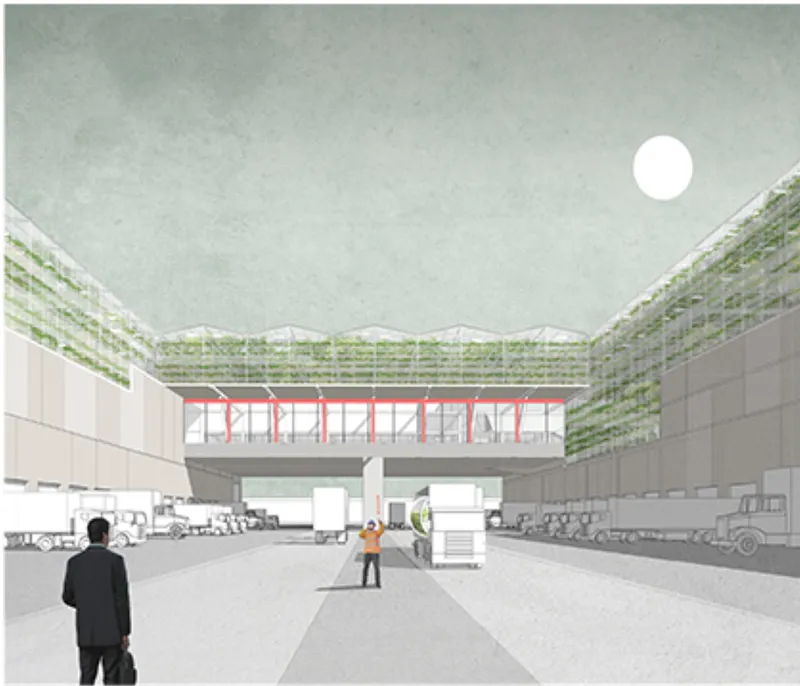
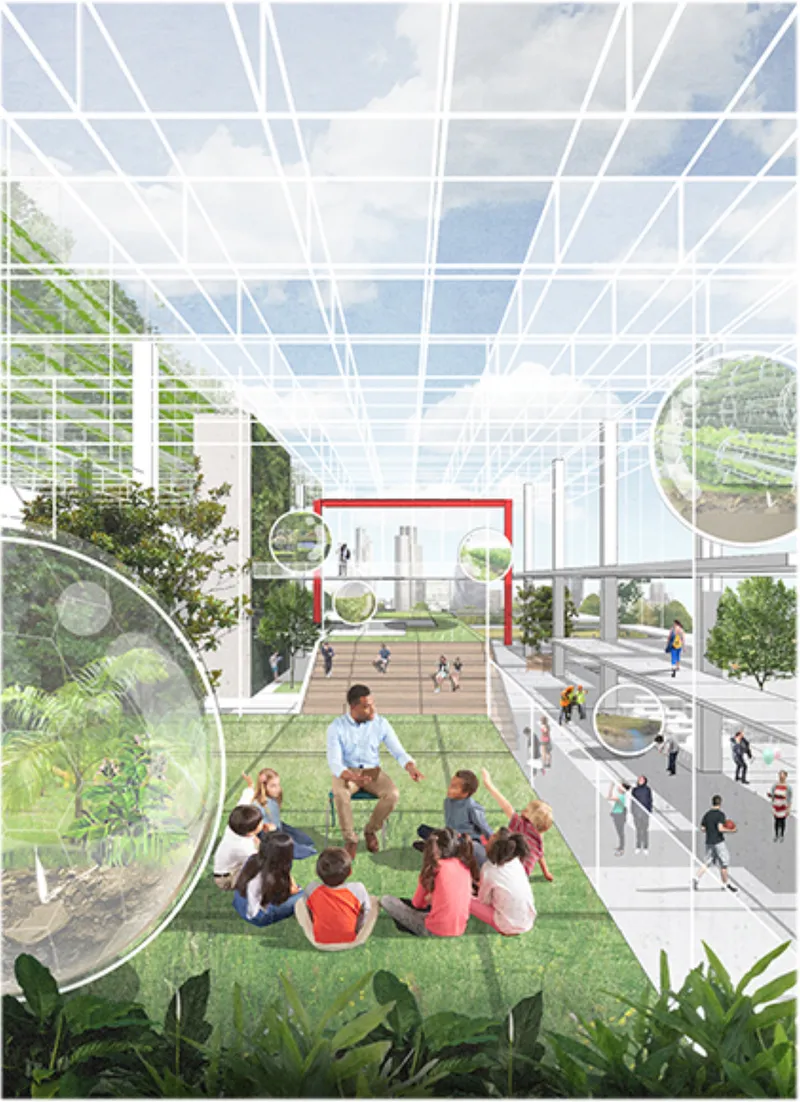
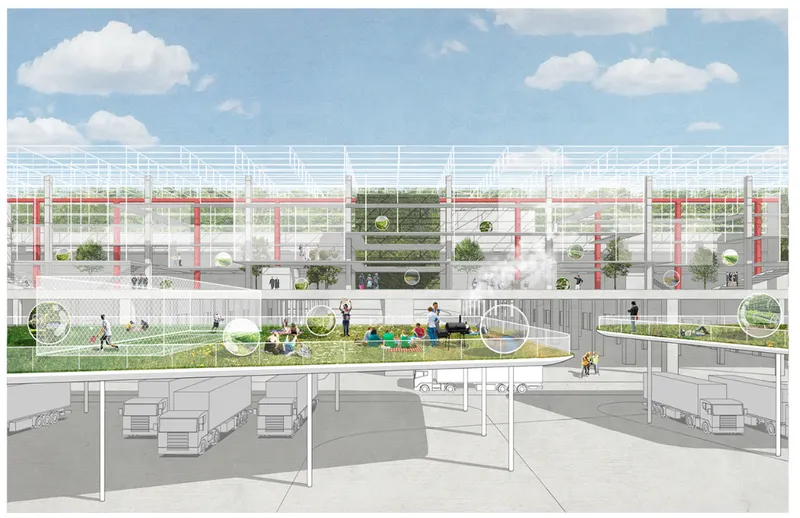
The elevated bridge shown in the opening rendering does more than connect buildings; it stitches together two scales of urban life. Below, trucks load and unload in a functioning wholesale yard. Above, pedestrians walk through green-clad volumes that house growing spaces and public programs. The contrast is deliberate. Keeping the loading dock operational means the market retains its economic role, while the elevated landscape adds a civic layer that invites residents into a world they rarely see. The green cladding isn't decorative; it signals that the architecture itself participates in food production.
Step inside the glazed atrium and the atmosphere shifts entirely. Terraced gardens cascade down through a light-filled interior where children sit on a grass lawn. This is the Education Zone in action: a space designed to teach citizens about food systems, healthy diets, and ecological practices through direct sensory experience rather than signage. The decision to place a lawn inside a market building is pointed. It collapses the rural-urban boundary, making agriculture feel domestic rather than distant.
Six Phases of Transformation
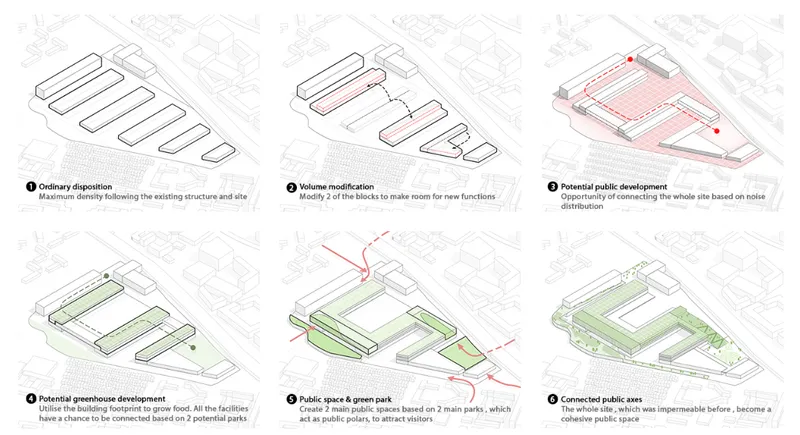
The axonometric phasing diagram reveals a careful developmental logic. Starting from the existing market structure, the design adds layers incrementally: greenhouse roofs, public squares, educational platforms, and finally a fully integrated public realm. This phased approach matters because it acknowledges that transforming a functioning wholesale market cannot happen overnight. Each phase preserves operational capacity while layering new programs on top. By the final stage, the site reads less as a market with additions and more as a new urban district organized around food.
Every Room Serves the Food Cycle
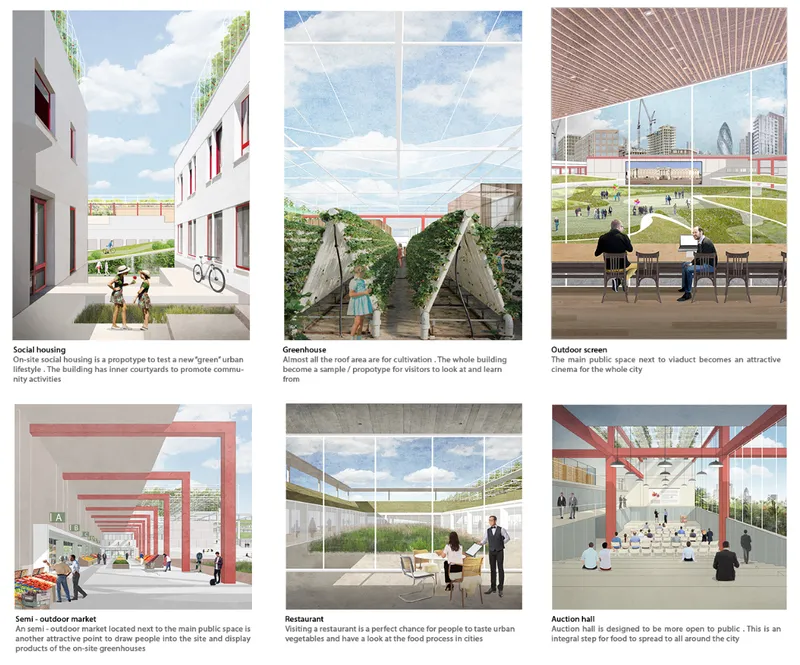
The six perspective renderings present a catalog of interior conditions: a planted courtyard, a productive greenhouse, a café, a covered market hall, a restaurant, and a wholesale auction space. What makes this sequence compelling is its range. The same architectural system accommodates the informal sociality of a café and the hard economics of a wholesale auction. Courtyards become edible landscapes. Greenhouse roofs double as public amenities. No space is single-purpose, and every room connects back to the food cycle in some way, whether through production, education, trade, or consumption.
The section rendering cuts through the full vertical stack of the proposal. A greenhouse roof caps the building, tiered gardens with people occupying them step down through the middle levels, and an underground loading dock with trucks sits at the base. This section is the clearest expression of the project's thesis: that food production, community space, and logistics can be vertically integrated without one compromising the other. The underground dock keeps heavy vehicles away from pedestrian life, while the greenhouse captures daylight and rainwater at the top of the section.
Stacking Programs from Parking to Public Life
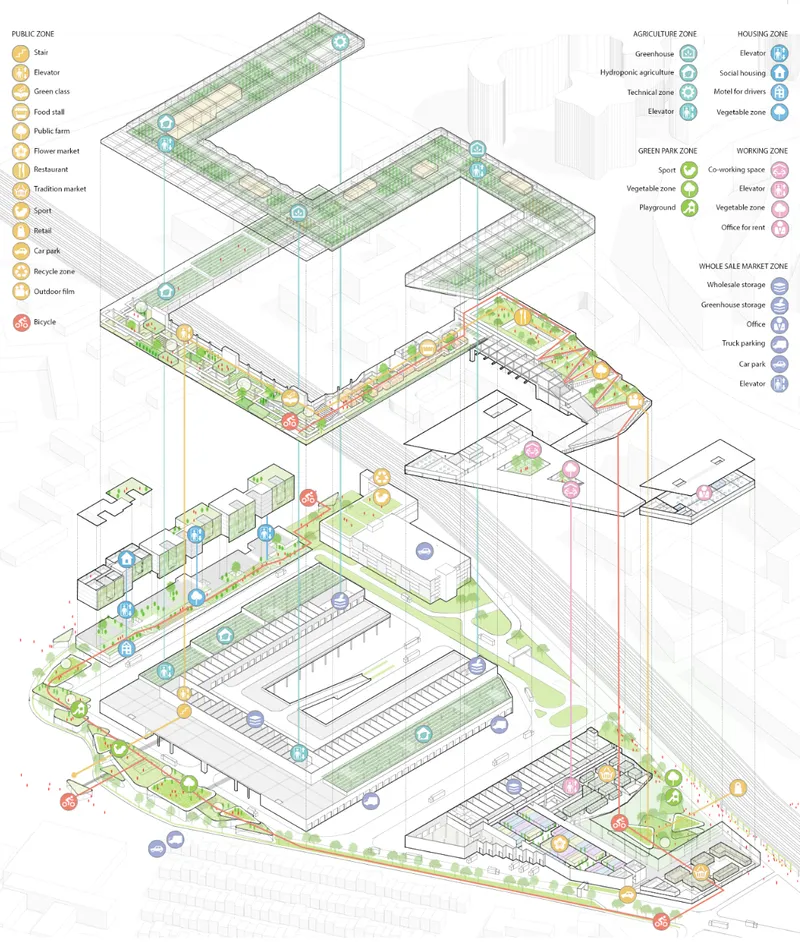
The exploded axonometric diagram breaks the building into its programmatic layers: public spaces and greenhouses at the top, market and service zones in the middle, wholesale storage and parking at the base. Reading from bottom to top, the diagram maps a gradient from private logistics to collective urban life. Parking and storage occupy the ground that the public never needs to see. The Production Zone, with its hydroponic systems and urban farms, occupies the middle register where controlled environments and natural light intersect. At the top, open-air public spaces and greenhouse roofs create the face of the building, the part that engages the city. The clarity of this separation is one of the project's strongest organizational moves.
Why This Project Matters
Most proposals for urban food systems focus on rooftop farms or community gardens, valuable but limited in scale. We Are How We Eat operates at a different register, taking on the full supply chain from wholesale logistics to household consumption and folding it into a single architectural proposition. By choosing an existing wholesale market as the site, the designers avoid the trap of greenfield idealism. They work with real constraints: truck access, cold storage, trading floors, the unglamorous machinery that keeps a city fed.
The deeper ambition here is behavioral. Architecture becomes a vehicle for changing how people relate to food, not through mandates but through spatial proximity. When you walk past a greenhouse on your way to buy groceries, when your children sit on a lawn inside a market building, the distance between farm and fork collapses. Hùng Trần, Cao Minh, and Đạt Đinh Công have produced a proposal that treats food not as a problem to solve but as a medium through which cities can become more resilient, more legible, and more generous.
View the Full Project
About the Designers
Designers: Hùng Trần, Cao Minh, Đạt Đinh Công
Enter a Design Competition on uni.xyz
uni.xyz runs architecture and design competitions year-round that reward proposals with spatial conviction and real site intelligence.
Project credits: We Are How We Eat by Hùng Trần, Cao Minh, Đạt Đinh Công Urban Meal Mine (uni.xyz).


Popular Articles
Popular articles from the community


Jaramillo Van Sluys Arquitectura and Urbanismo Turn a Demolished Registry Lot in Quito into an Orchard Plaza
In Quito's Centro Histórico, a 2,800 m² plaza exposes the San Agustín convent wall and redraws its lost Augustinian orchard in volcanic stone.

David Ortega Stacks a Two-Story Mexico City Penthouse Around a Steel Stair and a Pergola-Shaded Roof Terrace
In Colonia Roma, a 300 m² penthouse uses oak joinery, a planted steel stair and a slatted roof pergola to make a new-build apartment feel like a house.

LT2A and OPEN Architectes Thread a Brick and Glass High School Through a Wooded Belgian Campus
In Braine-l'Alleud, a 3,000 m² wing for Collège Cardinal Mercier pairs pale brick with a glazed colonnade, deferring to a small chapel and a dense wood.

longwave studio Reorganizes a 112 m² Tainan Apartment Around the Daily Routines of a Family and Two Cats
In Tainan, Taiwan, birch plywood, rust-red furniture and a freestanding plaster wall link arrival, storage, work and family life in one apartment.

Similar Reads
You might also enjoy these articles

Gil Mello Arquitetura Tilts a Single Roof Toward the Waterfalls on a Plateau Above Aiuruoca, Brazil
In Aiuruoca, Minas Gerais, a 200 m² house of local labor and reclaimed poles pairs a low valley veranda with a tall mountain one.

U.GA Architects Wraps an Oval Rooftop Pool in Curved Board-Formed Concrete on Busan's Jeollidan-gil
In Busan's Jeonpo-dong, a 454 m² mixed-use block stacks a neighborhood facility, guest rooms and an oval rooftop pool inside spiraling concrete walls.

Felipe Hess Arquitetos Turns a Blind Stone Wall to the Street and Opens a Brazilian House onto a Courtyard and Canal
A canal-front house in Brazil hides behind painted stone and planting, then opens to an olive-tree courtyard, a reed-ceilinged porch and a curving pool.

David Macias Steps a Doorless Stone and Plaster House Down a Tropical Colombian Hillside
In the humid hills of Colombia, Threshold House replaces the front door with an open void and terraces its 850 m² down the slope instead of fighting it.


Comments (0)
Please login or sign up to add comments
No comments yet. Be the first to comment!