
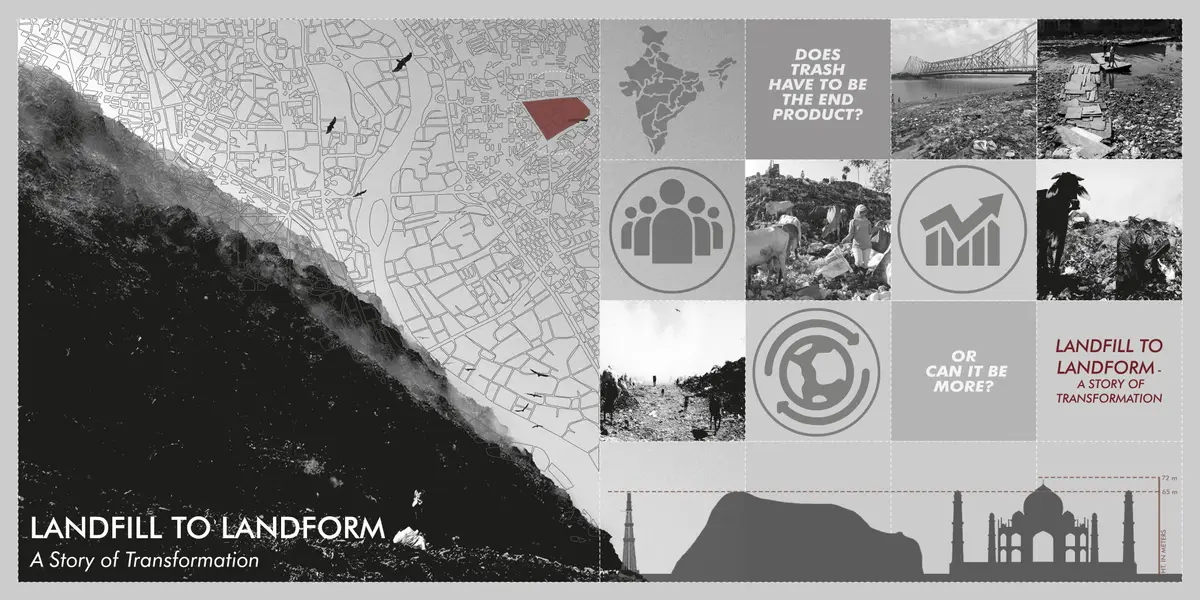
Landfill to Landform_A Story of Transformation
Continued use of decommissioned Landfill sites is a major cause of concern in developing countries. Ghazipur Landfill Site, located in New Delhi, India has been in news headline for its height being compared to Qutub Minar and Taj Mahal. These sites are affecting environmentally, socially and economically, and thus require a permanent solution.
Project Media
COVER IMAGE
The image features the current status of the landfills, their impact on society and environment and if we change the perspective towards landfills they can be more than just waste.
ANALYSIS
The boards explain the in-depth analysis of Ghazipur Landfill site, performed at territorial, neighbourhood and site scale, to understand the impact radius of the landfill sites on the surroundings. It also highlights various sources and types of waste received by the landfill site per day.
PROCESS and STRATEGIES
The board focuses on the strategies adopted for the site, catering to the surroundings and highlights the proposed processes Landfill Gas Recovery Plant, Waste Cycle and Energy Utilization Cycle on the site. It also gives an overview of the timeline of the project development, through various phases.
MASTERPLAN
The board features the masterplan proposed with the design program, for the Ghazipur Landfill Site, and the potential of a mountain of garbage to be transformed into an urban space that can not only offer a natural habitat but also serve as an awareness center while playing a significant pant in the city waste-management cycle.
LANDSCAPE-Analysis and Elements
The boards underline the identifies areas suitable for sparse or dense plantation and, the key criteria for selection of plants and planting techniques as per slope analysis. It also highlights the different types of environments proposed for the site as well as a few native species suitable for the climate of New Delhi.
STRUCTURAL COMPOSITION
The structure of the building has been planned keeping in mind the need for large column-free spaces within for exhibition and gatherings. The sloping roof has the strength to support intensive as well as extensive levels of gardening with punctures that lit the space within naturally.
LANDFILL INTERPRETATION CENTER
Passive Design Techniques has been adopted for planning with a gradual sloping green roof for rainwater harvesting to meet indoor-water demands while the energy demands are met through renewable sources of energy generated onsite. Also, environmentally preferable materials have been suggested for the overall design.
PHYTO-REMEDIATION POND and DETENTION BASIN
To treat leachate on-site a phytoremediation pond has been planned which shall filter the liquid naturally. While a basin has been designed to capture and harvest rainwater and surface run-off. The treated and the collected water shall be used for meeting the on-site irrigation water demands.
LIVE MUSEUM and HILLTOP PLAZA
The live museum includes enclosed connections to the waste-management zone on the site with the on-site trails to offer visitors an experience of different processes of segregation and energy production. It also shows the plaza that has been planned to provide a visitor with a panoramic view of the site and surroundings.
MAZE IN WASTE, URBAN WOODS and WINDING STAIRWAY
The board highlights the maze designed within a mound of waste to provide visitors with an experience that shows the transformation of the site from Landfill to Landform. It also shows the patches of forests planned to re-establish the lost natural habitat and types of site connections to offer different experiences to the users.
PROJECT VISION
The views show the final design proposal at eats epitome, with flourishing flora and revived natural habitat. The site shall serve as a landmark once developed and become a gateway for the eastern border of New Delhi. The proposal shall attract all user-types and researchers giving them the opportunity to learn and share.
URBAN VISION and LEED
The board firstly shows the short-term influence of the proposal on the site and long term impact on the Delhi environment, through re-establishment of natural habitat and biodiversity and improving local climatic conditions. Secondly, it highlights the LEED strategies adopted for the design proposal to make the site self-sustainable.
FAQ_1
Q1_Q2_Q3
FAQ_2
Q4_Q5
FAQ_3
Q6_Q7
FAQ_4
Q8_Q9

Project Score
Project Team (3)


Designer, Landscape Architecture, Research Associate, Structural Designer


Co - Author, Designer, Landscape Architecture, Research Associate


Co - Author, Designer, Landscape Architecture, Research Associate
Location
PUBLISHED ON 30th April 2020


Similar Projects
Discover related projects you might like





Comments (45)
Please login or sign up to add comments
Wow, lavoro fantastico!
Very Interesting! Municipal Solid Waste Management is the foremost necessity in India. With the right engineering integration, projects like this have the capacity to transform India's waste dumping problems.
I like it
ok
It is just superb ...
Superb thought!!!
Wow. Good work.
That's quite a work. Well done!
Absolutely superb. Great efforts. Keep up your good work.
Welldone Sherinmole, good luck for future 👍🏼