
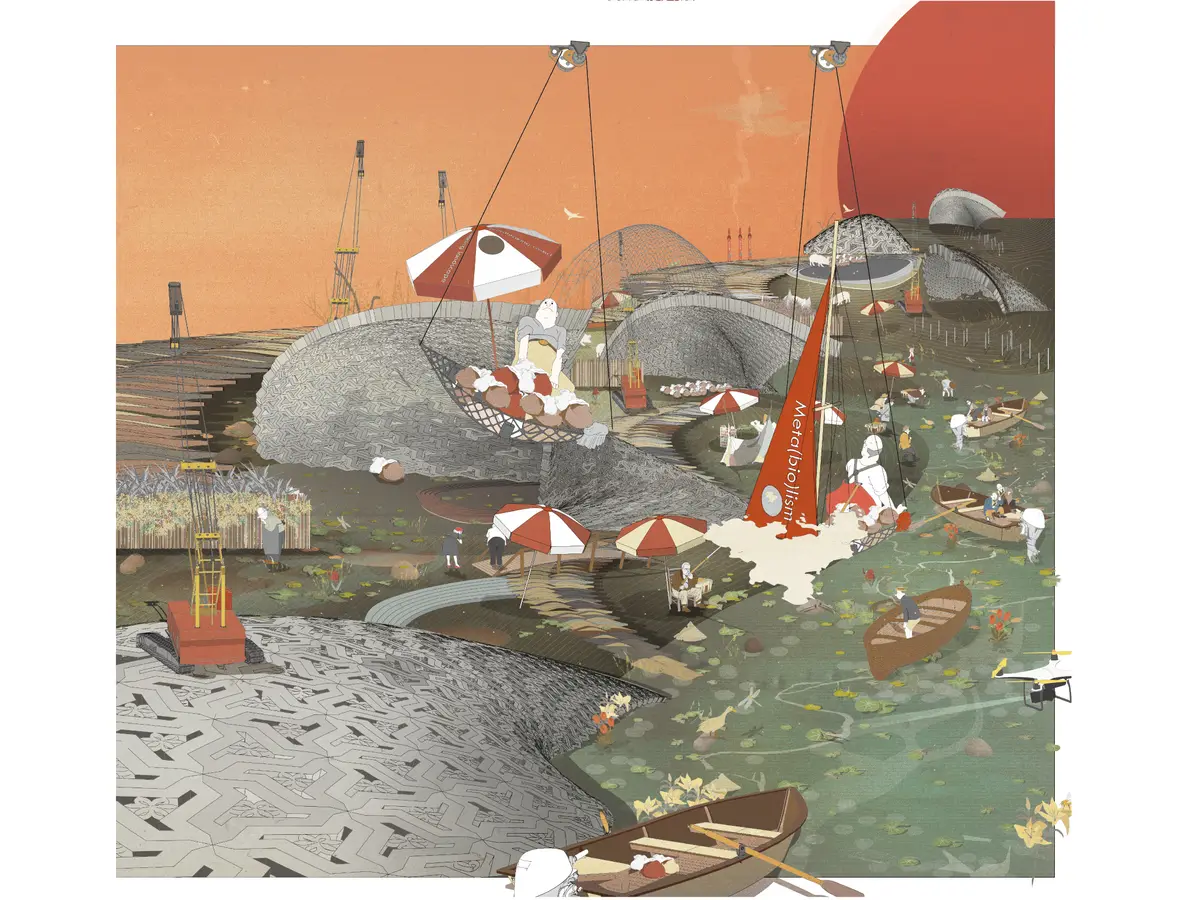
Meta(bio)lism
Meta(bio)lism proposes an energy & resource re-use strategy which people can adapt under the effects of extreme weather. The landscape will both redirect flood water, preventing flood disaster and allow mining of the Kaolin soil to be more efficient and sustainable. Human beings will rediscover their relationship with nature over time.
Project Media
The main feature of meta(bio)lism is the way it responses to nature. It’s all about giving and taking. We give up some of t our lands and we can get many resources from nature. It will be a wonderful garden open to all fauna and flora rather than solid and gigantic infrastructures.
The results of the experiments revealed that a useful composite with good properties can be successfully developed, by using treated pineapple leaf as a reinforcing agent for the bisphenol matrix.
I would like to introduce Dashu’s potential in developing sustainability and simultaneously preserving local beliefs. Meta(bio)lism explores synthetic materiality to achieve sustainability by conducting a series of experiments. It researched into pineapple production in Dashu town, contributing to a mass of pineapple waste. However, the pineapple leaf is one of the strongest natural fibres which is being used in machinery currently. Subsequently, the tests started with local clays, pineapple pulp and leaf which are available in the region, all based on two essential factors; environmental friendliness and viability, seeking the possibilities of composite materials. The results of the experiments revealed that a useful composite with good properties can be successfully developed, by using treated pineapple leaf as a reinforcing agent for the bisphenol matrix.
Waste management has been another environmental concern in Dashu, which is the largest producer of pineapple in Taiwan. As 40 per cent of pineapple is not edible and most of it is pineapple leaf. However, pineapple leaf is one of the strongest natural fibre which has been used in different fields. Then I conducted a set of experiments by mixing pineapple leaf fibre and kaolin clay to produce bio-bricks, trying to make the most of the waste. Also, the table in the diagram shows pineapple leaf enhances the bricks’ physical property. From page 10 to 11. After that, I tried to seek the optimum architectural typology of bricks, based on geometric principles & Sierpinski’s theory. , dealing with some natural threats such as earthquakes and strong wind. Taking the inspiration of one Chinese interlocking structure, Dougon,, I devised a novel masonry system. This system includes self-interlocking components and coding developed by Eth and myself.
Moreover, in order to communicate applicable and advanced technology with the fabrication process, I researched into the mass production and pre-fabrication system. Then I chose 3D printing as a method to produce the prototypes as it enabled me to create them with a high level of precision at fast speed. With the components assembled together, a high degree of complexity and interesting spatial possibilities can be created, developing spatial diversity of brick buildings and infrastructure. Next, material durability, spatial qualities and structural capacity were also determined through computational and physical testing. According to the results, the new masonry system offers structurally stronger typologies of brick buildings by assembling these components, which contains pineapple leaf and kaolin soil. The diagram illustrates the construction process in four simple steps; generating a species by grasshopper and rhino vault, setting up scaffolding and steel wires, then paving it with the prototypes and dismantling the temporary structures.
This landscape-like pavilion allows people to explore and linger around, they will be intrigued by the pineapple pastry’s aroma draped with landscape and get to know traditions in this region more. Through participation, it will boost community cohesion and develop cultural identity simultaneously.
After understanding the impressive characteristics of spiral structure, I came up with a way to utilise them in order to achieve the goals. Firstly, through carrying out several CFD simulations, the patterns of flood movement in this area can be studied in the diagrams. As we can see, there are different spirals, due to various topographic conditions, which are unnoticeable to the human eye. Following that, I attempted to devise several arch structures assembled by the brick components in accordance with the lengths and widths of spirals, as well as optimum spiral typologies dissipating energy with minimal dispersions.
Inspired by a mechanism in the natural world; vortex, which is the strongest structure dissipating energy, I researched into this natural phenomenon. As long as the effects of viscosity and diffusion are negligible, the fluid in a moving vortex is carried with it. In particular, the fluid in the core and matter trapped by it tends to remain in the core as the vortex moves about. This is a consequence of Helmholtz’s second theorem. Thus vortices can transport mass, energy and momentum over considerable distances compared to their size, with surprisingly little dispersion. –cited from Revolvy’s research
The spiral-like structures respond to a range of complex, physical and environmental conditions examined by digital tools. Largely placed on the core of every spiral typology detected by CFD simulations, to maximize the functionality of the performative landscape, the structures offer channels which allow Kaolin soil to be transported inside and dissipate approximately 70 %of power generated by flash flooding. Thus, the structures can not only act as an agent amplifying this natural phenomenon(spiral), reducing the impacts resulted from flash flooding , but also a context awareness of hydrology, informing people that an imminent flood will occur. Furthermore, this system will also create after sequenced flooding events, allowing people to ‘harvest’ kaolin soil inside the spiral-like structures.

Project Score
Be the first to rate this project
Project Team (1)

Project Owner
PUBLISHED ON 15th January 2020

Similar Projects
Discover related projects you might like





Comments (0)
Please login or sign up to add comments
No comments yet. Be the first to comment!