
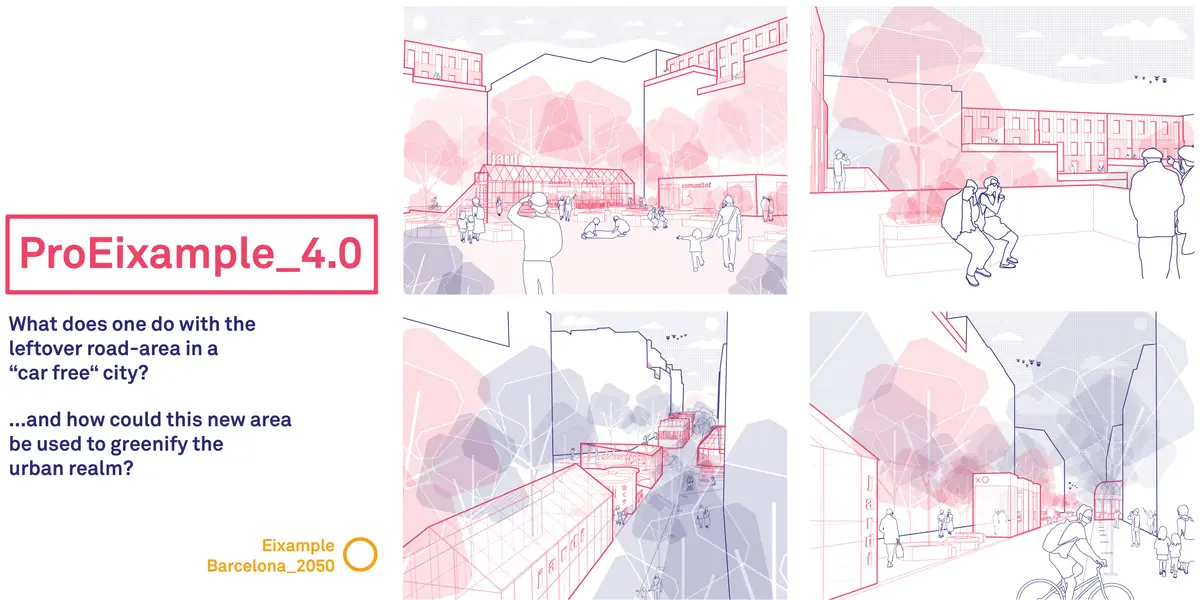
ProEixample_4.0
Taking inspiration from a previosuly implemented, greenfication movement in Barcelona, and using the Superblock scheme as a basis for investigation, ProEixample_4.0 poses the following questions: What does one do with the leftover road-area in a "car-free" city? And how could this new area be used to greenify the urban realm?
Sign in to view this project
Create a free account or log in to access project galleries and media.
Sign In
Project Score
Project Team (3)


Associated Disciplines (4)


Location
Barcelona, Catalonia, Spain
Spain
PUBLISHED ON 20th October 2020

Explore Future City Competitions
Discover active competitions in this discipline


Hosted by UNI
Challenge to visualize slums of 2080
Prize Pool:USD 7,000
Regular registration ends: 5 days left
Submission ends: November 1, 2026
Worldwide

Hosted by UNI
Challenge to design a shop stop sunk in the city
Prize Pool:USD 7,000
Regular registration ends: 5 days left
Submission ends: November 1, 2026
Auckland, New Zealand

Hosted by UNI
Render competition to represent the city as a machine
Prize Pool:USD 7,000
Regular registration ends: November 30, 2026
Submission ends: December 1, 2026
Worldwide

Hosted by UNI
Design challenge to equip cities with modern furniture
Prize Pool:USD 7,000
Regular registration ends: December 30, 2026
Submission ends: January 1, 2027
New York, United States
Similar Projects
Discover related projects you might like


Comments (3)
Please login or sign up to add comments
What we talk about when we talk about Architecture? Do we talk about innovation, social behavior, nature, growth, time, change, sustainability, weather, citizenship, atmosphere, water, adaptability, welfare, environment…?. This project….yes.
A deep analysis and great infographics. Proposal respectful with the existing. I would only add that having a good synthesis capacity is important to transmit the clarest ideas... sometimes it was too complex to understand. Also, I would have appreciated seeing a more visual (more realistic perharps) photography of the impact of the proposal in the city.
A very good proposal. It keeps a perfect balance between preexisting respect and forward-thinking. the authors made a powerful analysis of the metabolism of the Eixample district nowadays. It assumes the goals of the competition (increasing density, for example) in a realistic way, feasable and equilibrate. there is also an interesting reflecction on how to "fulfill" the street spaces once the cars disappear. the proposal is very well explained, very clear and seductive. the drawings explain very well the concept, the ideas and the implementations, with nice axonometries.