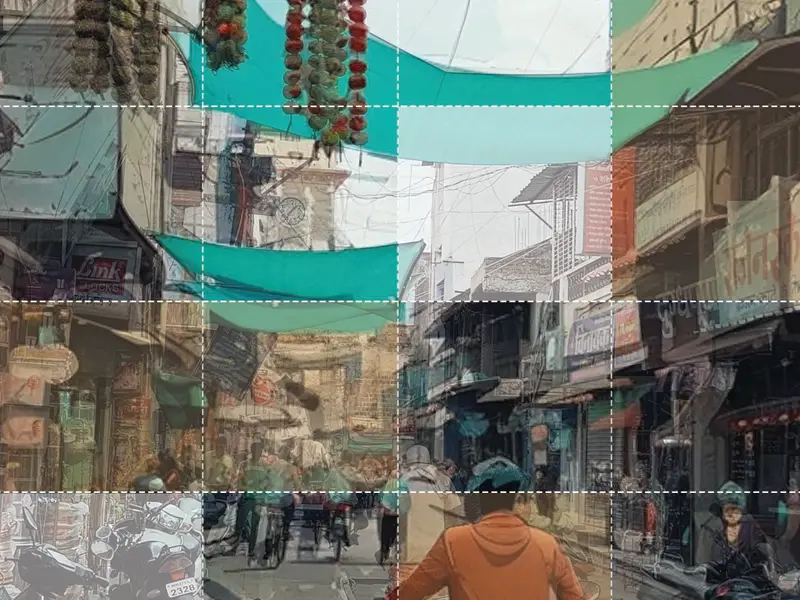
From Tradition to Transformation A Study on Revitalizing Amravati’s Market Precinct.
We have been constantly evolving and so have our towns and cities. In the process of evolution, we are either moving out of our traditional habitats (which are not just places of living but places to socialize, work, etc) or evolving them. While evolving, the question is that are we moving out or moving away from our way of living. Adapting to the present and preparing for the future is essential for survival, but it shouldn't lead to the deterioration of our historical roots. As our cities expand, there has been a noticeable shift from traditional living patterns to more urbanized ones, and the older parts of our cities bear witness to this transformation. One such witness is the Old city market precincts, which were once, spaces where people both lived and worked simultaneously. Old city market precincts have historically been the vibrant cores of urban and rural communities, shaping the way people live and connecting them to the broader world through trade. These markets served as economic hubs, eliminated the need for extensive commutes, and played a pivotal role in daily life, akin to a living corridor and a source of community news that rejuvenated mental well-being. The rise of suburban retail outlets, shopping centers, local convenience stores, and the influence of online commerce have gradually eroded the commercial vitality of our cities. Simultaneously, population growth has led to housing challenges. While the expansion of businesses beyond city centers, driven by privatization, has promoted economic growth, it has also led to the gradual disintegration of the urban fabric by disintegrating the core as people move out to these newly developed urban centers, leaving behind them abandoned spaces and plots in dispute. This phenomenon raises pertinent questions: Is this disintegration an inexorable decline of our city centers? Are they depleting the green pockets that traditional markets once embodied? It is imperative to recognize that the demise of traditional public markets precincts would lead to a lot of issues. These market precincts, by promoting local commerce, fostering walk-ability, and reducing vehicular emissions, offer significant economic and environmental benefits. They also function as communal living rooms for those residing above, nurturing community life and safety, catering to people of all age groups. To prevent the abandonment of these invaluable spaces, it is essential to provide comprehensive solutions that rejuvenate and make them socially and economically viable. Through the lens of Public spaces, markets precincts serve as important public spaces for the City and ‘Architecture as a mechanism to revitalize them as Everyday spaces’ is an inquiry to promote Human interactions, Community life and bring the City’s economic core back to life, to create a concept of an Urban Twilight. This study seeks to understand the formation of Amravati, driven by trade and commerce, its expansion through business growth, and the subsequent impact of urbanization on the deteriorating core of the old city fabric. The scope of this thesis project involves emphasizing the significance of an Urban Renaissance for markets globally. It specifically centers on the creation of a 10-minute walkable radius of revitalized defunct plots around a market, serving as a model for the broader revitalization of such markets. The project would outline the stages of development for the 10-minute walkable zone, with a detailed focus on one stage. The aim is to establish a template for market revitalization efforts worldwide.

 Streetscape
  Sustainable Cities

Similar Publications
Discover more publications you might be interested in

A Design Proposal for Adamjee Jute Mill Development and Research Center

Community-Led Housing

Reclaiming the Margins

Unlocking Potential: Exploring Underutlized Spaces Through the Case of Yashwant Stadium

The "Gen-Z-fication" of Mumbai: A Case of Ranwar Village, Bandra

Hodi-Mandai Geram: A Culturally Sensitive Village for a Disappearing Ethnic Group
Explore Urban Design Competitions
Discover active competitions in this discipline


Challenge to reimagine the Iron Throne

Photograph architecture without architects

Illustrate the lost glory of Angkor Wat - Render Challenge

Design challenge to reuse E-waste
Comments (0)
Please login or sign up to add comments
No comments yet. Be the first to comment!