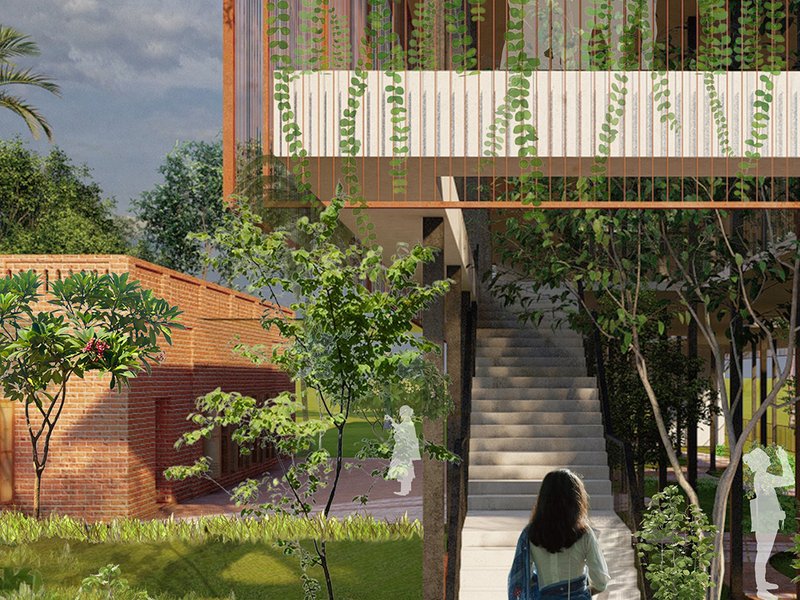
SHIKOR - The Presence of Absence (Sir Jagadish Chandra Bose Center for Scientific Research
Sir Jagadish Chandra Bose, a famous Bengali scientist who was born in Munshiganj, Bangladesh.He invented Electromagnetic Radiation which results in today's 5G internet, he was the first man who proved that plants have life. His ancestor's house in Munshiganj has been neglected for many years. The project aims to revive Sir Jagadish Chandra Bose House for the global community through plant science museum and plant research center. In addition, it is known from the Global Innovation Index that the position of Bangladesh is far behind in terms of research, which may be due to the lack of proper facilities for laboratories. The purpose of this project also questioned what 21st century laboratory architecture should be. Bangladesh cannot fall behind in this age of technology if Sir Jagadish Chandra Bose, who came from a rural background at that time, was able to make a stir in the world. Therefore, the project begins at Sir Jagadish Chandra Bose's birthplace, where his roots are traced. Site Analysis The site is located in a place called Rarikhal in Munshiganj, Bangladesh. Site area is 13.5 acres. The Sir Jagadish Chandra Bose School and College building located on the site is being newly constructed on the adjoining land. The site is surrounded by 7 ponds and has numerous old trees. Identifying the existing trees are there because tree presence is essential for plant research. Since the location is inside the Arial Beel Zone, the water level has been taken into consideration during design. Concept There are two considerations to approach the concept. The first comes from Sir Jagadish Chandra Bose's philosophy, and the second is from site analysis. · As per the literature authored by Sir Jagadish Chandra Bose, the coexistence of living and non-living entities embodies his principles, which he unveiled throughout his life through his diverse explorations. · Since the site is a flood-prone area, the museum has been conceived as a green backdrop to highlight Sir J.C Bose's house rather than submerging it underground. · The Surujabala Bhaban, as it bears the spirit of the old buildings of Bengal, can be opened for public use. · By studying the local houses of Munshiganj, it is known that the houses being elevated preserve the biodiversity of the place. On the other hand, the Bose house facade can be proportionately divided into solid voids to create a new style of architecture. · The project may also include lab experimental plant exhibition where people can listen to plant's voice, plant’s waves through a device in different tones. One can feel the pulse of the tree and gain more knowledge about the tree. The eastern part of the project is the researchers' zone, where they can conduct indoor and outdoor research. The western area is the public zone where one can learn about the flora-fauna which will make them realize the importance of trees in the present time. Efforts have been made to minimize reshaping the natural elements present on the site. An attempt has been made to enrich the existing flora-fauna which will be reflected as Sir J.C Bose’s philosophy and also memorable to the general public and researchers.

 Conservation Architecture
  Museum
  Landscape Architecture
  Research

Similar Publications
Discover more publications you might be interested in



Lesser-Known Architects: Analyzing the Contributions and Underrepresentation of Female Arc






STREETS FOR PEOPLE REIMAGINE STREETS AS SAFE, HEALTHY AND HAPPY PUBLIC SPACES










Explore Architecture Competitions
Discover active competitions in this discipline




The International Standard for Design Portfolios


The Global Benchmark for Architecture Dissertation Awards


The Global Benchmark for Graduation Excellence


Challenge to reimagine the Iron Throne
Comments (0)
Please login or sign up to add comments
No comments yet. Be the first to comment!