


Concept Art
TOOLVisual development and imaginative design exploration that establishes mood, narrative, and aesthetic direction for creative projects.
Concept art is visual development: the paintings, sketches and quick digital images that explore the ideas, mood and world of a project before anyone commits to producing it. It is used in film, video games, animation and architecture, and its job is to answer "what could this look and feel like?" early, while changes are still cheap.
What is concept art?
In architecture, concept art is the evocative image made before the drawings are settled: a painted view of a building in its landscape, a night scene that shows how light will fall, a collage that tells a story about the people who will use a place.
The standard definition describes concept art as visual art used to convey an idea for film, games, animation, comics or other media before it is put into the final product. The key word is "before". A concept image is a proposal, not a deliverable. It tests a direction so that a team, a client or a jury can react to it.
Three neighbouring practices are easy to confuse with it:
- Concept art vs illustration. An illustration usually explains or decorates something that already exists, such as a text, a product or a finished building. Concept art comes first and asks open questions. The same artist may do both; the difference is the position in the process. Our illustration page covers the explanatory side.
- Concept art vs final render. A photoreal render shows a design that has been resolved in detail, with real materials and correct geometry. A concept image can be loose, exaggerated and partly wrong, because its purpose is atmosphere and intent. Renders sit closer to 3D visualization.
- Concept art vs concept architecture. The design idea behind a building, its parti or organising thought, is covered on our page on concept architecture. Concept art is the visual practice that communicates such an idea.
Within film and game studios the work is usually split into types. Keyframes are single images of important story moments, painted to fix lighting, colour and composition. Environment concepts design the places: cities, interiors, landscapes. Prop and character concepts design objects and people, often as sheets of variations. Many projects begin with a mood board, a collection of reference images, colours and textures that sets the emotional range before any original painting starts.
"When words could not convey my ideas, I could always point to one of Ralph's fabulous illustrations and say, 'Do it like this.'"
George Lucas, on concept artist Ralph McQuarrie's paintings for Star Wars (2012)
That sentence sums up the purpose of the discipline. Concept art is a shared reference point that replaces paragraphs of description, whether the audience is a film crew or a competition jury.
A short history of concept art
The term itself is associated with animation. According to the same reference, it was in use at the Walt Disney animation studio as early as the 1930s. Since then it has become a specialist role in animation, film and game studios.
Architecture has a much older tradition of the same thing: drawings made to imagine a world rather than to build a specific building. Three milestones show the line clearly.
Piranesi's prisons. Giovanni Battista Piranesi's Carceri d'invenzione (Imaginary Prisons) are a series of 16 etchings, first published in 1750 and reworked for a second edition around 1761. They show enormous vaults, stairs and machines that could never be built. They are still studied because they treat architecture as atmosphere and scale rather than as a buildable plan.

Boullée's cenotaph. In 1784 the French architect Étienne-Louis Boullée drew a cenotaph for Isaac Newton: a colossal sphere set on a circular base, shown under a dramatic sky. It was never built. The drawings work like a keyframe: one image that fixes the emotional idea of a monument.

Sant'Elia's new city. In 1914 the Italian architect Antonio Sant'Elia drew his Città Nuova, a city of stepped housing blocks, external lifts, bridges and layered streets. The Manifesto of Futurist Architecture, published the same year and attributed to him, reads like a brief for a concept artist:
"We must invent and rebuild the Futurist city like an immense and tumultuous shipyard, agile, mobile and dynamic in every detail; and the Futurist house must be like a gigantic machine."
Manifesto of Futurist Architecture, attributed to Antonio Sant'Elia (1914), trans. Caroline Tisdall

The line continues through the twentieth century. The American architect Lebbeus Woods, for example, spent much of his career on drawings rather than buildings; the Getty Research Institute, which holds 52 of his drawings for A-City and 4 Cities and Beyond, describes them as near-cinematic statements of his philosophy. This is why the boundary between architectural concept art and visionary architecture is so thin.
Key principles of concept art
Styles change with every tool and generation, but strong concept images tend to share the same habits.
Story first
Every concept image should answer one question: what happens here, and to whom? A painting of a building with no people, weather or time of day is a model shot, not concept art. Decide the moment you are showing before you decide the style.

Silhouette and composition
Viewers read shapes before details. A clear silhouette against a simple background, a strong horizon and one focal point make an image readable at thumbnail size, which is how juries and online audiences first meet it. Test a composition by shrinking it or turning it into flat black shapes.
Light and atmosphere
Light carries most of the emotion. Low sun, fog, rain or night lighting can turn the same massing into a refuge or a threat. Choose a lighting scenario that supports the story, and keep the value range simple: a dark foreground against a lit background, or the reverse.

Scale cues
Without reference objects, a viewer cannot tell a pavilion from a megastructure. People, trees, vehicles, doors and stairs give scale. Piranesi exaggerated scale by shrinking his figures; architectural concept art usually needs honest scale so a jury trusts the proposal.
Iteration
Concept art is cheap on purpose. Professionals produce many rough thumbnails, pick the strongest few and develop only those. A competition board built from one unquestioned image is weaker than one where the final view was chosen from several. Keep the discarded versions; they show your process in a portfolio.
Concept art on uni.xyz
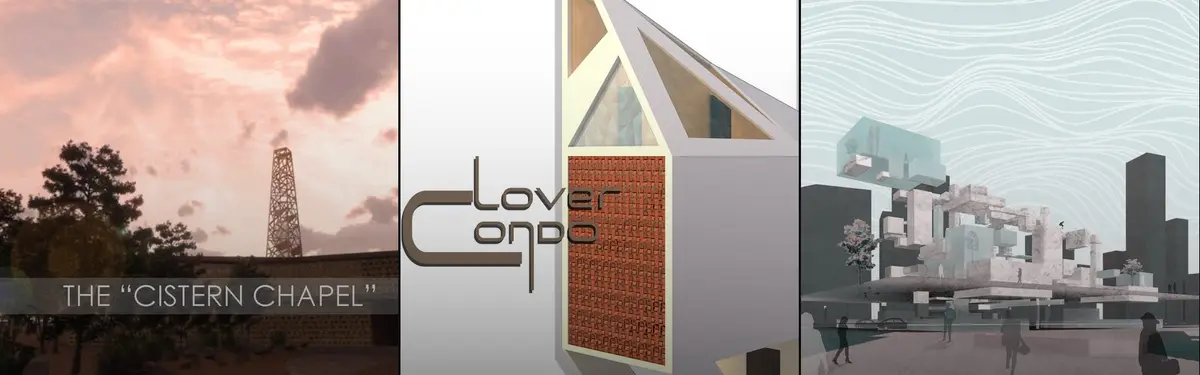
On uni.xyz, concept art mostly appears inside architecture competition entries: the opening board of a submission, where a team has one image to win attention. The projects below show the range.
PRAKOSHTH, by Shivani Dolas, Prashansa Parashar and Sajal Patidar, is the most liked project in this topic. Entered in the Bharat Bhavan 2020 competition, it proposes built forms that merge with the landscape of its site in Ranchi, Jharkhand, as a platform for fine arts, literature, theatre, cinema, dance and music. Its cover is a pale, painterly panorama in which the buildings almost dissolve into the terrain, an image about belonging rather than about objects.

pictuRESQ tackles flood relief. The team describes a neighbourhood block centred on a school, built around social cohesion and a bottom-up approach to housing. Its hand-painted board is closer to a storybook illustration than to a technical sheet, which is exactly why it stands out.
The Vayu Bridge, by Shubham Jangid, Shailin Dayani and Harsh Khodiar, was entered in The City Link competition, where it received the People's Choice Award. The team reduced its statement to three words, "free spirit, happy locals, hygge", and let a sunset view of the bridge over water do the rest. It is a good example of a keyframe: a single mood that sells the idea.

Place of People, by Rishabh Kalra, Lakshay Jasoria, Parul Gupta and Ashi Sharma, also won a People's Choice Award, in the Memory competition. It proposes a public space in the heart of Aleppo meant to support personal healing and community strength. The cover combines a circular void, a crowd and city fragments into one collage, so the subject of the project, people, is literally the image.

Treehouse@SG, by Keith Lim, Chng Kai Jiunn, Diane Lee and Ashley Chen, was an Editor's Choice in the NomadHouse 2020 competition. Its concept follows the growth of a tree through seasons, offering spaces to live, work and play, and the board pairs a growth diagram with a view of the tower among city blocks.
Two entries in the Circle of Life competition show how far atmosphere can carry a serious programme. In Light We Return, by Jienan Zhang, Liao He and Joe He (Honorable Mention), replaces heavy stone tombs with crystal-like prisms set in a dense urban context, and its grey board glows with backlit niches. Is This The End? by Shayan Rakhshan (People's Choice Award) argues that a cemetery can become a lively plaza and uses stacked translucent volumes over a city skyline to make that case.
Mangata, named after the reflection of the moon on water, won a People's Choice Award in the Pause competition. Its team lists AutoCAD, Photoshop and Lumion among its tools, and the cover mixes a line drawing of the structure with a painted lotus, a reminder that concept art in architecture is often a hybrid of drawing, rendering and painting.
Challenges and future directions
AI image generators and authorship. Text-to-image tools can now produce a polished "concept" in seconds. That is useful for mood boards, but it raises two problems. The first is authorship: the US Copyright Office concluded in 2025 that AI outputs are protectable only where a human author has determined sufficient expressive elements, and that writing prompts is not enough on its own. The second is design quality: a generated image can look finished while containing no real decisions about structure, programme or site. Read each competition brief for its rules on AI tools before you start.

Speed vs depth. Competitions reward a striking first board, and it is tempting to spend most of the time on it. Juries, however, turn the page. The best entries use concept art to open an argument that the plans, sections and diagrams then prove. Treat the hero image as the first sentence of the story, not the whole story.
New media. Real-time engines and VR now let a concept move from a still frame to an explorable scene, which blurs the line between concept art, game design and architectural visualization. The core skills remain the same: a clear story, readable shapes, convincing light and honest scale.
Concept art for students and designers
For students, concept art is the fastest way to make a thesis or competition idea legible. Useful angles include the speculative city (in the tradition of Sant'Elia and Woods), architecture for film worlds, which links to film, and memorial or healing spaces where mood matters as much as programme. Build a habit of quick value thumbnails by hand; our drawing page has more on that foundation.
In a portfolio, show the sequence: mood board, thumbnails, chosen keyframe and the drawings that follow. That proves you can think, not only render. Then test the skill under a deadline in one of the open uni.xyz competitions, where the cover image is the first thing a jury sees.
Frequently asked questions
What is concept art in simple words?
Concept art is early visual exploration. Artists paint or draw how a world, place, character or building could look and feel before it is produced, so that a team can agree on a direction.
What is the difference between concept art and illustration?
Concept art comes before production and explores options; illustration usually communicates something already decided, such as a story, product or finished design. The techniques overlap, but the purpose and timing differ.
Is concept art used in architecture?
Yes. Architects use concept images to explore atmosphere, test ideas with clients and win competitions. The tradition goes back at least to the visionary drawings of Piranesi and Boullée in the eighteenth century.
What software do concept artists use?
Digital painting software such as Photoshop is common, often combined with 3D tools for quick block-outs. In architecture, teams frequently paint over views from modelling and rendering software. Pencil and paper are still the fastest tool for thumbnails.
Can AI-generated images count as concept art?
They can be useful references, but they raise authorship questions, and competition briefs may set rules on their use. Concept art is valued for the design decisions it records, so the human choices in the image matter most.
References and further reading
- Concept art, Wikipedia
- 'Star Wars' conceptual artist Ralph McQuarrie dies, CNN
- Carceri d'invenzione (Imaginary Prisons), Wikipedia
- Manifesto of Futurist Architecture, Italian Futurism
- Lebbeus Woods Drawings and Sketchbook, Getty Research Institute
- Copyright Office Releases Part 2 of Artificial Intelligence Report, U.S. Copyright Office


Popular projects
View all 339 projects


Latest journals
View all 2 journals

Picture Perfect
A graphic Design challenge, Illustrating 2019 in one poster a day.


