
Hyperlocal
Rebuilding Mumbai with a new local.
Overview

Fig. 1:Ever-growing population has resulted in the need for better transport
Increasing population and public transport
With the increasing population yet confined to the number of resources available, many beings continue to struggle in search of a decent livelihood- a place to live, food to eat and a medium to commute. The aspect of travel on a regular basis however lies a similar issue for people of all social and economical grounds of a place. Public modes of transportation management to respond to a considerable number of affairs like congestion on roads, pollution due to vehicles, and an economic way to commute.
Traffic congestion remains a major concern all around the world despite the progress in technological fields concerning public transportation and mixed-use developments. So is the case of the commercial capital city of India, but what makes it different from other cities in the world is its confounding number of people using public modes to commute.
Being the only world level ‘alpha-city(1)’ of India - MUMBAI, bears a lot of pressure as a city staging platform to millions of dreams, livelihoods and lifestyles.
The Melting Pot: Hyperlocal Mumbai
Mumbai, previously known as Bombay, is the capital city of the Indian state of Maharashtra and stands as the wealthiest city in the country. It is well-known for its diverse culture and is considered a melting pot of several cultures and communities.
Overtaking the country capital’s population in 2013, Mumbai currently has around 21 million people residing in it, making it the most populous city in India (2016).
It also is the fourth most populous city in the world with a population density of eighty thousand people per square mile. More than 60% of the people in Mumbai reside in slums. Their dwellings are made up of whatever materials are readily available or can be sourced to them at cheaper prices and sewage pipes of large diameters turn into an aisle between slums where most of the land is either utilized by the built, or dumped with garbage.
This same city also acts as a home to the highest number of hyperlocal millionaires and billionaires in the country. It has the highest GDP (Gross Domestic Product) in the South, West and Central Asian regions. Along with the thriving film industry, Mumbai is also a leading financial and industrial ‘Megacity’.
Transportation in the city

Fig. 2: City’s transportation lines and plans
The city of Mumbai with a present population of over 21 million generates more than 17 million trips in a day. Although, unlike other metropolitan cities, the majority of Hyperlocal Mumbaikars depend on local trains and buses as their means of egress.
With less than 20% of the commuters opting for private cars or taxis, Mumbai might seem a very citizen-friendly city, but it's not! Even this minor portion accounts for millions of vehicles on the road, leading to congestion and longer traffic jams. The rail and road network expansion failed to keep pace with the traffic growth resulting in traffic problems.
About 80% of commuters use public means of egress.
Local trains cater to about 8 million passengers a day.
Over 50% of the total rail users of India (in one day) belong to Mumbai.
Mumbai has the most successful local-rail network connection in terms of the number of people it is serving to. The Suburban Railway is an offshoot of the first passenger railway to be built by the British in India and is also the oldest railway system in Asia. This network has the highest passenger density in the whole world.
The Current Situation Fig. 3: Interpretation of city’s expected population growth
The existing system caters to millions of Mumbaikars on a daily basis in a very cost-efficient and convenient way, the issues attached to it are worth worrying about- safety being one of the most prioritized aspects over those related to comfort and cost. With an increasing number of users every year, the trains get overcrowded more and more, leading to higher possibilities of deaths caused by falling off a moving train and stampede on-board and in the stations.
A total of around 26000 incidents have been reported on falling off a moving train of which nearly 27% succumbed to death and many survived but with permanent injuries.
The other key reason behind deaths occurring is those who were crossing or trespassing near the railway tracks. This tolls to a higher number of deaths compared to people falling off the train. A few even died of an electric shock from the open wires running above the train, when they had to climb on the top in an attempt to travel by no space left inside the train.
2030 - A COMPLEX SYSTEM? OR A SMART SOLUTION?
The increasing death toll is an indicator of the over-the-limit utilisation of Mumbai locals. A number of proposals have been and are being made in order to minimize, if not eradicate, this problem of congestion and those coming attached to it.
The monorail and metro networks are two such cases where a new system (to the city) has been launched. As discussed, transportation in Mumbai has maintained its epitome of a public-friendly interface and continues to prevail despite the issues questioning its current stage.
The modification of the current system needs to be assessed and acted upon keeping in mind that it has been happening every now and then, yet the ongoing issues continue to prevail. Merging a few current ones along with introducing a new system might have an advantage in terms of efficiency by taking support of the tried-and-tested existing systems.
A new system altogether will provide a blank canvas on which the city can be interpreted and redesigned accordingly.
Design Problem
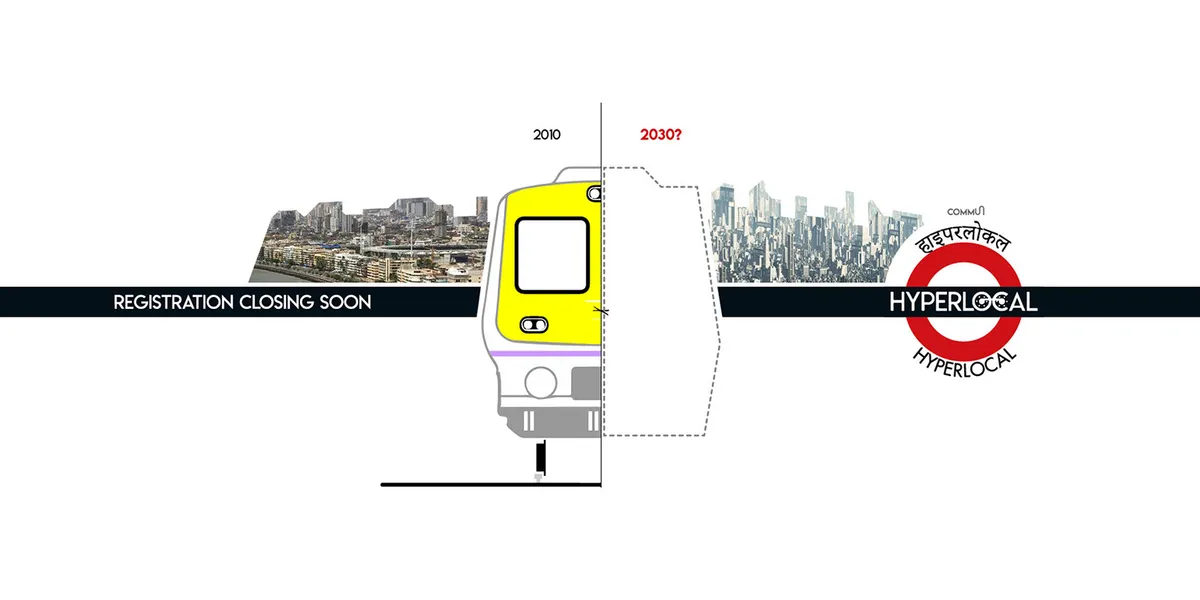
The challenge of this competition here is to propose a new system ‘Hyperlocal’ for the commuters and express the vision of how the city might appear in 2030.
It is a new network that caters to existing and upcoming issues of Mumbai - and is not limited to commuting, but more of redesigning the hyperlocal. Will your design drive more people to use the public modes of transportation? Or will it generate a balance between private and public modes making sure both congestion and overcrowding are taken care of?
While tackling these situations, important factors like the mode of transport, its capacity, frequency, halt points and how they reshape themselves need to be addressed in a precise yet explanatory manner. It might also include the impact on neighbouring facilities and how its interdependency with live, work and urban contexts turn out. The underlying motive is to capture a conceptual picture of how the ‘hyperlocal’ responds to the issues mentioned above and overall Mumbai. The major focus needs to remain on the articulation of these in a conceptual manner through text, illustrations, photographs or graphics.
Location
As a design challenge, the entire rail network of Mumbai connecting the local stations acts as the underlying site. The difference here is a patch of land that runs through the entire city connected from end to end. An intervention like this can heal, build, enrich the entire city within. But to set a prototype hyperlocal for addressing common issues and possible outcomes at a practical level, the site selected is the link between stations of Andheri and Vile Parle on the Western Line of Mumbai suburban network. This patch of the land is inclusive of both stations.
Similar Competitions
Discover competitions you might be interested in


Design challenge to reuse E-waste

Challenge to design locus for the upliftment of human rights


A Global Graduation Competition for Architecture, Urban Design & Interior Design