
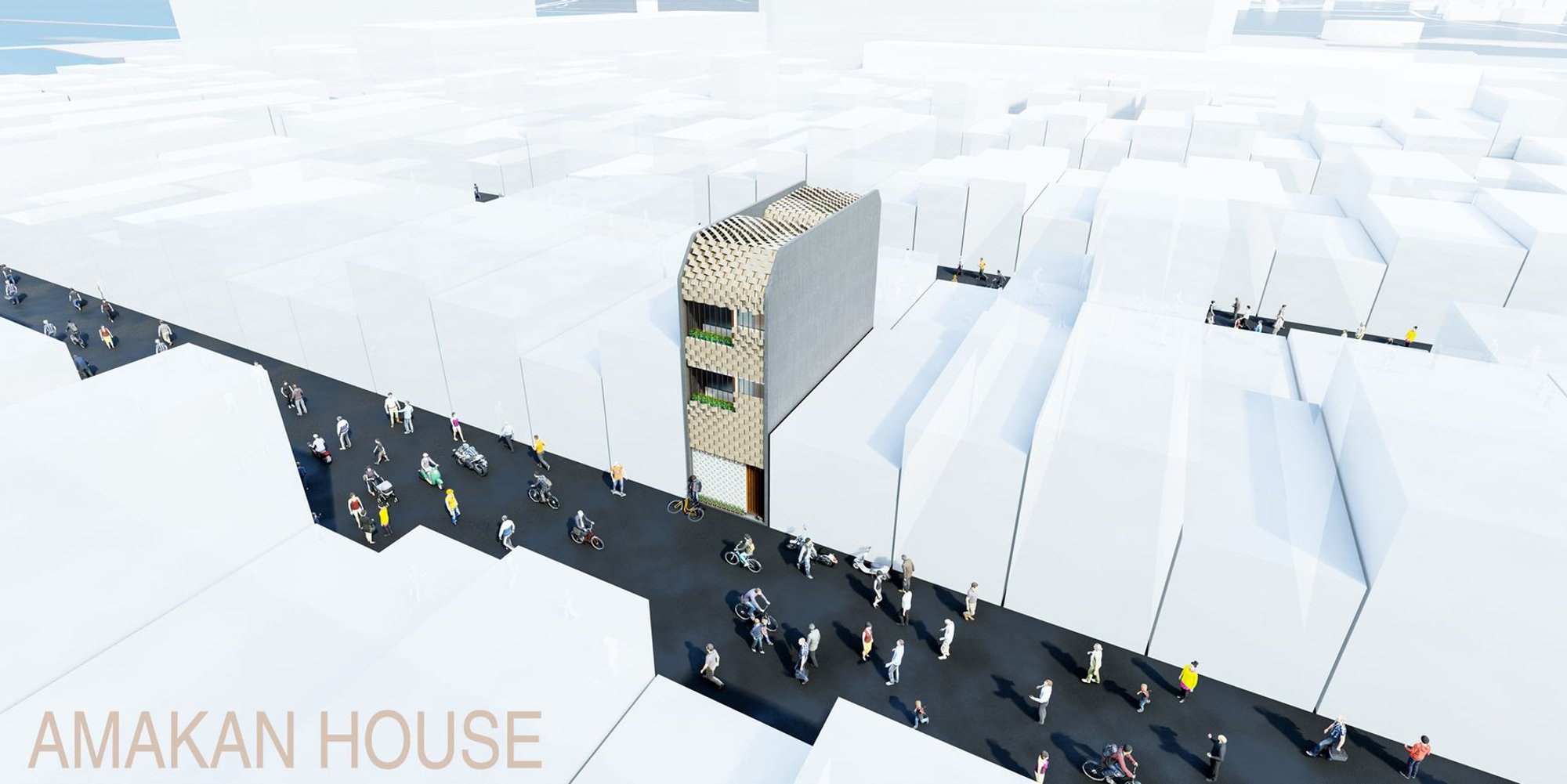
Amakan House: Bamboo Weave and Split Levels Tackle Urban Density in Cebu
A 48-square-meter vertical home for three generations wraps itself in indigenous bamboo cladding to breathe, filter light, and resist flooding.

On a plot just four meters wide and twelve meters deep, a house for three generations stacks public commerce on the ground floor, private bedrooms above, and a working roof deck at the top. The Amakan House takes its name from its most visible move: a woven bamboo screen that wraps the street-facing facade, turning an indigenous craft material into an environmental filter that ventilates, shades, and identifies the building as unmistakably Filipino.
Designed by JM Studio and Maureen Chu, the project sits in Sawang Calero, a densely populated village in Cebu City, Philippines, where narrow lots and urban congestion define the built environment. Within 48 square meters of floor area, the designers have organized a cafeteria, kitchen, visitor area, bedrooms for grandparents, parents, and children, plus laundry and drying zones on the roof. It is a complete domestic and commercial program compressed into a vertical section, held together by a split-level strategy that separates public life from private retreat without wasting a single square meter on corridors.
A Woven Facade on a Four-Meter-Wide Street Front
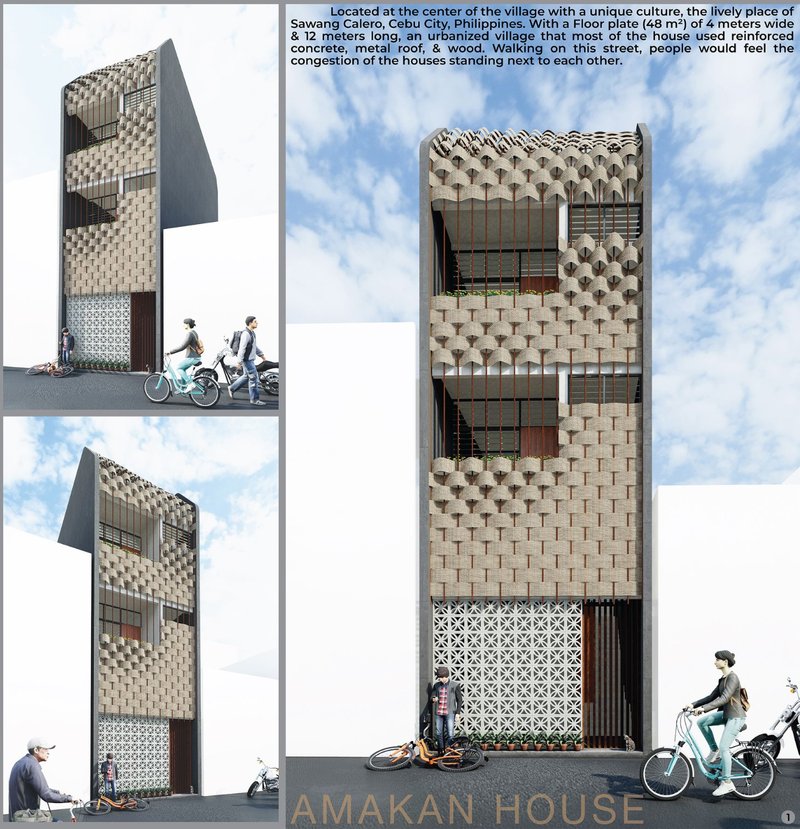
Seen from the street, the Amakan House reads as a tall, slender volume wrapped in a basket-pattern masonry screen. The amakan cladding, a native bamboo weave traditionally used in rural Philippine construction, is recast here as an urban facade material. It performs double duty: filtering harsh tropical sunlight before it reaches interior surfaces, and allowing cross-breezes to pass through the building envelope. The narrow proportions of the lot mean the facade is essentially the only public face of the house, and the woven texture gives it a strong visual identity that distinguishes it from the concrete neighbors pressing in on either side.
A Central Staircase Organizes Four Levels of Living
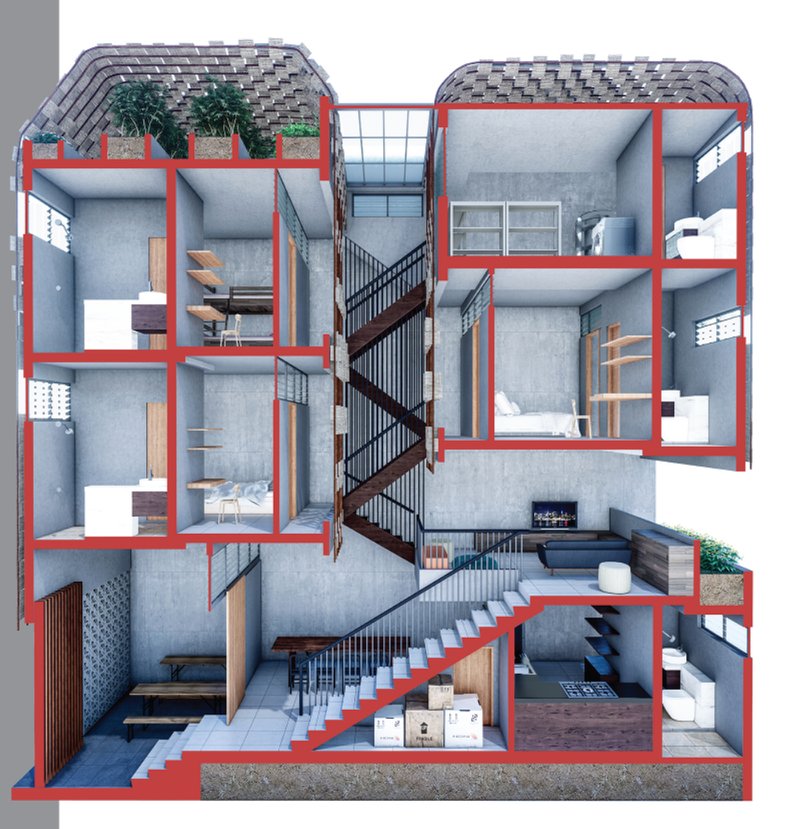
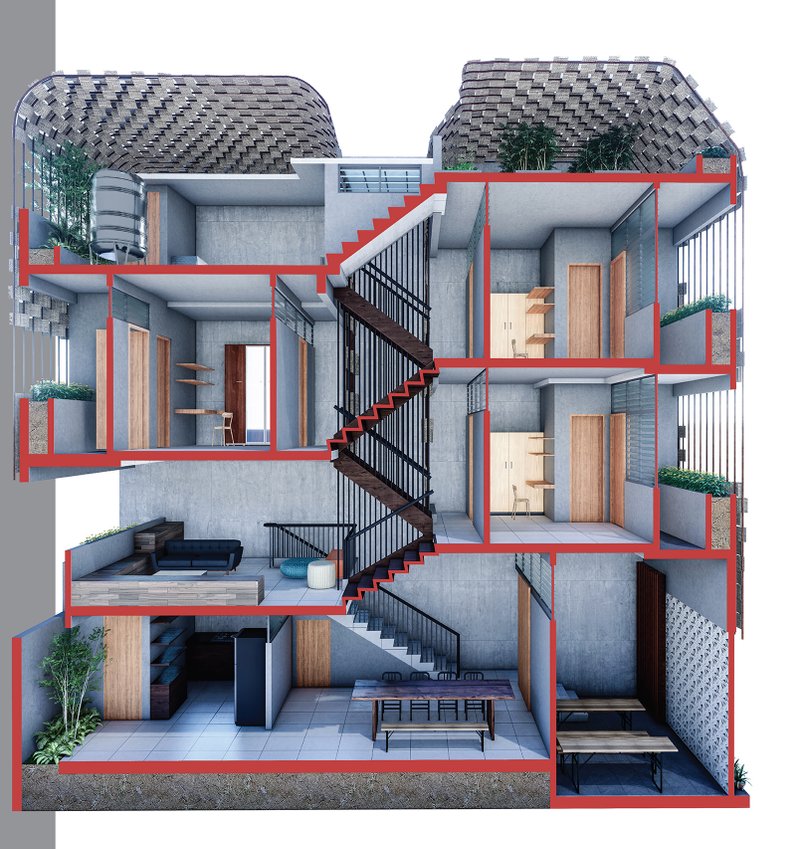
Two sectional views reveal how the interior works. A central steel staircase threads through concrete floor plates, linking the ground-floor cafeteria and kitchen to upper-level bedrooms and finally to the planted roof terraces above. The split-level arrangement staggers floor heights so that each generation of the family occupies a distinct zone. Grandparents, parents, and children each have dedicated sleeping areas, while the ground level is given over entirely to the family's home-based food business and shared utilities. The staircase doubles as a central void, pulling warm air upward through the stack effect and drawing fresh air in at lower levels.
Viewed from the opposite angle, the section exposes the relationship between the staircase and the planted terraces that cap the building. These green pockets are not decorative afterthoughts; they soften the concrete mass, improve localized air quality, and provide usable outdoor space on a lot where ground-level landscaping is impossible. The roof deck itself serves a practical purpose as a drying and laundry zone, recognizing that in dense tropical neighborhoods, service functions need dedicated real estate.
Passive Cooling Engineered Through the Section
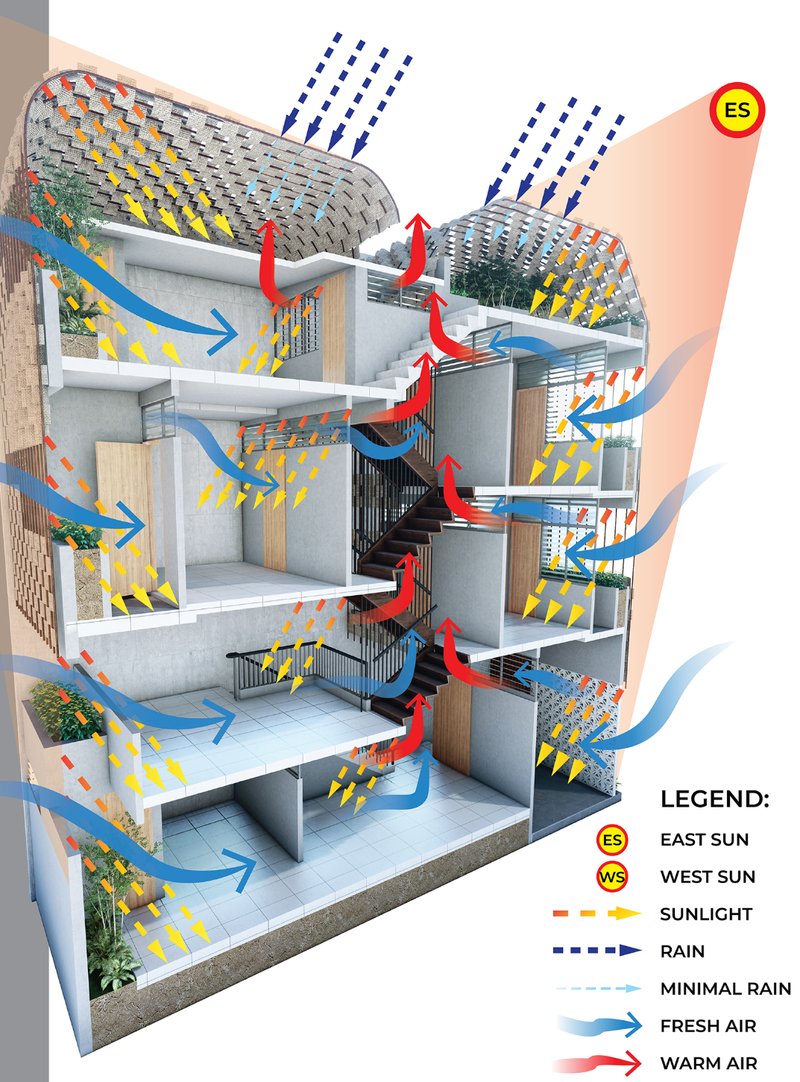
The environmental diagram lays out the passive strategies in clear terms. Colored arrows trace airflow paths through the building section, showing how cross-ventilation and the stack effect work in tandem. Cool air enters through jalousie windows and louvered doors at lower levels, rises through the central void as it heats, and exhausts at the roof. Sun-path lines illustrate how skylights admit daylight to interior zones that would otherwise be permanently dark on a lot this narrow, while the amakan screen and decorative breeze blocks intercept direct solar gain on the facade. Rainwater harvesting completes the sustainability picture: roof water is collected and redirected to toilets, landscaping, and sanitation, reducing the household's dependence on municipal supply.
The house is also raised above ground level, a critical detail in a city where flooding is a recurring threat. By lifting the inhabited volume, the designers protect the ground-floor commercial space and buy the family time during heavy rains. It is a simple move with outsized practical value, and it speaks to the project's overall approach: every decision addresses a specific constraint of the site, climate, or program.
Why This Project Matters
Amakan House refuses to treat micro-architecture as an exercise in minimalism for its own sake. The 48-square-meter footprint is not a lifestyle choice; it is the physical reality of building in one of the densest neighborhoods in Cebu City. The designers respond with a program that is genuinely complex: a three-generation household, a food business, service zones, and passive environmental systems, all organized within a vertical section that never feels like a diagram. The bamboo weave facade anchors the project in local material culture while performing as a serious piece of environmental engineering.
What JM Studio and Maureen Chu demonstrate is that vernacular intelligence and contemporary spatial thinking are not opposing forces. The amakan screen, the raised floor, the central void, and the split-level strategy are all drawn from a deep reading of Philippine building traditions, yet they are assembled with the precision and intentionality of a well-resolved competition entry. For anyone working on urban housing in tropical climates, this project offers a compact and convincing argument that density, comfort, and cultural identity can coexist on a four-meter-wide lot.
View the Full Project
About the Designers
Designers: JM Studio, Maureen Chu
Enter a Design Competition on uni.xyz
uni.xyz runs architecture and design competitions year-round that reward proposals with spatial conviction and real site intelligence.
Project credits: Amakan House by JM Studio, Maureen Chu.




Popular Articles
Popular articles from the community

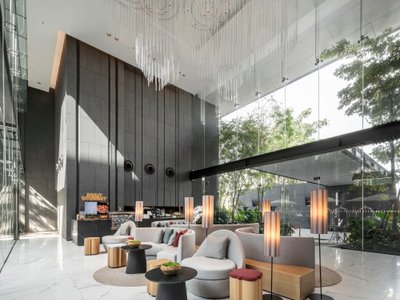
IDIN Architects Wraps a Hua Hin Hotel Around a Private Courtyard to Escape the City
Dusit D2 Hua Hin turns an urban infill site in Thailand's family vacation heartland into a self-contained resort through courtyard planning.
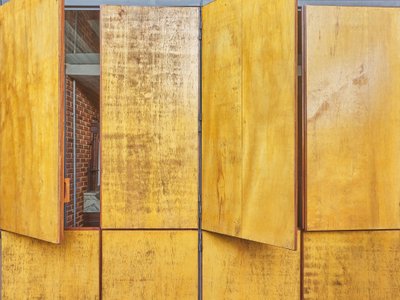
gru.a Builds a 70 m² Timber Shelter That Opens Like a Farm Door in Brazil's Valley of the Vines
In the mountainous region near Rio de Janeiro, a compact retreat uses plywood panels and deep eaves to blur the line between inside and out.
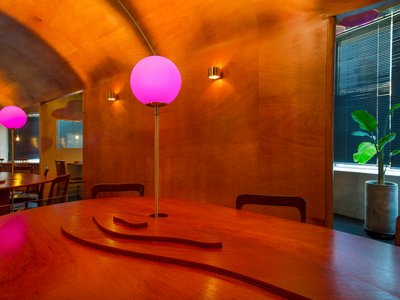
Indiesalon Carves a Plywood Cave into a Seoul Bistro's Second Floor
Munhwa Bistro's second Seongsu branch wraps diners in a laminated timber vault laced with colored light and mirror illusions.
BLDUS Turns a 250-Square-Foot Screened Porch into a Pine Forest Temple in East Hampton
A gabled cedar pavilion mimics the rhythm of surrounding pines, anchoring a 1990s wooded home to its hollow in Long Island.
Similar Reads
You might also enjoy these articles
D and P Associates Build a Pi-Shaped House of Rammed Earth Memory on Vietnam's Red River
A 640-square-metre residence in Ngoc Thuy channels the pisé wall traditions of Vietnam's northern highlands into a riverfront family home.
Johnston Architects Reimagines the Methow Valley Hay Barn as a Small-Town Library in Winthrop
A 7,300-square-foot timber library channels the region's agrarian vernacular to serve a rural Washington community of 400 year-round residents.
STILL YOUNG Builds a Glowing Campfire in the Snow for ARC'TERYX at a Chinese Ski Resort
A timber-framed pavilion at Beidahu Ski Resort in Jilin wraps warmth and glacier-like resin around outdoor retail.
gru.a Builds a 70 m² Timber Shelter That Opens Like a Farm Door in Brazil's Valley of the Vines
In the mountainous region near Rio de Janeiro, a compact retreat uses plywood panels and deep eaves to blur the line between inside and out.


Explore Housing Competitions
Discover active competitions in this discipline




The Global Benchmark for Architecture Dissertation Awards


Design challenge to reuse E-waste
Comments (0)
Please login or sign up to add comments
No comments yet. Be the first to comment!