

Exploring the Final Frontier: The Rise of Futuristic Space Architecture
This article delves into the Spacestop project, showcasing advanced designs in futuristic space architecture for gravity and radiation protection.


Futuristic Space Architecture
In a world where the boundaries of innovation continually expand, the concept of futuristic space architecture has taken a significant leap from the pages of science fiction to the drafting tables of today's visionaries. With the successful unveiling of the Spacestop shortlisted project, a space station-hotel by Kirill Shapovalov, we're witnessing the dawn of a new era in architectural design—one that defies gravity and challenges the cosmos itself.

The Spacestop Project: A Visionary's Dream
Location and Stability in Space
The Spacestop project redefines futuristic space architecture by meticulously planning its placement at Lagrange Point L1, a harmonious orbital haven where gravitational forces balance out. Here, amidst the celestial silence, the space station promises stability with minimal energy for position correction, a testament to strategic spatial planning.
A Novel Approach to Gravity and Radiation
Shapovalov's brainchild doesn't merely recycle the traditional rotating torus concept for artificial gravity. Inspired by the levitating frog experiment by Andre Geim and Michael Berry, this station employs an ingenious diamagnetic response method. This approach promises a future where artificial gravity and radiation protection are harmoniously integrated, propelling futuristic space architecture into new realms of possibility.

Architectural Innovations at the Final Frontier
Designing for Gravity and Protection
In the unique vacuum of space, futuristic space architecture must creatively tackle the absence of gravity and the peril of cosmic radiation. Shapovalov's design proposes an electrifying solution—a cylindrical structure with an external winding that doubles as a shield against space's lethal embrace.
The Building Blocks of the Spacestop
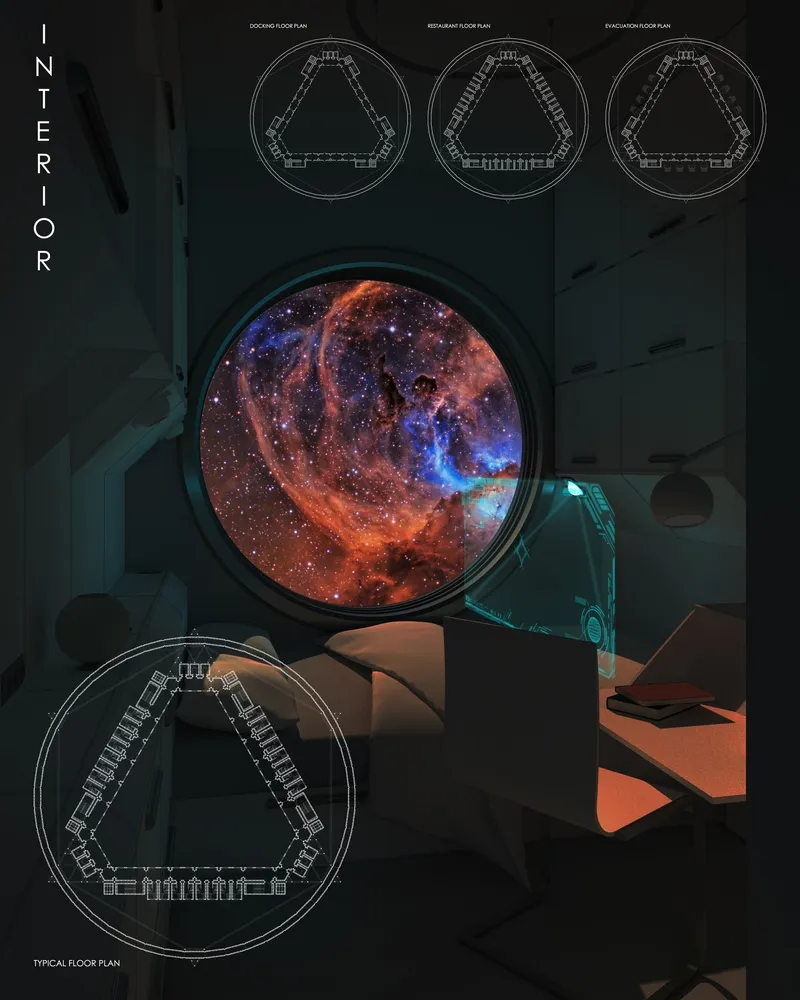
Delving into the structure, the Spacestop's construction echoes terrestrial familiarity—a simple, yet robust triangular metal frame. This design choice ensures that each modular unit, whether for living or technical operations, can be assembled on Earth and installed seamlessly in space, showcasing a blend of innovation and practicality in futuristic space architecture.
Modular Living in the Stars
The station's internal layout is a marvel of modular efficiency. Standard units, passageways, and vertical communication modules are pre-fabricated, optimizing space and resources. This approach to futuristic space architecture not only simplifies transportation but also enables a hermetically sealed environment, crucial for the harsh vacuum of space.
Operational Elegance in Orbit
Life-Sustaining Systems and Waste Management
At the heart of the Spacestop station, life-support systems interweave through floors and ceilings, forming a lifeline of air, water, and temperature regulation. Waste disposal is centralized on a technical floor, emphasizing sustainability in futuristic space architecture.
The Upper Echelons of Engineering
Ascending the station, one finds the nerve center of operations—engineering systems that power the station and maintain the life-giving 'rings.' This design highlights the strategic layering of functionality in futuristic space architecture, ensuring all systems are accessible yet unobtrusive to the living quarters.
As we gaze into the night sky, projects like the Spacestop station bring us closer to a future where the cosmos becomes a canvas for architectural masterpieces. Through ingenuity and foresight, futuristic space architecture will pave the way for humanity's interstellar aspirations, making living among the stars a tangible tomorrow.
In conclusion, the Spacestop is more than a mere concept—it is a beacon of human innovation, an architectural symphony composed in the key of space. As we continue to explore the vast expanse of the universe, the futuristic space architecture embodied by the Spacestop project stands as a testament to our unyielding desire to reach beyond the skies and make a home amongst the heavens.


Popular Articles
Popular articles from the community


Conexión: Biophilic Design Reimagines High-Rise Living in Hong Kong
Conexión reimagines high-rise living in Hong Kong through biophilic design, green facades, shared spaces, daylight, water and nature within.

The Musturak Paradise: Senior Living Architecture for a Connected Future in Temara, Morocco
The Musturak Paradise reimagines senior living architecture in Temara via private homes, social spaces, culture, community, and shared care.

The Ocean Hive: Sustainable Architecture for a Self-Sufficient Civilization at Sea
The Ocean Hive imagines sustainable architecture at sea, where modular habitats, algae, wave power and ocean waste sustain a growing colony.

Co-Life: Senior Housing Design That Reconnects Older Adults With the City
Co-Life reimagines senior housing design through healing gardens, shared streets, workshops, and a sustainable community across generations.

Similar Reads
You might also enjoy these articles

Day and Night Park: A Time-Based Urban Newsstand in Beijing
A temporary urban newsstand in Beijing blending travel, light, and reading through poetic colors, compact form, and community-focused design.

Modernist Patio Renovation in El Masnou, Barcelona by Oliver Segura Arquitectura + Cebrià Arquitectura
Modernist patio renovation blending tradition and innovation with a movable pool, leveled floors, and Catalan materials in El Masnou.

Alto Residencial Coop: Cooperative Housing Development in Santiago de Compostela by Carbajo Barrios Arquitectos
A linear cooperative housing complex blending white volumes and perforated metal façades, enhancing community living, natural light, privacy, and urban integration.

Vil Genis School by BPA ARCHITECTURE – Massy, France
Vil Genis School in Massy, France, features sustainable design, south-facing classrooms, community integration, accessible spaces, and modern educational architecture.

Explore Futuristic Workspaces Competitions
Discover active competitions in this discipline

Challenge to reimagine the Iron Throne

Photograph architecture without architects

Illustrate the lost glory of Angkor Wat - Render Challenge

Design challenge to reuse E-waste
Comments (0)
Please login or sign up to add comments
No comments yet. Be the first to comment!