
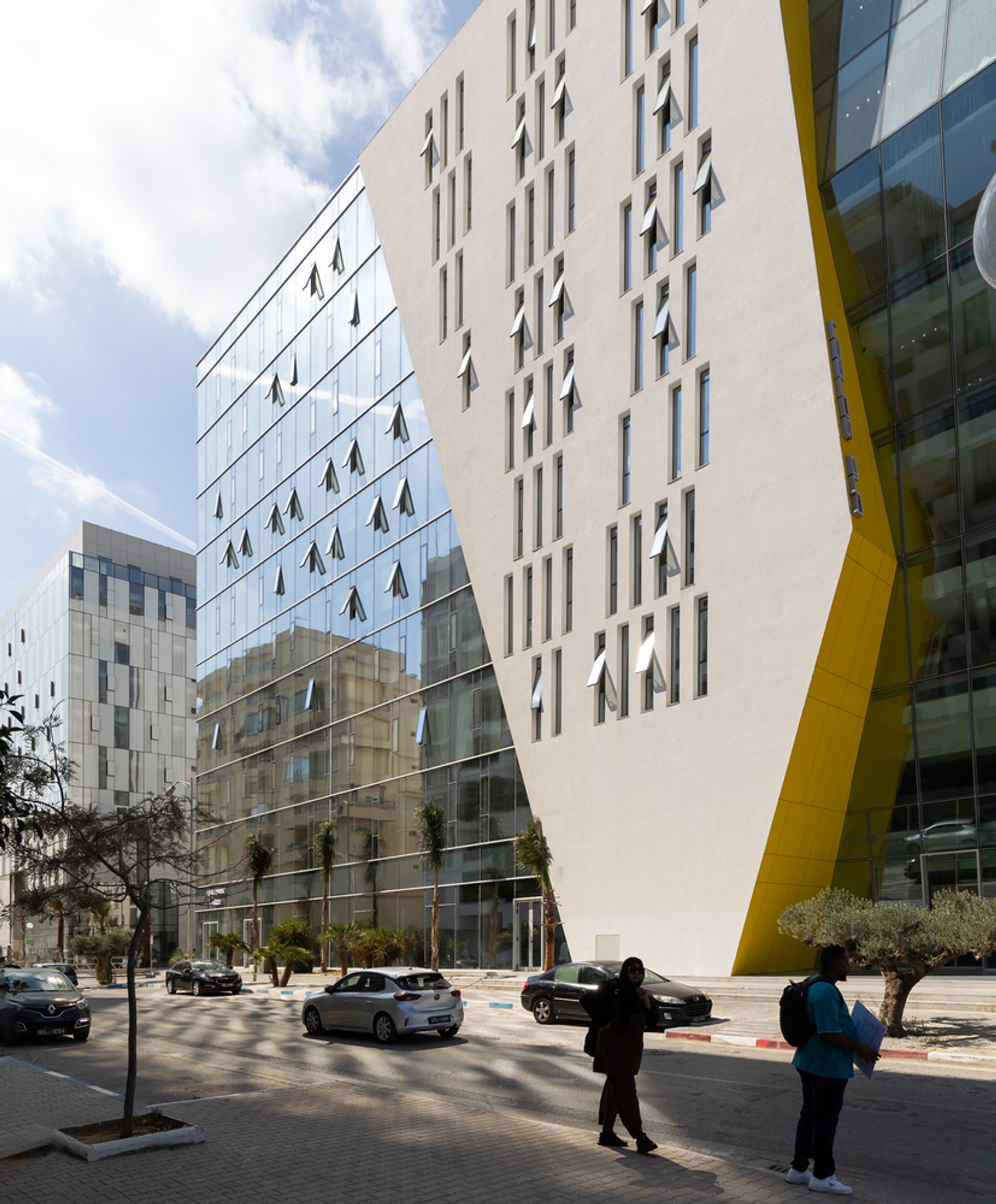
ARK-architecture and AUDA Slash a Fluorescent Yellow Diagonal Through a Tunis Office Tower
A 23,000 square meter workplace in Les Berges du Lac 2 pairs a modular concrete grid with bold color and climate-responsive facades.

Office buildings in North Africa's business districts tend to play it safe: blue glass, grey cladding, repetitive floor plates. The Screen Office in Tunis does none of that. Designed by ARK-architecture and AUDA, this 23,000 square meter tower in Les Berges du Lac 2 takes the familiar ingredients of a speculative office building and rearranges them into something genuinely memorable, anchored by a fluorescent yellow diagonal volume that cuts through the white and glass envelope like a streak of highlighter across a spreadsheet.
What makes the project worth studying is how seriously it treats climate, modularity, and identity as interconnected problems rather than separate checklists. The structural grid is a strict 5.5 by 5.5 meter module, the facade shifts from glass curtain wall to punched openings depending on orientation, and the yellow HPL cladding that defines the entrance also organizes circulation across ten levels. Completed in 2023, long-listed for the EU Mies van der Rohe Award in 2024, the building makes a case that responsible commercial architecture in a Mediterranean climate does not have to look austere.
The Yellow Slash
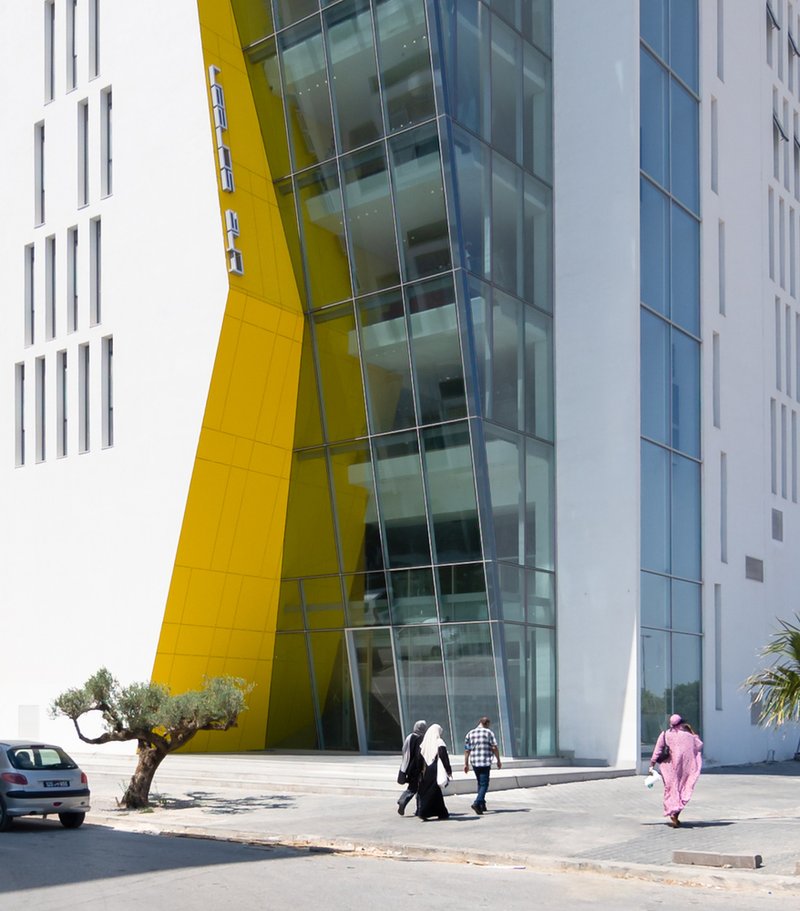
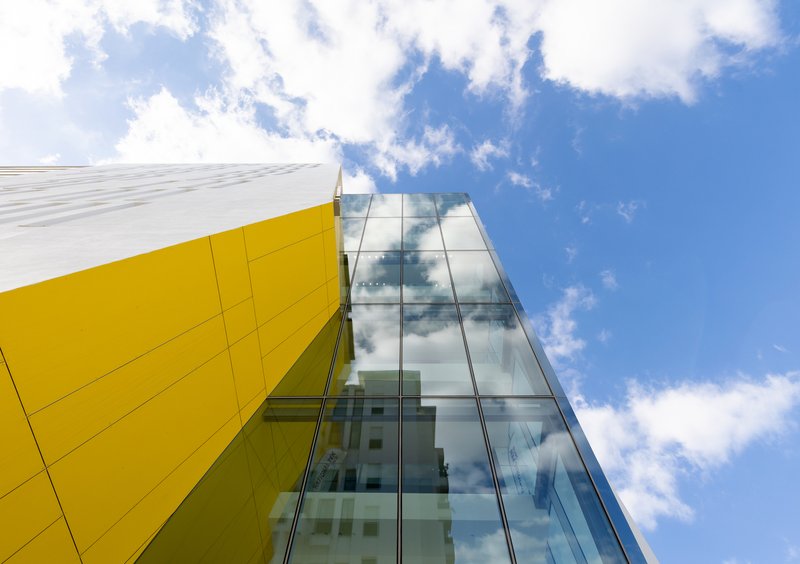
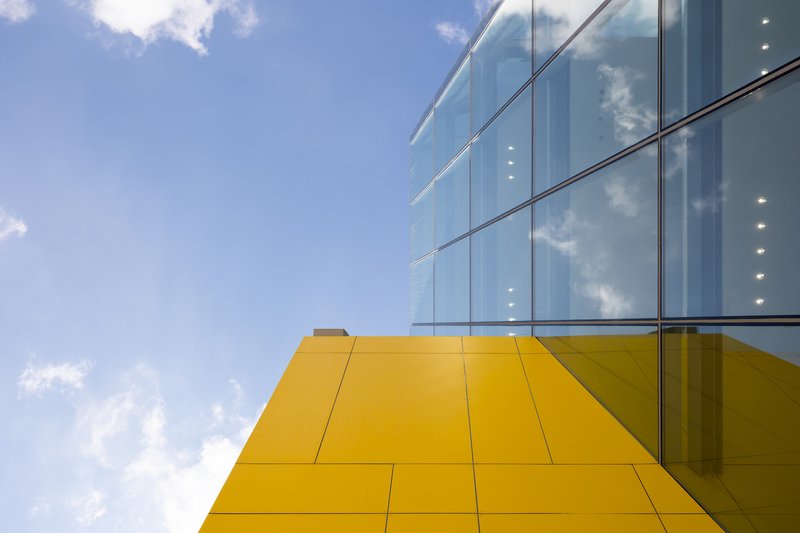
Fluorescent yellow is almost never seen in Tunisian architecture. That alone would make the diagonal volume a provocation. But its purpose goes beyond color. The angled element houses the main entrance, frames a cantilevered balcony supporting an olive tree (a direct nod to Tunisia's agricultural heritage), and creates a legible street address visible from blocks away. Clad in HPL panels, its glossy surface catches shifting Mediterranean light across the day, oscillating between warm gold and acid green.
Structurally, the slash introduces a double inclination in the reinforced concrete wall that supports it, a technical move that the architects use to dramatic visual effect. Where the yellow panels meet the glass curtain wall, the joint is resolved with surgical precision. There is no ambiguity about where the entrance is, no confusion about how to approach the building. That clarity, in a business district where most lobbies hide behind identical canopies, is the building's first gift to the street.
Facade as Filter
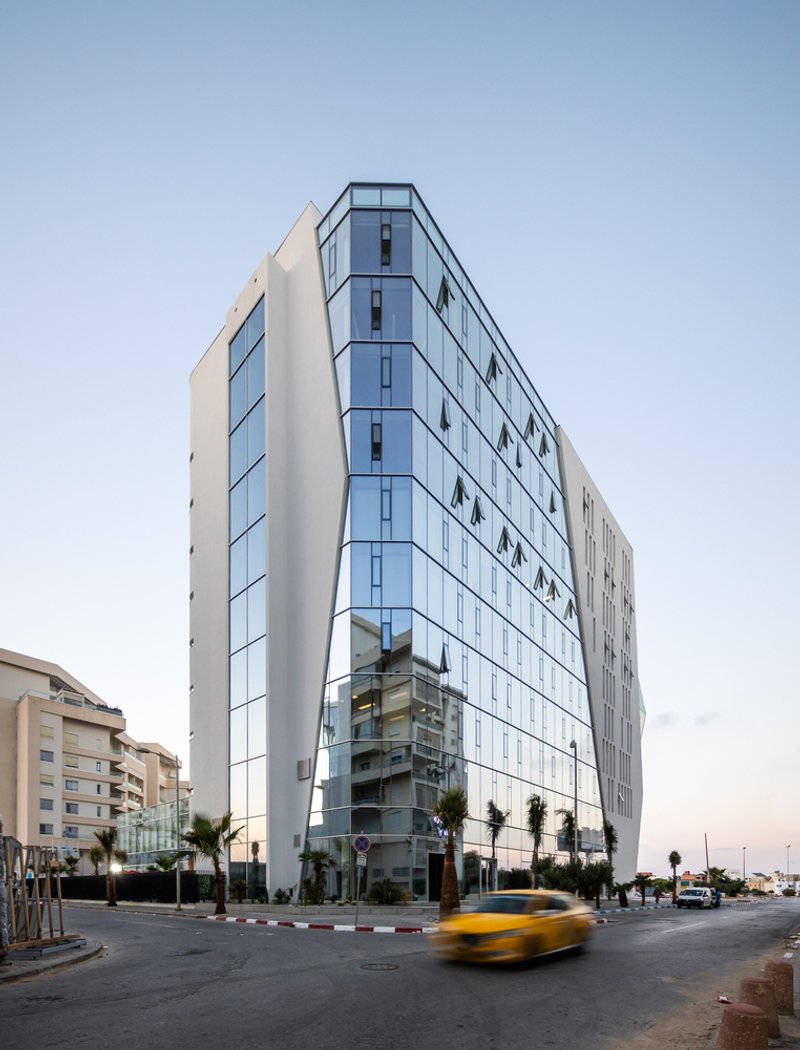
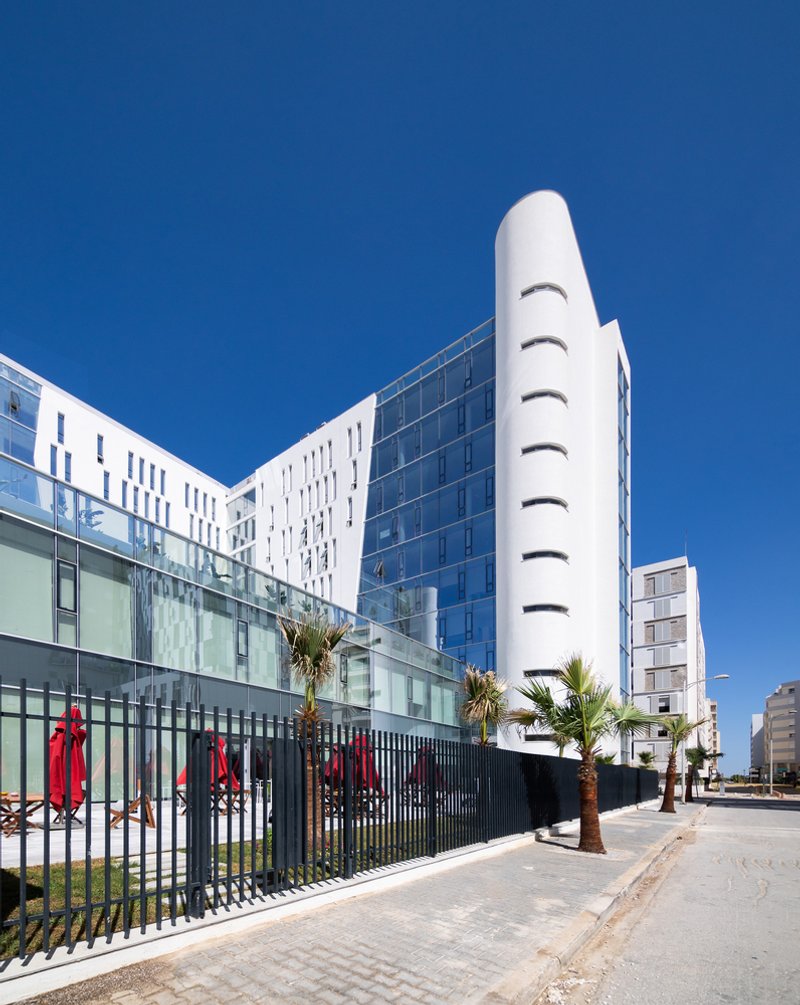
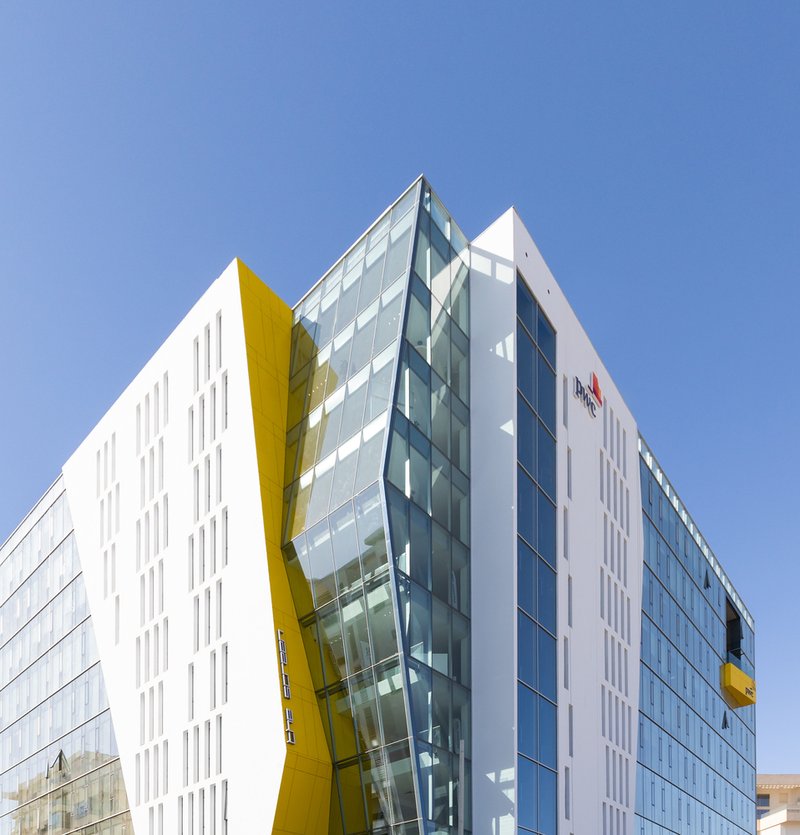
The Screen Office earns its name through the treatment of its perimeter. The white facades are not uniform; they shift between punched windows and narrow light slits depending on solar exposure, while the glass curtain wall occupies the orientations where daylight is an asset rather than a liability. The building is 16 meters wide, divided into three structural grids, and the central bay absorbs all the mechanical and circulation infrastructure at a compressed ceiling height of 2.50 meters. This frees the facade bays to reach 2.90 meters net, maximizing the perception of openness at the perimeter where people actually sit.
The result is a layered envelope that reads differently from every angle. From the southwest, the building is a white screen punctured with geometric openings. From the northeast, it is predominantly glass. Walk around the block and you understand that the architects have treated each elevation as a distinct response to sun, wind, and view, unified only by the yellow diagonal that anchors the corner.
Entering the Building
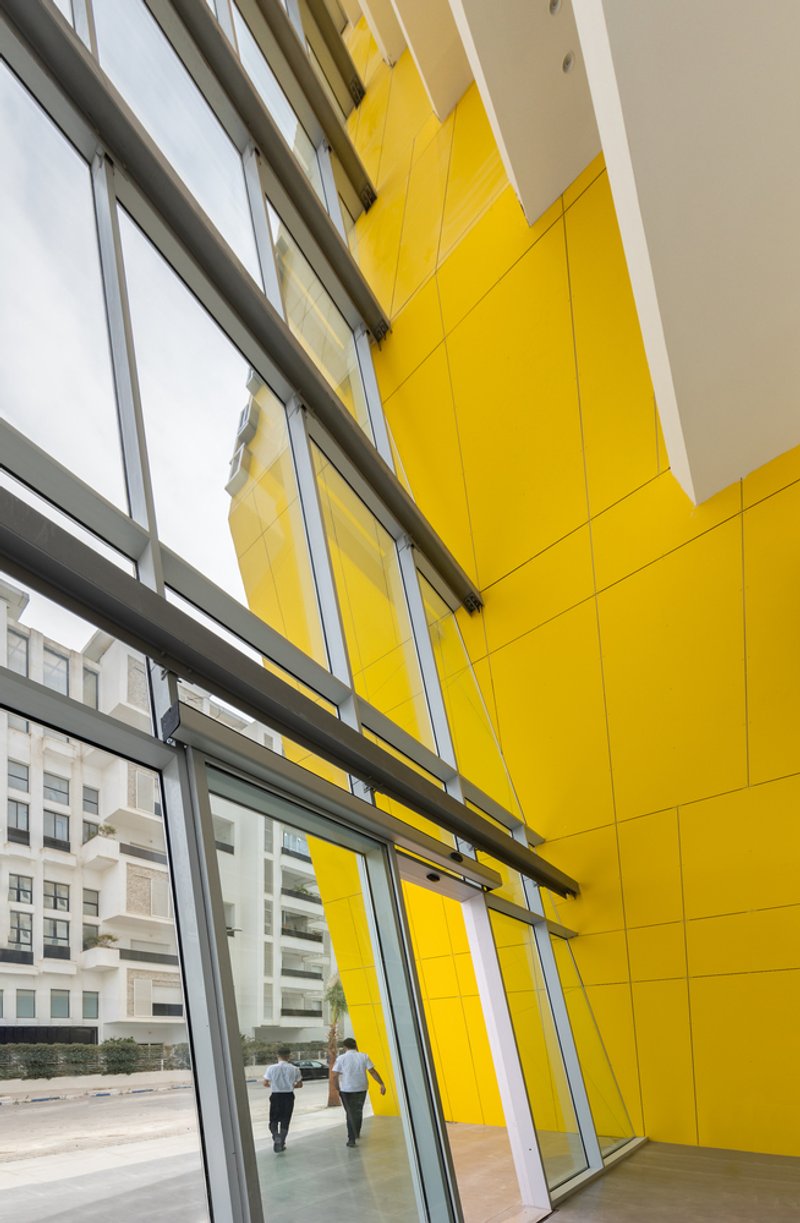
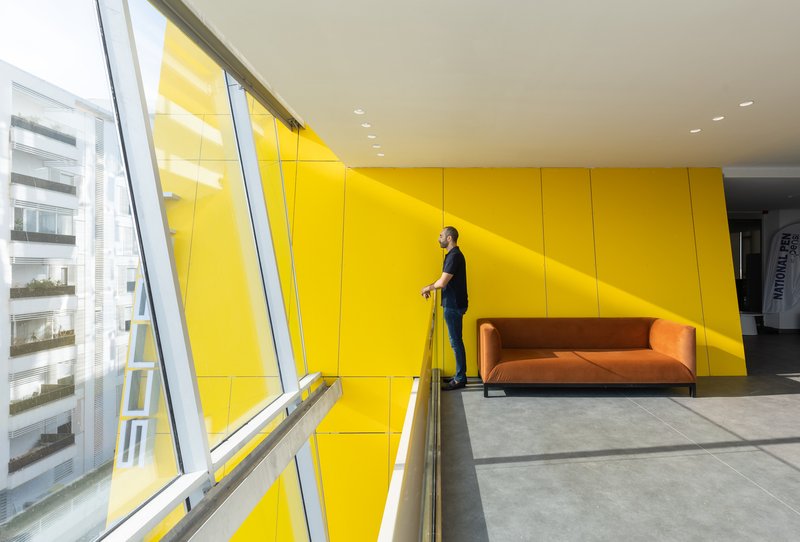
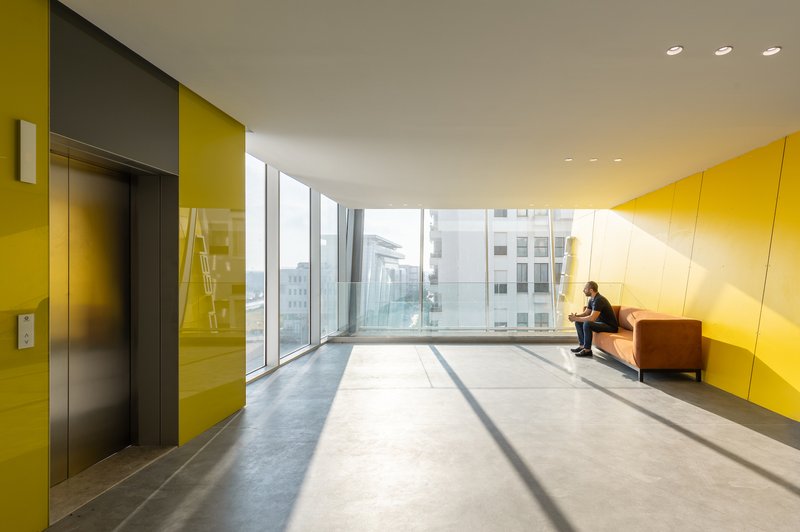
The entry sequence is deliberately theatrical. You pass beneath the angled yellow soffit, through floor-to-ceiling glazing that leans outward, and into a lobby where the yellow wraps walls and ceiling without interruption. The slanted glass throws angular shadows across the floor, and the entire space feels like stepping inside the diagonal volume you saw from the street. An orange sofa placed against the yellow wall reads as a deliberate warm counterpoint, not an afterthought.
Six panoramic elevators serve the tower from here, and the yellow color language continues into the elevator lobbies on every floor, creating a wayfinding system that works without signage. It is a simple strategy but an effective one: follow the yellow and you will always find your way to the core.
The Workplace Floors
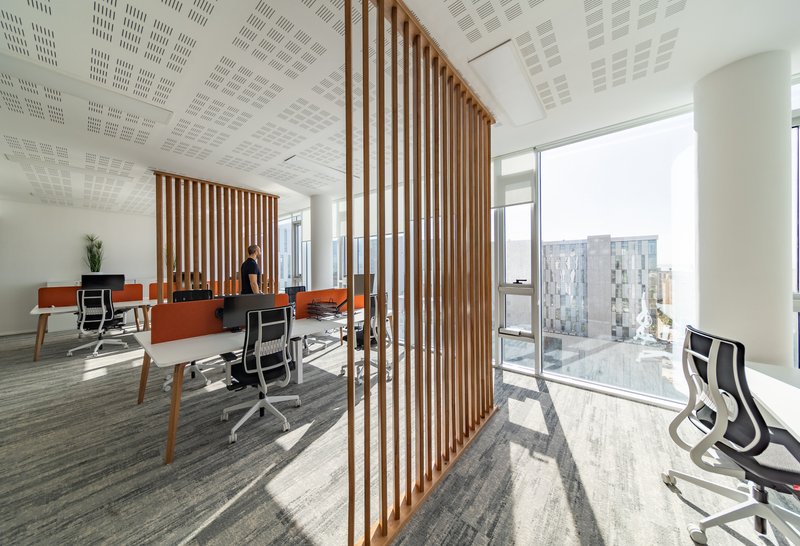
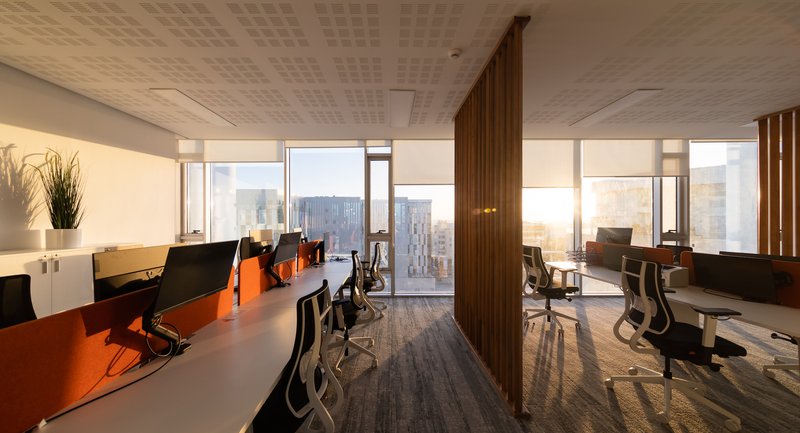
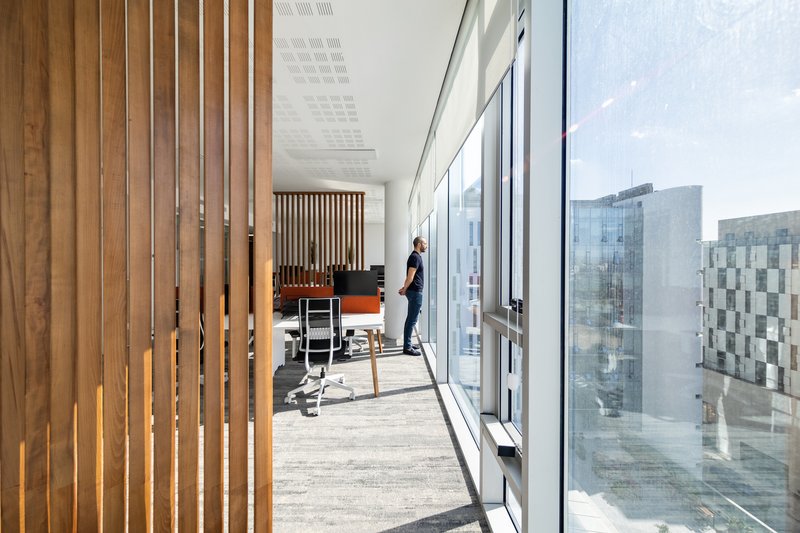
Eight office levels sit above a two-story podium, each organized around the same modular framework. Timber slat screens subdivide the open plans into zones without killing sightlines. Perforated acoustic ceiling panels handle noise. The combination gives each floor the feel of a large, well-lit loft rather than a conventional cellular office. Afternoon light rakes across the carpet through the facade's narrow slits, creating a pattern of long shadows that shifts hour by hour.
The repetitive structural grid is key to the building's flexibility. Because the 5.5 meter bays use flat beams that do not protrude below the slab, tenants can configure ceilings and partitions freely. This is a speculative office building designed to accommodate tenants that do not yet exist, and the architects have wisely prioritized adaptability over fixed scenography.
Communal Spaces and the Rooftop
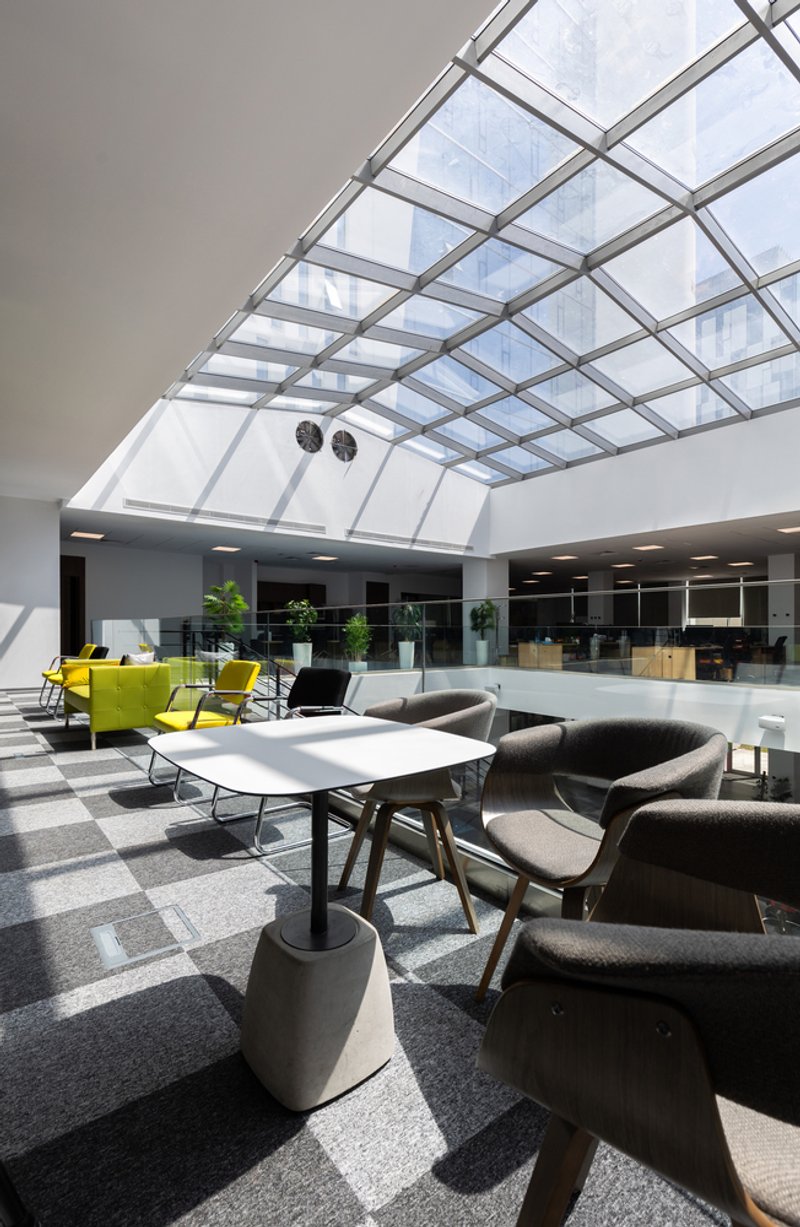
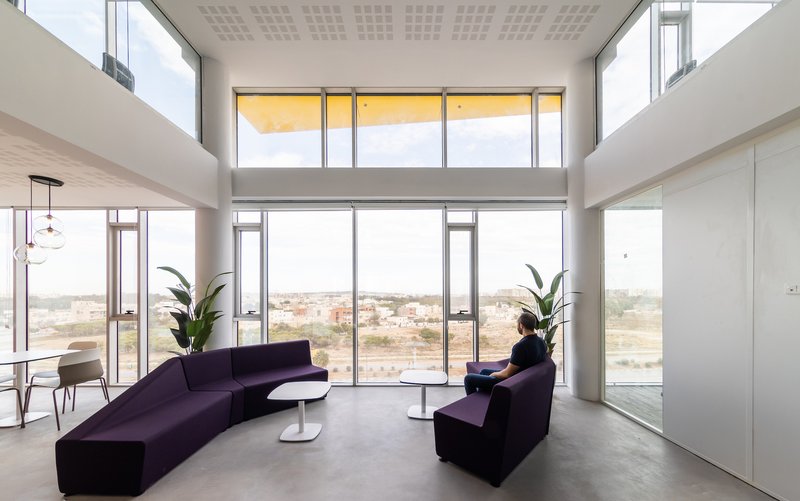
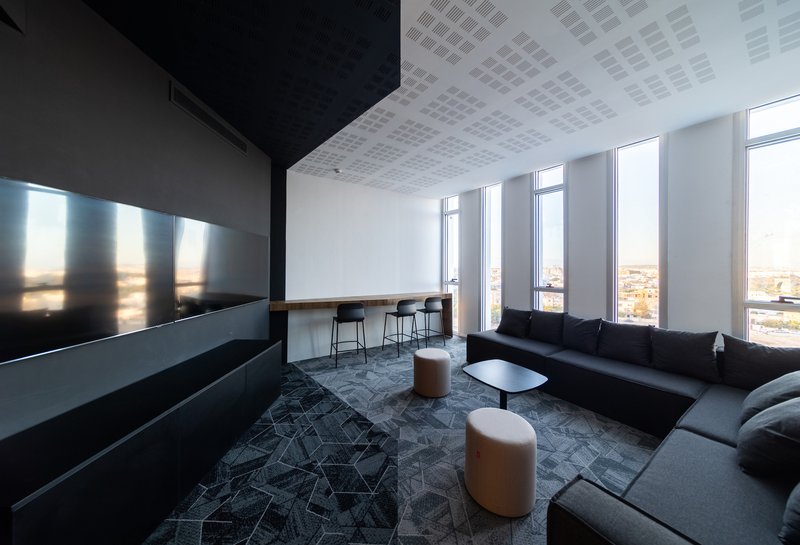
The atrium at the base of the building operates as a social condenser. Beneath a gridded skylight, seating clusters sit on a terrazzo floor, casting sharp shadows that feel almost Mediterranean in their graphic quality. On upper levels, a double-height lounge with purple upholstery and potted plants provides a decompression zone that could belong to a co-working space or a boutique hotel. The architects clearly believe that workplace well-being is not a perk but a spatial requirement.
The rooftop takes this further. Dining and relaxation areas offer a 360-degree panoramic view of Tunis, and the terrace is designed as an outdoor room, not a leftover mechanical deck. The message is that every square meter of this building, including the sky, is usable space.
The Olive Tree and the Cantilever
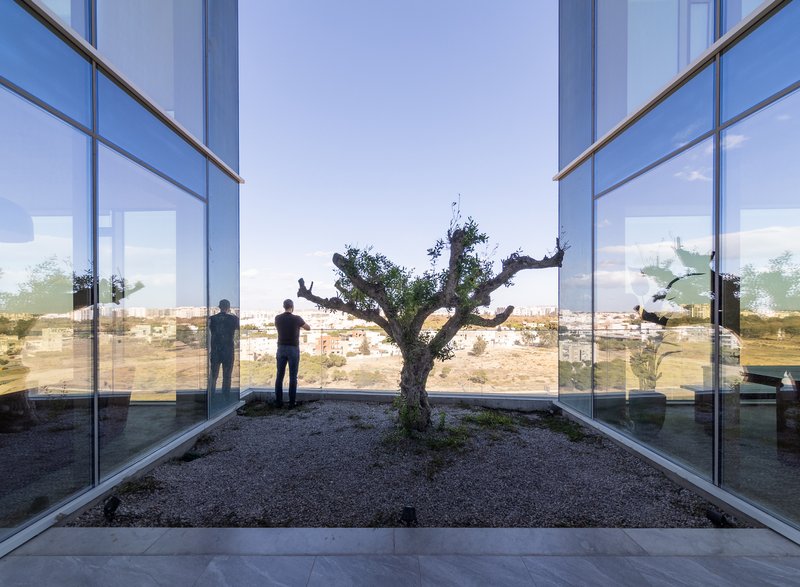
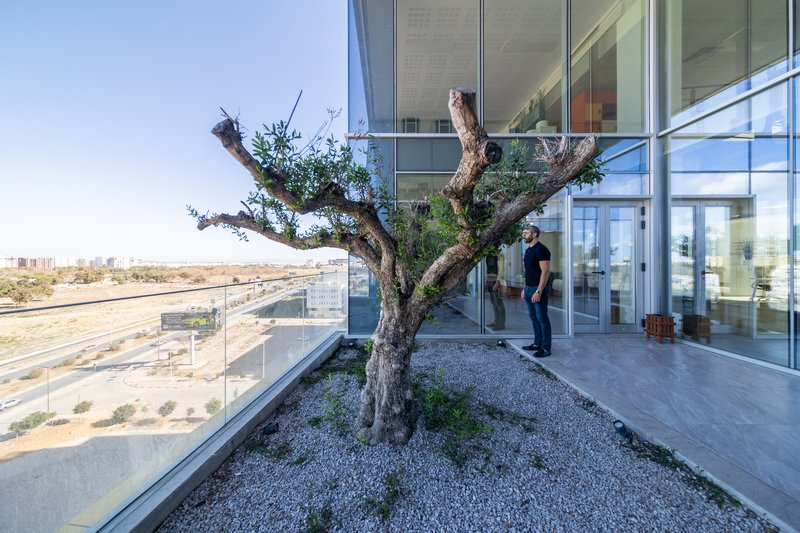
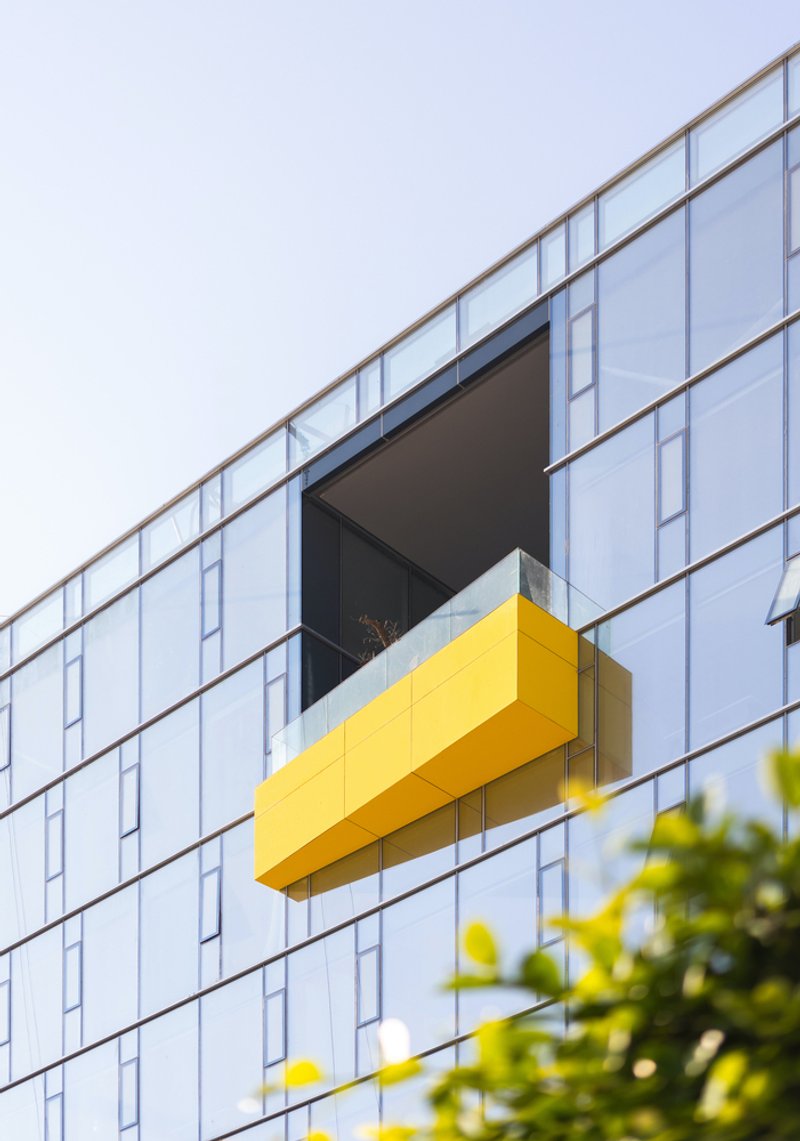
Two olive trees anchor the building's relationship to Tunisian identity. One sits in a glazed internal courtyard at the base, its gnarled trunk framed by reflective glass walls and a gravel bed. The other occupies a cantilevered balcony projecting from the yellow volume, suspended above the street in a gesture that is part landscape, part provocation. The cantilever is structural, not decorative: the reinforced concrete wall with its double inclination supports the projection, and the tree grows in a gravel planter that integrates with the building's drainage system.
These are not token green elements. The olive tree is Tunisia's most symbolically loaded plant, and placing one in a corporate office tower, suspended in air, reads as a deliberate claim that commercial architecture can carry cultural meaning without resorting to ornamental pastiche.
After Dark
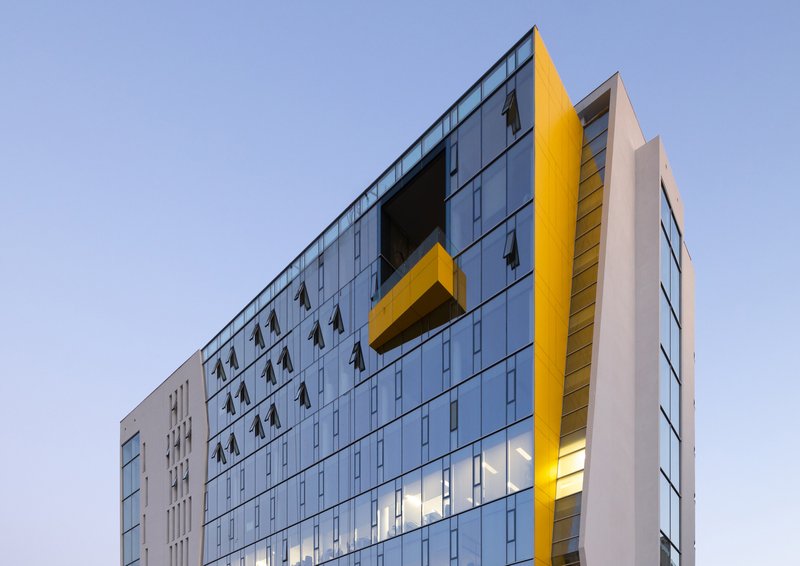
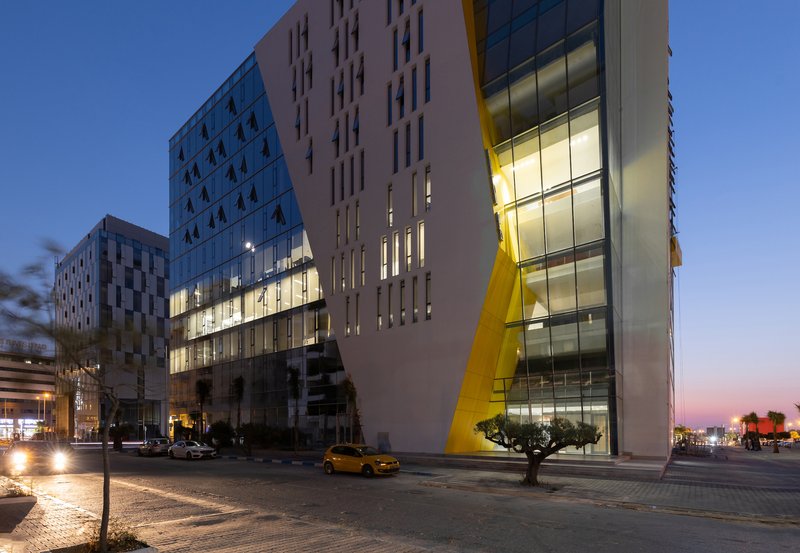
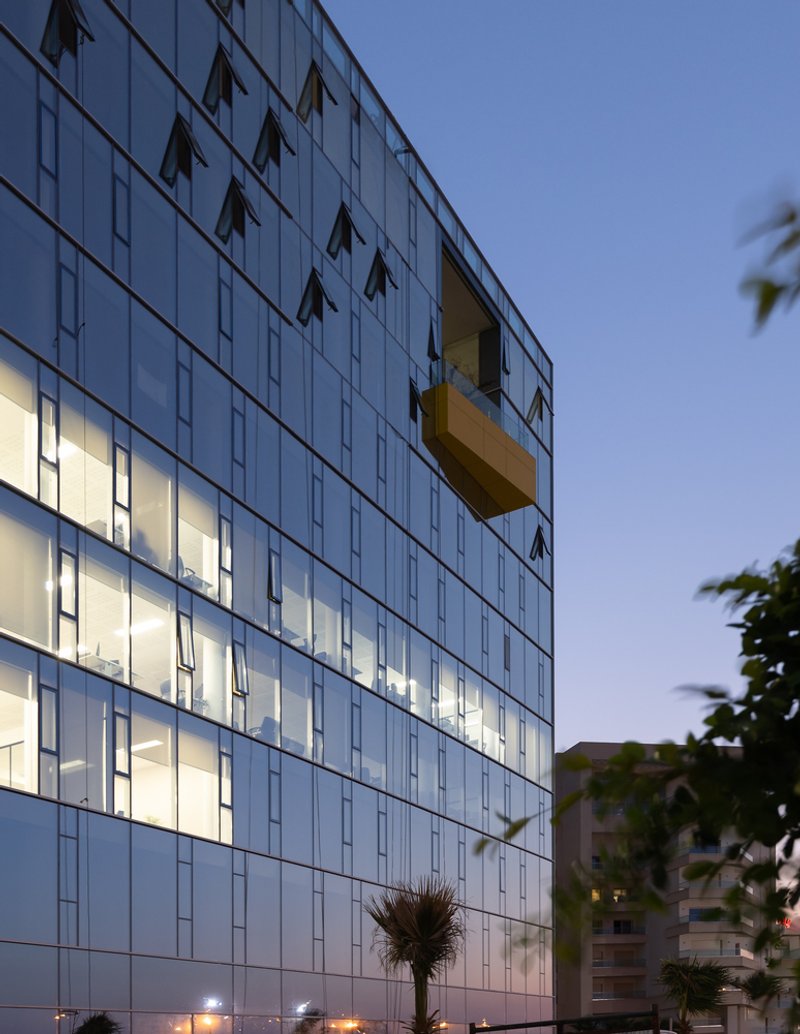
At twilight, the building inverts its daytime logic. The white screen fades to grey, and the glass curtain wall begins to glow from within, revealing the stacked floors and the cantilevered yellow volumes as illuminated beacons. The triangular window openings on the opaque facades, barely noticeable by day, become precise cuts of warm light. The yellow taxi passing at street level in one view is almost too perfect: the building's palette has already colonized the city around it.
Plans and Drawings
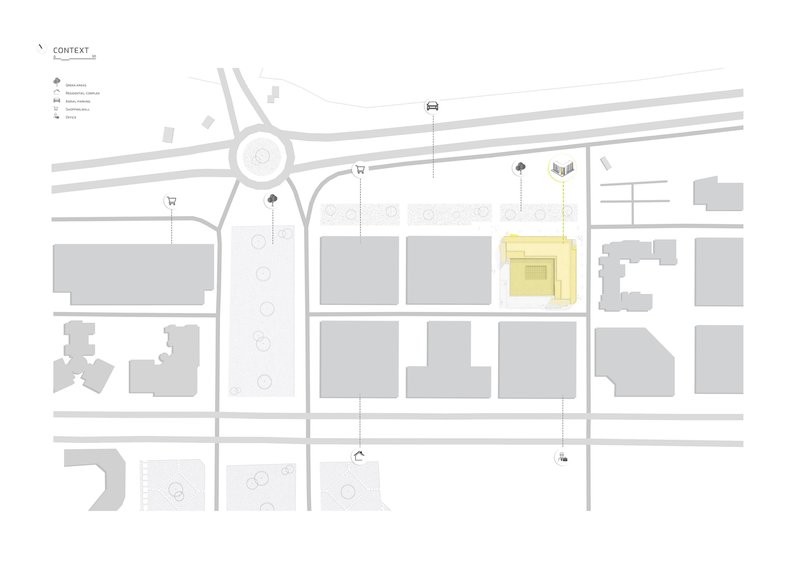
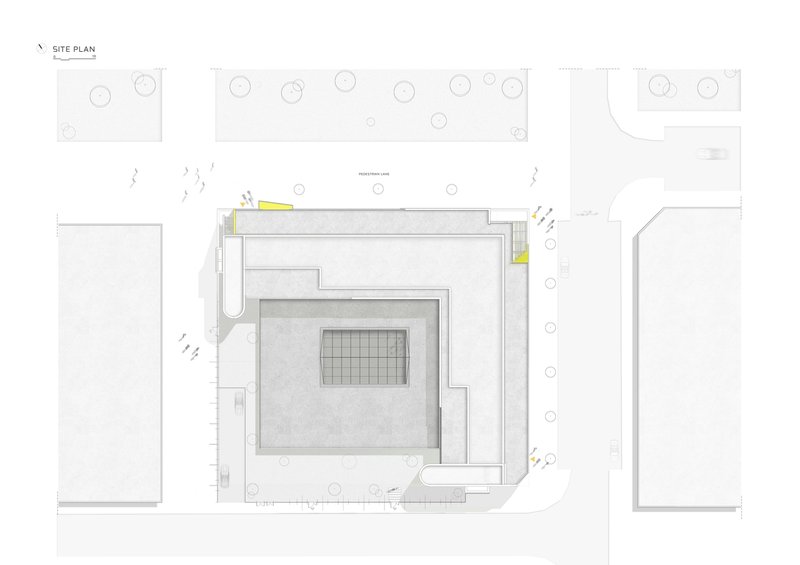
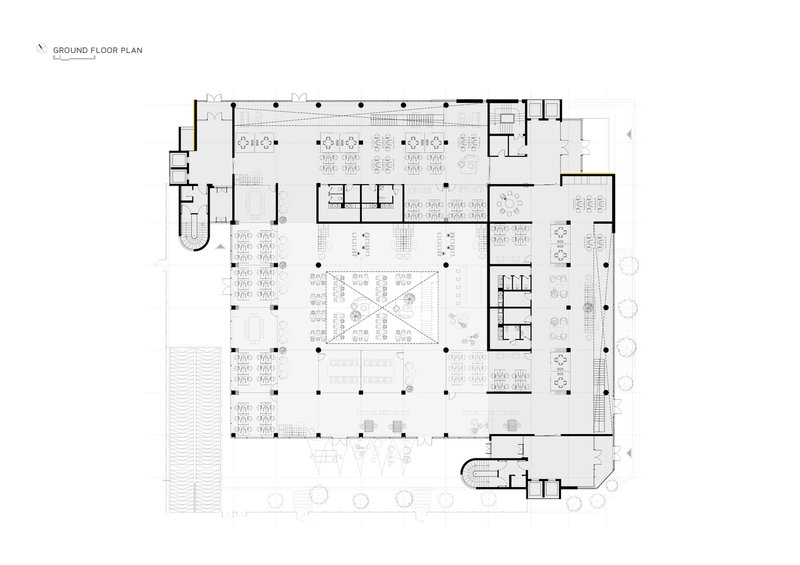
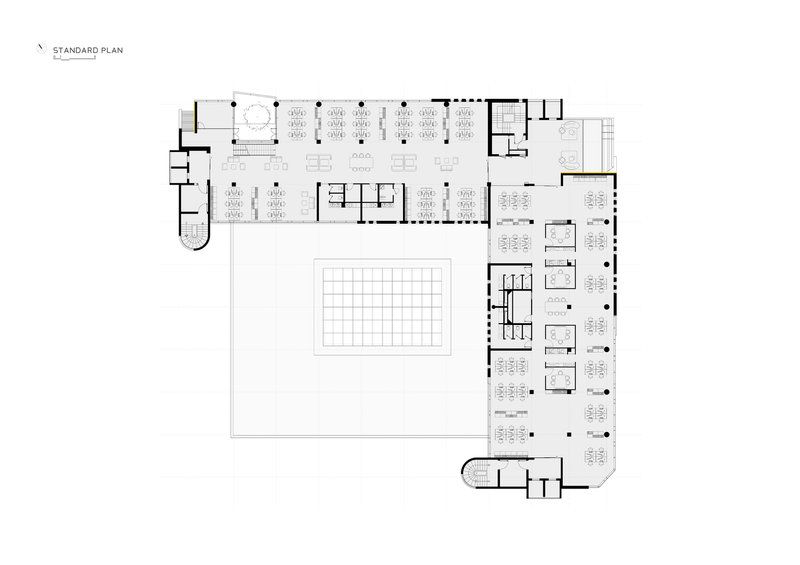
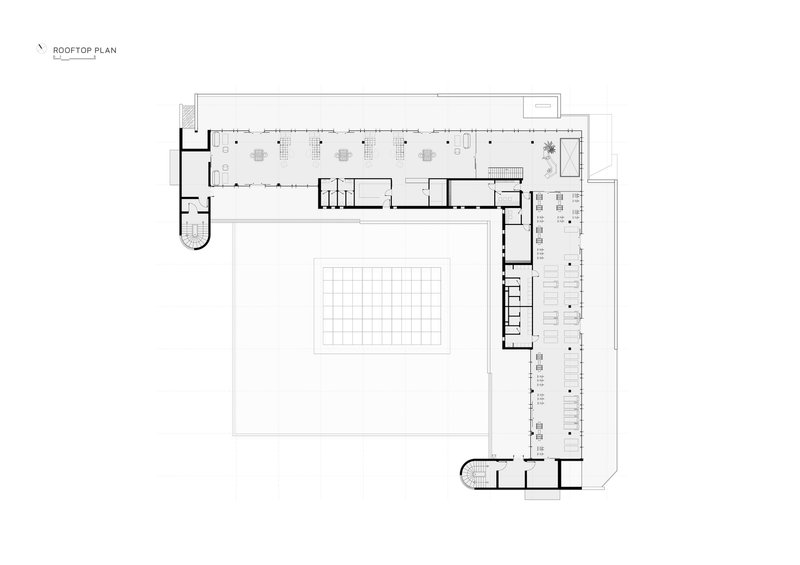
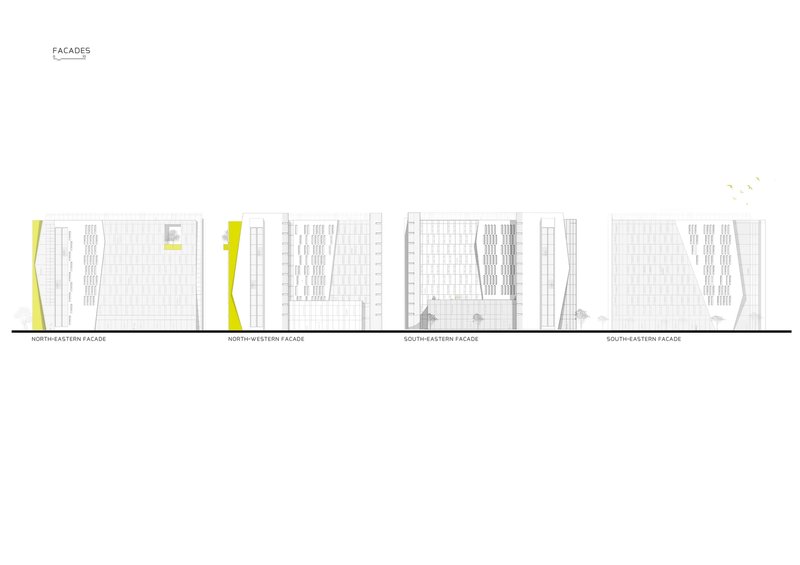
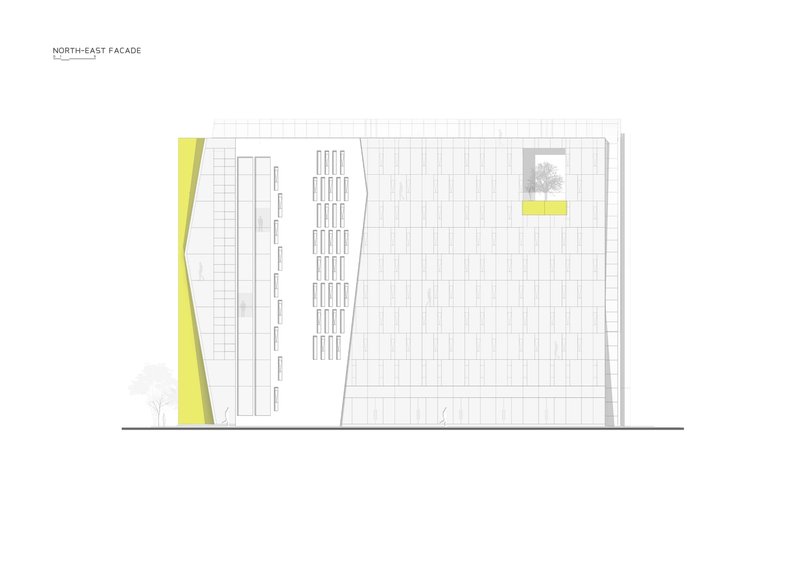
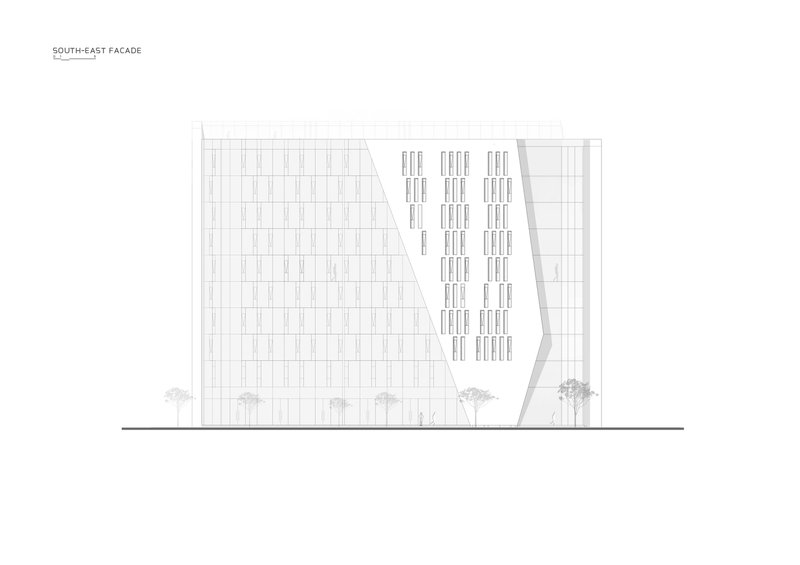
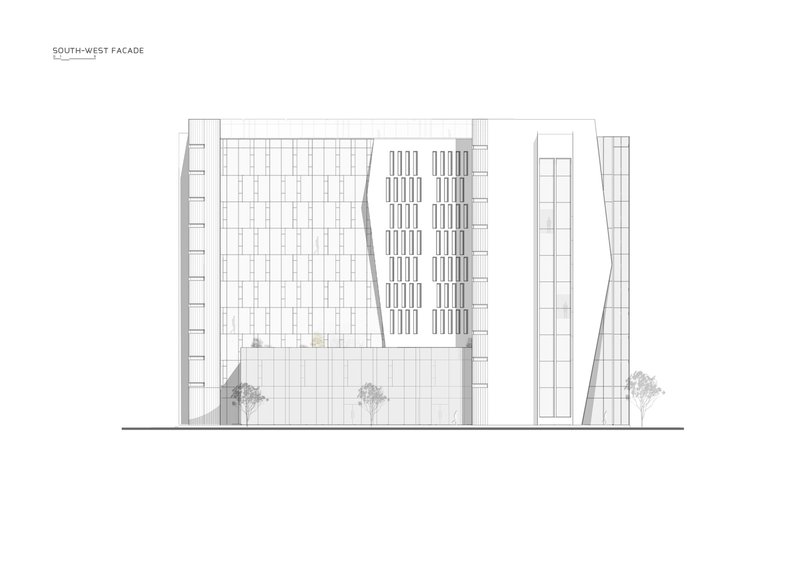
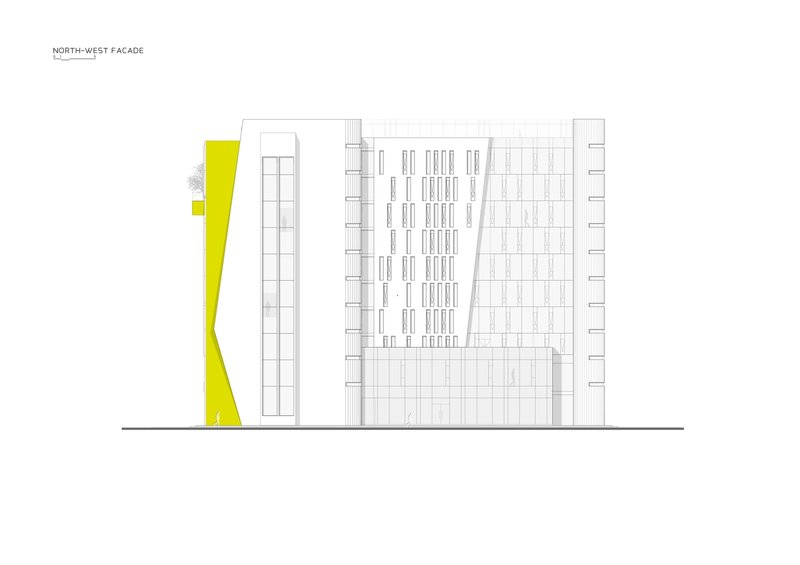
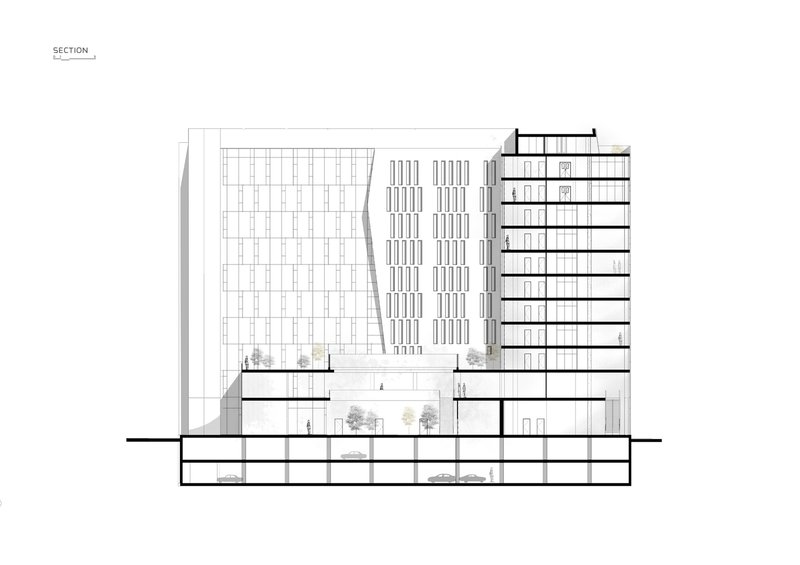
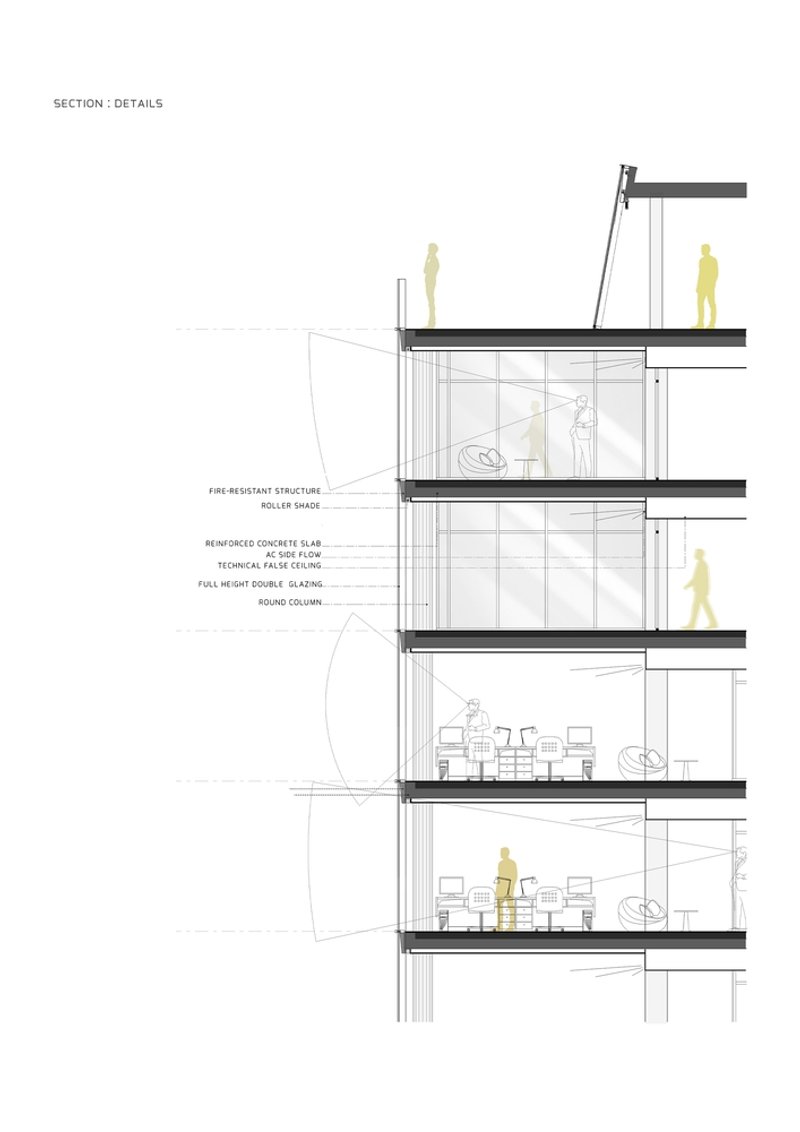
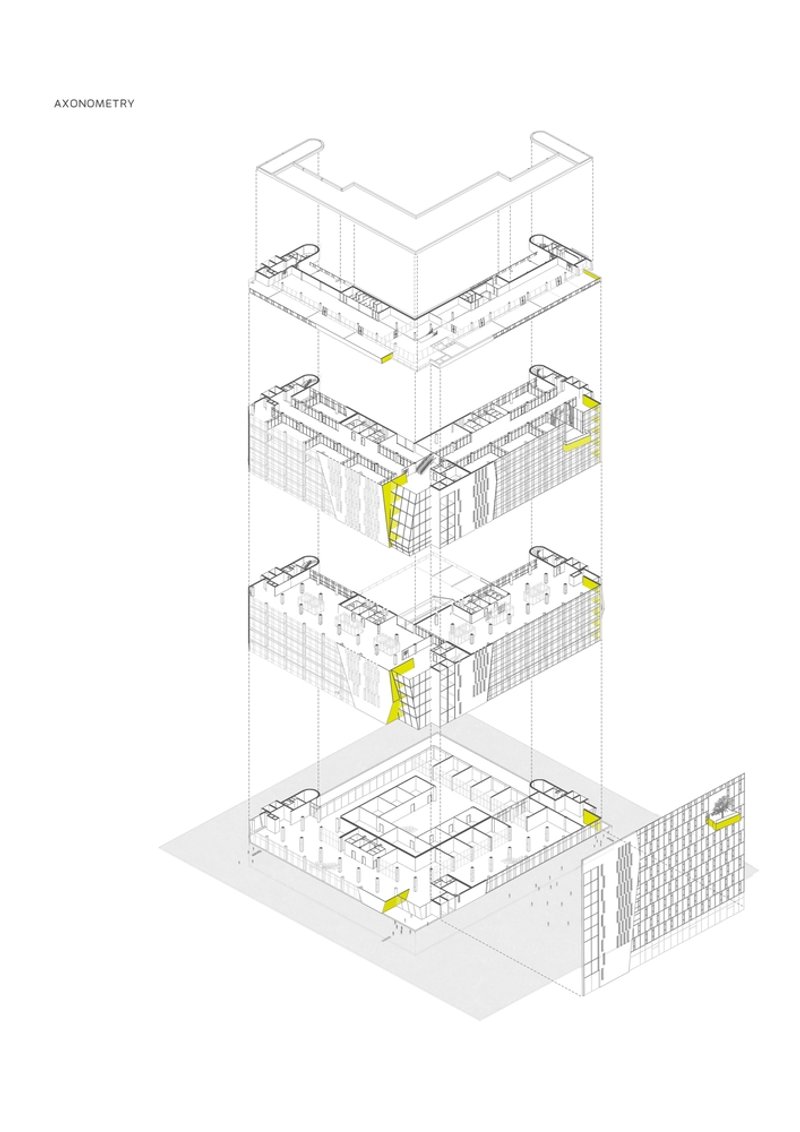
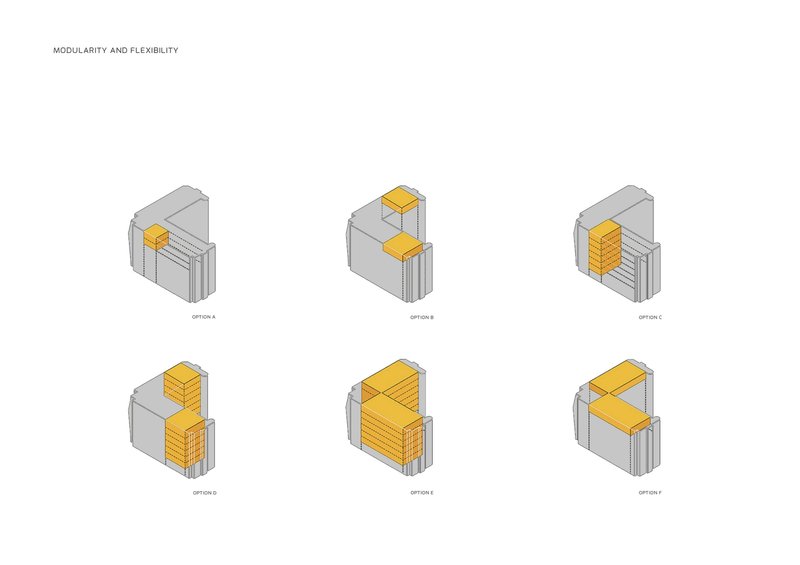
The drawings reveal what the photographs only hint at. The site plan shows the building occupying a corner lot within the Lac 2 grid, its yellow diagonal aligned to the street intersection. The standard floor plan confirms the three-bay organization: two perimeter zones wrapping a compressed central core. The elevations display all four facades side by side, making explicit how the ratio of glass to solid shifts with orientation. Louvered bands appear on the hotter exposures, while the cooler sides open up to full curtain wall.
The axonometric exploded view is particularly telling. It isolates the yellow circulation cores and mesh facade elements as discrete systems that slot into the concrete frame. The isometric diagrams at the bottom show six modular configuration options, demonstrating that the building was conceived not as a singular composition but as a kit of parts. The section drawing confirms two basement levels of parking beneath the ten above-grade floors, with the curved facade element at the corner given its own structural expression. Every drawing reinforces the same argument: rigor in the grid, freedom at the edges.
Why This Project Matters
The Screen Office matters because it proves that a speculative office building in a North African business district can be architecturally ambitious without abandoning pragmatism. The modular grid accommodates any tenant configuration. The facade responds to climate with specificity, not gesture. The yellow diagonal creates urban identity from a material choice that most developers would reject as too risky. ARK-architecture and AUDA have delivered a building that functions as infrastructure and reads as architecture, which is harder than it sounds.
It also matters as a statement about regional practice. The long-listing for the Mies van der Rohe Award signals that European institutions are paying attention to work coming out of Tunis, and this building deserves that attention. Not because it mimics European precedents, but because it synthesizes local climate knowledge, cultural references like the olive tree and the mashrabiya-inflected screen, and contemporary workplace thinking into a coherent whole. Les Berges du Lac 2 now has a landmark that earns its visibility.
The Screen Office, designed by ARK-architecture and AUDA. Located in Les Berges du Lac 2, Tunis, Tunisia. 23,000 square meters. Completed 2023.
About the Studio
AUDA
Share Your Own Work on uni.xyz
If projects like this are the kind of work you want to make, uni.xyz is a place to publish your own, find collaborators, and enter design competitions.



Popular Articles
Popular articles from the community

BAUEN Builds Two Rammed Earth Volumes in Paraguay Inspired by the Ovenbird's Nest
In San Bernardino, a house of compacted earth channels the instinct of a constructive bird to shelter life from the Paraguayan summer.
IDIN Architects Wraps a Hua Hin Hotel Around a Private Courtyard to Escape the City
Dusit D2 Hua Hin turns an urban infill site in Thailand's family vacation heartland into a self-contained resort through courtyard planning.
OMCM arquitectos Builds a Summer House in Paraguay from Quarry Waste Blocks and Three Sacred Trees
In the young hillside neighborhood of Altos, a 696-square-meter concrete volume hovers on six pillars around three preserved native Yvyraju trees.
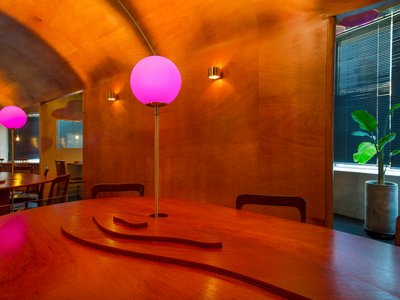
Indiesalon Carves a Plywood Cave into a Seoul Bistro's Second Floor
Munhwa Bistro's second Seongsu branch wraps diners in a laminated timber vault laced with colored light and mirror illusions.

Similar Reads
You might also enjoy these articles

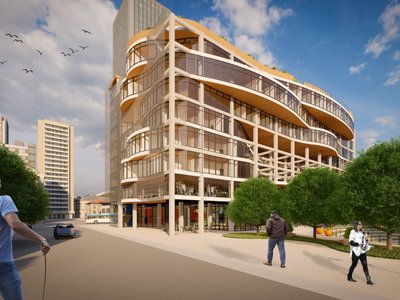
Olio Towers: A Mid-Rise for Performers That Fuses Housing, Rehearsal, and Stage
Located blocks from Houston's Theater District, this modular tower stacks living units around a central performance atrium.
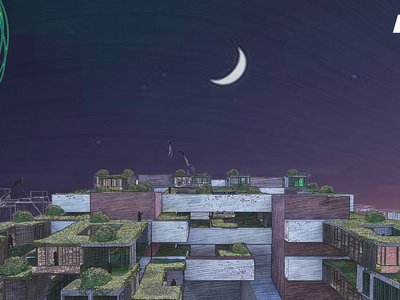
Oasis: Modular Green Housing Carved into Dhaka's Urban Fabric
A shortlisted Plugin Housing entry reclaims unauthorized settlements in Dhaka with stepped concrete volumes, green roofs, and ventilation-driven design.

Black Hole: A Floating Megastructure for the Post-Physical Era
Emiliano Mazzarotto envisions a spherical, self-scaling arena where e-sports, digital hotels, and holographic stadiums replace traditional public space.
Compact & Sustainable Living in Piraeus: A Four-Level Family Home Built Around Light and Air
A narrow townhouse in one of Greece's densest port cities uses a central atrium and passive strategies to house three generations under one roof.
Explore Architecture Competitions
Discover active competitions in this discipline




The International Standard for Design Portfolios


The Global Benchmark for Architecture Dissertation Awards


The Global Benchmark for Graduation Excellence


Challenge to reimagine the Iron Throne
Comments (0)
Please login or sign up to add comments
No comments yet. Be the first to comment!