
Xocomaidan: A Cacao Cultural Center Rooted in Maya Spatial Ritual
Bamboo domes, clay pavilions, and a reimagined plaza anchor a climate-responsive cultural complex in Tabasco, Mexico.


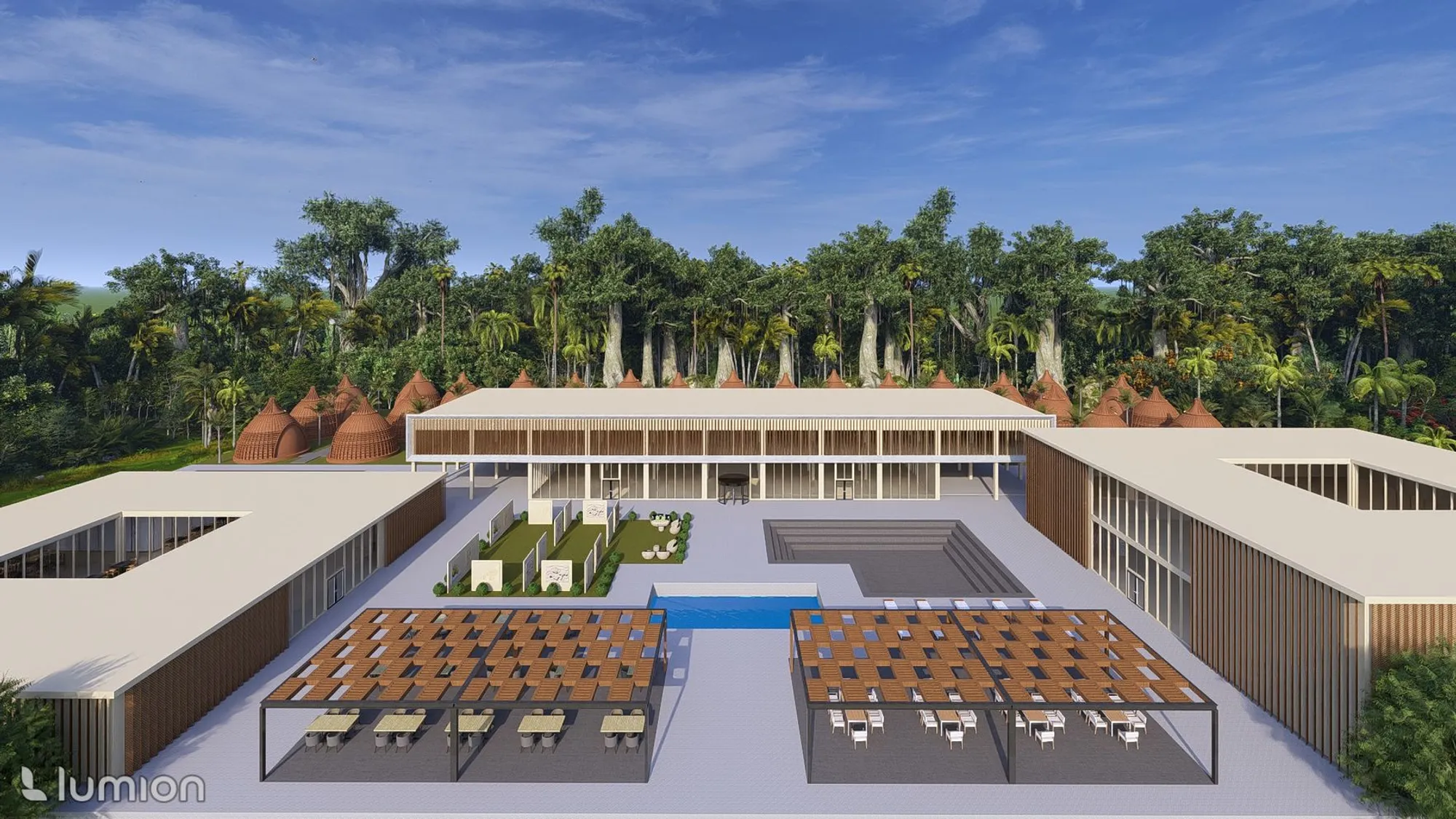
What happens when you take the central plaza of an ancient Maya city, the spiritual and social nucleus where ceremony, commerce, and community life converged, and rebuild it as a functioning cultural center surrounded by cacao plantations? Xocomaidan answers that question with a modular complex of woven dome pavilions, bamboo pergolas, and terracotta-hued volumes arranged around an open courtyard in Comalcalco, Tabasco, Mexico. The project does not merely reference Maya architecture; it attempts to reconstruct the spatial logic of the maidan, the communal square, as a living program of hospitality, education, and ecological stewardship.
Designed by Gökçe Lafcı as a Shortlisted entry in the Xocolatl competition, Xocomaidan sits within the sacred cacao-growing region of southern Mexico. The brief called for architecture that honors chocolate's deep cultural roots while addressing contemporary needs. Lafcı responded with a scheme that fuses museum, workshop, eco-lodging, restaurant, and amphitheater into a single campus governed by a square grid system drawn from Maya urban planning principles.
Woven Domes Scattered Across a Tropical Plaza
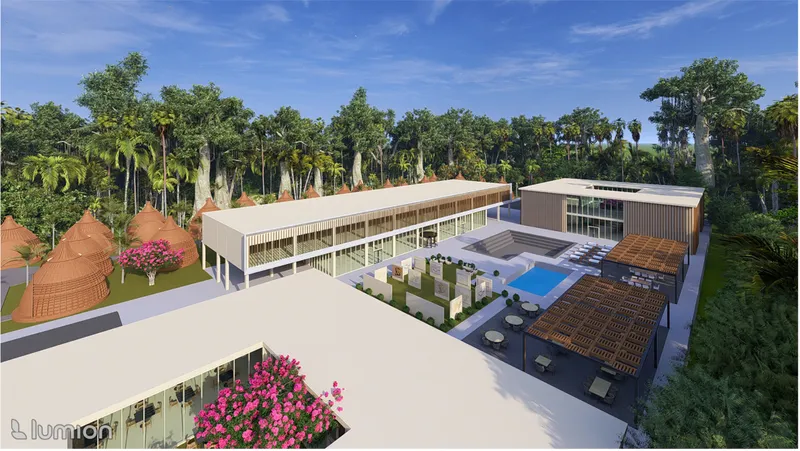
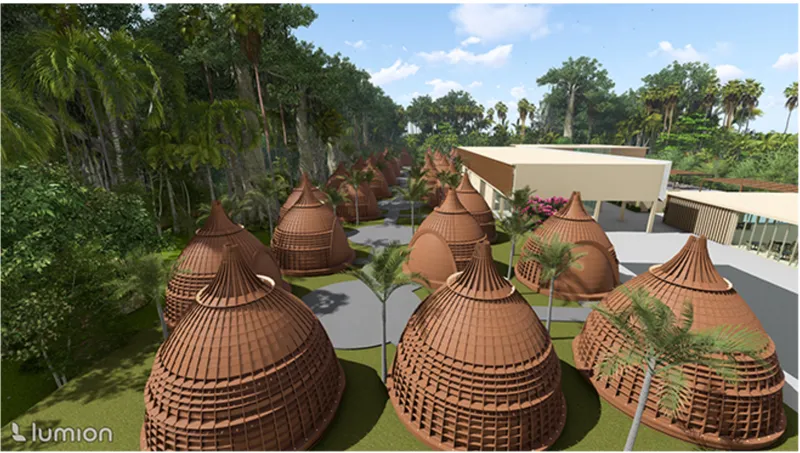
From above, the masterplan reads as a constellation of circular and rectilinear forms distributed along a perimeter that frames a generous central courtyard. The woven dome pavilions, their lattice skins rendered in deep terracotta browns that echo the color of dried cacao, reference traditional Maya dwellings while functioning as intimate eco-lodging villas. These circular structures are positioned at the rear of the site, offering privacy to guests without breaking the visual rhythm of the campus. Palm trees and tropical forest buffer the edges, reinforcing the project's ambition to blur the boundary between built form and vegetation.
The long horizontal pavilion anchoring the public side of the complex houses the museum, restaurant, and workshop spaces. Its low profile defers to the dome silhouettes while maximizing cross-ventilation, a passive cooling strategy made necessary by Tabasco's heat and humidity. The divided masses along the perimeter are not arbitrary; they channel prevailing breezes through gaps that function as shaded corridors, keeping the central square comfortable throughout the day.
Slatted Pergolas and the Architecture of Shade
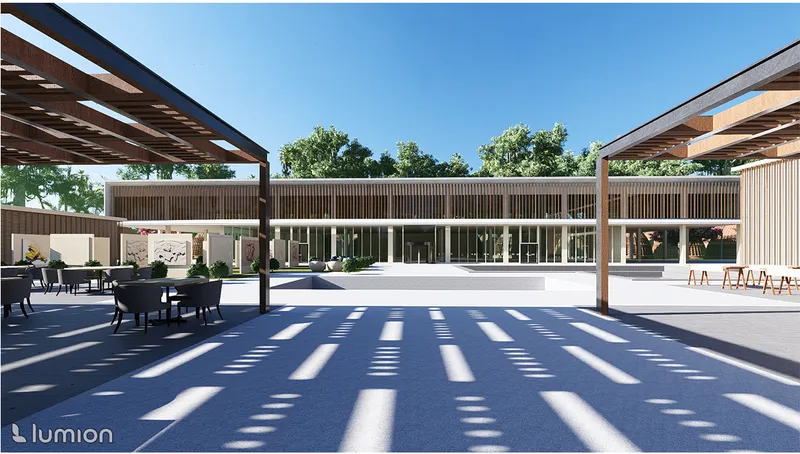
One of Xocomaidan's strongest spatial moments occurs under the covered terrace, where timber slat pergolas cast rhythmic striped shadows across the ground plane. In a tropical climate where direct sun is relentless, shade becomes the primary architectural gesture. Rather than relying on heavy walls or mechanical cooling, Lafcı deploys layered canopies of bamboo and timber that filter light incrementally. The glazed facade behind the pergola connects the sheltered outdoor zone to the interior program, creating a threshold that is neither fully inside nor fully outside. It is a design move rooted in vernacular intelligence: the understanding that in hot, humid regions, the most occupied spaces are often the ones between enclosure and exposure.
Gallery Walls That Double as Cultural Artifacts
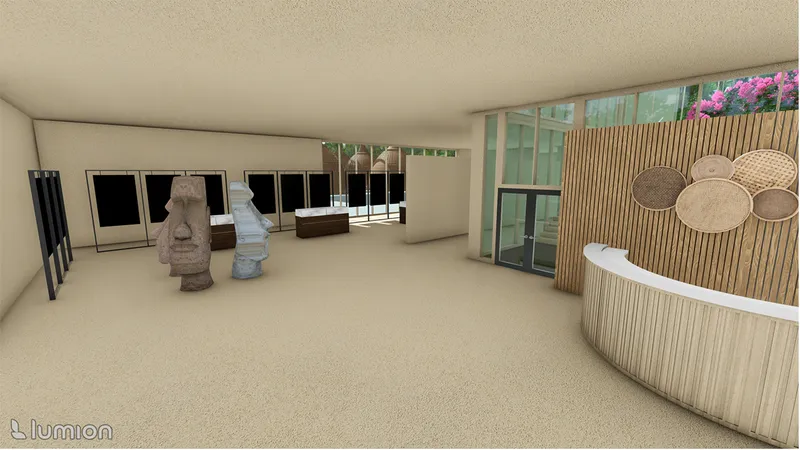
Inside the museum wing, stone sculptures sit on minimal plinths while a vertical slat wall hosts woven basket displays, turning the architecture itself into an exhibition surface. The material palette here is restrained: natural stone, timber slats, and muted earth tones that keep the focus on the artifacts. This interior strategy reinforces the project's broader thesis that materiality and cultural relevance are inseparable. Locally sourced bamboo, clay tiles, and thatch minimize the carbon footprint of construction while evoking the tactile warmth of vernacular Mesoamerican structures. The deep brown hues that recur throughout the complex symbolize fertility and the sacred essence of cacao, grounding every surface in the narrative of the site.
Courtyards, Pools, and the Geometry of Retreat
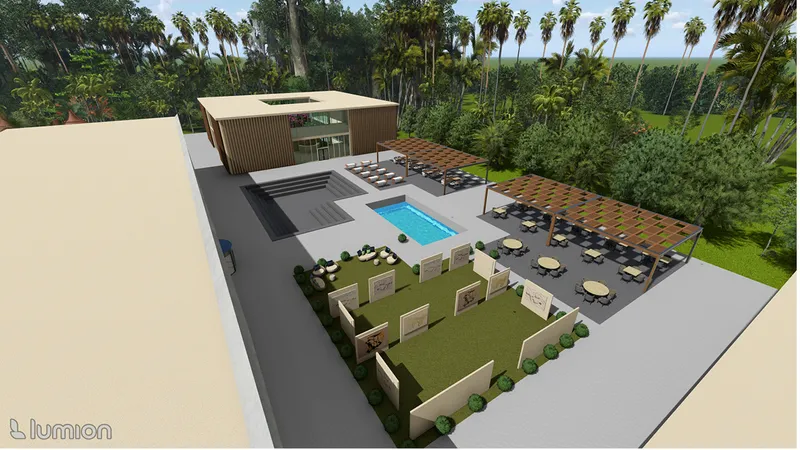
The lodging zone at the rear of the campus introduces a quieter register. A swimming pool sits within a courtyard defined by timber pergolas and hedge-lined garden beds, offering guests a contained landscape that contrasts with the open plaza at the center of the complex. The aerial view reveals how the square grid organizes even these more private spaces, with planting beds and water features aligned to the same geometric logic that governs the public zones. Privacy here is achieved through landscape rather than walls: dense hedging and palm canopy create enclosure without sacrificing airflow.
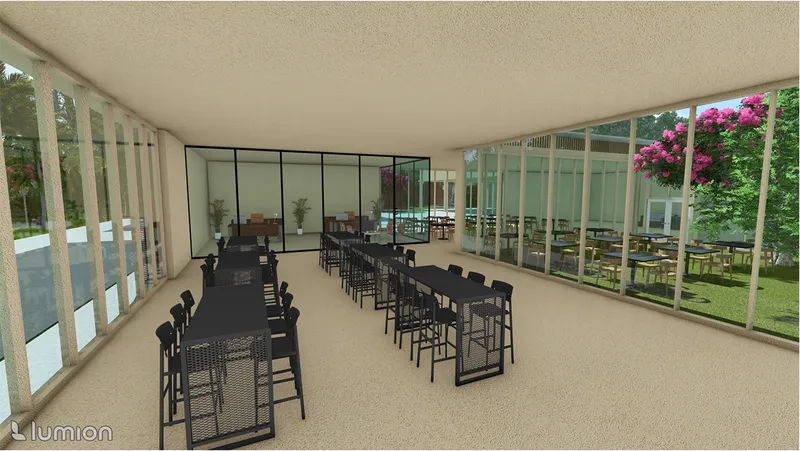
The dining hall operates at the intersection of public and private. Black tables and chairs sit within a volume defined entirely by floor-to-ceiling glass, dissolving the boundary between the restaurant interior and the surrounding greenery. The effect is immersive: diners are enveloped by tropical vegetation on every side, a spatial experience that reinforces Xocomaidan's core ambition of weaving architecture and nature into a single continuous environment. These moments of transparency also serve a practical function, allowing natural light to penetrate deep into the plan and reducing dependence on artificial illumination.
Why This Project Matters
Xocomaidan succeeds because it treats heritage not as a decorative overlay but as a spatial operating system. The Maya plaza was never just an open area between buildings; it was the organizing principle of civic life, a calibrated void that shaped movement, ritual, and social hierarchy. By extracting that logic and applying it to a contemporary program of museum, workshop, lodging, and dining, Lafcı demonstrates that vernacular intelligence can generate architecture that is simultaneously culturally resonant and climate-responsive.
The project also makes a compelling case for material regionalism. In an era where sustainability is often reduced to energy metrics and certification checklists, Xocomaidan argues that the most sustainable choice is often the most culturally specific one: bamboo harvested from the surrounding landscape, clay shaped by local craft traditions, thatch that breathes with the humidity of the tropics. These are not nostalgic gestures. They are pragmatic responses to a site where imported materials would carry both a higher carbon cost and a weaker connection to place. For a competition centered on the cultural legacy of cacao, that alignment between material, meaning, and ecology feels exactly right.
View the Full Project
About the Designers
Designer: Gökçe Lafcı
Enter a Design Competition on uni.xyz
uni.xyz runs architecture and design competitions year-round that reward proposals with spatial conviction and real site intelligence.
Project credits: Xocomaidan by Gökçe Lafcı Xocolatl (uni.xyz).



Popular Articles
Popular articles from the community


The Ocean Hive: Sustainable Architecture for a Self-Sufficient Civilization at Sea
The Ocean Hive imagines sustainable architecture at sea, where modular habitats, algae, wave power and ocean waste sustain a growing colony.

Co-life: Sustainable Architecture for Age-Friendly Community Living
Co-life reimagines sustainable architecture for seniors through courtyards, rammed earth, shared gardens, and spaces designed for belonging.

Lunar Spiral: Space Architecture Shaped by the Mathematics of the Universe
Lunar Spiral reimagines space architecture through Fibonacci geometry, lunar regolith, levitating habitats, and self-sustaining Moon living.

Play: Fragments of Their World
Familiar architecture becomes modular playground design, creating safe spaces where displaced children can learn, connect, imagine and play.


Similar Reads
You might also enjoy these articles
Sustainable Architecture Design: Embracing Nature and Modernity at Villa Solsidan
The article explores Villa Solsidan by AndrénFogelström, showcasing its sustainable architecture design and integration with the natural surroundings in Saltsjöbaden, Sweden.
Scientific and Educational Monitoring Center of the Yenisei, Krasnoyarsk
Architecture as an instrument for ecological research, education, and environmental awareness along Russia’s largest river.
Development of Andretta Artist’s Village, Palampur, Himachal Pradesh, India
Reimagining Andretta as a living cultural landscape where art, architecture, and community converge to shape a global creative village.
Street Children Rehabilitation Center: A Model of Social Architecture for Community Rehabilitation
An inclusive social architecture project that transforms streets into nurturing environments, restoring dignity, identity, and opportunity for vulnerable children.




Comments (0)
Please login or sign up to add comments
No comments yet. Be the first to comment!