
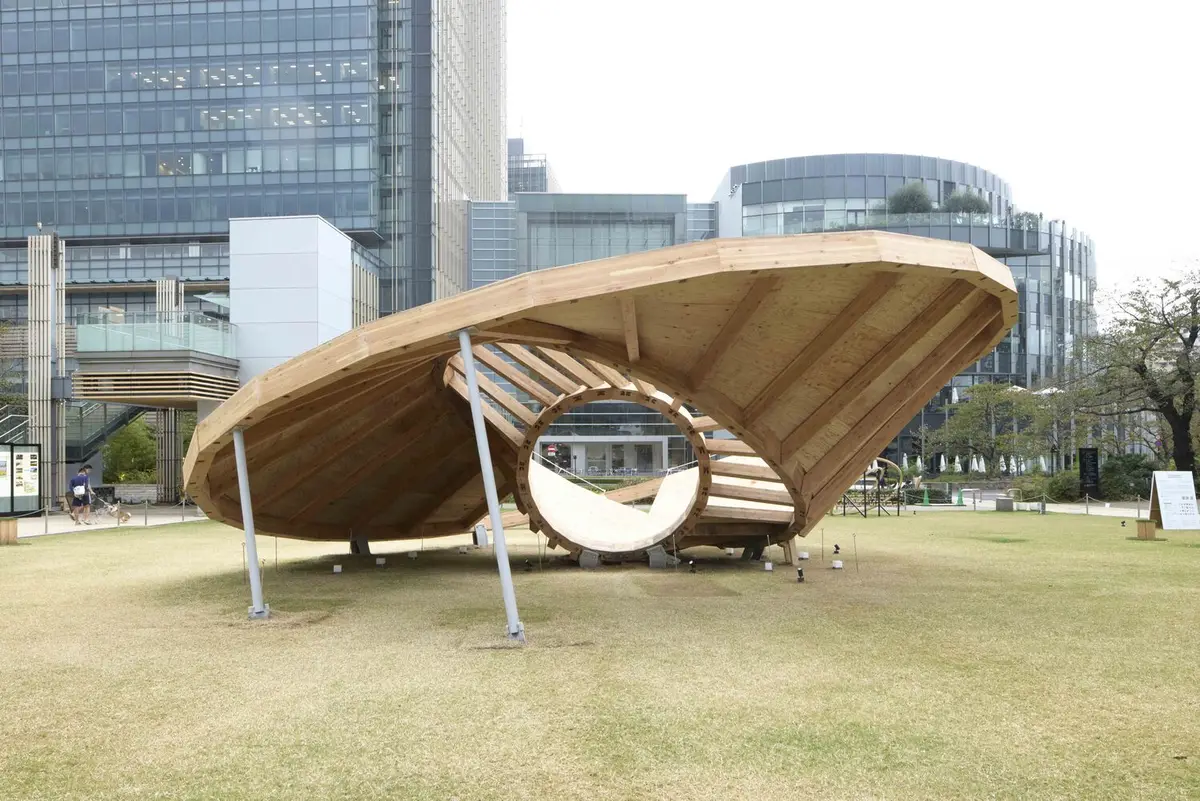
TAILAND Rolls Three Interlocking Timber Rings into a Climbable Pavilion for Tokyo Midtown
Logging Hill uses CNC-fabricated plywood shells at three scales to turn a Minato City park into an interactive playground.


Playground equipment in most cities defaults to steel tubes and injection-molded plastic. TAILAND, the Tokyo practice led by Taichi Kuma, took the opposite tack for Tokyo Midtown DESIGN TOUCH 2024: three timber rings, sized at 2, 5, and 10 meters in diameter, interlocked and skinned with plywood to form a continuous landscape of slopes, bowls, and oculi. The result, called Logging Hill, occupied a 25 square meter footprint on a Minato City lawn for three weeks and drew crowds of children and adults who climbed it, sprawled across it, and decorated it with stickers.
What makes the project worth studying is not its impermanence but its argument. Kuma treats timber not as a noble finishing material reserved for interiors or facades but as a structural and tactile surface people can run on, sit against, and chalk up with drawings. Every ring touches the ground, so there is no single entrance or orientation. You approach, you choose a surface, you inhabit it however you like. That looseness is precisely engineered: each beam was CNC-machined by Shelter Co., Ltd. to produce the double-curved profiles that make the pavilion both climbable and self-supporting.
Three Rings on a Lawn
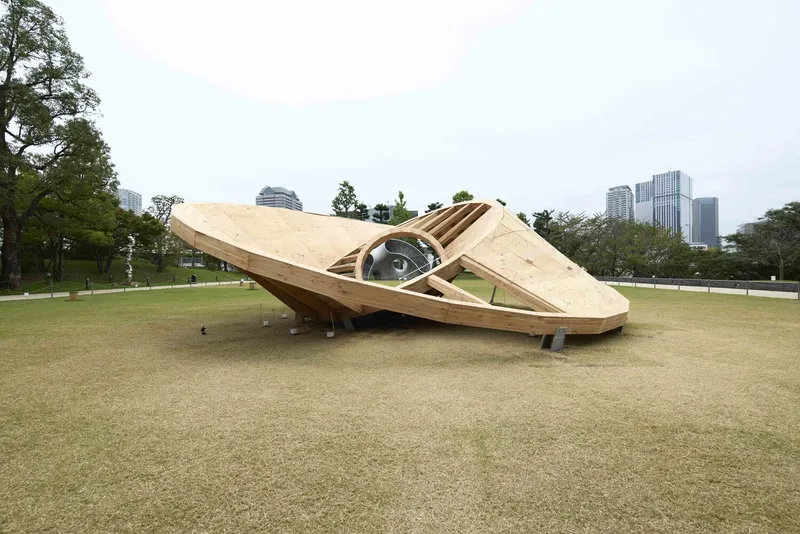
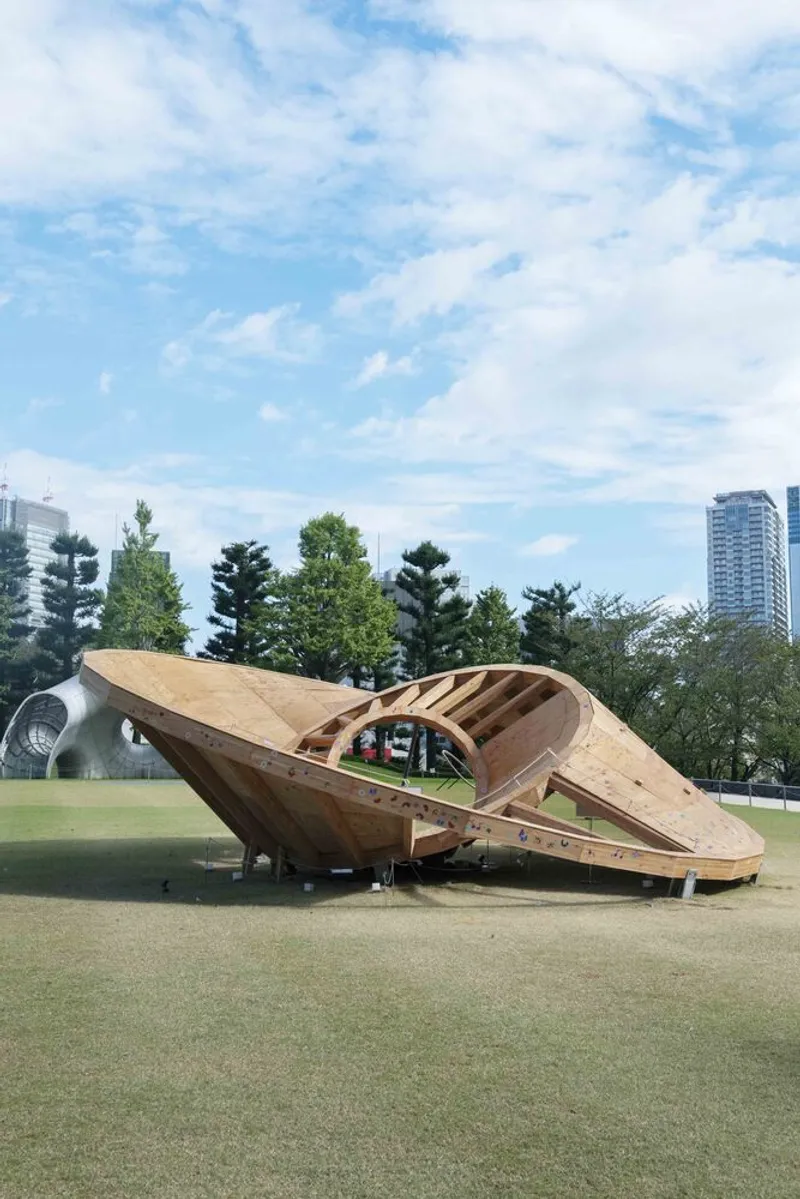
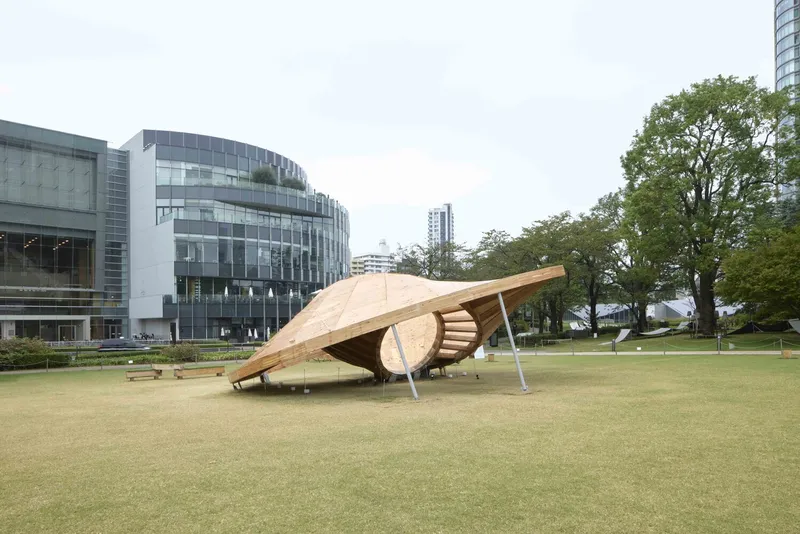
From a distance, Logging Hill reads as a single sculptural form, something between a seashell and a skate park. Walk closer and the logic becomes legible: three independent ring geometries, each at a different scale, nested and tilted so that their plywood surfaces merge into a continuous topography. The largest ring, ten meters across, anchors the composition and provides the broadest climbable slope. The smallest, at two meters, creates an intimate pocket where a child can sit inside a curved wall of wood.
Siting the pavilion on an open lawn beside the glass towers of Tokyo Midtown sharpens the contrast between organic curvature and corporate orthogonality. The timber shell absorbs sunlight in warm tones that shift through the day, a quality steel or plastic could never replicate at this scale.
The Structure from Below


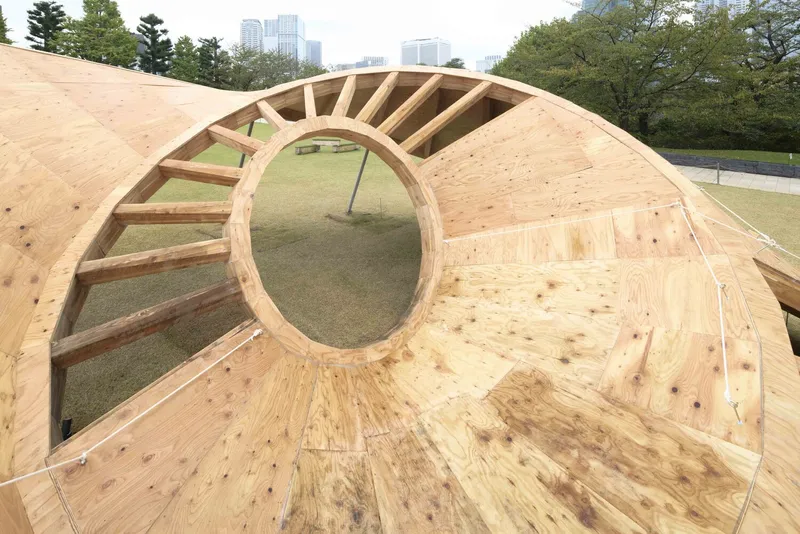
Looking up through one of the circular openings reveals the radial rib structure that holds the whole thing together. Laminated timber beams fan outward from each oculus like the spokes of a wheel, their profiles varying beam by beam because no two curvatures are identical. The 3D CNC machining process that produced these members is the quiet technical achievement of the project: it turns what appears to be a freeform sculpture into a precisely resolved kit of parts.
Plywood panels span between the ribs, creating the smooth surfaces people actually touch. The grain and knots remain visible, a deliberate choice that keeps the material identity legible even as the geometry pushes well beyond conventional timber construction.
A Surface Made for Bodies
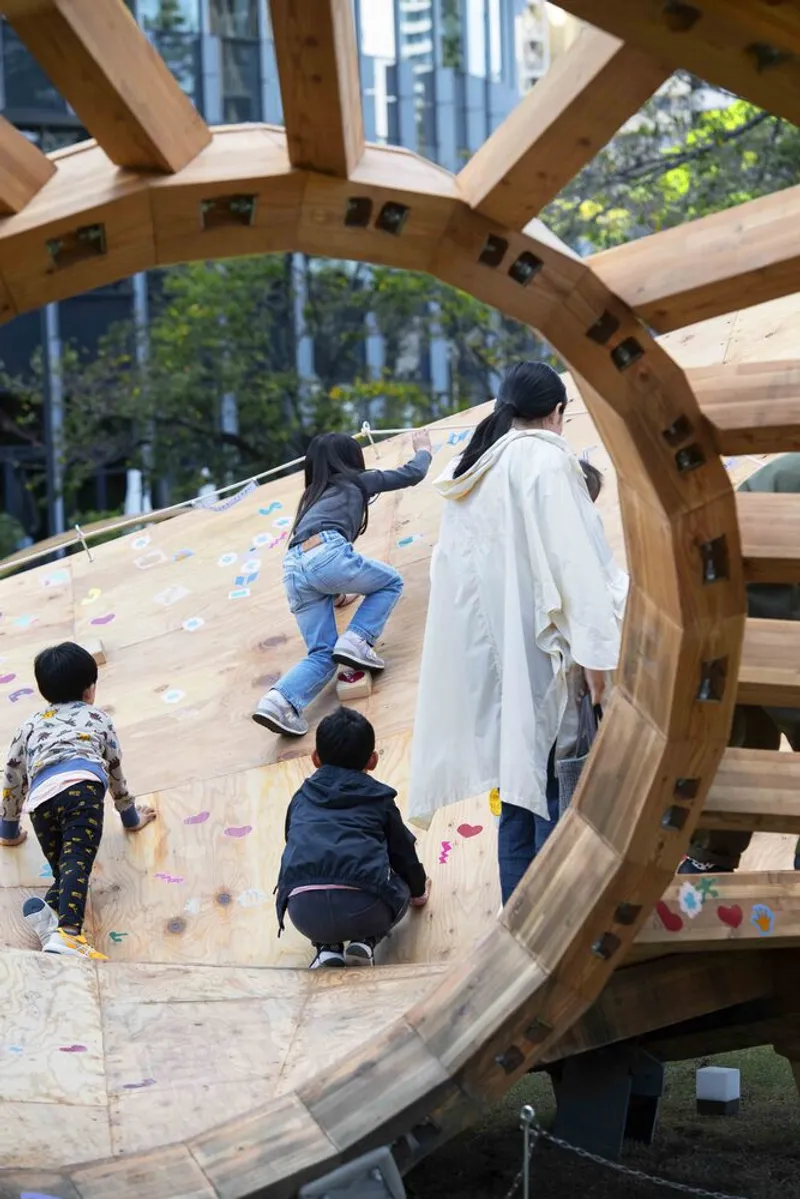

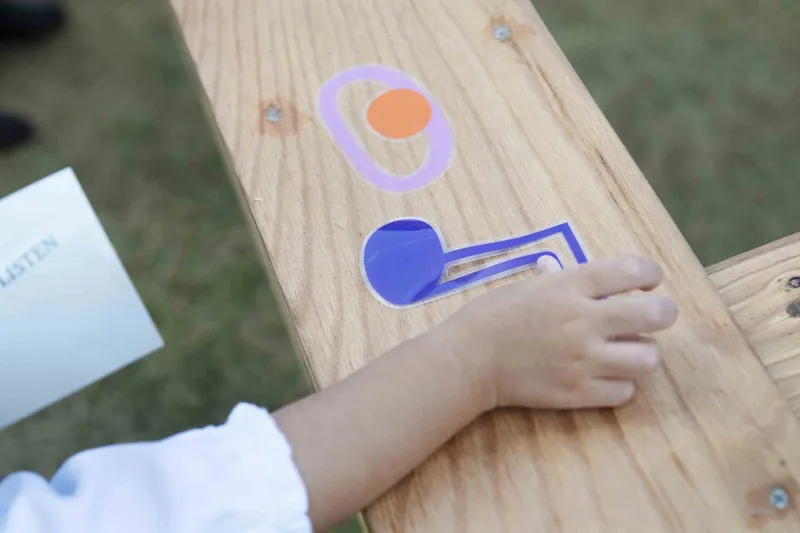
The strongest images from the installation are not the hero shots of the form but the candid ones: a child drawing with chalk on a sloped plywood deck, a toddler reaching across timber marked with graphic symbols, groups of kids scrambling up the curved surface with flower petals stuck to their shoes. Kuma designed Logging Hill so that every surface is a potential seat, slide, desk, or stage. There are no railings, no signs dictating behavior. The architecture itself communicates what is possible through its slopes and edges.
Treating an entire pavilion as a continuous inhabited surface collapses the usual hierarchy between structure, furniture, and floor. It is an old idea, traceable to the Noguchi playgrounds of the 1960s, but the material choice updates it. Timber is warm, slightly yielding, and forgiving of bare skin in a way that concrete and steel are not. For a children's environment, that tactile quality matters more than any formal gesture.
Interactive Markings
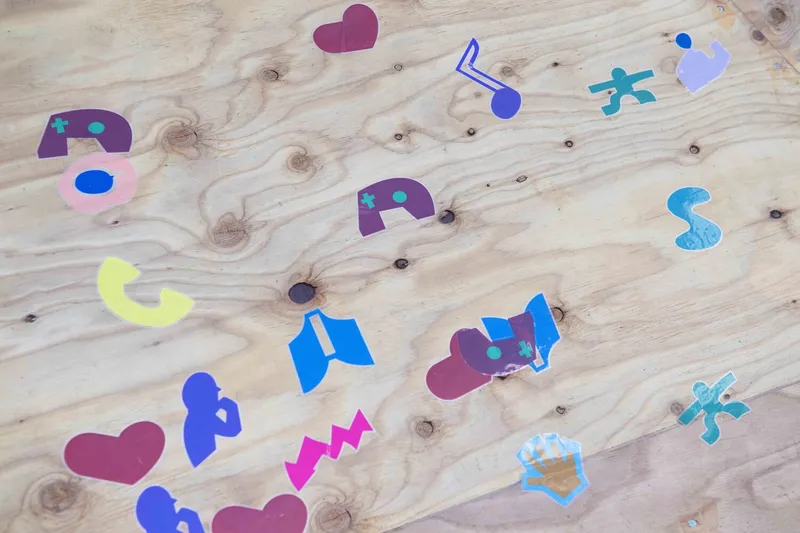

TAILAND introduced a participatory layer by distributing printed cards and stickers depicting abstract graphic shapes. Visitors selected shapes that represented their activities or moods and applied them directly to the plywood surfaces. Over the three-week exhibition, the pavilion accumulated a colorful palimpsest of marks, transforming from a pristine timber object into a collective diary of use.
The gesture is simple, almost naïve, but it accomplishes something important: it gives visitors permission to claim the structure as their own. Public architecture rarely invites that kind of personal inscription. By building it into the program from the start, Kuma sidesteps the anxiety cities have about "damage" to public objects and reframes wear as evidence of success.
Framed Views and Thresholds
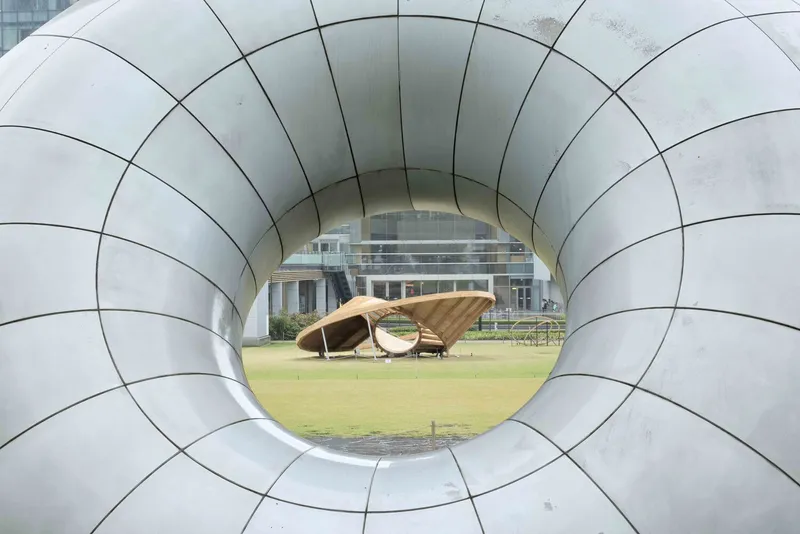
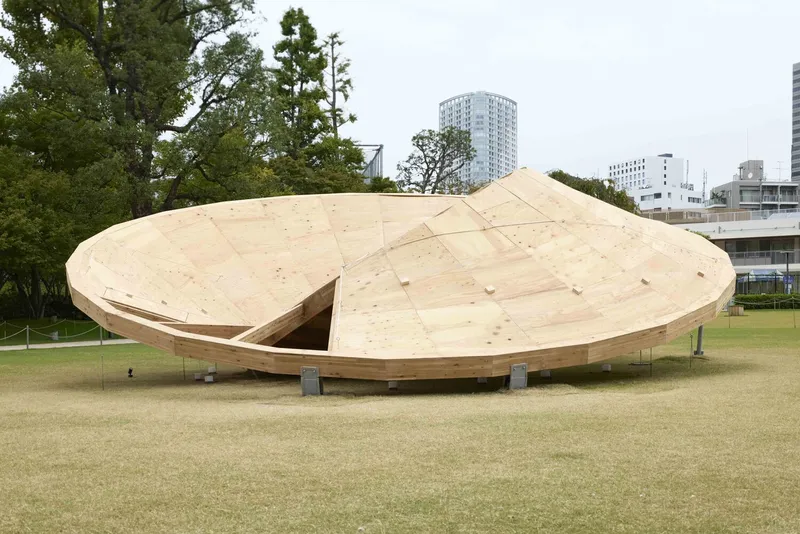

The circular openings do double duty. Structurally, they are the convergence points of the radial ribs. Experientially, they act as portals, framing the surrounding park and cityscape in tight circles of green and glass. Walking through or peering through one of these apertures compresses the vast Midtown context into a viewfinder, making you suddenly aware of the sky, the tree canopy, or the office tower you had been ignoring.
The metal ring visible in some views suggests a steel collar at each opening, a pragmatic reinforcement that also provides a crisp edge against the softer plywood. It is a small detail, but it signals that the project is carefully detailed despite its temporary status.
After Dark


At dusk, uplighting from below transforms the pavilion into a glowing timber lantern. The warm illumination catches the grain of the plywood and casts long shadows from the radial ribs, making the interior structure visible from the outside for the first time. Against the blue-hour skyline of Roppongi, the effect is striking: the pavilion looks simultaneously ancient and alien, a campfire-era shelter dropped onto a 21st century corporate plaza.
Night lighting also extends the pavilion's usable hours, a practical consideration for any temporary installation competing for attention in a city that does not sleep early. The warm glow draws people across the lawn the way a lit window draws pedestrians on a dark street.
Plans and Drawings

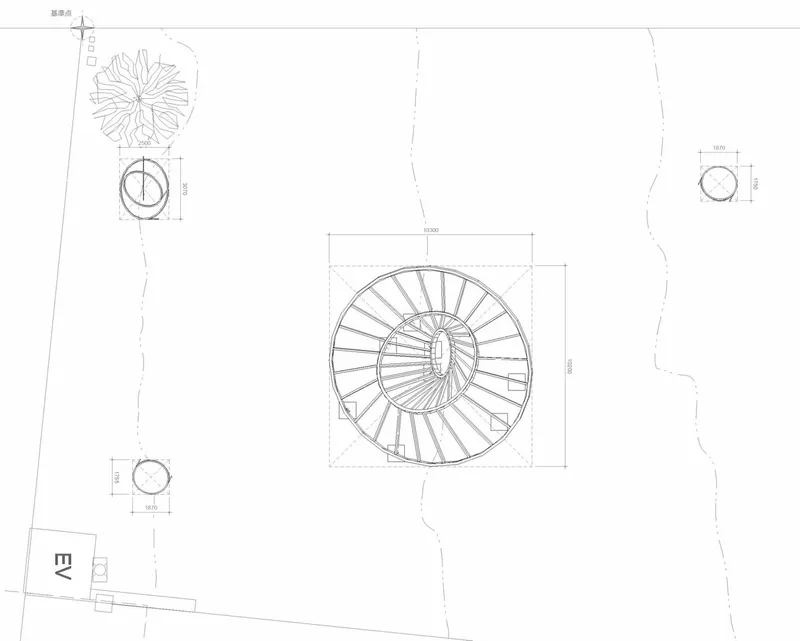
The plan drawing shows the spiral logic underlying the three rings: a central staircase anchors the geometry while the surrounding tree locations dictated the precise placement and tilt of each ring on the lawn. What reads as a spontaneous sculptural gesture on site turns out to be tightly choreographed around existing landscape features and pedestrian sight lines. The overhead view of the completed pavilion, with its scattered timber elements, confirms how the rings nest together to define pockets of enclosure and openness.
Why This Project Matters
Logging Hill is a pavilion that does not ask to be admired from a respectful distance. It asks to be climbed, scribbled on, and napped against. That posture is rare in contemporary installation design, where formal ambition often produces objects that discourage touch. TAILAND's decision to build the entire thing from CNC-machined timber, a material warm enough to invite contact and strong enough to survive it, aligns ethics with aesthetics in a way that feels genuinely useful for the discipline.
The project also makes a quiet case for timber in urban public infrastructure. If three plywood rings can replace a conventional steel playground for three weeks and draw bigger crowds, the implication is clear: the material is ready for permanent applications that cities have not yet imagined. Taichi Kuma and TAILAND have built a proof of concept disguised as a party trick, and that might be the smartest way to change a city's mind.
Logging Hill, designed by Taichi Kuma of TAILAND. Tokyo Midtown, Minato City, Japan. 25 m². 2024. Photography by Kaoru Yamada and Taro Hirano.
About the Studio
Share Your Own Work on uni.xyz
If projects like this are the kind of work you want to make, uni.xyz is a place to publish your own, find collaborators, and enter design competitions.


Popular Articles
Popular articles from the community


longwave studio Reorganizes a 112 m² Tainan Apartment Around the Daily Routines of a Family and Two Cats
In Tainan, Taiwan, birch plywood, rust-red furniture and a freestanding plaster wall link arrival, storage, work and family life in one apartment.

U.GA Architects Wraps an Oval Rooftop Pool in Curved Board-Formed Concrete on Busan's Jeollidan-gil
In Busan's Jeonpo-dong, a 454 m² mixed-use block stacks a neighborhood facility, guest rooms and an oval rooftop pool inside spiraling concrete walls.

LT2A and OPEN Architectes Thread a Brick and Glass High School Through a Wooded Belgian Campus
In Braine-l'Alleud, a 3,000 m² wing for Collège Cardinal Mercier pairs pale brick with a glazed colonnade, deferring to a small chapel and a dense wood.

Juan García Correa, John González and Claudia Rueda Sink a Circular Amphitheater into a Manizales Engineering Building
On the La Nubia campus in Manizales, Colombia, the S1 Building folds labs and offices into a hillside of ramped lawns that double as a campus route.

Similar Reads
You might also enjoy these articles


Hodi-Mandai Geram
Project Function: Preservation and revitalization of the Intangible heritage and socio-spatial identity of the Hodi by Housing, Cultural Memory Center, Sacred Grove, landscape, local tourism economy


Olio Towers: A Mid-Rise for Performers That Fuses Housing, Rehearsal, and Stage
Located blocks from Houston's Theater District, this modular tower stacks living units around a central performance atrium.

Oasis: Modular Green Housing Carved into Dhaka's Urban Fabric
A shortlisted Plugin Housing entry reclaims unauthorized settlements in Dhaka with stepped concrete volumes, green roofs, and ventilation-driven design.

Black Hole: A Floating Megastructure for the Post-Physical Era
Emiliano Mazzarotto envisions a spherical, self-scaling arena where e-sports, digital hotels, and holographic stadiums replace traditional public space.

Explore Heavy Timber Competitions
Discover active competitions in this discipline

Challenge to reimagine the Iron Throne

Photograph architecture without architects

Illustrate the lost glory of Angkor Wat - Render Challenge

Design challenge to reuse E-waste
Comments (0)
Please login or sign up to add comments
No comments yet. Be the first to comment!