

Birdseye Builds a Sculptor's Gallery on a Vermont Horse Farm in Corten and Glass
A 1,720-square-foot studio in Williston, Vermont channels agrarian metal sheds and Donald Judd's Marfa to frame marble sculpture.


On a 20-acre working horse farm in Vermont's Champlain Valley, sculptor Richard Erdman needed a space that could hold large-scale marble work, host visitors, and sit comfortably alongside stables, hay barns, and equipment sheds. Birdseye answered with the Annex Studio & Gallery, a 1,720-square-foot pavilion clad in corrugated Corten steel that reads as a natural extension of the farm's agrarian metal vocabulary. Completed in 2022, the building is sited at the northwest edge of the farmyard, bookending the existing cluster of structures and opening three glass walls toward rolling pastures and distant mountains.
What makes the project worth studying is its refusal to separate rugged function from curatorial precision. The same building that houses a jib crane and a hydraulic loading door for moving thousand-pound stones also deploys black walls and ceilings calibrated to make white marble glow. Birdseye cites Donald Judd's Chinati Foundation in Marfa, Texas as a philosophical touchstone, and the comparison holds: both projects treat the container as inseparable from the art it displays. Here, though, the container also has to coexist with sheep, paddock fencing, and New England weather.
Agrarian Skin, Sculptural Bones
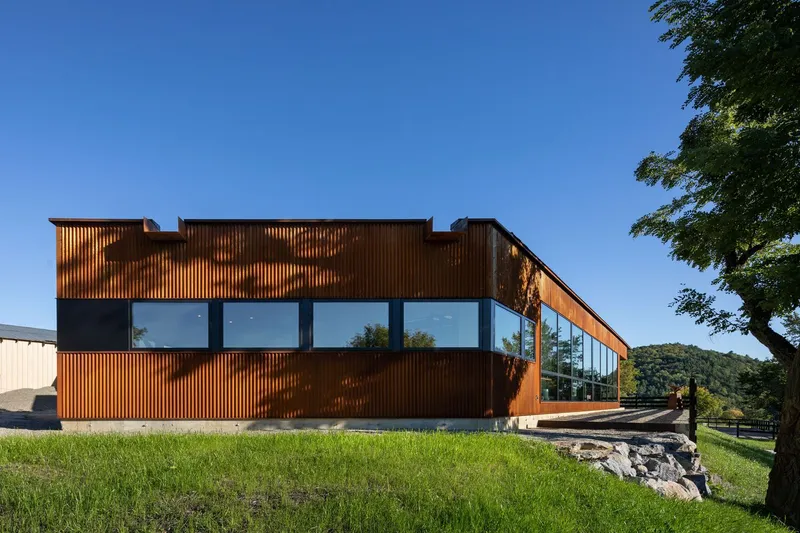

The Corten cladding is the first thing you notice, and it is the most legible decision in the project. Weathering steel panels wrap the cantilevered shed roof and walls, picking up the rust-brown palette of the surrounding farm buildings while signaling that something different is happening inside. Continuous ribbon glazing cuts through the cladding on the long elevations, pulling the landscape into the interior without breaking the building's monolithic silhouette. The result is a form that reads simultaneously as barn and gallery, depending on your vantage point and the time of day.
Structurally, exposed steel members inside the studio mirror the proportions of traditional timber frame bents. It is a subtle move: the building's skeleton references the post-and-beam construction of Vermont barns while using a material robust enough to support the jib crane and the cantilevered roof. The Corten panels themselves contain recycled steel content, aligning with the project's broader commitment to eliminating fossil fuels from the site.
Threshold and Entry
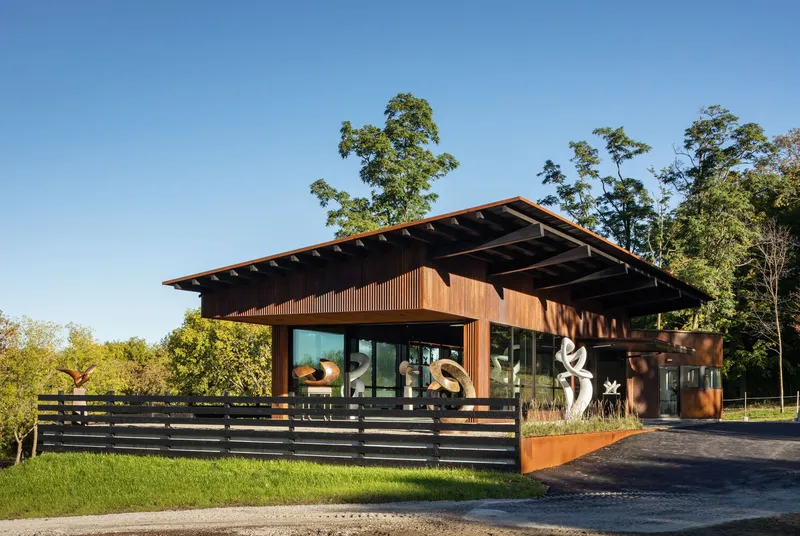
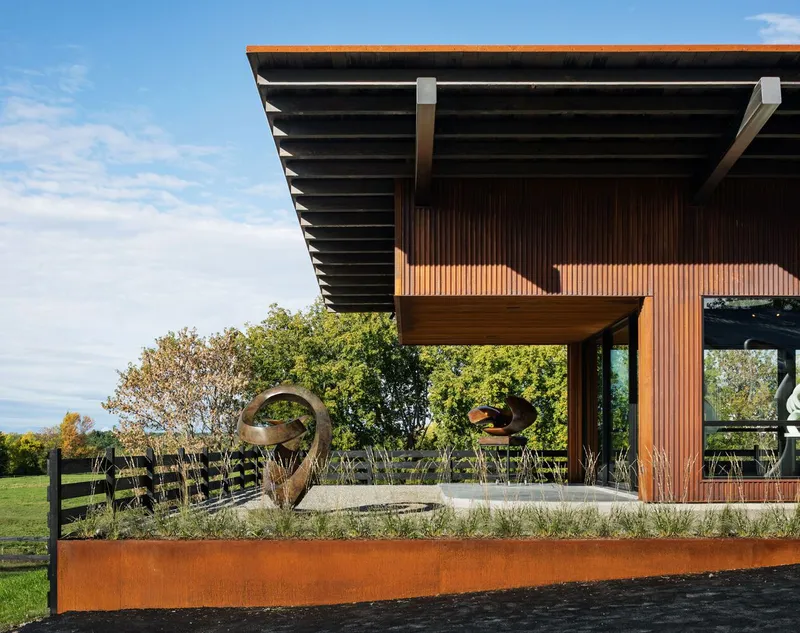
Approaching the building, the deep cantilevered roof overhang compresses the entry sequence and frames sculpture visible through glass before you step inside. Horizontal slat fencing along the plinth edge directly mimics the paddock rails a few meters away, grounding the gallery in its equestrian context. The transition from compacted stone ground cover to polished concrete interior is handled with a flush threshold at the hydraulic loading door, an operational necessity for rolling heavy sculptures in and out that doubles as a clean architectural gesture.
Vertical timber cladding on parts of the facade introduces a warmer texture against the Corten, and a planted bed with a weathering steel edge softens the base. These are not decorative additions. They mediate between the hard industrial envelope and the pastoral landscape so that the building never feels alien on the farm, even at its most gallery-like.
The Dark Gallery
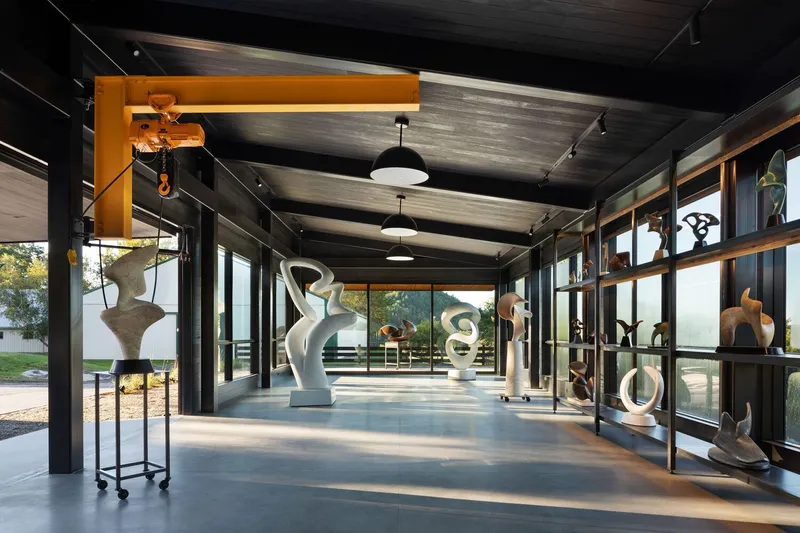
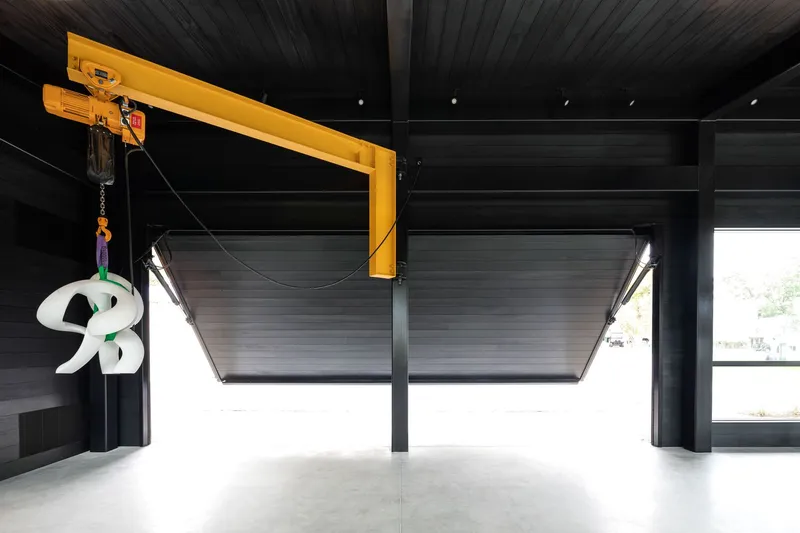
Inside the main studio volume, black walls and ceilings absorb light and push all visual attention toward the marble sculptures. Pendant lights and targeted LEDs supplement natural daylight from the three glass walls, giving the space a controlled luminosity that changes character throughout the day. Monumental steel shelving is integrated directly into the window composition, so maquette models and smaller works sit against a backdrop of sky and pasture rather than drywall. The effect is closer to a collector's private vault than a white-cube gallery.
The working side of the building is just as considered. A yellow overhead jib crane spans the ceiling of the loading bay, and two sectional doors open wide enough to accommodate large-scale sculpture on steel pedestals fitted with casters. The black slatted ceiling treatment in this zone maintains visual continuity with the gallery while acknowledging the grittier demands of handling stone. It is rare to see a building serve both installation logistics and exhibition aesthetics this seamlessly.
The White Counterpoint

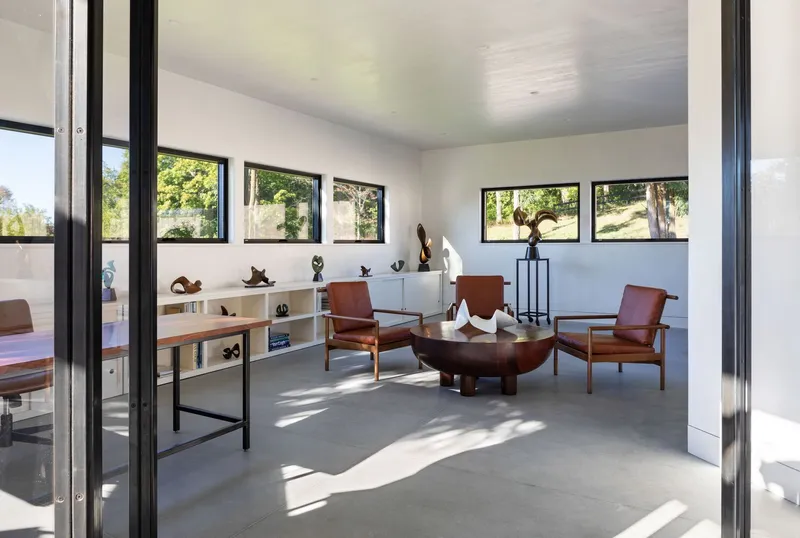
The gallery's square plan transforms into a curved office and library volume clad in white plaster, a deliberate material and chromatic inversion. Leather armchairs, custom wood cabinetry, and sculpture on pedestals give this space the character of a salon rather than a workspace. The curve itself echoes the organic forms of Erdman's sculpture, a gesture that could feel heavy-handed but works here because the rest of the building is so rectilinear and restrained.
A horizontal window band in the living space frames views of grazing sheep, collapsing the distance between art world and agricultural world in a single glance. The polished concrete floor runs continuously from the dark gallery through the white office, binding the two halves together. Natural plaster and Swedish pine tar finishes contribute to indoor air quality and eliminate the off-gassing common in conventional gallery construction, a quiet health benefit that aligns with the building's all-electric, fossil-fuel-free operation.
Landscape as Pedestal
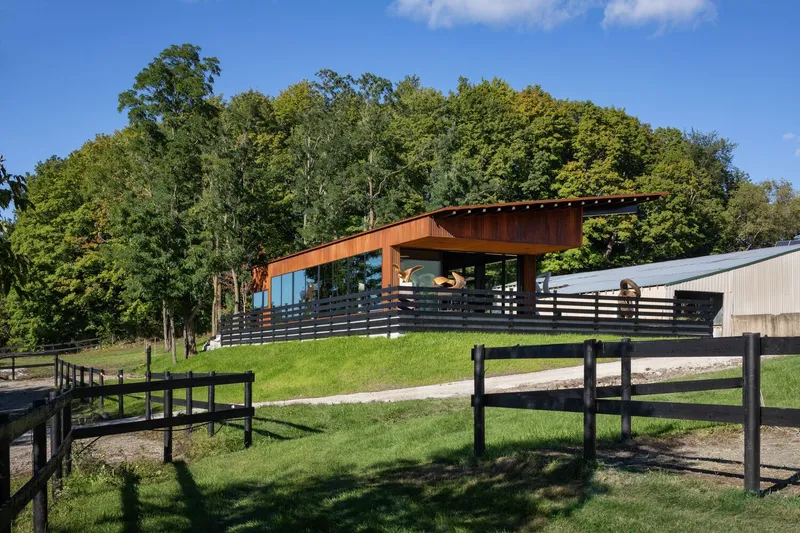
The building sits on a raised landscape plinth surfaced in compacted stone that extends to an infinity edge of concrete on the south and west sides and a Corten edge on the east and north. This plinth operates as an outdoor sculpture terrace, a drainage strategy, and a visual buffer all at once. Permeable gravel manages water capture and erosion control without the need for conventional stormwater infrastructure, keeping the ground plane clean and the lawn unbroken.
The black wooden guardrail wrapping the plinth directly references the painted steel paddock fencing visible in adjacent pastures. Placed on a sloped site with a wooded hillside behind it, the gallery reads as both a terminus and a beginning: the last building in the farmyard sequence, but also the point where art and landscape meet without mediation. A ground-mounted photovoltaic array elsewhere on the property powers the entire operation, completing a building that takes as little from the site as possible.
Plans and Drawings
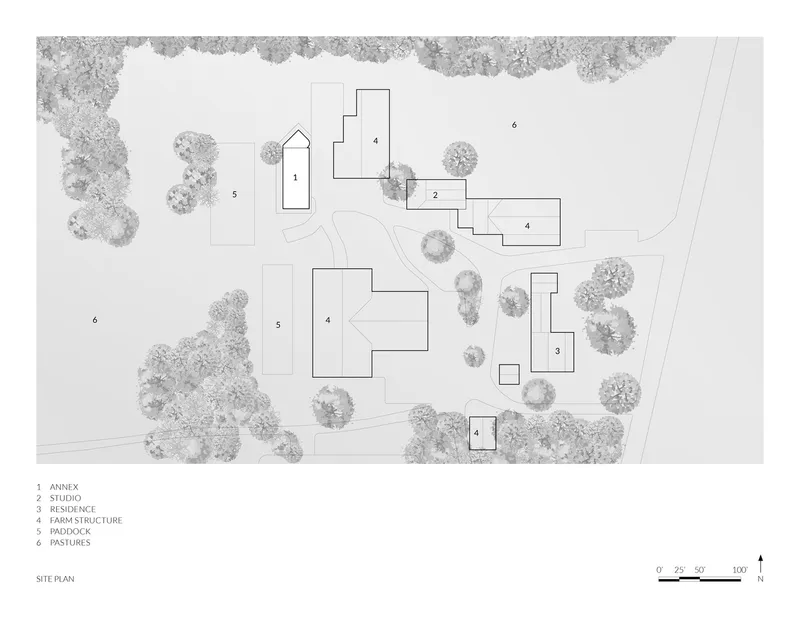
The site plan reveals the strategic logic behind the Annex's placement. Five structures scatter among mature trees, connected by paths that suggest informal circulation rather than a rigid axis. The gallery sits at the western edge, perpendicular and parallel to surrounding buildings, closing the farmyard composition without walling it off. The drawing makes clear how much of the project's success depends on what Birdseye chose not to build: no new driveways, no formal forecourt, no landscape that would compete with the pastures already there.
Why This Project Matters
The Annex Studio & Gallery matters because it demonstrates that a building can serve a highly specific artistic program without retreating into aesthetic isolation. Birdseye treated the horse farm not as a constraint to overcome but as a design language to absorb. Corten steel, shed roofs, paddock rails, and flush thresholds are all drawn from the immediate context, yet they produce a space sophisticated enough to exhibit marble sculpture under museum-quality conditions. The building proves that vernacular intelligence and curatorial ambition are not in conflict.
At a moment when many art spaces default to generic white boxes dropped onto cleared sites, the Annex offers a counter-model. Its all-electric systems, permeable ground plane, recycled-content cladding, and passive ventilation strategy show that sustainability in a gallery context does not require sacrificing atmospheric control or aesthetic rigor. And its collaborative genesis, designed in close dialogue between architect and sculptor in the spirit of Judd's Marfa, reminds us that the best exhibition spaces emerge when the artist has a seat at the table from the first sketch.
Annex Studio & Gallery by Birdseye. Williston, Vermont, United States. 1,720 sq ft (160 sq m). Completed 2022. Photography by Michael Moran Photography.
About the Studio
Share Your Own Work on uni.xyz
If projects like this are the kind of work you want to make, uni.xyz is a place to publish your own, find collaborators, and enter design competitions.


Popular Articles
Popular articles from the community


Jaramillo Van Sluys Arquitectura and Urbanismo Turn a Demolished Registry Lot in Quito into an Orchard Plaza
In Quito's Centro Histórico, a 2,800 m² plaza exposes the San Agustín convent wall and redraws its lost Augustinian orchard in volcanic stone.

GROUP A Strips a 1969 Rotterdam Harbor Headquarters to Its Frame and Wraps It in Timber Louvers
In Rotterdam's M4H harbor district, Ferro Offices reuses a 1969 frame, adds one timber storey and reaches BREEAM-NL Outstanding.

David Ortega Stacks a Two-Story Mexico City Penthouse Around a Steel Stair and a Pergola-Shaded Roof Terrace
In Colonia Roma, a 300 m² penthouse uses oak joinery, a planted steel stair and a slatted roof pergola to make a new-build apartment feel like a house.

Architekt Andreas Gruber Scatters 23 Dark Timber Chalets Across a South Tyrolean Forest Edge
In Molini di Tures, Amonti Chalets breaks a resort into a hamlet of gabled timber houses, with parking, storage and services pushed into the slope.

Similar Reads
You might also enjoy these articles


Hodi-Mandai Geram
Project Function: Preservation and revitalization of the Intangible heritage and socio-spatial identity of the Hodi by Housing, Cultural Memory Center, Sacred Grove, landscape, local tourism economy


Olio Towers: A Mid-Rise for Performers That Fuses Housing, Rehearsal, and Stage
Located blocks from Houston's Theater District, this modular tower stacks living units around a central performance atrium.

Oasis: Modular Green Housing Carved into Dhaka's Urban Fabric
A shortlisted Plugin Housing entry reclaims unauthorized settlements in Dhaka with stepped concrete volumes, green roofs, and ventilation-driven design.

Black Hole: A Floating Megastructure for the Post-Physical Era
Emiliano Mazzarotto envisions a spherical, self-scaling arena where e-sports, digital hotels, and holographic stadiums replace traditional public space.

Explore Architecture Competitions
Discover active competitions in this discipline

Challenge to reimagine the Iron Throne

Photograph architecture without architects

Illustrate the lost glory of Angkor Wat - Render Challenge

Design challenge to reuse E-waste
Comments (0)
Please login or sign up to add comments
No comments yet. Be the first to comment!