

Seitaro Aso Graduates Concrete Bands Floor by Floor to Shield a Tokyo Apartment Block
A mixed-use building on a busy Ota City shopping street uses descending parapets to tune privacy, light, and urban connection on every level.


Living above a shopping street means negotiating a constant tension: you want the energy of the neighborhood without its noise and scrutiny. For a compact apartment building in Omori-cho, Ota City, SEITARO ASO ARCHITECTURE INC. found a solution in a single, repeating element: a concrete band that wraps all four sides of the facade and changes height from floor to floor. At the second level, where residents are closest to the foot traffic and car noise below, the band rises to 1100 mm. By the fourth floor it drops to 600 mm, letting in more sky and light. The gradient is legible from the street, turning a privacy strategy into the building's primary architectural expression.
Completed in 2023, the 393 m² building stacks commercial space on the ground floor beneath four stories of single-occupant apartments. Structural engineer Tatsumi Terado Structural Studio helped realize the bearing-wall system that does double duty, carrying loads while concealing air conditioning units and water heaters on the balconies. The result is a facade that reads as a sequence of thick, hovering concrete shelves, each one revealing a slightly different slice of the city depending on where you stand inside.
The Graduated Facade
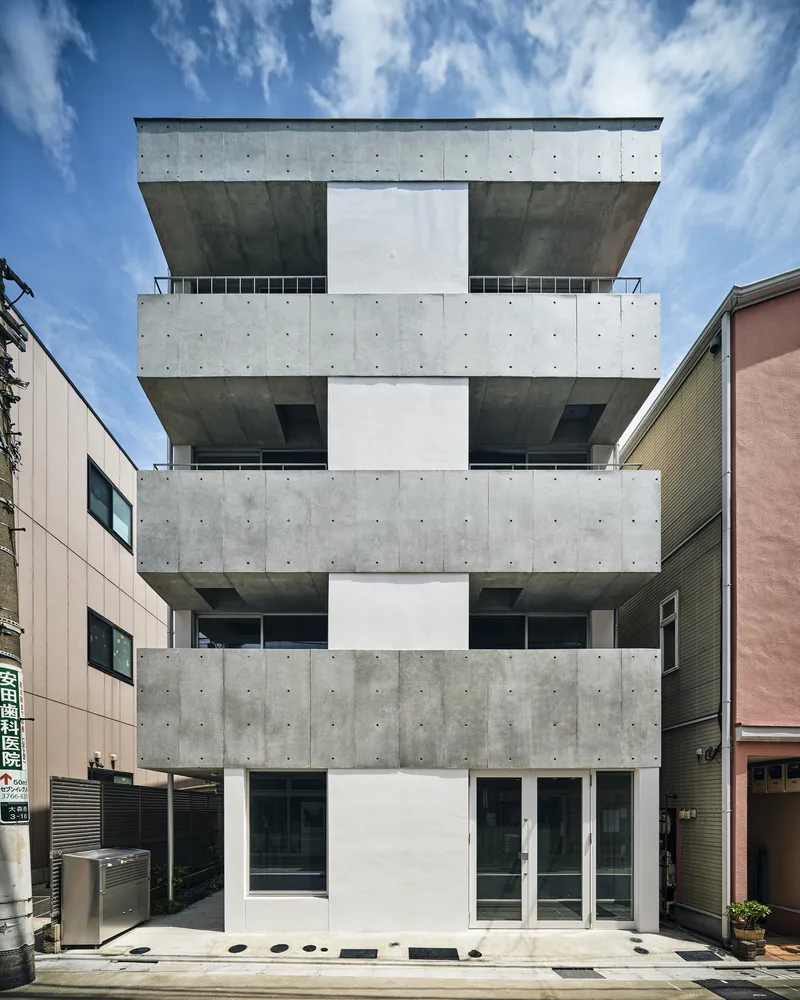
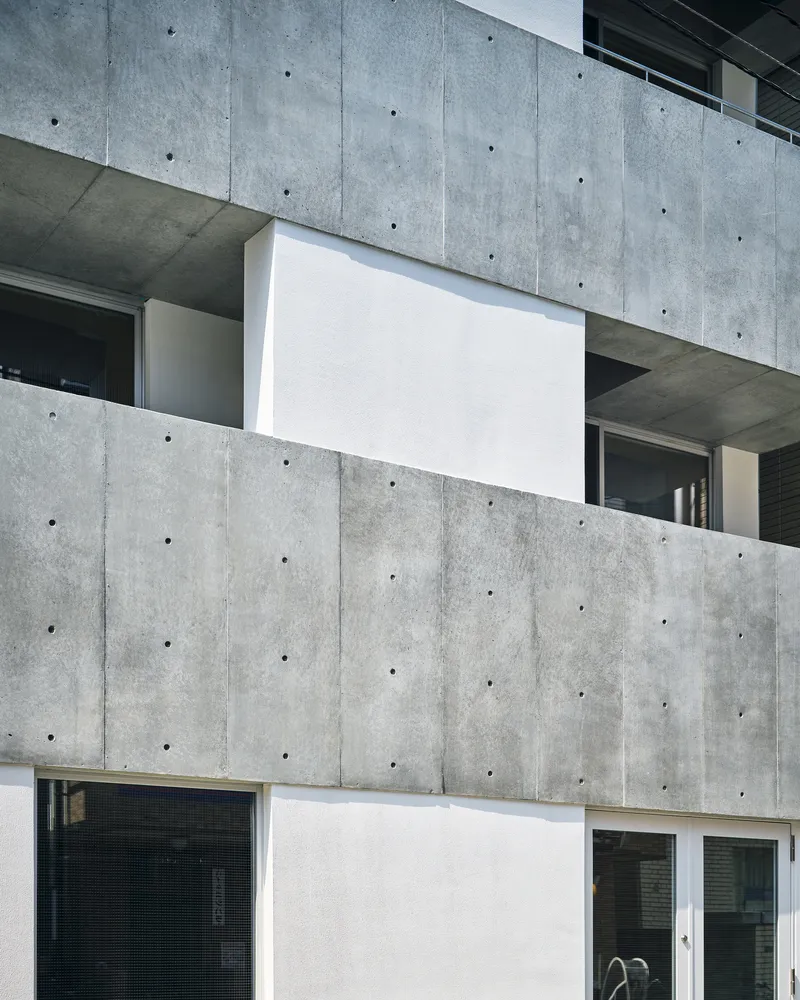
From the sidewalk, the building's rhythm is immediately clear. Stacked concrete slabs project outward, and between them, recessed white balcony panels sit in deep shadow. The concrete is raw, punctuated with formwork tie holes that the architects left exposed rather than patching over. Drainage joints in the balcony eaves were deliberately omitted so that each band reads as a continuous, monolithic volume rather than a thin ledge bolted to the structure.
Achieving clean water runoff without those joints required a construction trick: shoring posts on the eaves side were lowered slightly during casting, allowing the concrete to set with a subtle built-in slope. Water drains back toward the building rather than dripping off the edge, eliminating the need for visible flashing or channels. It is the kind of detail that never photographs well but makes everything else in the photograph possible.
Threshold Conditions: Entry and Ground Level
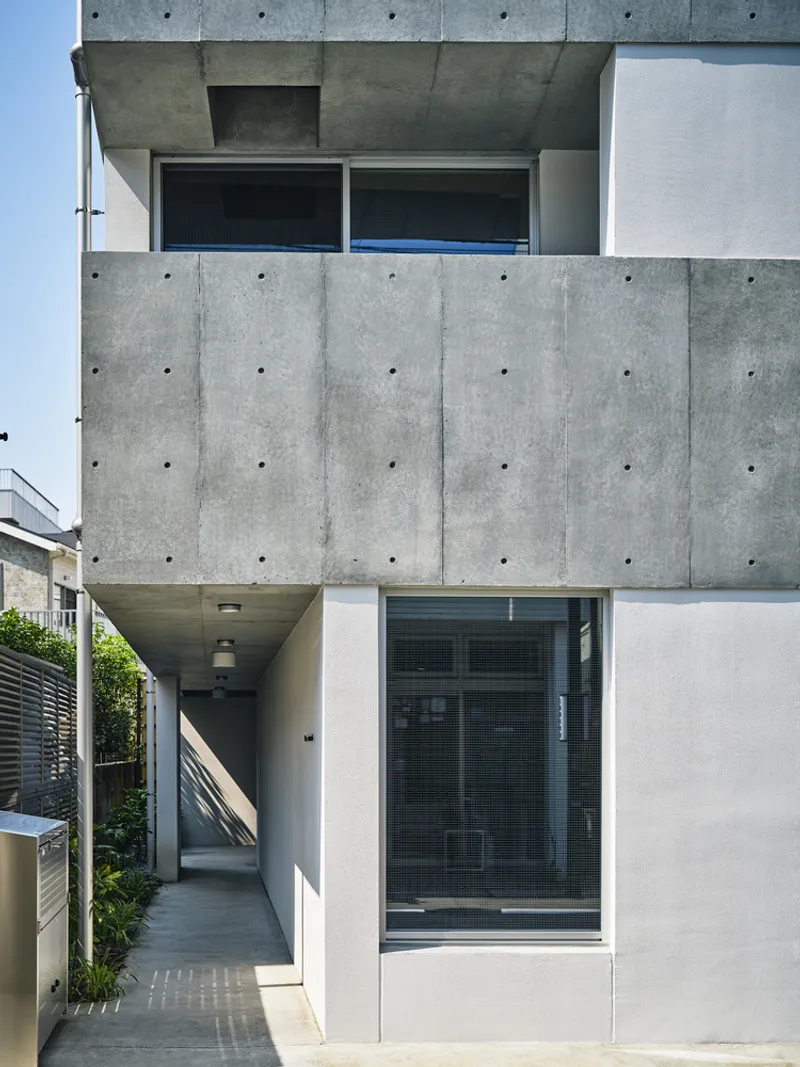

The approach to the building is compressed and deliberate. A narrow side path passes beneath cantilevered concrete slabs, flanked by a planted bed and a horizontal timber fence that introduces the only natural material on the exterior. The fence softens the transition from street to entrance without pretending the building is anything other than concrete and glass.
At the lower levels, the concrete bands do their heaviest work. Board-formed walls frame deep-set windows that crop the street scene into controlled vignettes. A passerby with an umbrella, a flash of shopfront signage: the view is selective, almost cinematic. Sounds from the shopping district filter in as ambiance rather than intrusion, which is precisely the calibration the architects were after.
Raw Concrete and Warm Wood Inside
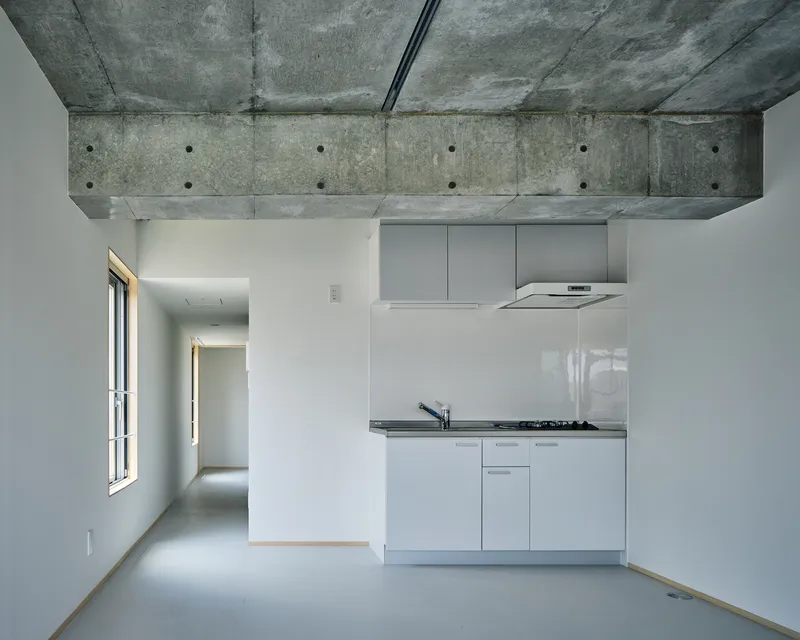
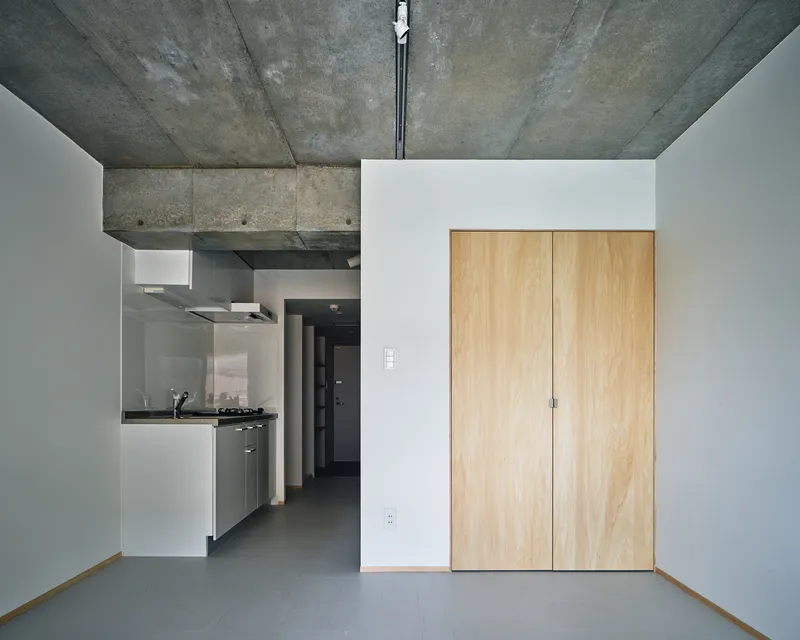
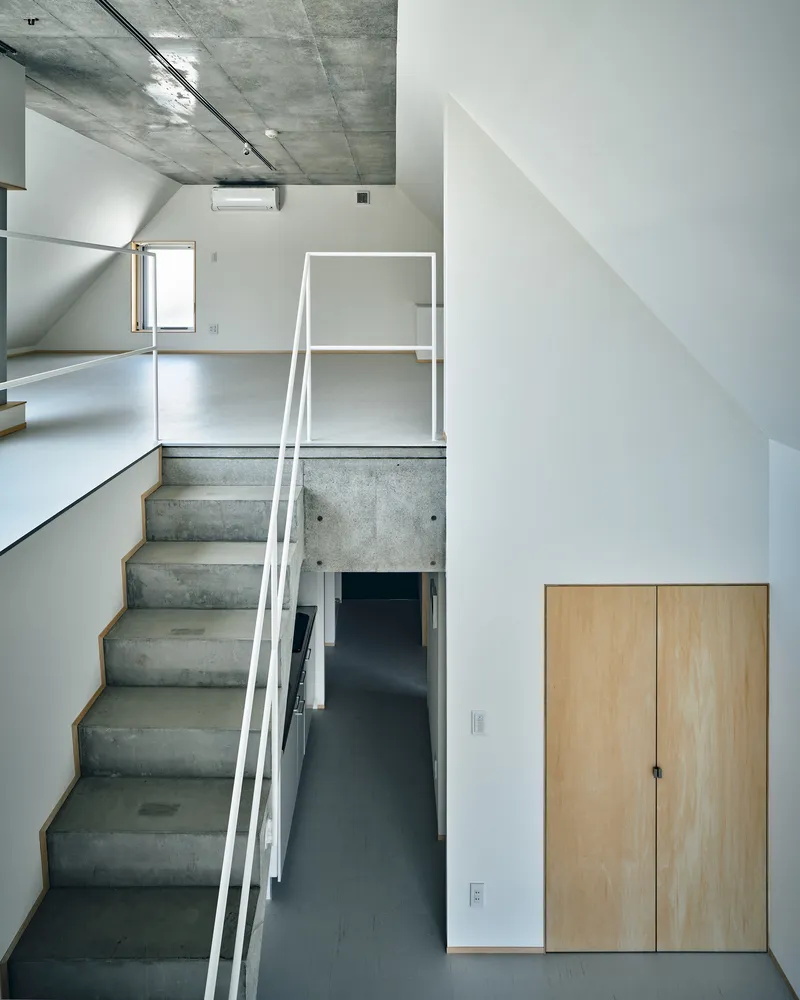
Step inside and the material palette tightens to two voices: exposed concrete overhead and basswood plywood at hand height. The ceilings retain their formwork texture and visible tie holes, carrying the honesty of the exterior straight through the section. Below that rough plane, closet doors, skirting boards, and window frames are all fabricated from the same basswood plywood, its laminated edges left visible.
Those laminated edges are not a budget shortcut. They echo the layered horizontality of the concrete bands outside, creating a quiet dialogue between the two materials. Compact kitchens tuck beneath concrete beams, and split-level stairs with white steel railings connect floors with an economy of space that suits the building's single-occupant program. Nothing here asks to be admired; everything asks to be used.
Living with the Sky
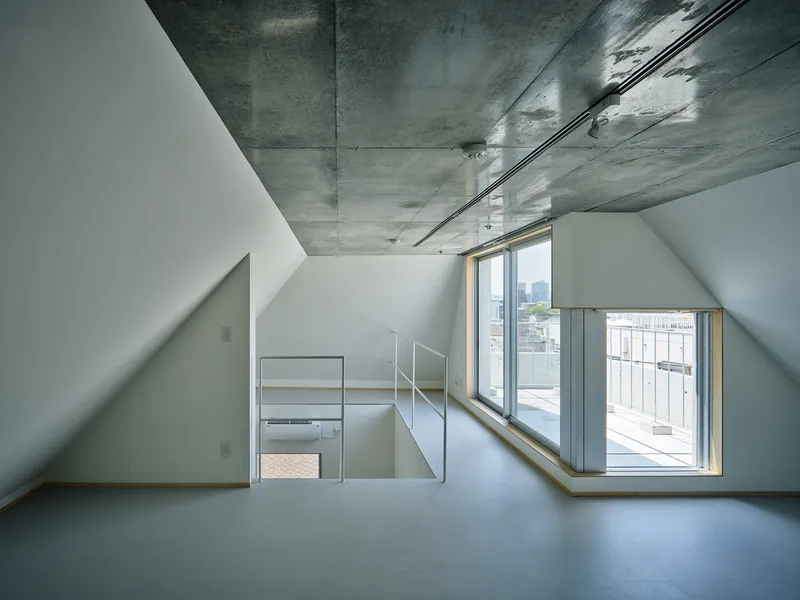
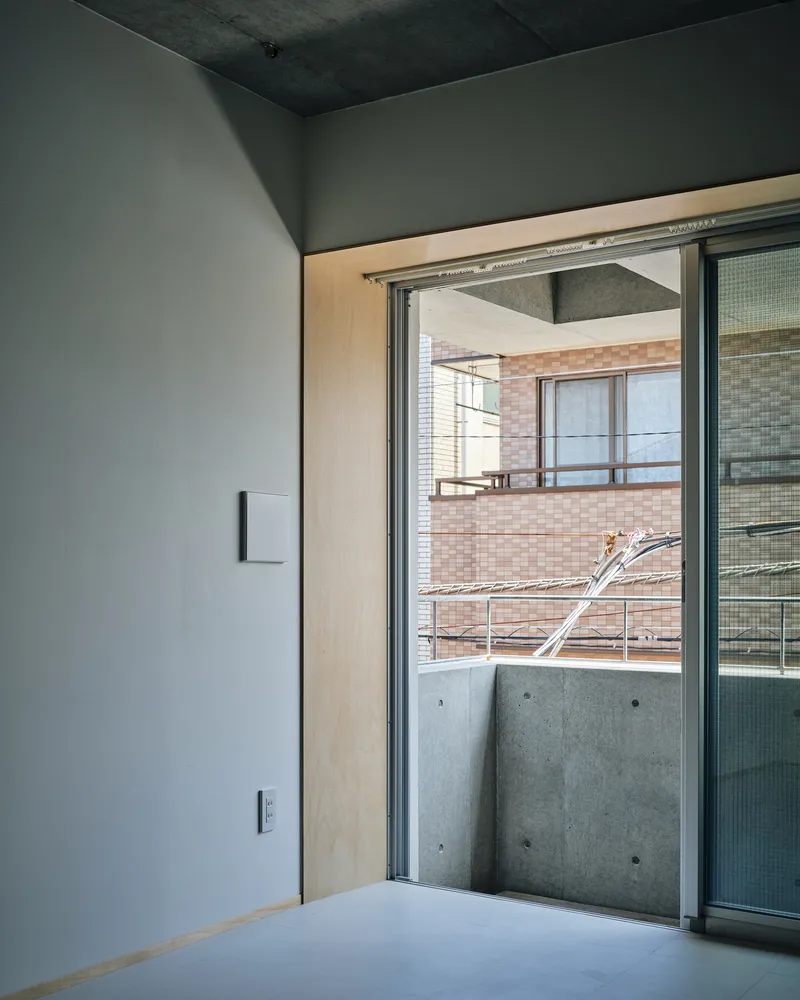
The payoff of the graduated parapet strategy is most evident on the upper floors. Where the second-floor apartments peer through narrow horizontal slots, the fourth-floor units open up to angled windows framed 400 mm deep, pulling in views of neighboring rooftops and open sky. The floor-length frames in basswood plywood act as deep sills, wide enough to set a coffee cup on, blurring the line between window and furniture.
Balconies on these upper levels become genuinely usable outdoor rooms. The concrete band still wraps around, but at 600 mm it functions more as a railing than a wall, and the white bearing panels behind conceal mechanical equipment without stealing daylight. A sliding glass door opens the living space onto the balcony in one gesture, and the view across Ota City's low-rise fabric feels surprisingly expansive for a building of this footprint.
Why This Project Matters
The Omori-cho apartment building is a case study in doing one thing well. Rather than deploying a catalog of strategies, Seitaro Aso identified a single architectural move, the variable-height concrete band, and let it organize privacy, structure, services, and expression simultaneously. Every decision in the project, from the omitted drainage joints to the basswood laminations, orbits that central idea. The discipline is rare, and it pays dividends in legibility: anyone walking past this building understands what it is doing and why.
More broadly, the project offers a replicable logic for dense urban sites where living and commerce overlap. You do not need large setbacks or elaborate screening systems to reconcile a busy shopping street with quiet domestic life. You need a section that changes its mind floor by floor, letting the relationship between inside and outside evolve with altitude. That is a simple proposition, but executing it with this level of material and constructional care is what turns a proposition into architecture.
Apartment Complex in Omori-cho by SEITARO ASO ARCHITECTURE INC., Ota City, Japan. 393 m². Completed 2023. Structure Engineering: Tatsumi Terado Structural Studio. MEP: Ryo Miura LLC. Construction: IWAMOTOGUMI CO., LTD.
About the Studio
Share Your Own Work on uni.xyz
If projects like this are the kind of work you want to make, uni.xyz is a place to publish your own, find collaborators, and enter design competitions.


Popular Articles
Popular articles from the community


Singing Woman: An Opera House That Performs Before the Curtain Rises
Ovidiu Cristian Pavel's conceptual opera house translates Estonia's choral identity into a sculpted waterfront landmark facing the Baltic Sea.


ETEH Reworks the Shared Spaces of São Domingos School in Brazil Around Timber, Color and Hanging Plants
At São Domingos School in Brazil, 436 m² of hall, refectory and library are recast with timber joinery, a yellow and blue code and trailing greenery.

Aquadapt: An Underwater Habitat That Rewrites Its Rooms by the Hour
Curved modules ring the seabed while one shell shifts from breakfast room to cinema, farm and football pitch as residents' needs change.

FCC Arquitectura Expands a Portuguese Granite House with a Board-Marked Concrete Wing
In Portugal, JV House pairs a cleaned-up whitewashed and granite dwelling with a timber-shuttered concrete extension, courtyards and a garden pool.

Similar Reads
You might also enjoy these articles


Hodi-Mandai Geram
Project Function: Preservation and revitalization of the Intangible heritage and socio-spatial identity of the Hodi by Housing, Cultural Memory Center, Sacred Grove, landscape, local tourism economy


Olio Towers: A Mid-Rise for Performers That Fuses Housing, Rehearsal, and Stage
Located blocks from Houston's Theater District, this modular tower stacks living units around a central performance atrium.

Oasis: Modular Green Housing Carved into Dhaka's Urban Fabric
A shortlisted Plugin Housing entry reclaims unauthorized settlements in Dhaka with stepped concrete volumes, green roofs, and ventilation-driven design.

Black Hole: A Floating Megastructure for the Post-Physical Era
Emiliano Mazzarotto envisions a spherical, self-scaling arena where e-sports, digital hotels, and holographic stadiums replace traditional public space.

Explore Aotu Architecture Office Competitions
Discover active competitions in this discipline

Challenge to reimagine the Iron Throne

Photograph architecture without architects

Illustrate the lost glory of Angkor Wat - Render Challenge

Design challenge to reuse E-waste
Comments (0)
Please login or sign up to add comments
No comments yet. Be the first to comment!