
The Birth: An Egg-Shaped Daycare That Rethinks Passive Design for the Tropics
A shortlisted entry for Form Follows Climate 2020 layers vegetation, climate skins, and dome geometry to cool a Kuala Lumpur childcare center without HVAC.


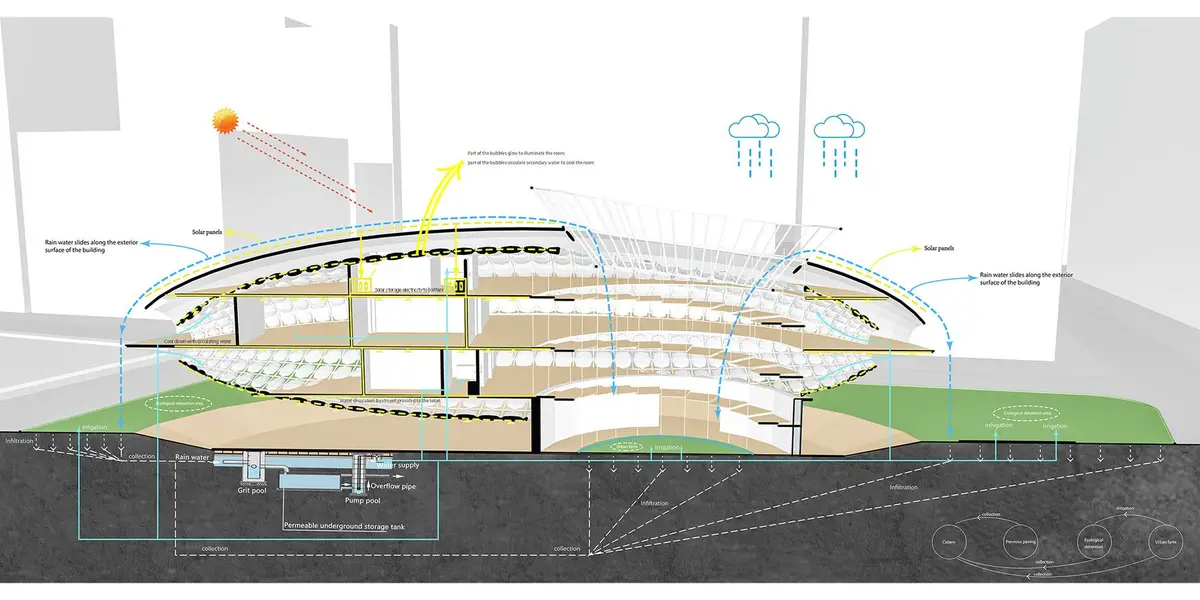
Most passive house models were conceived for temperate climates: thick insulation, airtight envelopes, south-facing glass. Drop that template into equatorial Kuala Lumpur, where humidity hovers near saturation and the sun sits almost directly overhead year-round, and the logic collapses. "The Birth" starts from this failure point, asking what a passive building actually looks like when heat gain comes from every direction and the rain arrives in daily torrents. The answer, according to its designers, is an egg: a curved, layered dome that replaces mechanical cooling with pressurized natural airflow, anti-radiation roofing, and rainwater harvesting built into the geometry itself.
Designed by 木南 殷 and Yiwen Zheng, the project was a shortlisted entry in the Form Follows Climate 2020 competition. The programme is a daycare facility, a choice that loads the egg metaphor with real content: new life sheltered inside a structure that is itself environmentally generative. Sited in Kuala Lumpur's rainforest climate, the design draws on seasonal shadow analyses, sun path data, temperature and humidity mapping, and prevailing wind studies to orient and shape the building.
From Egg Diagram to Ecological Dome
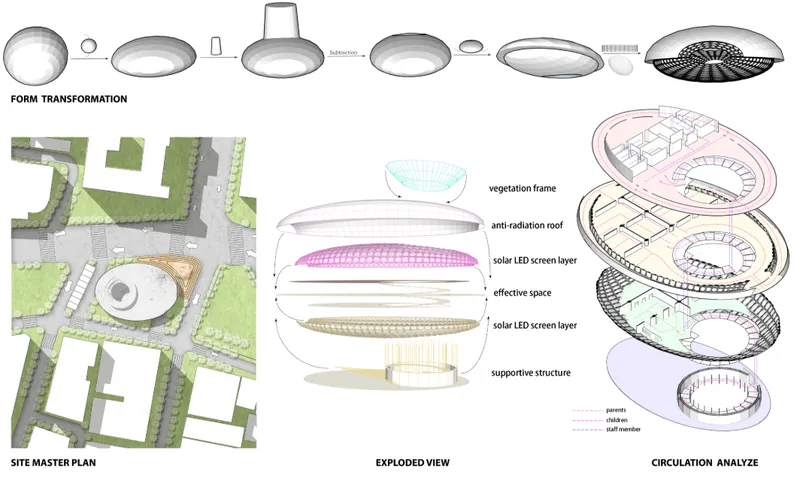
The composite drawing above traces the project's logic from abstraction to architecture. Form transformation diagrams show how the symbolic egg evolves into a sectional profile that optimizes air movement. The exploded axonometric breaks the envelope into its constituent layers: vegetation frames, solar LED screening panels, responsive climate skins, and an anti-radiation roof canopy. Each layer addresses a specific performance demand. The vegetation frames absorb solar radiation before it reaches interior surfaces. The screening mediates daylighting. The climate skin adjusts to humidity and wind pressure. Together, they eliminate the need for a conventional HVAC system.
Circulation analysis in the same drawing reveals how the plan separates user groups (children, staff, parents) while maintaining visual connectivity between zones. Movement paths are defined yet fluid, a quality critical in daycare design where children need freedom to explore without losing the sight lines that keep caregivers confident.
Curved Sections and Lifted Ground Planes
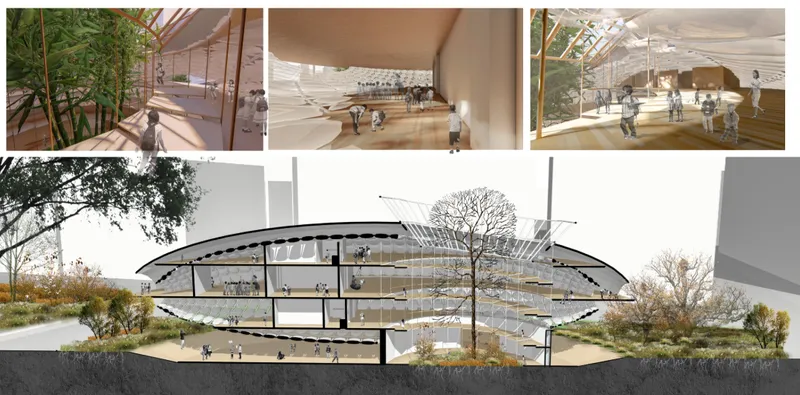
The section drawing reveals the building lifted above the ground plane, a deliberate move to reduce site heat gain and improve ventilation beneath the structure. Multi-level interior spaces sit under a continuously curving roof, and the curvature is not decorative: it channels air upward, creating a natural stack effect that pressurizes and moves air through the layout without fans. Rainwater follows the dome's geometry to collection points, where it is filtered and stored below grade.
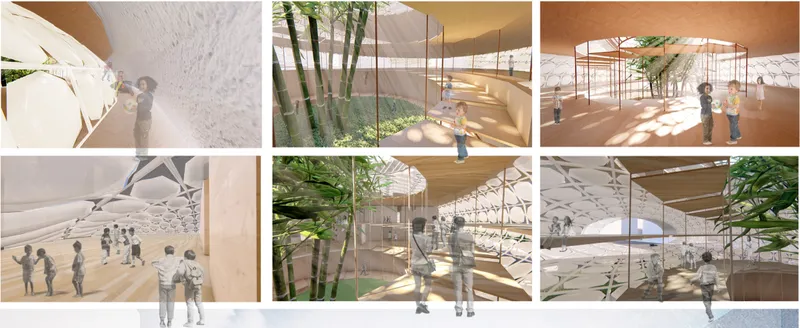
The interior renderings confirm what the section promises. Bamboo groves grow inside the building envelope, their canopies catching dappled sunlight filtered through the layered roof above. The light quality is soft and diffused, far from the harsh glare of unshielded tropical sun. These spaces read as biophilic learning environments where the boundary between inside and outside dissolves. Children occupy rooms that feel enclosed yet open, a paradox achieved through the dome's generous volume and the transparency of its screening layers.
Canopy Roofs as Public Threshold
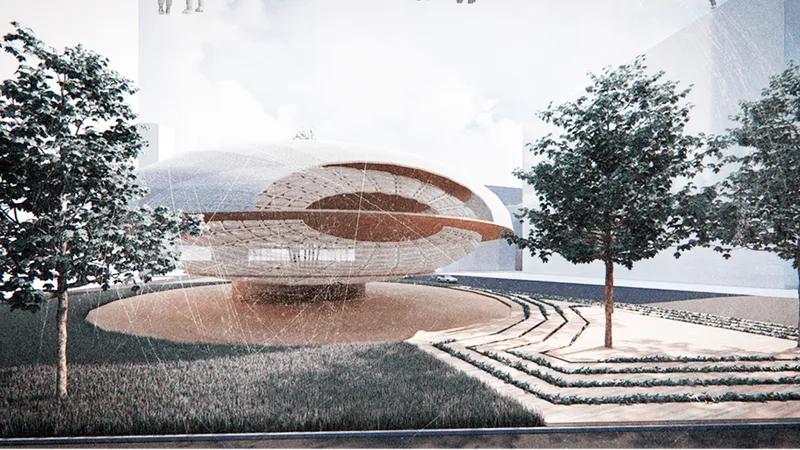
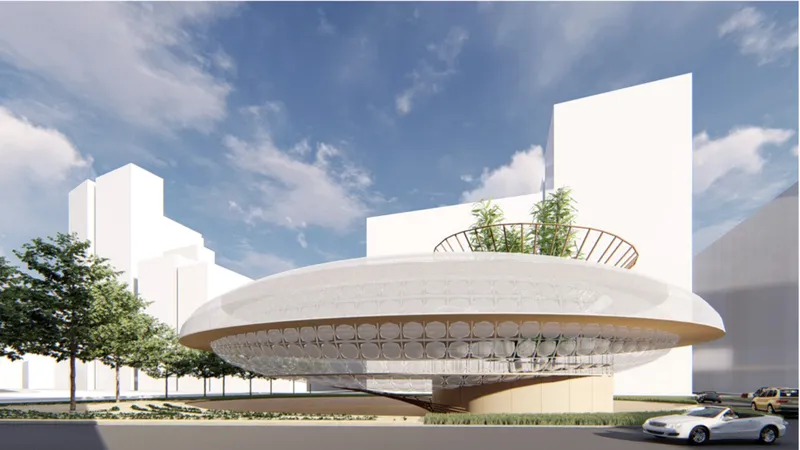
Seen from the exterior, the building presents itself as a series of layered canopy roofs hovering above a planted forecourt. Water fountains and trees establish a transition zone between city and school, cooling the microclimate before visitors even enter the building. The patterned underside of the disc-shaped roof creates a shaded public ground, a generous civic gesture in a climate where shade is the most valuable amenity a building can offer the street.
The planted terrace atop the structure extends the ecological performance upward, adding thermal mass and evaporative cooling to the roof assembly. White volumes below the canopy reflect solar radiation rather than absorb it. Every surface is doing work. The overall impression is of a building that treats its climate not as a problem to be sealed out, but as an energy source to be choreographed through form, orientation, and material layering.
Tension Between Concept Purity and Layered Ambition
Juror Jaap Wiedenhoff, Partner and Senior Consultant at ABT Netherlands, praised the core idea but noted that it was "too much diluted by too many ideas that bear little or no relation with the nice and simple basic concept." It is a fair critique, and one that speaks to a tension endemic to competition entries by young designers: the impulse to demonstrate everything you know can work against the clarity of a single, legible proposition. The egg is powerful. The passive ventilation strategy is rigorous. Whether the solar LED screens, responsive skins, and vegetation frames all cohere into a buildable system, or whether they remain parallel ambitions stacked in an exploded axonometric, is the question the project leaves open.
Why This Project Matters
"The Birth" matters because it refuses to treat passive design as a temperate-climate monopoly. The comparison studies embedded in the project's research, contrasting traditional passive house typologies with the demands of high-humidity equatorial zones, identify a real gap in sustainable design discourse. By proposing adaptive insulation, hermetic dome geometry, and HVAC-free operation for a Kuala Lumpur daycare, the project stakes a claim that passive architecture must be reinvented, not merely transplanted, for the tropics.
It also demonstrates that programme choice can amplify a conceptual argument. A daycare is not just any building; it is a space where the youngest members of society spend their formative hours. Designing that space without mechanical cooling, with bamboo and filtered daylight and naturally pressurized air, is a statement about what kind of environments we believe children deserve. The egg may be a heavy-handed symbol, but the ambition it contains, to shelter new life inside a structure that is itself ecologically alive, is worth taking seriously.
View the Full Project
About the Designers
Designers: 木南 殷, Yiwen Zheng
Enter a Design Competition on uni.xyz
uni.xyz runs architecture and design competitions year-round that reward proposals with spatial conviction and real site intelligence.
Project credits: The Birth by 木南 殷, Yiwen Zheng Form Follows Climate 2020 (uni.xyz).


Popular Articles
Popular articles from the community


Conexión: Biophilic Design Reimagines High-Rise Living in Hong Kong
Conexión reimagines high-rise living in Hong Kong through biophilic design, green facades, shared spaces, daylight, water and nature within.

The Ocean Hive: Sustainable Architecture for a Self-Sufficient Civilization at Sea
The Ocean Hive imagines sustainable architecture at sea, where modular habitats, algae, wave power and ocean waste sustain a growing colony.

The Musturak Paradise: Senior Living Architecture for a Connected Future in Temara, Morocco
The Musturak Paradise reimagines senior living architecture in Temara via private homes, social spaces, culture, community, and shared care.

Hill & Cross Opera: Sculptural Opera House Architecture Shaped by Tallinn’s Landscape and Identity
Hill & Cross Opera reimagines opera house architecture in Tallinn through its sculptural hill, civic plaza, glass wave and a luminous cross.

Similar Reads
You might also enjoy these articles

Bao Huynh Watercolor Atelier: A Serene Art Retreat in Hội An
Bao Huynh Watercolor Atelier in Hội An blends multifunctional art spaces, sustainable design, local materials, and family-friendly living in a serene environment.

Atelier Macri Concept Store Interior Design by CASE-REAL
Atelier Macri store features a "ko" counter, walnut wood details, cork displays, blending retail, gallery, and seamless customer experiences.

Manuel Vargas Izquierdo Stadium and High-Performance Sports Center: Architectural Excellence in Jalpa de Méndez
The Manuel Vargas Izquierdo Stadium blends sustainable design, inclusive sports facilities, and cultural-inspired architecture, revitalizing Jalpa de Méndez’s public spaces.

KAKR Buluh Awar Hall: Revitalizing Community and Ecology Through Bamboo Architecture
Community built bamboo hall revitalizes Buluh Awar village, empowering youth, restoring ecology, celebrating vernacular craftsmanship through sustainable architecture and culture.

Explore Passive Architecture Competitions
Discover active competitions in this discipline

Challenge to reimagine the Iron Throne

Photograph architecture without architects

Illustrate the lost glory of Angkor Wat - Render Challenge

Design challenge to reuse E-waste
Comments (0)
Please login or sign up to add comments
No comments yet. Be the first to comment!