

Biosphere: Modular Dome Settlement Designed for Arctic Survival on Ellesmere Island
A prefabricated community of glass-clad domes on hydraulic stilts, engineered to house 1,000 residents in Canada's extreme north.


What does it take to build a home where temperatures plunge far below zero, winds never stop, and the ground shifts beneath you? On Ellesmere Island in Northern Canada, one of the most inhospitable landmasses on Earth, Biosphere answers that question with a sprawling network of glass-domed dwelling units that sit on hydraulic supports above the snowpack. The settlement is designed for up to 1,000 residents and treats the Arctic not as a hostile environment to conquer but as a dynamic system to move with. Units can be relocated without disturbing the terrain, the community can expand or contract based on environmental cues, and the architecture borrows from the igloo's geometry while deploying advanced thermal glass and fiber-reinforced polymers.
Biosphere is a shortlisted entry in the EHC: Arctic competition, submitted by Pranita Khedkar. The project sits within the emerging discipline of extreme climate architecture, a field concerned with making the planet's shrinking habitable zones viable through sustainable, flexible, and resilient design. Rather than proposing a fortress against nature, Khedkar envisions a living organism: a settlement that breathes, adapts, and grows in rhythm with one of the harshest climates on the planet.
Layered Construction: Steel Skeletons, Thermal Glass, and Cob Floors
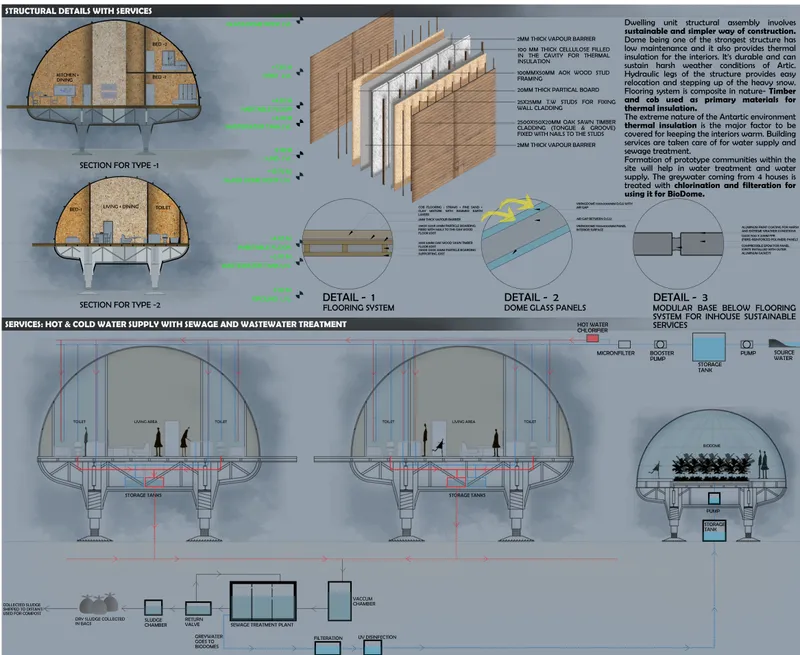
The technical drawing above reveals how each dome is assembled: a reinforced galvanized steel skeleton forms the structural frame, wrapped in 10mm Pilkington thermal insulation glass and clad in timber where privacy or additional insulation is needed. The exploded axonometric breaks down a multi-layered envelope incorporating vapor barriers, insulation, and ventilation channels that maintain internal thermal balance under fluctuating Arctic conditions. Cob flooring provides thermal mass at ground level, absorbing and slowly releasing heat. Below the dome, hydraulic supports elevate the entire unit above drifting snow, a critical detail for a site where the ground surface is never stable.
Service diagrams integrated into the drawing show how hot and cold water supply, sewage, and greywater recycling are routed through the raised foundation system. These compact service units feed directly into the biodome agriculture modules, creating a closed loop where waste becomes resource. The dome geometry itself is not decorative; it maximizes solar gain while maintaining thermal inertia, reducing reliance on external energy inputs in a region where fuel logistics are a serious constraint.
A Microcosm Inside Each Dome: Worship, Work, and Urban Farming
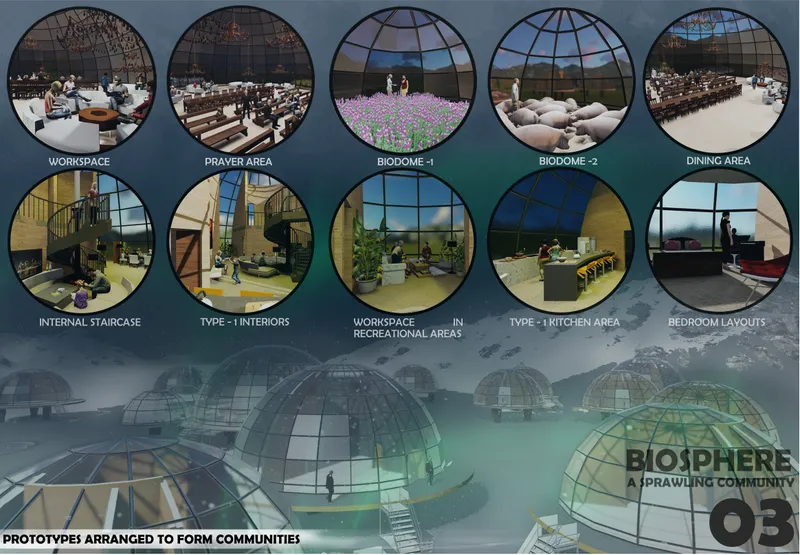
Khedkar's rendered vignettes show that Biosphere is not merely shelter; it is a complete community compressed into dome-shaped rooms. Interior scenes depict workspaces, prayer halls, dining areas, and planted biodomes, each occupying its own module within the larger settlement network. The biodomes function as agricultural hubs supporting poultry, plant biodiversity, and food sustainability, turning the settlement into a self-sufficient microcosm rather than an outpost dependent on supply lines from the south.
What stands out in these interior renderings is the quality of light. The glass envelope floods each space with diffused Arctic daylight, and the circular geometry eliminates dead corners, giving even compact modules a sense of openness. Acoustics and privacy are addressed through the radial organization of interior partitions, allowing residents to share communal areas while retreating to enclosed zones when needed.
Circular Plans and Elevated Platforms: Three Prototypes for Different Needs

The floor plans and elevations reveal three prototype sizes: 50 sqm, 118.5 sqm, and 118.5 sqm, each calibrated for different programmatic demands. The smaller unit serves residential functions, while the larger modules accommodate agricultural biodomes, recreational spaces, or research facilities. Every plan is organized around a circular footprint with radial room divisions, a layout that distributes structural loads evenly across the dome shell and creates intuitive interior circulation without corridors or wasted space.
Elevations confirm the raised platform base, which serves a dual purpose: it lifts living spaces above snow accumulation and houses the compact service infrastructure beneath. The prefabricated nature of these modules means they can be transported, assembled on site with minimal heavy equipment, and repositioned as the community's needs evolve. Phased expansion is built into the settlement's DNA, with new domes added to the network as the population grows or as environmental conditions shift the settlement's footprint.
Glowing Under the Aurora: Architecture That Belongs to Its Landscape
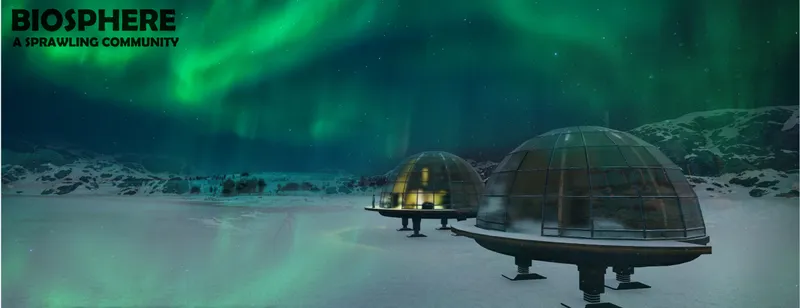
The most arresting image in the project shows two illuminated geodesic domes glowing warmly against a snow-covered landscape, the green curtain of the aurora borealis rippling overhead. It is a scene that encapsulates Biosphere's central proposition: human settlement does not have to scar the places it occupies. The glass-clad forms read as extensions of the terrain rather than intrusions upon it, their transparent skins blurring the boundary between interior warmth and exterior wilderness.
The panoramic views offered by the dome geometry are not just aesthetic. Residents can observe weather patterns, shifting ice, and seasonal light changes from within their homes, maintaining a visual and psychological connection to the Arctic environment. In a context where isolation and sensory deprivation are real threats to mental health, this transparency is a design strategy with tangible human benefits.
Why This Project Matters
Biosphere does not romanticize the Arctic or treat it as a blank canvas for architectural experimentation. It takes the specific challenges of Ellesmere Island seriously: the brutal cold, the persistent wind, the shifting snow, the logistical nightmare of supply chains in the far north. Every design decision, from the hydraulic stilts to the greywater-fed biodomes to the prefabricated modular system, responds to a real constraint. The result is a settlement framework that could genuinely function, not just as a concept but as a phased, buildable strategy for extreme climate habitation.
What Khedkar offers here is a shift in thinking about where and how humans can live as climate pressures redraw the map of habitability. The project refuses the binary of retreat or resistance. Instead, it proposes coexistence: a community that moves with its environment, expands when conditions allow, and contracts when they don't. In a discipline increasingly preoccupied with resilience, Biosphere presents one of the more convincing visions of what resilient settlement actually looks like at the edge of the habitable world.
View the Full Project
About the Designers
Designer: Pranita Khedkar
Enter a Design Competition on uni.xyz
uni.xyz runs architecture and design competitions year-round that reward proposals with spatial conviction and real site intelligence.
Project credits: BIOSPHERE: A Sprawling Community by Pranita Khedkar EHC: Arctic (uni.xyz).


Popular Articles
Popular articles from the community


David Macias Steps a Doorless Stone and Plaster House Down a Tropical Colombian Hillside
In the humid hills of Colombia, Threshold House replaces the front door with an open void and terraces its 850 m² down the slope instead of fighting it.

LT2A and OPEN Architectes Thread a Brick and Glass High School Through a Wooded Belgian Campus
In Braine-l'Alleud, a 3,000 m² wing for Collège Cardinal Mercier pairs pale brick with a glazed colonnade, deferring to a small chapel and a dense wood.

Juan García Correa, John González and Claudia Rueda Sink a Circular Amphitheater into a Manizales Engineering Building
On the La Nubia campus in Manizales, Colombia, the S1 Building folds labs and offices into a hillside of ramped lawns that double as a campus route.

longwave studio Reorganizes a 112 m² Tainan Apartment Around the Daily Routines of a Family and Two Cats
In Tainan, Taiwan, birch plywood, rust-red furniture and a freestanding plaster wall link arrival, storage, work and family life in one apartment.

Similar Reads
You might also enjoy these articles

Gil Mello Arquitetura Tilts a Single Roof Toward the Waterfalls on a Plateau Above Aiuruoca, Brazil
In Aiuruoca, Minas Gerais, a 200 m² house of local labor and reclaimed poles pairs a low valley veranda with a tall mountain one.

U.GA Architects Wraps an Oval Rooftop Pool in Curved Board-Formed Concrete on Busan's Jeollidan-gil
In Busan's Jeonpo-dong, a 454 m² mixed-use block stacks a neighborhood facility, guest rooms and an oval rooftop pool inside spiraling concrete walls.

Felipe Hess Arquitetos Turns a Blind Stone Wall to the Street and Opens a Brazilian House onto a Courtyard and Canal
A canal-front house in Brazil hides behind painted stone and planting, then opens to an olive-tree courtyard, a reed-ceilinged porch and a curving pool.
David Macias Steps a Doorless Stone and Plaster House Down a Tropical Colombian Hillside
In the humid hills of Colombia, Threshold House replaces the front door with an open void and terraces its 850 m² down the slope instead of fighting it.


Comments (0)
Please login or sign up to add comments
No comments yet. Be the first to comment!