

Brest Post Office by Chatillon Architectes: A Landmark Revival through Adaptive Reuse Architecture
Chatillon Architectes transforms a historic Brest post office into a senior residence through sustainable adaptive reuse architecture and renewal.


The Brest Post Office Transformation, led by Chatillon Architectes, is a compelling example of adaptive reuse architecture that breathes new life into a historic civic structure in the heart of Brest, France. Originally constructed in 1927, destroyed during World War II, and rebuilt by Pierre-Jack Laloy between 1947 and 1950, the building’s third transformation redefines its role for the present day—this time as a vibrant senior residence.


Honoring History through Contemporary Design
Once a symbol of civic infrastructure, the Brest Post Office was reimagined to serve the community in a new way, while preserving its architectural legacy. Chatillon Architectes carefully approached the transformation by blending preservation with innovation. The building’s historic shell—marked by a neo-regionalist style—is preserved and enhanced with a modern architectural language that remains sensitive to the site's layered past.


The architects maintained the building’s U-shaped typology, but restructured the internal organization by inserting a new, contemporary wing. This move created a central entrance courtyard and enclosed garden, both of which now serve as organizing and experiential anchors. These spaces celebrate openness, greenery, and human interaction, aligning with the building’s new residential function.


Contemporary Wing as a Transparent Threshold
The defining feature of the transformation is the new concrete and glass brick wing, which acts as both threshold and gateway. Supported by six structural columns, this elevated volume opens visual and physical access from the street to the heart of the complex. It creates an uninterrupted spatial flow—from entrance to reception to garden—enhancing permeability and reinforcing a sense of welcome.

Materially, the new wing respects the post-war original. The concrete and glass elements subtly echo the textures of the granite, stone, and concrete used in the original construction. Yet, they also project a forward-looking identity—modern, light-filled, and transparent. This tactful contrast ensures that the addition doesn’t overpower but rather extends the building’s character into the present.

Interior Transformation Rooted in Well-Being
Inside, the architecture shifts from bureaucratic stiffness to residential warmth. Once an administrative institution, the building now embraces life. The spatial organization emphasizes community, openness, and comfort. Floor-to-ceiling windows create luminous interiors, wooden accents bring softness and tactility, and warm communal zones redefine how the building is experienced by residents and visitors alike.

Flamant Interior Design contributed to this sensory transformation with furnishings and finishes that balance durability with domesticity. The result is a space that feels welcoming, peaceful, and dignified—qualities essential for its new purpose as housing for older adults.

Architecture that Connects Past and Future
The transformation of the Brest Post Office is grounded in the principle that adaptive reuse architecture is not simply a sustainable act—it is cultural stewardship. Simon Chatillon, partner at Chatillon Architectes, emphasizes this universal approach: revealing hidden value, linking heritage with contemporary needs, and ensuring that architecture serves communities across time.

In this project, adaptive reuse becomes a tool to reinforce civic identity. The building’s recognizable form remains a landmark within Brest’s city center, but its function has evolved to meet today’s urban and social realities. It’s a powerful gesture: from postal workers to residents, from paperwork to personal care, the building evolves without erasing.

A Model for Sustainable Urban Transformation
Beyond its aesthetic and functional achievements, the Brest Post Office exemplifies how thoughtful reuse contributes to sustainable urban development. Instead of demolition and displacement, the project offers continuity and care. It anchors memory while expanding possibility. The landscape, curated by A3 Paysage, integrates greenery and calm throughout the complex, making it an oasis within the city.
This project stands as a vital reminder that old buildings are not obsolete—they are opportunities. By adapting, enhancing, and reimagining them, architects like Chatillon Architectes demonstrate that sustainability is about more than carbon—it is about connection.

All Photographs are works of Antoine Mercusot


Popular Articles
Popular articles from the community


Juan García Correa, John González and Claudia Rueda Sink a Circular Amphitheater into a Manizales Engineering Building
On the La Nubia campus in Manizales, Colombia, the S1 Building folds labs and offices into a hillside of ramped lawns that double as a campus route.

LT2A and OPEN Architectes Thread a Brick and Glass High School Through a Wooded Belgian Campus
In Braine-l'Alleud, a 3,000 m² wing for Collège Cardinal Mercier pairs pale brick with a glazed colonnade, deferring to a small chapel and a dense wood.

Jaramillo Van Sluys Arquitectura and Urbanismo Turn a Demolished Registry Lot in Quito into an Orchard Plaza
In Quito's Centro Histórico, a 2,800 m² plaza exposes the San Agustín convent wall and redraws its lost Augustinian orchard in volcanic stone.

GROUP A Strips a 1969 Rotterdam Harbor Headquarters to Its Frame and Wraps It in Timber Louvers
In Rotterdam's M4H harbor district, Ferro Offices reuses a 1969 frame, adds one timber storey and reaches BREEAM-NL Outstanding.

Similar Reads
You might also enjoy these articles

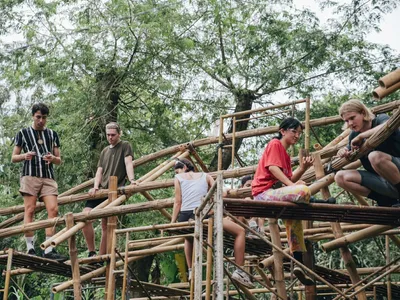
Bamboo Housing Challenge 2026: Design Affordable, Sustainable Homes Using Bamboo
An international design competition by Bamboo U and IBUKU inviting architects and designers to reimagine affordable housing using bamboo — with the winning design built full-scale in Bali.
Computational Design & Education: Beegraphy Design Awards Introduces 7th Category (Featuring Jiyun's Innovative Approach)
Dive into Beegraphy’s 7th Design Awards category, where computational design meets education to create immersive, interactive learning tools, inspired by Jiyun’s work.
From Parametric Lighting to Urban Furniture: Join the 2nd Workshop in Beegraphy’s Computational Design Series
Dive into Cutting-Edge Design Techniques and Practical Applications with Industry Experts

Last Call: Unleash Your Architectural Genius in SHAK's Kindergarten Design Competition
Urgent call for architects to join SHAK's kindergarten design competition before the looming deadline

Explore Architecture Competitions
Discover active competitions in this discipline

Challenge to reimagine the Iron Throne

Photograph architecture without architects

Illustrate the lost glory of Angkor Wat - Render Challenge

Design challenge to reuse E-waste
Comments (0)
Please login or sign up to add comments
No comments yet. Be the first to comment!