

IGArchitects Turns 60 Square Meters into a Boundless Concrete Frame for Living in Saitama
Three misaligned walls and seven floor slabs at different heights dissolve the limits of a compact Tokyo-area home for two.


Sixty square meters is a studio apartment in most cities. In the hands of IGArchitects, led by Masato Igarashi, it becomes something closer to a vertical landscape: a single open volume carved into seven floor slabs at varying heights, bounded by three walls that refuse to line up with one another. The Building Frame of the House, completed in 2023 in Saitama, Japan, is a home for a married couple who work remotely and wanted to remain aware of each other's presence without sharing a single flat plane. The answer was to eliminate conventional rooms entirely and let the structure itself organize domestic life.
What makes the project genuinely interesting is its refusal of the obvious move. A 60m² home for two people invites the miniaturization playbook: fold-down beds, pocket doors, clever storage tucked into every crevice. Igarashi went the opposite direction, pursuing a large air volume and generous vertical scale that makes the house feel far bigger than its footprint. The floors themselves become the furniture. A 450mm step becomes a bench. A slab edge becomes a desk. The boardmarked concrete walls, left raw, do double duty as structure and finish. There are no partition walls to speak of, yet the staggered levels create pockets of intimacy that a single open loft never could.
The Stagger as Organizing Principle
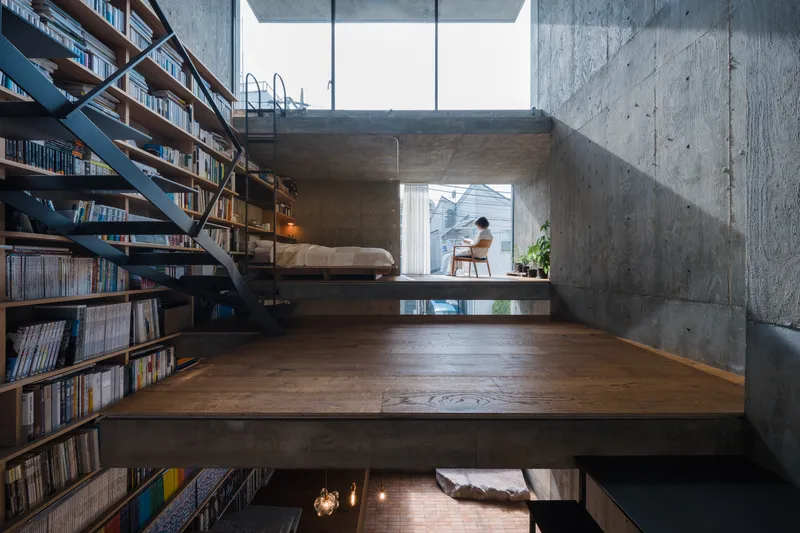
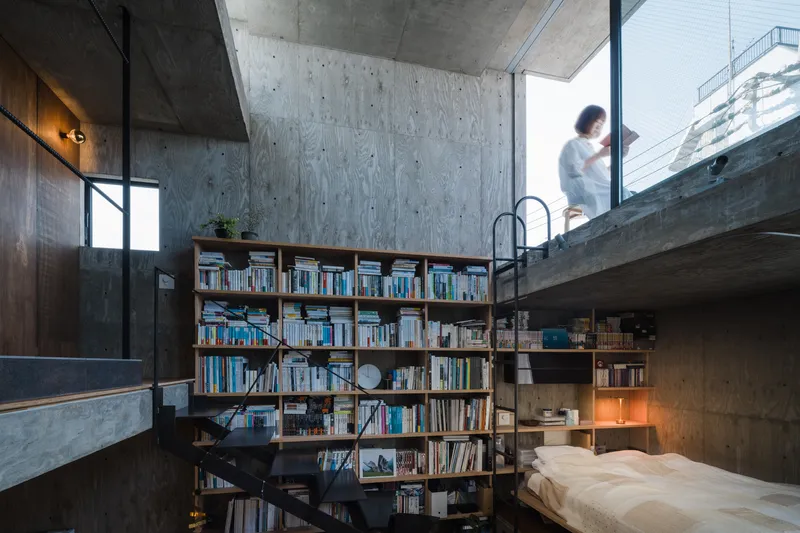
The house reads differently from every vantage point because nothing is level with anything else. The seven floor slabs step up, down, and sideways along the skewed north wall, so each platform occupies its own micro-territory without needing a door or a wall to mark it. From the upper balcony level you look down through the full double height of the space; from the timber platform at ground level you look up into a vertical stack of concrete and light. The misalignment is not decorative. It is the entire spatial strategy, generating the variety of relationships between inside and outside that a conventional plan could never achieve in this footprint.
Structural engineer Yousuke Misaki of EQSD deserves credit for making the offset geometry work in reinforced concrete. Each slab's height and depth adjusts along the angled north wall, meaning no two floor-to-ceiling dimensions are the same. The result is a section that behaves almost like topography, where the occupants navigate small changes in altitude the way you might walk across a terraced hillside.
Concrete and Steel as Domestic Language
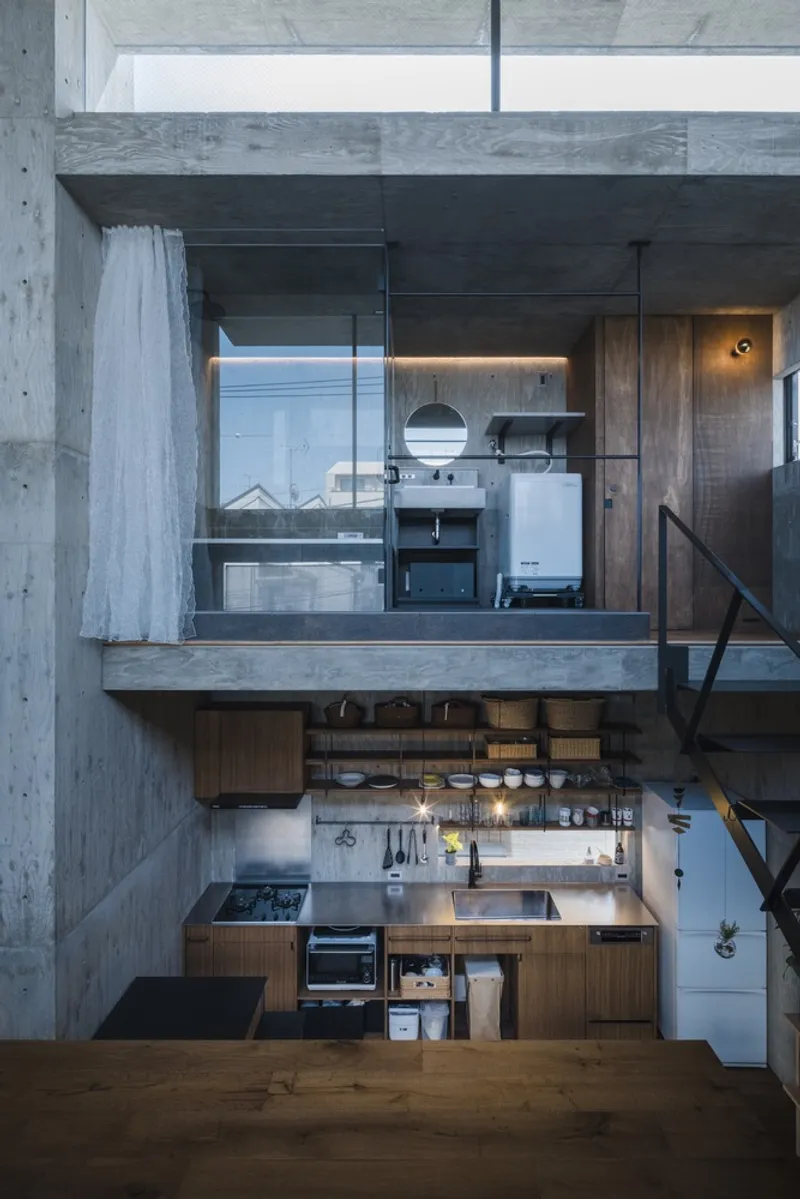
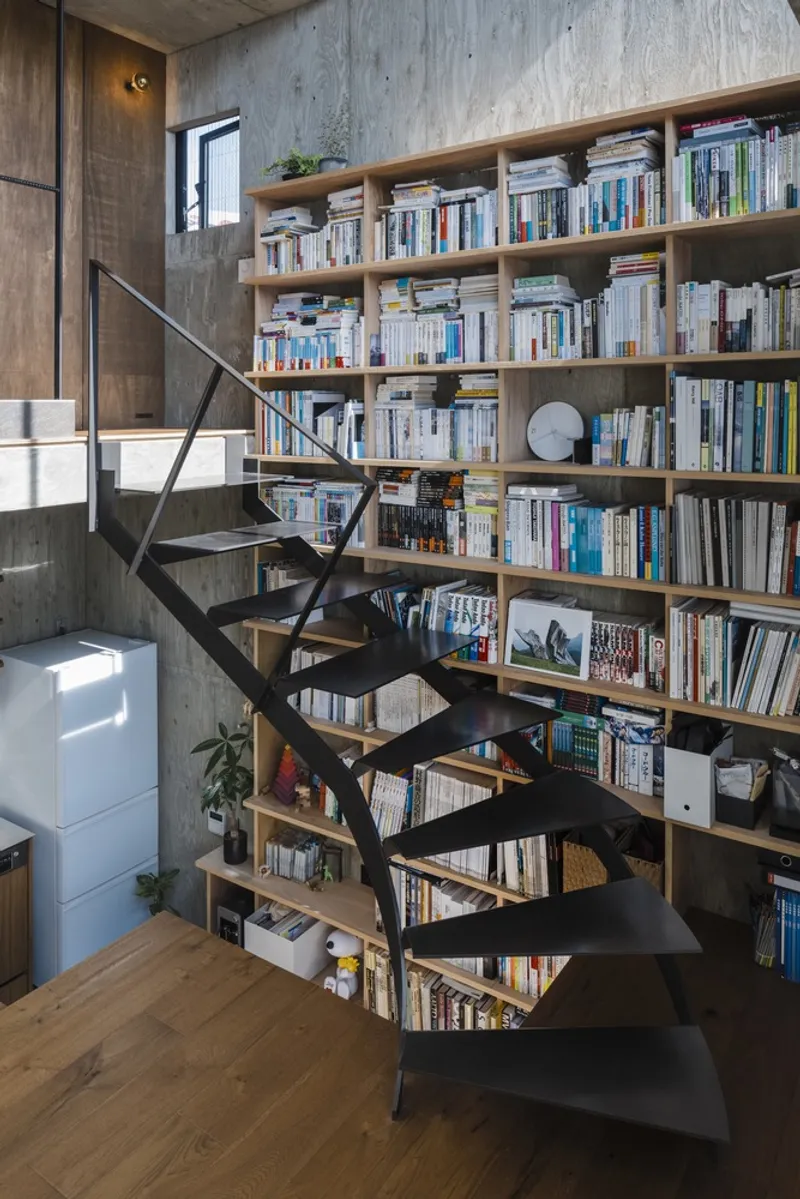
Boardmarked concrete is the dominant material, its wood-grain imprint left exposed on every wall surface. The texture softens what could be a brutally hard interior, giving the eye something organic to hold onto. Against this backdrop, the black-metal staircases and ladder, fabricated by Susumu Murata of KAMO CRAFT, cut sharp diagonal lines through the volume. They are deliberately thin, almost graphic, so they read as circulation devices rather than architectural features competing with the concrete frame.
Timber floors and cabinetry provide warmth at the points of closest contact: the platforms you sit on, the kitchen surfaces you touch, the bookshelves you reach into. The material palette is tight, just three elements, and the discipline pays off. Nothing distracts from the spatial experience of the stagger itself.
Light from the North, Privacy from the South
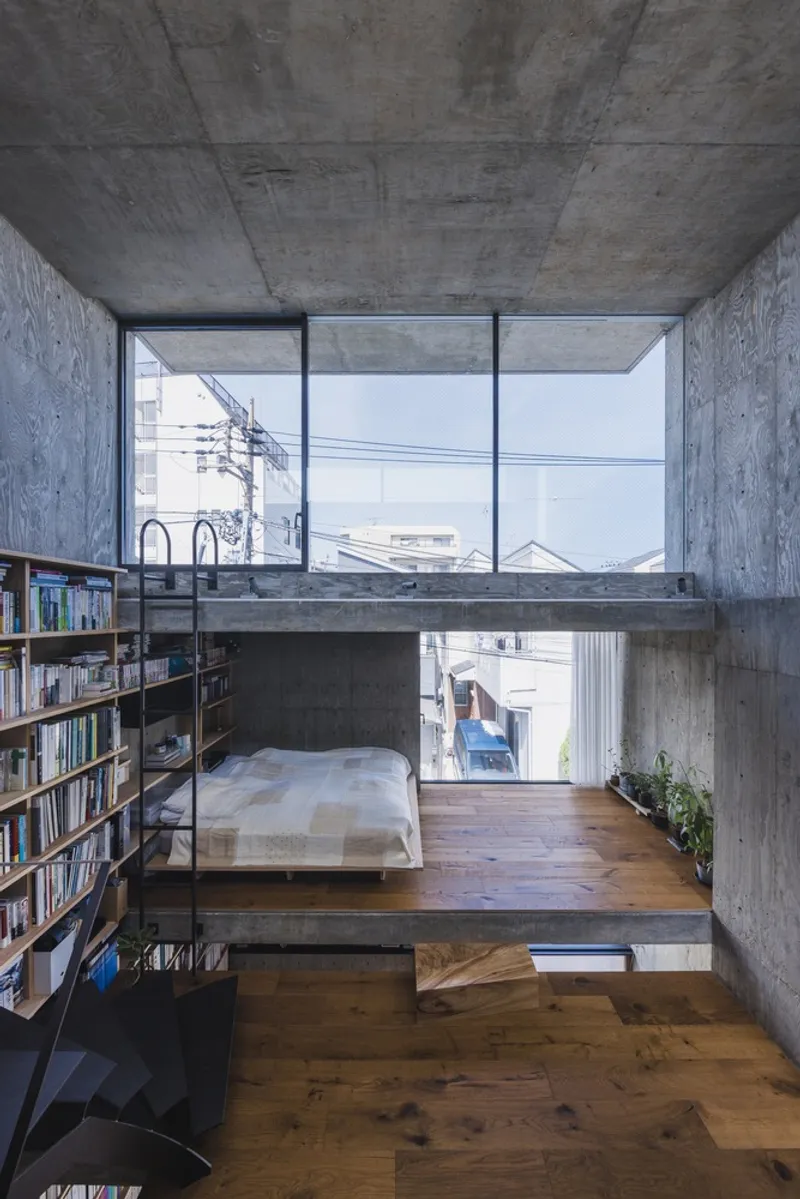

The south-facing wall is almost entirely closed, blocking harsh direct sunlight and shielding the interior from the street. The north wall, by contrast, is skewed outward to create a gap between the house and an adjacent vacant site, and it is punctured with generous glazing that welcomes even, indirect daylight throughout the day. Lighting designer Eri Nagao of ModuleX Inc. supplemented this strategy with fixtures calibrated to the varying ceiling heights, but the real story is how little artificial light the house seems to need during daytime hours.
The bedroom level sits high enough to peer over neighboring rooftops into a hazy Tokyo-area sky. The ground-level corner nook, with its terracotta tile floor and sliding glass door, opens directly to the street, collapsing the threshold between domestic interior and urban exterior. Privacy and exposure are modulated floor by floor, not room by room, which is a subtle but important distinction.
The Library as Vertical Core

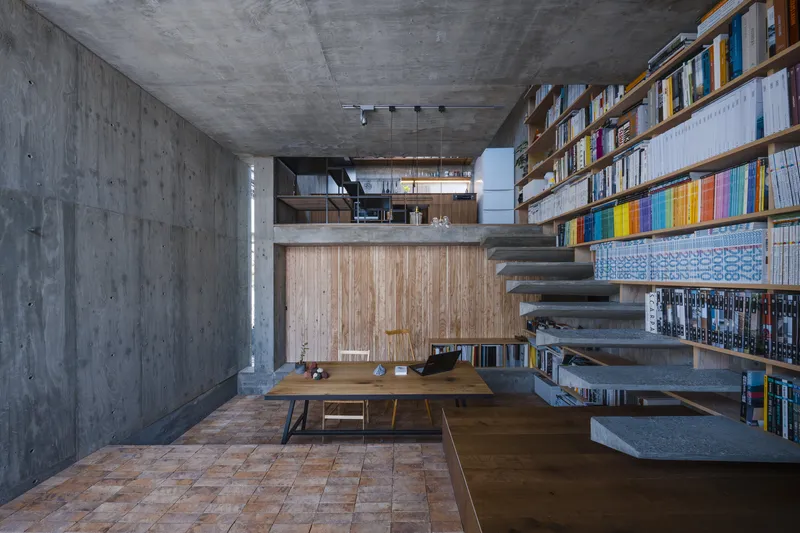
A floor-to-ceiling bookshelf wall runs through much of the house's height, acting as both storage and spatial anchor. It is the one element that ties the staggered levels together visually, a continuous vertical surface you can read from the dining table, the upper balcony, or the sunken terracotta alcove below. The cantilevered concrete stair treads that project from the wall beside it reinforce the sense that everything in this house is a surface with multiple uses: step, shelf, seat.
The lowered alcove beside the bookshelf, finished in warm terracotta tile and flooded with afternoon sun, is one of the most compelling moments in the house. It functions as a reading nook, a window seat, or simply a place to sit at a different altitude from the rest of the floor. In a home with no dedicated rooms, these altitude shifts become the equivalent of closing a door.
Why This Project Matters
The Building Frame of the House pushes back against two tired narratives at once. The first is that small urban homes must be clever puzzles of hidden compartments and transforming furniture. The second is that open-plan living means featureless lofts where every activity bleeds into every other. Igarashi found a third path: a single room that feels like many rooms because its floor planes never agree with one another. The 450mm step that becomes a seat is not a gimmick. It is an argument that architecture, not furniture, should define how people inhabit space.
For anyone designing compact housing in dense Asian or European cities, the lesson here is worth studying. Volume matters more than area. Section matters more than plan. And a concrete frame, if it is misaligned with enough precision, can do the work of partitions, furniture, and fenestration strategy all at once. At 60 square meters, this is one of the most spatially ambitious houses completed in Japan in recent years, and it earns every bit of its ambition.
Building Frame of the House by IGArchitects (Lead Architect: Masato Igarashi), Saitama, Japan. 60m². Completed 2023. Structural Engineering: Yousuke Misaki, EQSD. Lighting: Eri Nagao, ModuleX Inc. Hardware: Susumu Murata, KAMO CRAFT. Construction: Masanobu Arata, ARATA KENCHIKU KOBO. Photography by Ooki Jingu.
About the Studio
IGArchitects
Official website of IGArchitects, one of the studios behind this project.
igarchitects.jpShare Your Own Work on uni.xyz
If projects like this are the kind of work you want to make, uni.xyz is a place to publish your own, find collaborators, and enter design competitions.


Popular Articles
Popular articles from the community


Aquadapt: An Underwater Habitat That Rewrites Its Rooms by the Hour
Curved modules ring the seabed while one shell shifts from breakfast room to cinema, farm and football pitch as residents' needs change.


ETEH Reworks the Shared Spaces of São Domingos School in Brazil Around Timber, Color and Hanging Plants
At São Domingos School in Brazil, 436 m² of hall, refectory and library are recast with timber joinery, a yellow and blue code and trailing greenery.

David Ortega Stacks a Two-Story Mexico City Penthouse Around a Steel Stair and a Pergola-Shaded Roof Terrace
In Colonia Roma, a 300 m² penthouse uses oak joinery, a planted steel stair and a slatted roof pergola to make a new-build apartment feel like a house.

graciastudio Turns a Viewless Tijuana Lot Inward Around a Courtyard of Concrete, Timber and Trees
In Tijuana, Jorge Gracia's GA2 House stacks a timber-clad private floor over exposed concrete and replaces a missing view with a planted interior patio.

Similar Reads
You might also enjoy these articles


Hodi-Mandai Geram
Project Function: Preservation and revitalization of the Intangible heritage and socio-spatial identity of the Hodi by Housing, Cultural Memory Center, Sacred Grove, landscape, local tourism economy


Olio Towers: A Mid-Rise for Performers That Fuses Housing, Rehearsal, and Stage
Located blocks from Houston's Theater District, this modular tower stacks living units around a central performance atrium.

Oasis: Modular Green Housing Carved into Dhaka's Urban Fabric
A shortlisted Plugin Housing entry reclaims unauthorized settlements in Dhaka with stepped concrete volumes, green roofs, and ventilation-driven design.

Black Hole: A Floating Megastructure for the Post-Physical Era
Emiliano Mazzarotto envisions a spherical, self-scaling arena where e-sports, digital hotels, and holographic stadiums replace traditional public space.

Explore Tiny House Competitions
Discover active competitions in this discipline

Challenge to design mud housing for contemporary communities

Challenge to reimagine the Iron Throne

Photograph architecture without architects

Illustrate the lost glory of Angkor Wat - Render Challenge
Comments (0)
Please login or sign up to add comments
No comments yet. Be the first to comment!