
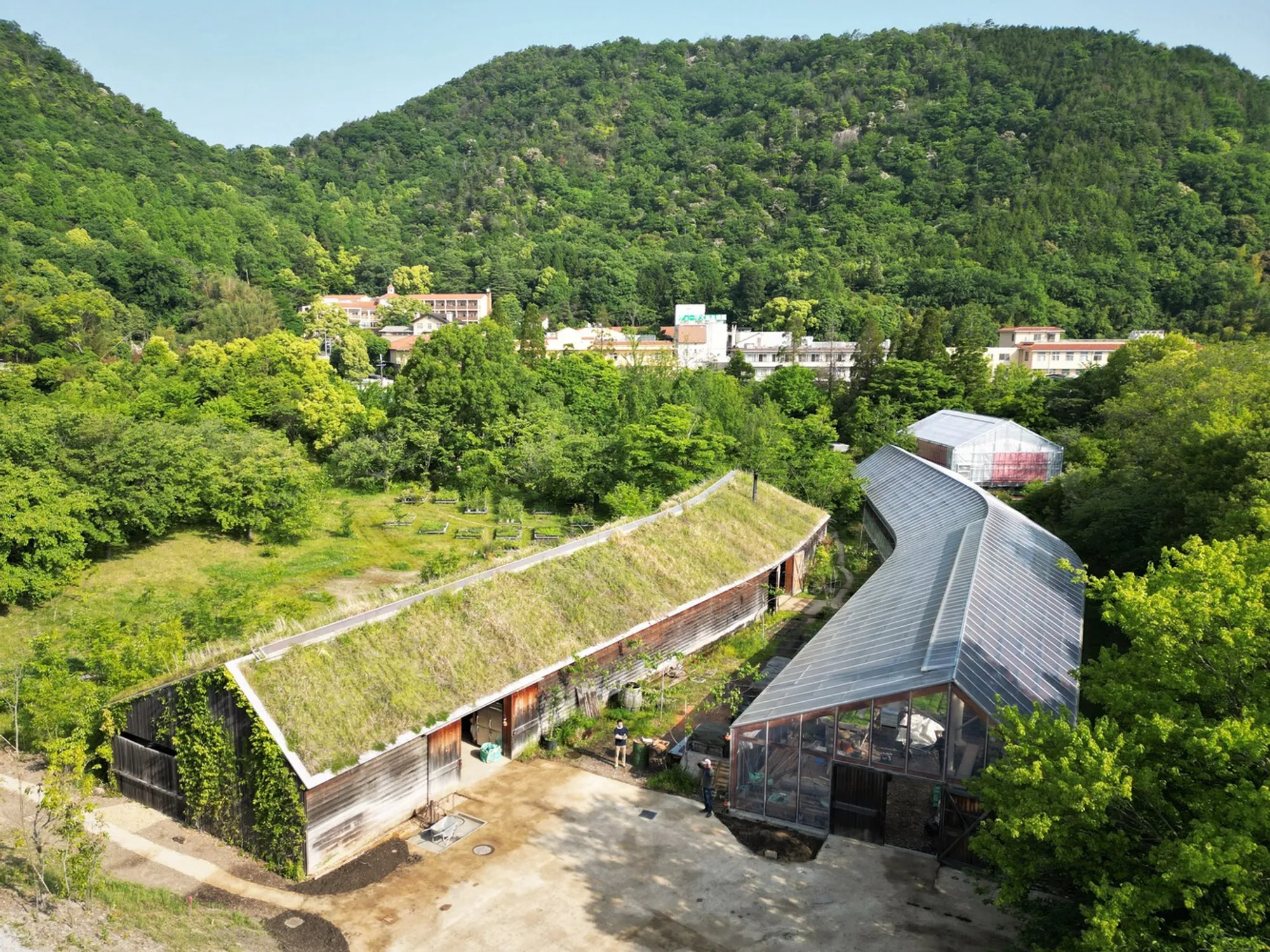
Kyoto University's Global Environmental Lab Plants a Greenhouse That Disappears into a Japanese Valley
Candy Farm merges timber construction and living roofs with the forested hillsides of rural Japan, blurring the line between building and landscape.


From above, you might miss it entirely. Two curved, green-roofed volumes slip between the tree canopy of a narrow Japanese valley, their planted surfaces continuing the meadow that surrounds them. Candy Farm, designed by Kyoto University's Global Environmental Architecture Lab, is a nursery and greenhouse project that treats camouflage not as gimmick but as genuine operating principle: the building performs as landscape, and the landscape performs as architecture.
What makes Candy Farm worth studying is its refusal to separate the structural and the ecological. The timber gabled frames that define the interior are simultaneously greenhouse armatures, structural spans, and spatial markers. The living roofs are not decorative afterthoughts bolted onto a conventional shed; they shape the massing of the whole project, pulling its profile down into the topography so that the built volumes read as gentle hillocks rather than imposed objects. It is a small building that asks a large question: what does it mean for architecture to belong to a site rather than occupy one?
Topographic Camouflage
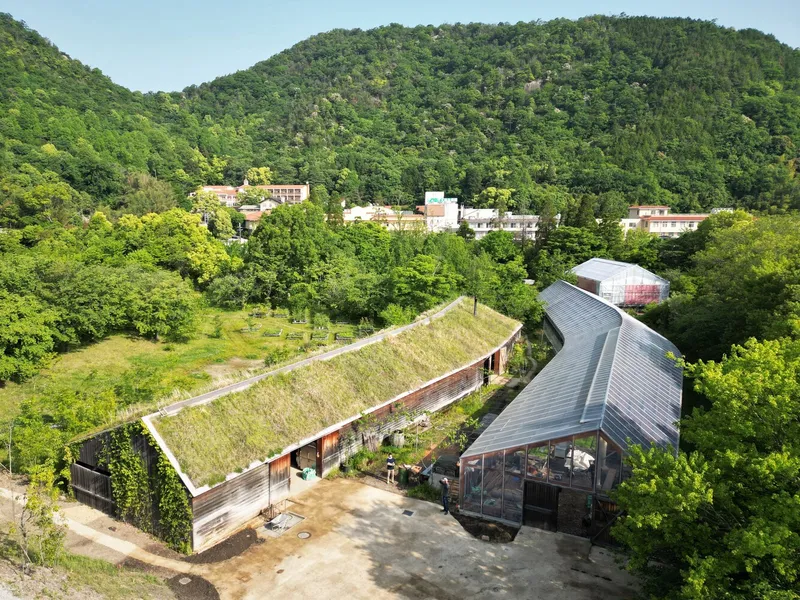
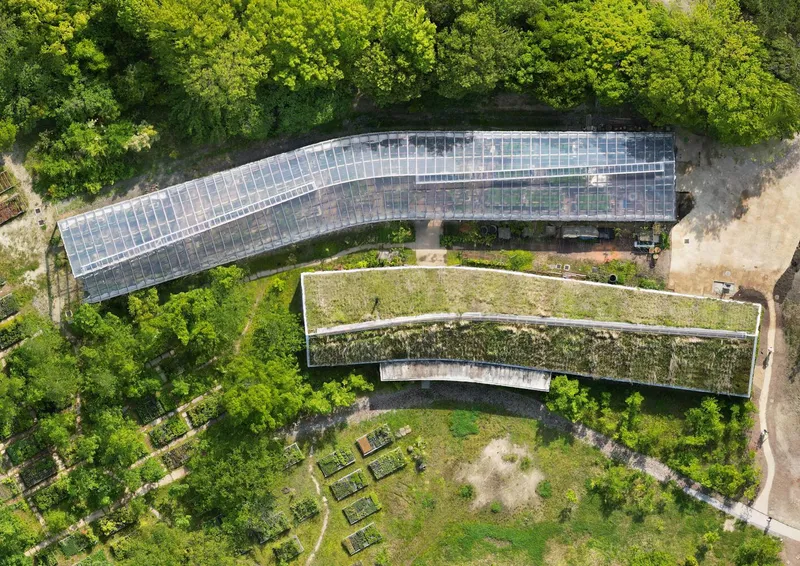
The aerial views tell the clearest story. Two elongated volumes, their roofs thick with grasses and wildflowers, nestle into the tree line as if they had always been there. The curving plan forms follow the contour of the valley floor rather than imposing a Cartesian grid on the terrain. Dense canopy closes in on every side, and the green roofs bridge the visual gap between built surface and forest floor.
This is not passive siting. The decision to curve the plan, to match roof vegetation to the surrounding meadow species, and to keep the ridge heights below the surrounding tree line all require active coordination between landscape and structural engineering. The result is a building that barely registers from above yet provides generous, light-filled interior volume at ground level.
The Timber Gable as Module
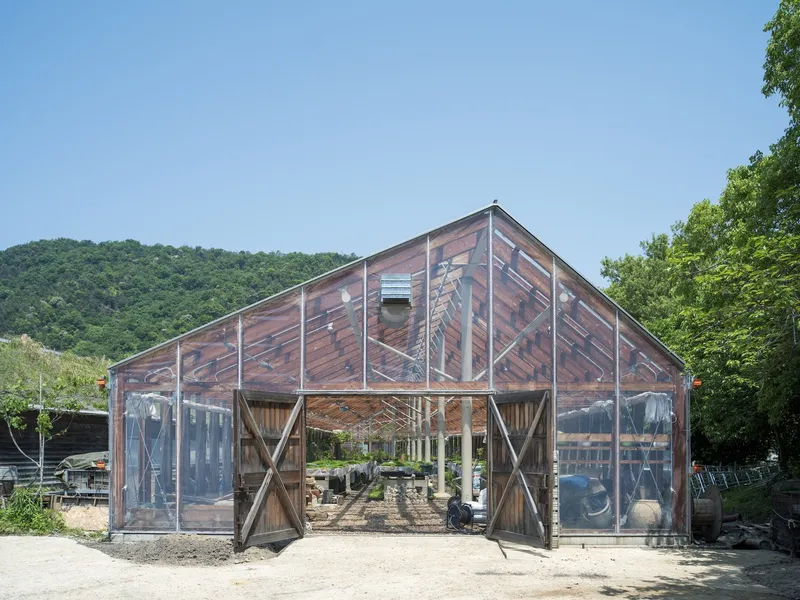
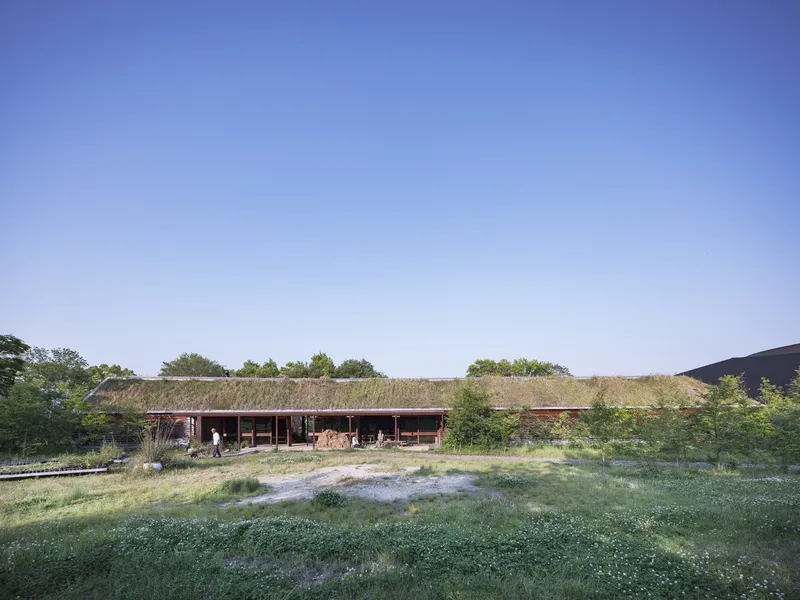
Seen from the side, Candy Farm reveals its structural logic. A transparent gabled greenhouse rises from a solid planted base, its timber frame reinforced with diagonal steel cross-bracing that reads as both honest engineering and deliberate graphic gesture. The repetitive gable module creates rhythm along the length of the building, and the transparency of the glass walls allows the surrounding greenery to flood in visually.
The planted roof structure visible from the meadow side shows how the two systems, living roof and gabled greenhouse, meet. Wildflowers in the foreground continue seamlessly onto the roof plane, while the gabled section rises above like a lantern. The joint between opaque and transparent is handled cleanly: no awkward flashing or clumsy transition, just a quiet shift from earth to glass.
Light, Structure, and Interior Atmosphere
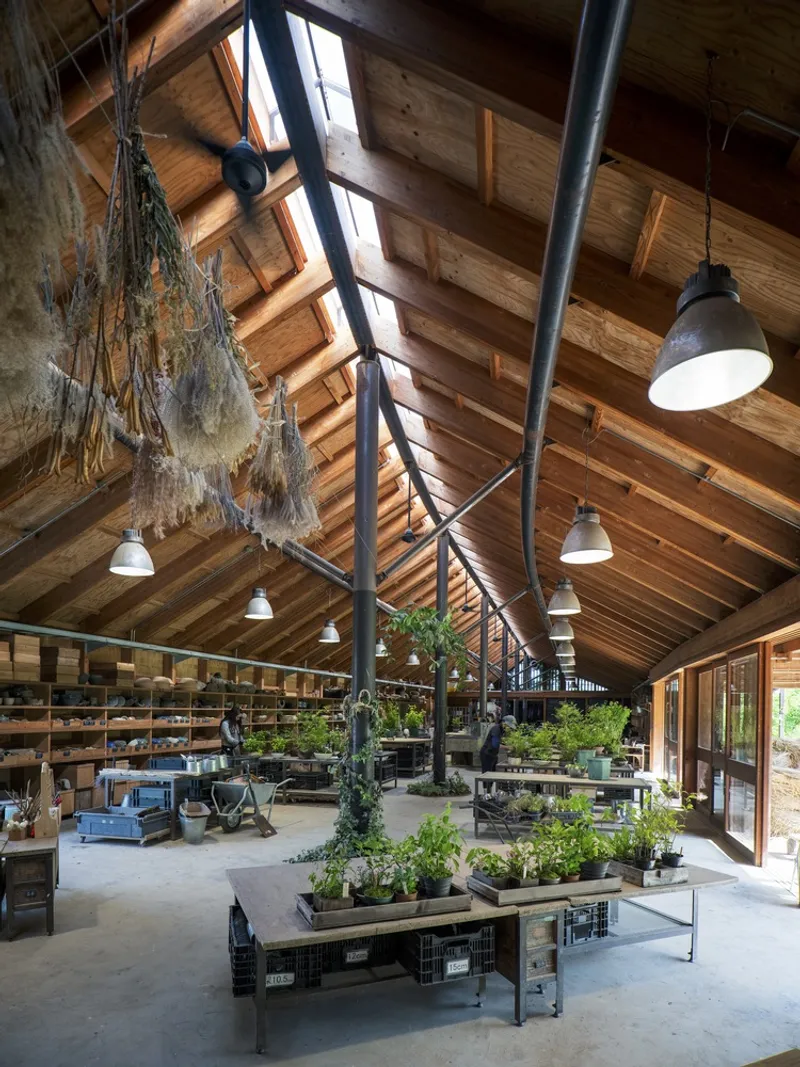
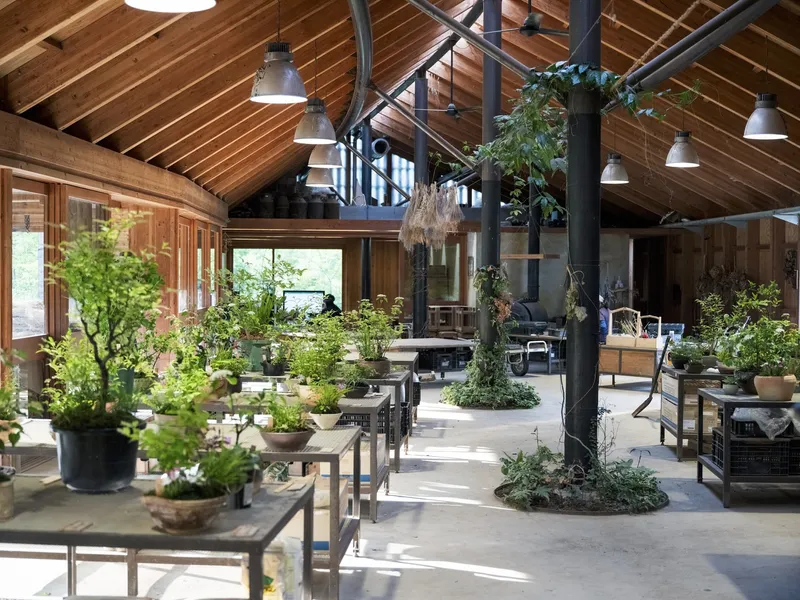
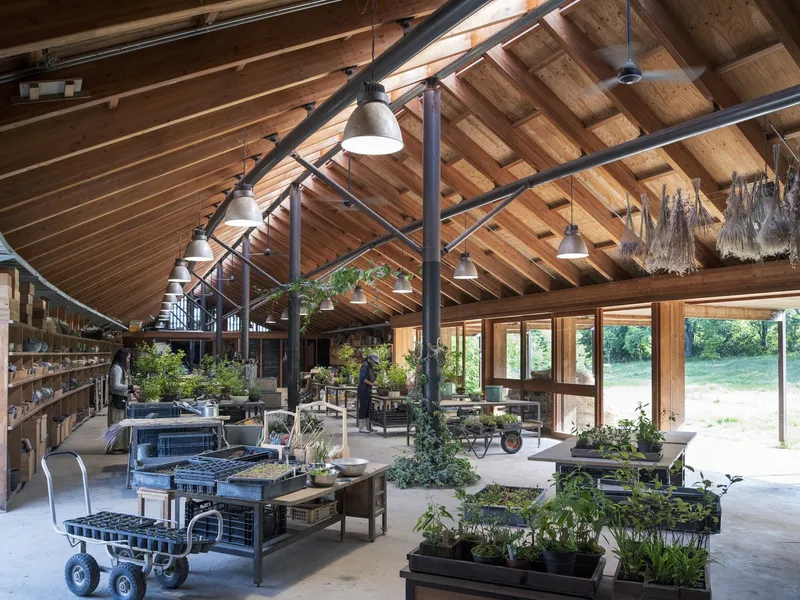
Inside, the repeated gabled bays create a nave-like sequence. Exposed timber rafters and steel columns establish a clear structural hierarchy: the columns carry gravity loads while the timber frames define enclosure and roof geometry. Skylights at the ridge wash the interior with diffuse natural light, and industrial pendant fixtures supplement on overcast days. It is a working greenhouse first, an architectural experience second, and that ordering of priorities gives the space its honesty.
The planted beds and potted nursery stock arranged along the interior reinforce the program's primacy. Rows of potted plants on display tables, soil beds at floor level, and the warm timber cladding overhead create an atmosphere closer to a botanical garden than a utilitarian polytunnel. The long interior views, framed by receding column bays, give the space a processional quality that rewards slow movement through it.
The material palette is deliberately restrained: timber, steel, glass, soil. Nothing competes for attention. The consequence is that you notice the plants, the light, and the rhythm of structure rather than any single signature detail. For a university research project, that restraint signals confidence in the design proposition itself.
Why This Project Matters
Candy Farm is a useful corrective to the school of green-roof architecture that treats vegetation as appliqué. Here, the planted surfaces are load-bearing participants in the building's formal and environmental strategy. They shape the massing, regulate interior climate, manage stormwater, and visually dissolve the boundary between building and site. The project demonstrates that ecological performance and spatial ambition are not competing agendas but reinforcing ones.
Coming from a university lab rather than a commercial practice, Candy Farm also models a different production context for architecture. The research agenda is embedded in the built form, not applied retroactively through published papers. For studios and students interested in the overlap between environmental science and design practice, this small project in a Japanese valley is one of the more convincing arguments we have seen for what that overlap can actually look like when it takes physical shape.
Candy Farm, designed by Kyoto University Global Environmental Architecture Lab, Japan. Photography by Kiyoshi Nishioka.
About the Studio
Share Your Own Work on uni.xyz
If projects like this are the kind of work you want to make, uni.xyz is a place to publish your own, find collaborators, and enter design competitions.


Popular Articles
Popular articles from the community


The Musturak Paradise: Senior Living Architecture for a Connected Future in Temara, Morocco
The Musturak Paradise reimagines senior living architecture in Temara via private homes, social spaces, culture, community, and shared care.

Hill & Cross Opera: Sculptural Opera House Architecture Shaped by Tallinn’s Landscape and Identity
Hill & Cross Opera reimagines opera house architecture in Tallinn through its sculptural hill, civic plaza, glass wave and a luminous cross.

Co-life: Sustainable Architecture for Age-Friendly Community Living
Co-life reimagines sustainable architecture for seniors through courtyards, rammed earth, shared gardens, and spaces designed for belonging.

The Ocean Hive: Sustainable Architecture for a Self-Sufficient Civilization at Sea
The Ocean Hive imagines sustainable architecture at sea, where modular habitats, algae, wave power and ocean waste sustain a growing colony.
Similar Reads
You might also enjoy these articles


Hodi-Mandai Geram
Project Function: Preservation and revitalization of the Intangible heritage and socio-spatial identity of the Hodi by Housing, Cultural Memory Center, Sacred Grove, landscape, local tourism economy


Olio Towers: A Mid-Rise for Performers That Fuses Housing, Rehearsal, and Stage
Located blocks from Houston's Theater District, this modular tower stacks living units around a central performance atrium.

Oasis: Modular Green Housing Carved into Dhaka's Urban Fabric
A shortlisted Plugin Housing entry reclaims unauthorized settlements in Dhaka with stepped concrete volumes, green roofs, and ventilation-driven design.

Black Hole: A Floating Megastructure for the Post-Physical Era
Emiliano Mazzarotto envisions a spherical, self-scaling arena where e-sports, digital hotels, and holographic stadiums replace traditional public space.

Explore Architecture Competitions
Discover active competitions in this discipline



Challenge to design public laboratory


Challenge to reimagine the Iron Throne


Photograph architecture without architects


Illustrate the lost glory of Angkor Wat - Render Challenge
Comments (0)
Please login or sign up to add comments
No comments yet. Be the first to comment!