
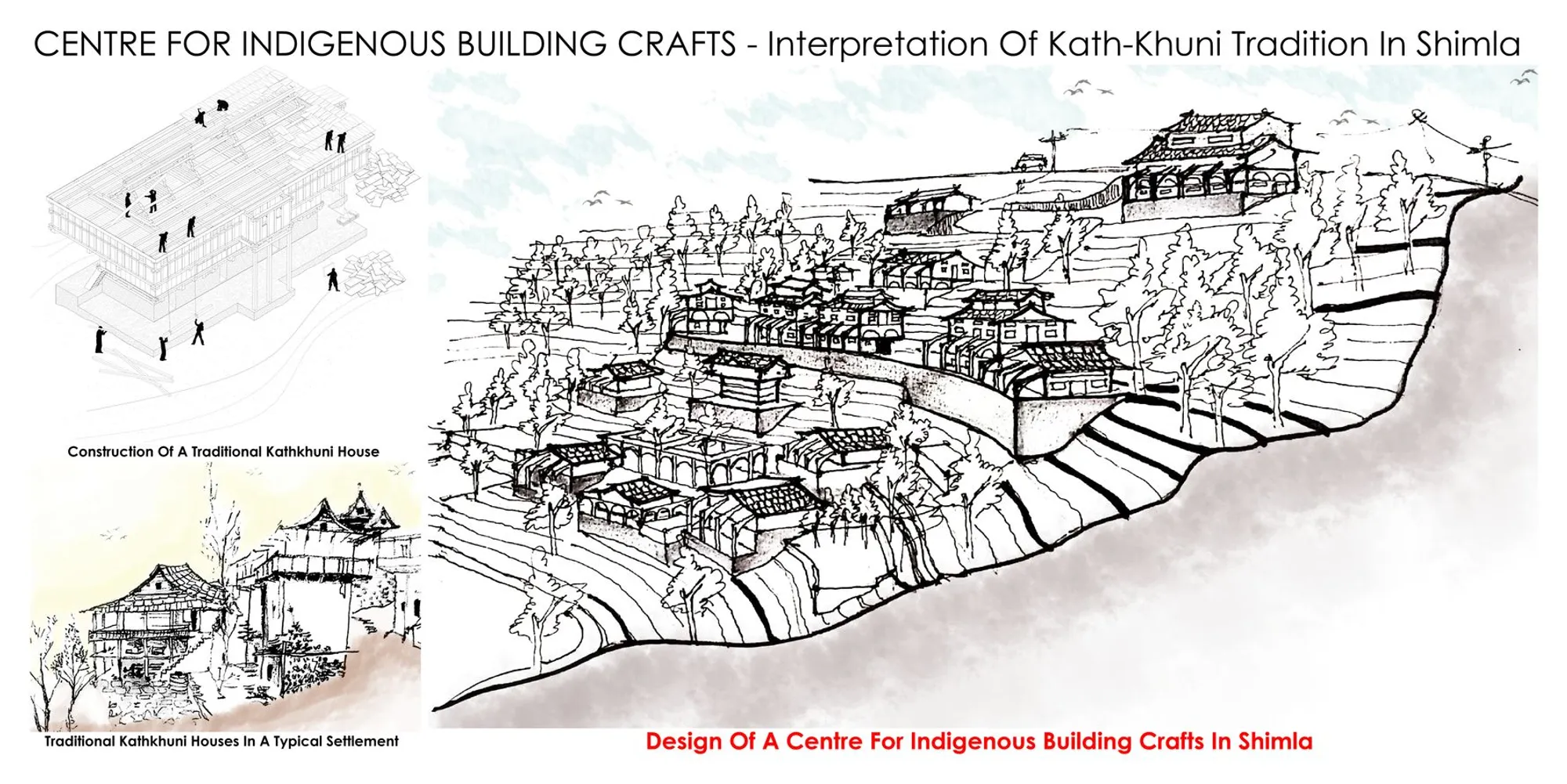
Center for Indigenous Building Crafts: Reinterpreting Kath-Khuni Construction in Shimla
A living campus in the Himalayas where dry stone and timber interlocking techniques become the foundation for a new school of vernacular practice.


In the Himalayan foothills, a construction technique has survived earthquakes, monsoons, and centuries of use without a single drop of mortar. Kath-Khuni, the ancient infill masonry system of alternating dry stone and seasoned wooden beams interlocked purely through craft and gravity, is now threatened not by nature but by the creep of concrete blocks and GI-sheet roofs. The Center for Indigenous Building Crafts proposes a direct counter: a campus in Shimla that treats this vernacular technique not as a relic to be preserved behind glass, but as a living practice to be taught, tested, and evolved.
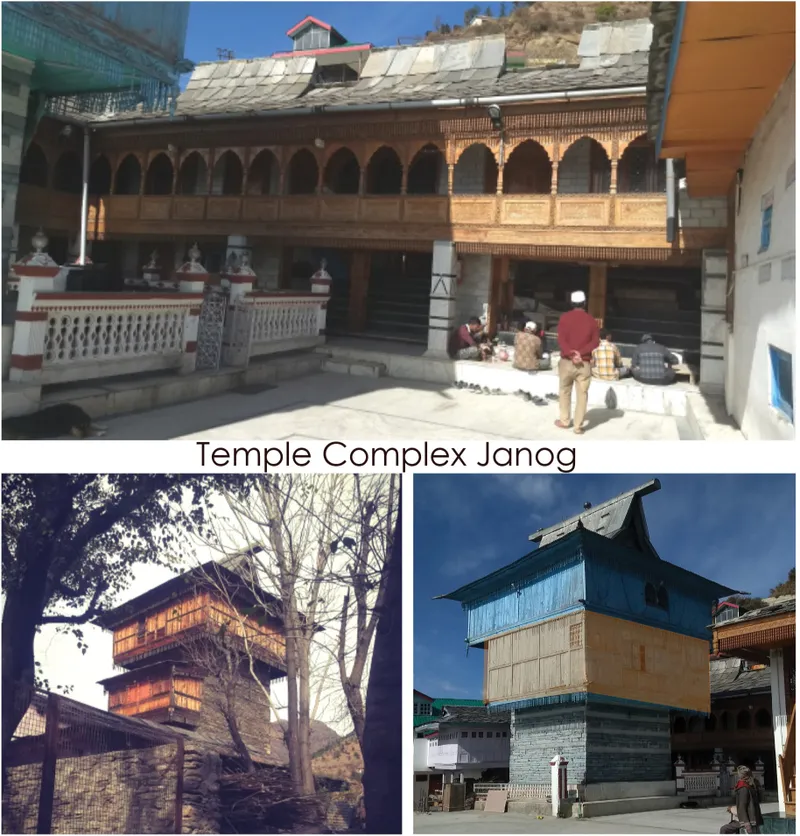
Designed by Keyur Shah and published on uni.xyz, the project is rooted in extensive fieldwork across remote Himalayan villages including Jangoo, Balag, and Dhagoli. These settlements informed the design language: temple complexes, elevated plinths, recessed courtyards, and homes aligned along topographic contours all find their way into the proposal. Set in Shimla, Himachal Pradesh, the center positions itself at the intersection of ancestral building knowledge and contemporary architectural education.
Reading the Hillside: Settlement Patterns as Design Logic
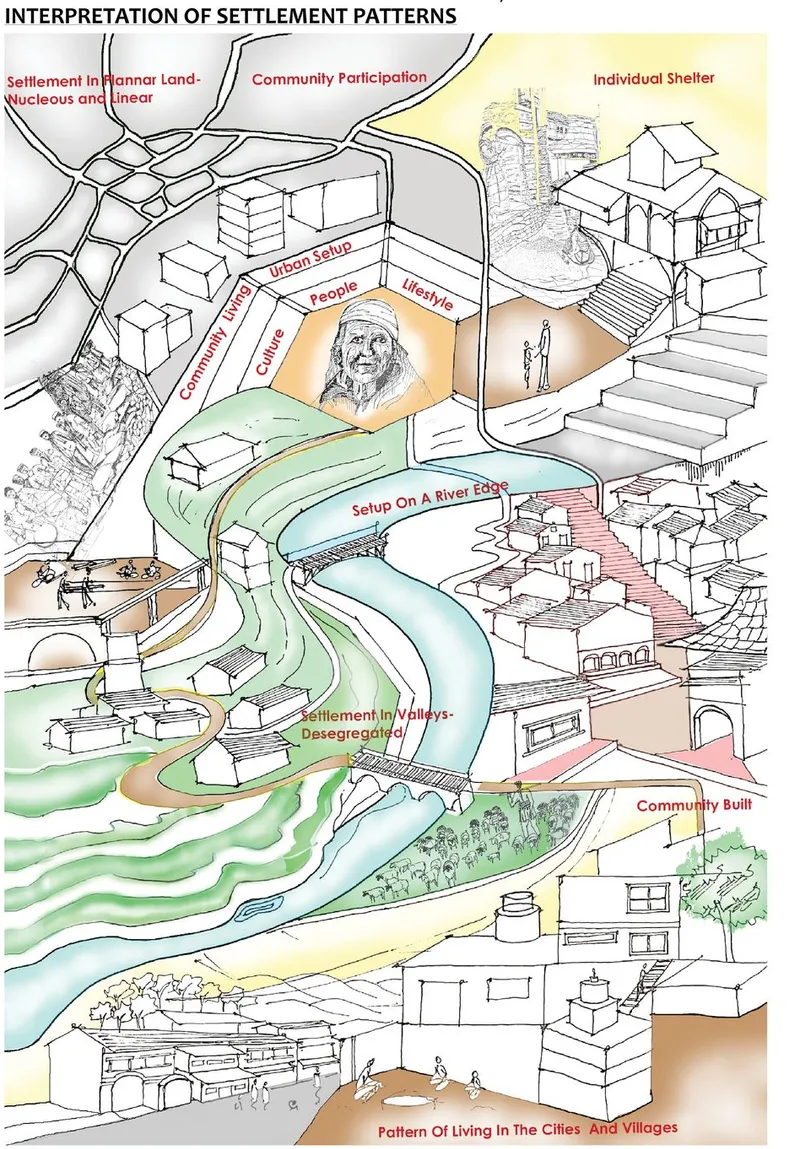
The axonometric drawing reveals how Shah studied existing settlement patterns along a river corridor, mapping zones for housing and community gathering. These patterns, where buildings follow contour lines and public life clusters around shared thresholds, become the organizational DNA of the campus. Rather than imposing a singular built form onto the hillside, the project distributes its program across the terrain in a way that mirrors the organic logic of Himalayan villages.
The timber arcade with its arched openings overlooking a courtyard shows what this logic produces at the scale of inhabited space. Vendors gather beneath a structure that is unmistakably contemporary in its program, a community café housed within a repurposed Kath-Khuni typology, yet grounded in the proportions, materials, and spatial generosity of traditional construction. The courtyard functions as both threshold and gathering ground, the kind of in-between space that Himalayan settlements have refined over centuries.
Festival Scale: Public Architecture That Holds a Crowd
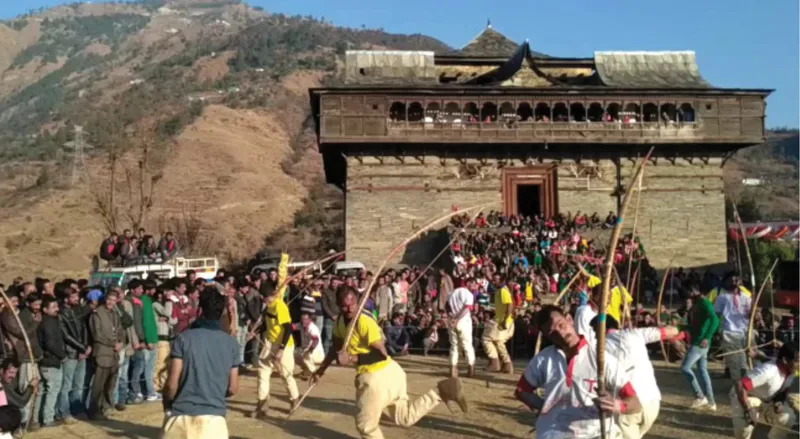
One of the more striking renderings shows a stone and timber structure with an elevated viewing gallery, packed with festival crowds in afternoon light. The image makes an argument that vernacular architecture is not inherently modest or small scale. Here, the Kath-Khuni technique supports a genuinely public building, one that can accommodate interpretation galleries, exhibition spaces, and the communal energy of regional cultural events. The elevated plinth, a detail drawn directly from village temple typologies, lifts spectators above the action while anchoring the structure to the slope.
Construction as Curriculum: Brackets, Sections, and Spatial Detail
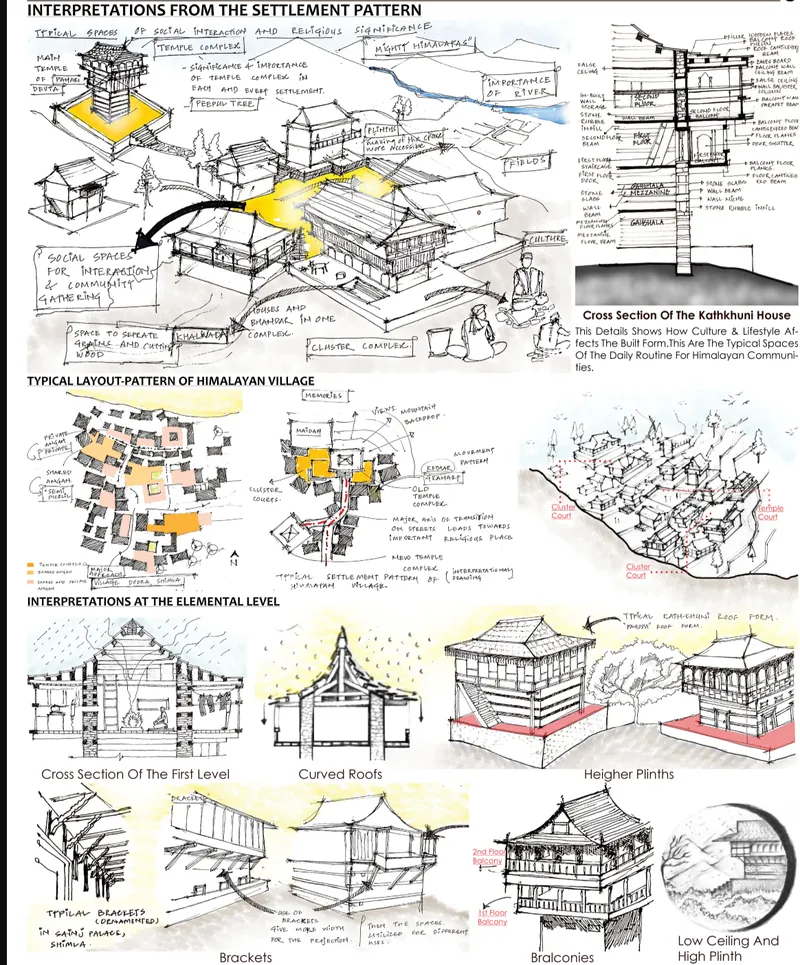
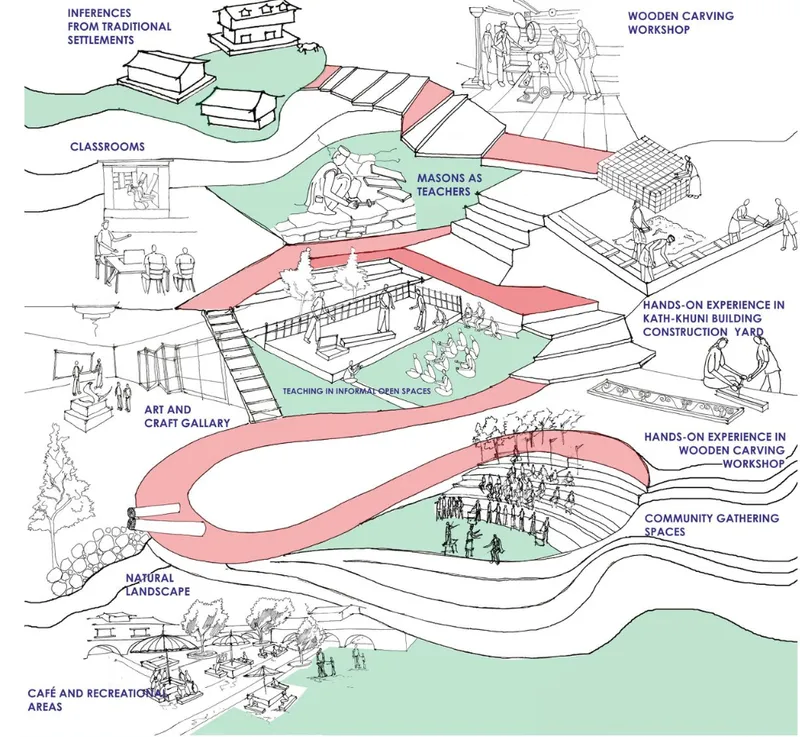
Shah's annotated sketches dissect the buildings at the level of the bracket, the beam joint, and the roof detail. Yellow highlight zones call attention to specific spatial relationships: how a timber bracket transfers load, how a recessed window creates depth in a stone wall, how roof overhangs manage water runoff on a steep site. These drawings are not decorative. They read as teaching documents, which is fitting for a center whose core mission is hands-on instruction in Kath-Khuni, Dhajji, and Tag construction systems.
The isometric drawing extends this pedagogical clarity to the campus plan. Terraced spaces are color-coded by function: classrooms, workshops, and open gathering areas step down the hillside in a sequence that mirrors both the topography and the learning progression. The inclusion of outdoor teaching platforms and open classrooms acknowledges that in vernacular construction, the building site itself is the most effective classroom. Local masons and artisans serve as instructors here, and the spaces are designed to support that direct, embodied transmission of knowledge.
Stepping Down the Slope: Terraced Volumes and Hillside Embedding
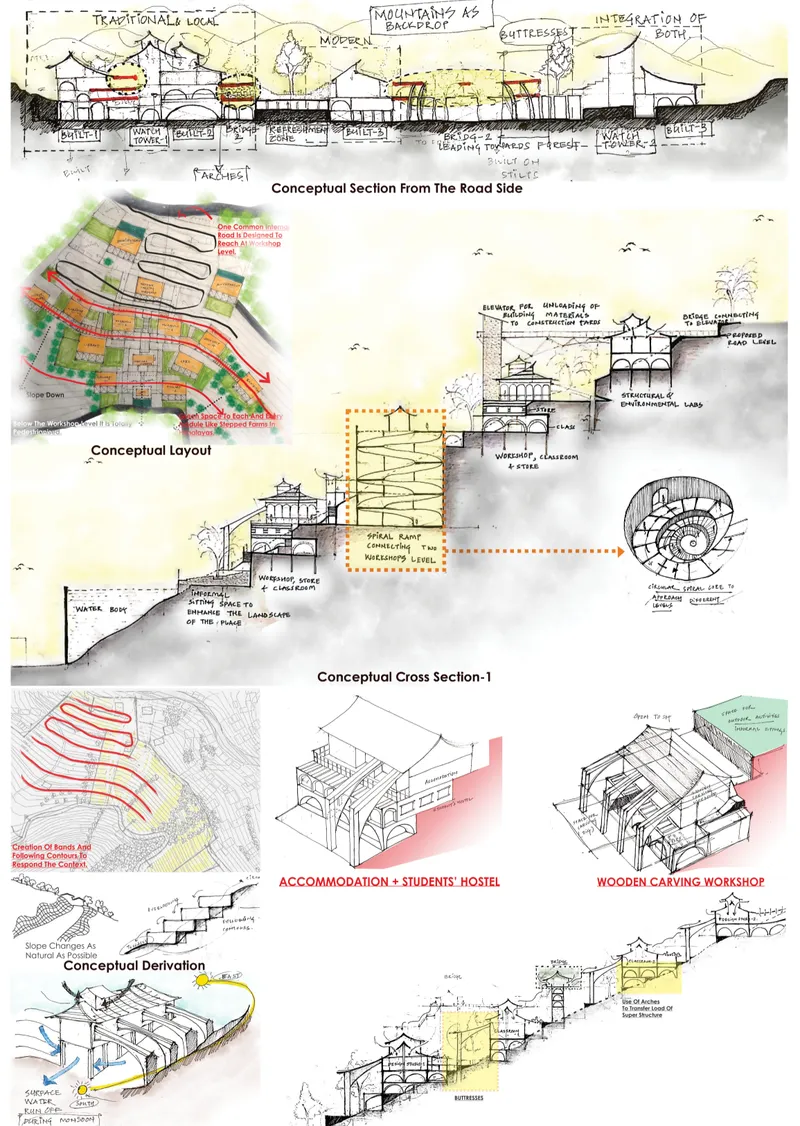
The section and plan drawings illustrate how building volumes are embedded into the hillside through stepped terraces, a strategy that minimizes excavation, manages stormwater naturally, and maintains visual continuity with the surrounding landscape. Each terrace becomes a usable surface: a structural laboratory at one level, a wooden carving studio at another, a library and archive tucked into the slope where the thermal mass of earth regulates interior climate.
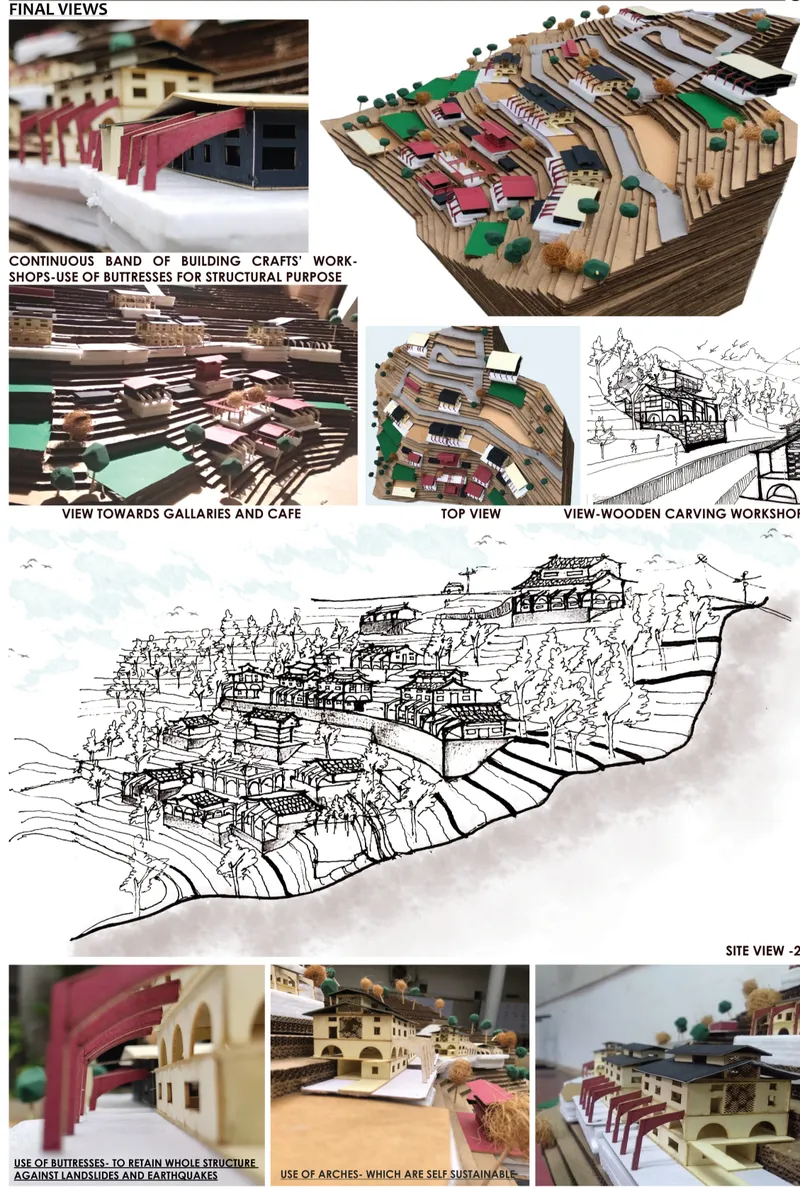
The physical model brings the full spatial proposition into focus. Layered timber and colored panel volumes cascade down the site, each unit legible as a distinct programmatic element while the whole reads as a single, cohesive settlement. The model makes visible what the drawings only imply: that the center is not a building so much as a small village, organized around the same principles of topographic sensitivity, material honesty, and communal life that define the best Himalayan settlements.
Why This Project Matters
The Center for Indigenous Building Crafts reframes a familiar preservation narrative. Instead of asking how to save a dying technique, Shah asks how to make it aspirational. The program, which spans hands-on workshops, environmental testing labs, artisan-led instruction, and public exhibition, treats Kath-Khuni not as a heritage curiosity but as a viable, seismically intelligent, climate-responsive construction system with direct relevance to contemporary building challenges in the Himalayan region.
The project's strength lies in its refusal to separate knowledge from practice. Every design decision, from the terraced campus plan to the timber arcade courtyard, is both a spatial proposition and a demonstration of the techniques being taught inside. In a region where concrete and corrugated steel are rapidly flattening architectural identity, this center offers a counter-model: one where cultural continuity and progressive design are not opposites but collaborators.
View the Full Project
About the Designers
Designer: Keyur Shah
Enter a Design Competition on uni.xyz
uni.xyz runs architecture and design competitions year-round that reward proposals with spatial conviction and real site intelligence.
Project credits: Center for Indigenous Building Crafts by Keyur Shah.




Popular Articles
Popular articles from the community


Play: Fragments of Their World
Familiar architecture becomes modular playground design, creating safe spaces where displaced children can learn, connect, imagine and play.

Lunar Spiral: Space Architecture Shaped by the Mathematics of the Universe
Lunar Spiral reimagines space architecture through Fibonacci geometry, lunar regolith, levitating habitats, and self-sustaining Moon living.

Hill & Cross Opera: Sculptural Opera House Architecture Shaped by Tallinn’s Landscape and Identity
Hill & Cross Opera reimagines opera house architecture in Tallinn through its sculptural hill, civic plaza, glass wave and a luminous cross.

The Ocean Hive: Sustainable Architecture for a Self-Sufficient Civilization at Sea
The Ocean Hive imagines sustainable architecture at sea, where modular habitats, algae, wave power and ocean waste sustain a growing colony.

Similar Reads
You might also enjoy these articles

Bao Huynh Watercolor Atelier: A Serene Art Retreat in Hội An
Bao Huynh Watercolor Atelier in Hội An blends multifunctional art spaces, sustainable design, local materials, and family-friendly living in a serene environment.

Atelier Macri Concept Store Interior Design by CASE-REAL
Atelier Macri store features a "ko" counter, walnut wood details, cork displays, blending retail, gallery, and seamless customer experiences.

Manuel Vargas Izquierdo Stadium and High-Performance Sports Center: Architectural Excellence in Jalpa de Méndez
The Manuel Vargas Izquierdo Stadium blends sustainable design, inclusive sports facilities, and cultural-inspired architecture, revitalizing Jalpa de Méndez’s public spaces.

KAKR Buluh Awar Hall: Revitalizing Community and Ecology Through Bamboo Architecture
Community built bamboo hall revitalizes Buluh Awar village, empowering youth, restoring ecology, celebrating vernacular craftsmanship through sustainable architecture and culture.

Explore Uttarakhand Architecture Competitions
Discover active competitions in this discipline



Challenge to design public laboratory


Design challenge to reuse E-waste
Comments (0)
Please login or sign up to add comments
No comments yet. Be the first to comment!