
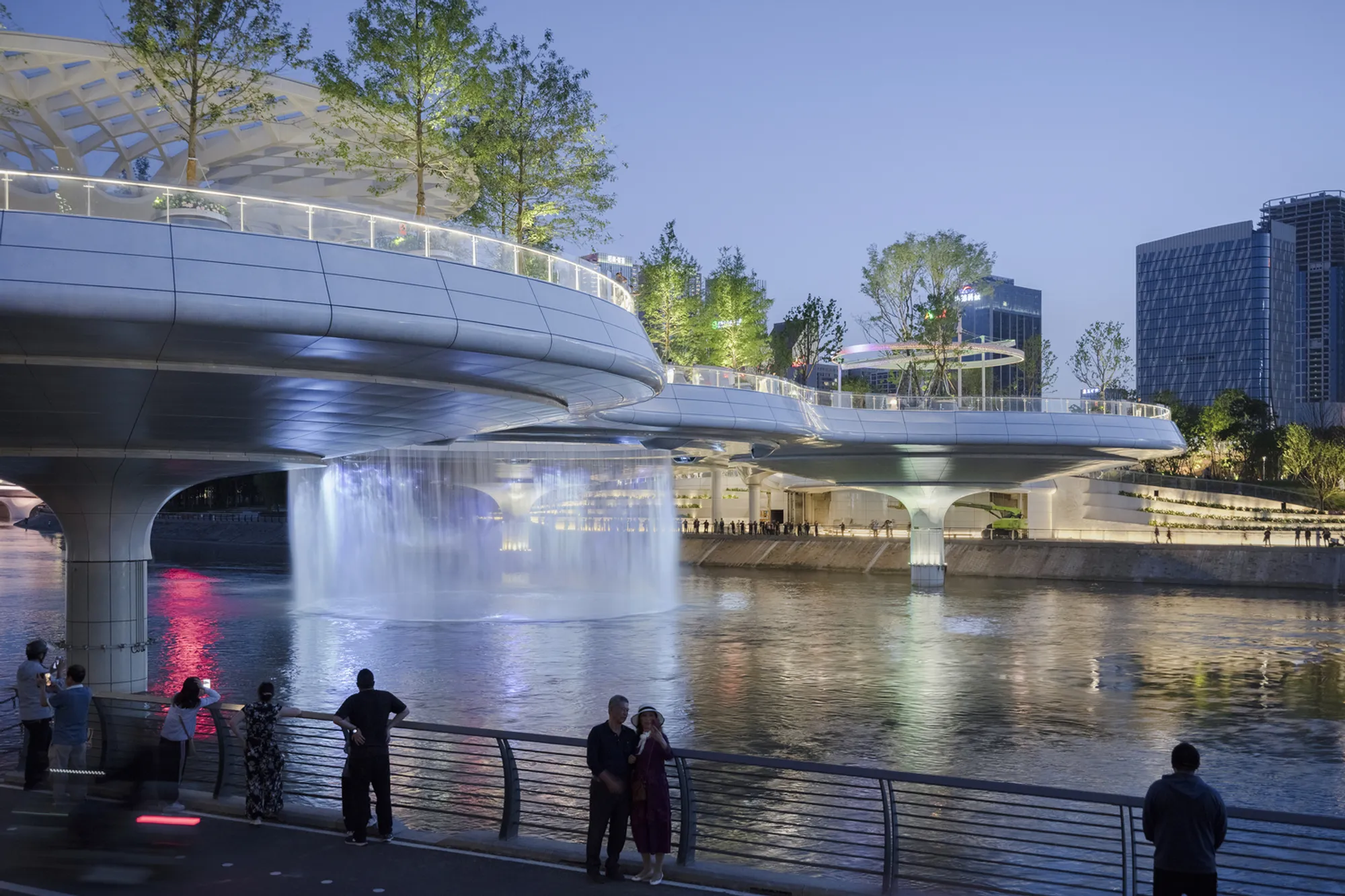
China Southwest Architectural Design Floats a 498-Meter Lotus-Leaf Park Over Chengdu's Jinjiang River
Nine cantilevered discs stitch a divided financial district back together with a three-level pedestrian bridge that doubles as an urban park.


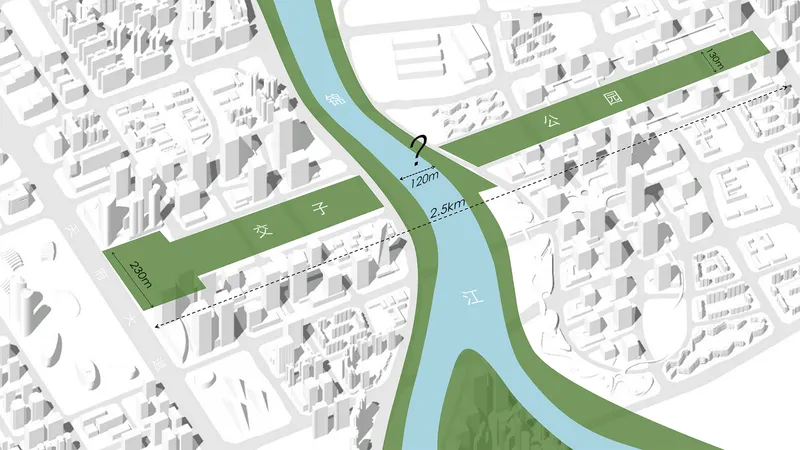
A river can connect a city or split it in two. In Chengdu's Jiaozi Financial Headquarters Business District, the Jinjiang River does the latter, slicing a 2.5-kilometer east-west green belt into disconnected halves. The response from China Southwest Architectural Design and Research Institute is not a bridge in any conventional sense. It is a 12,000-square-meter floating park composed of nine circular platforms, ranging from 300 to 1,600 square meters each, that hover over the water like oversized lotus leaves. At 498 meters long with a 120-meter river-crossing span, the Jiaozi Pedestrian Bridge completed in 2024 is simultaneously infrastructure, landscape, and public building.
What makes the project genuinely interesting is not its botanical metaphor but the way it weaponizes that metaphor structurally and programmatically. The lotus-stem-inspired irregular two-way rigid frame does real work: it balances the dead load of cantilevered discs, introduces lateral stability, and reduces mass through varied openings that also happen to let light, wind, and rain reach the river below. Each disc carries a distinct program, from a 24-hour unmanned library to a water bar to a circular outdoor theater carved from the riverbank terrain. The bridge is less a crossing than a public room suspended in three dimensions.
Nine Discs, One Continuous Landscape
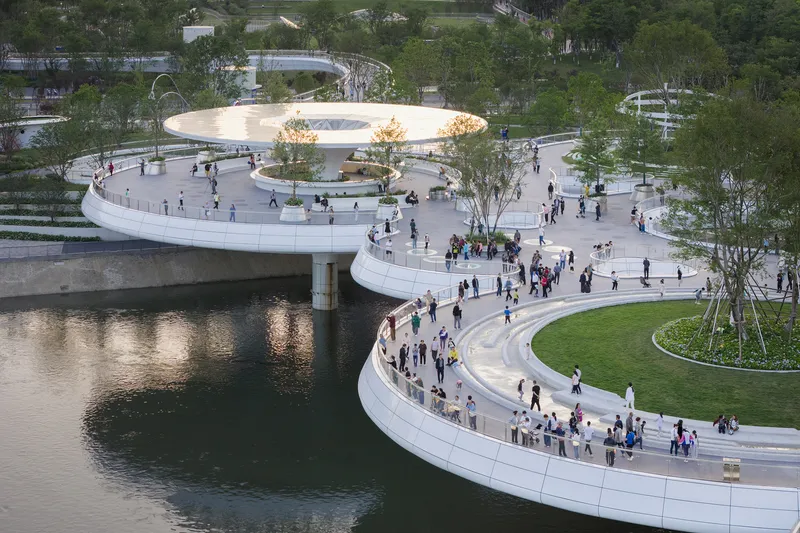
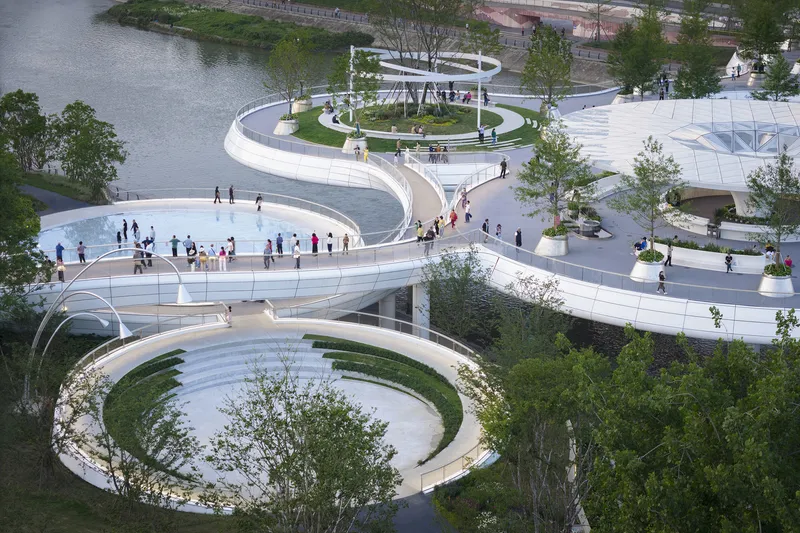
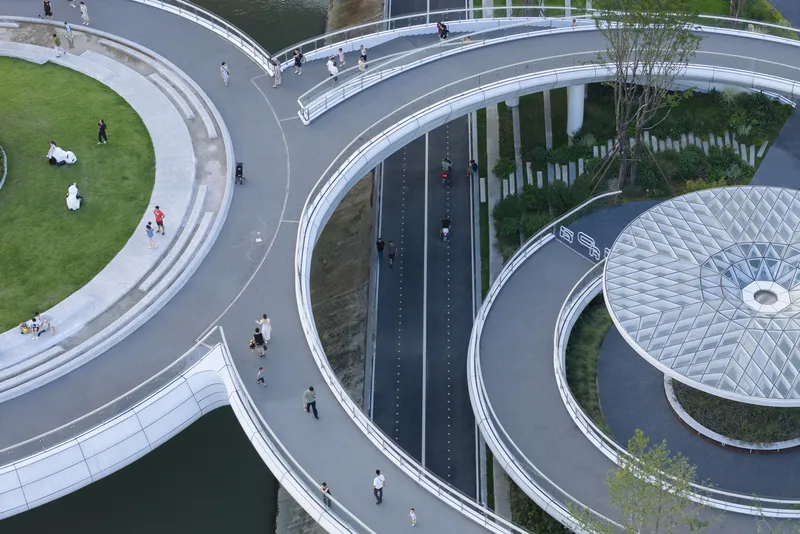
From above, the bridge reads as a constellation of circular platforms threaded together by curving paths. The nine discs vary enough in size and elevation to avoid monotony while maintaining a clear formal language. Gaps between them are not leftover space; they are designed apertures that preserve views of the river and allow sunlight to reach the water surface, protecting the ecological health of the waterway underneath.
46 trees, including Texas live oak, Japanese maple, Liquidambar formosana, Chinese tallow, and Chinese pistache, populate the platforms. Their placement is not decorative. Tree locations are determined by the structural load capacity of each cantilever, meaning the landscape plan and the engineering are a single integrated decision. Seasonal foliage shifts the color palette of the bridge throughout the year, giving the structure a living surface that no fixed material could replicate.
Three Levels of Circulation
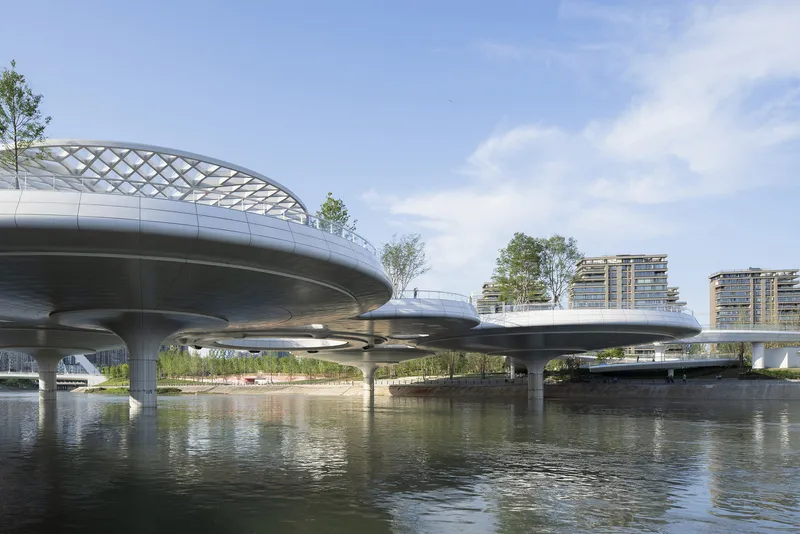
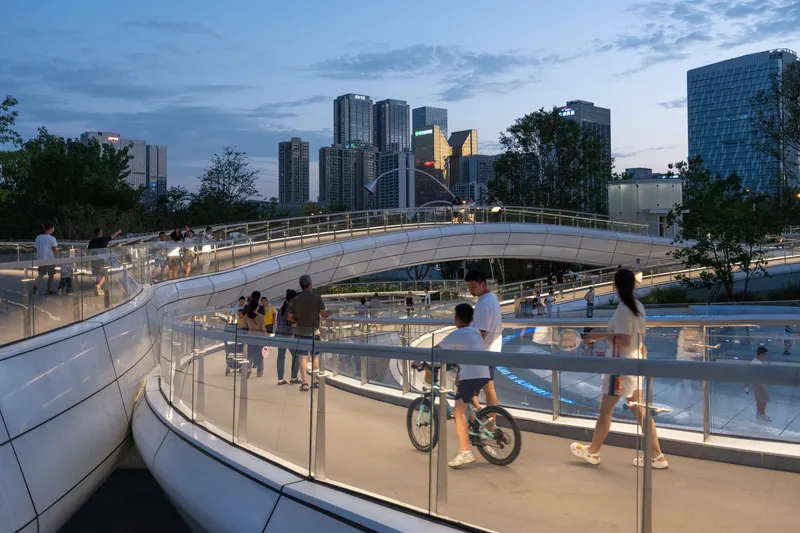
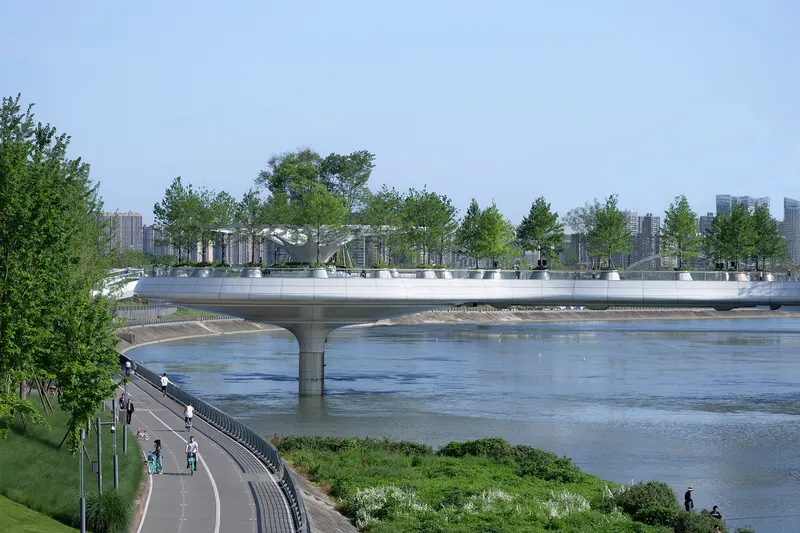
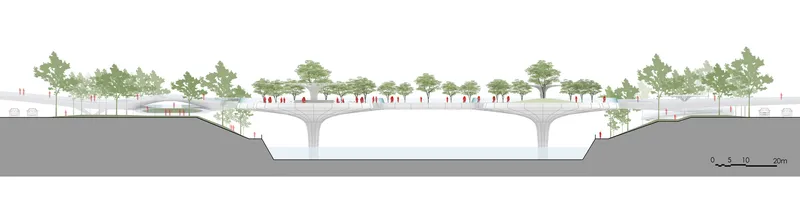
The most consequential design decision here is the three-level pedestrian route system. The upper level crosses the river and the adjacent roads, connecting the financial district's two halves at an elevation that clears vehicular traffic entirely. The middle level aligns with city streets, providing direct access to the surrounding urban fabric. The lower level drops to the riverside paths, linking into the existing greenway network. Ramps, stairs, and elevators stitch the three layers together.
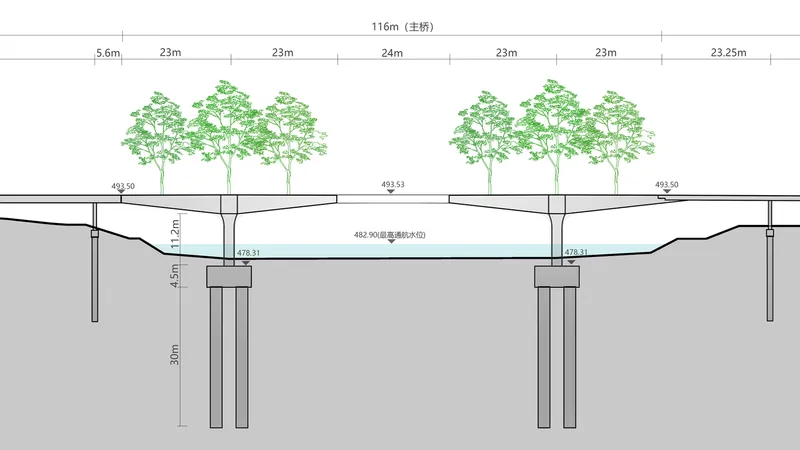
The architects invoke the Hanging Gardens of Babylon, which is the kind of reference that usually signals marketing overreach. In this case, the comparison has some structural honesty. The layered circulation does produce genuinely terraced public space, with planted canopies overhead and water at your feet. Cylindrical concrete columns rising from the waterway carry the upper decks, and their rhythm gives the underside of the bridge a civic scale that keeps the space beneath from feeling like an afterthought.
Shelter, Play, and the Covered Bridge Tradition
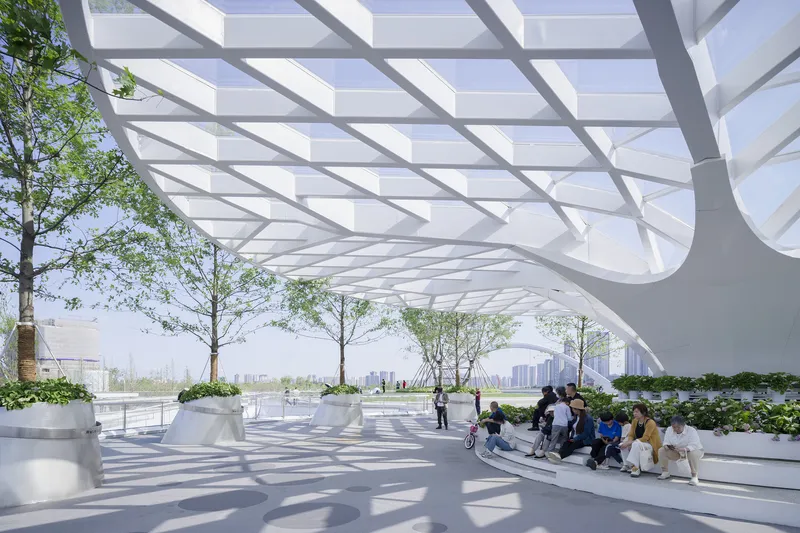
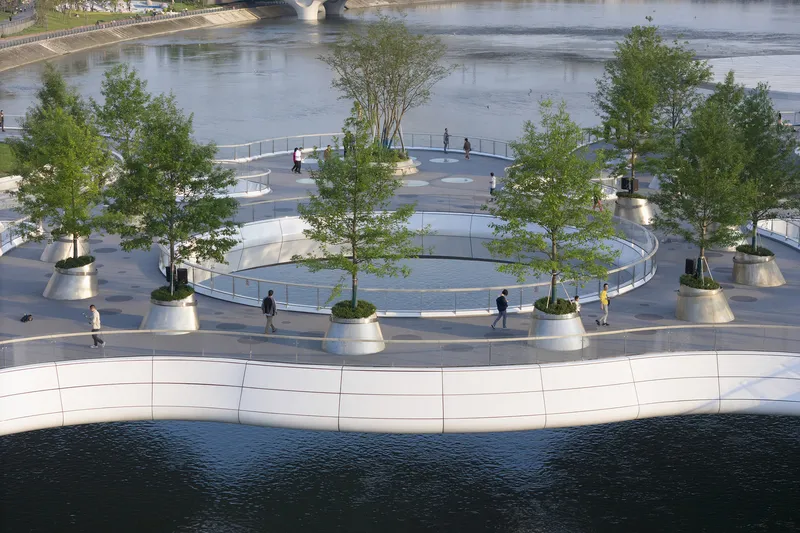
Western Sichuan has a long tradition of covered bridges, most notably the Nanqiao Bridge in Dujiangyan, where eaves shelter pedestrians from rain and sun. The Jiaozi Bridge updates that idea. The white structural lattice overhead on several platforms acts as a contemporary version of the traditional covered bridge canopy, filtering light without enclosing the space. Beneath it, visitors sit among conical planters and tree-lined terraces that overlook the river.
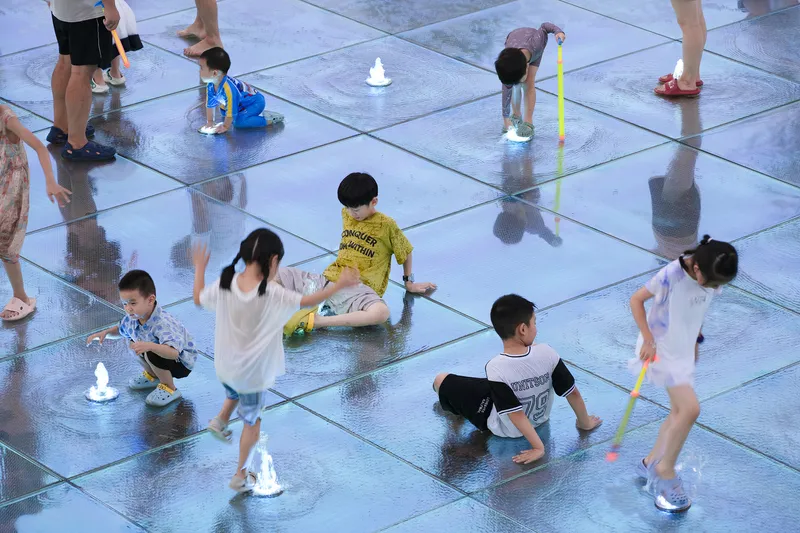
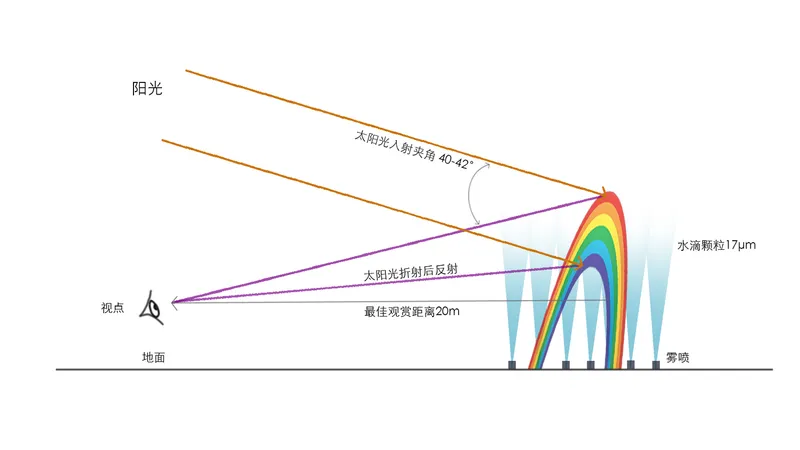
The playful side of the program is concentrated on a shallow water plaza with glass pavers, where children wade and launch toy boats. It is a simple gesture, but it demonstrates a commitment to making the bridge legible to all ages. Around the ring-shaped central deck opening, a water curtain installation doubles as a nighttime light show, while a 30-meter mist-spray installation called "Meeting the Rainbow" refracts sunlight at calculated angles to produce an artificial rainbow. That last detail sounds gimmicky until you see the engineering diagram: the spray trajectory is calibrated to the solar angle, which is more optics than spectacle.
Dusk and the Waterfront Edge
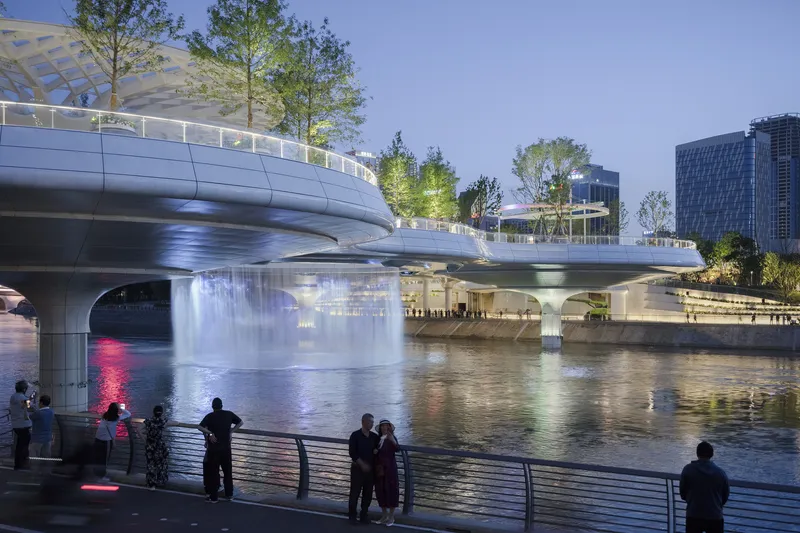
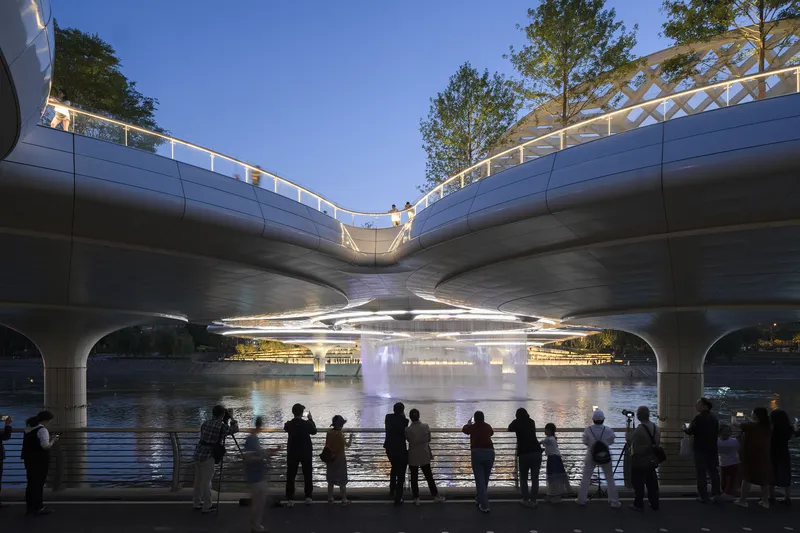
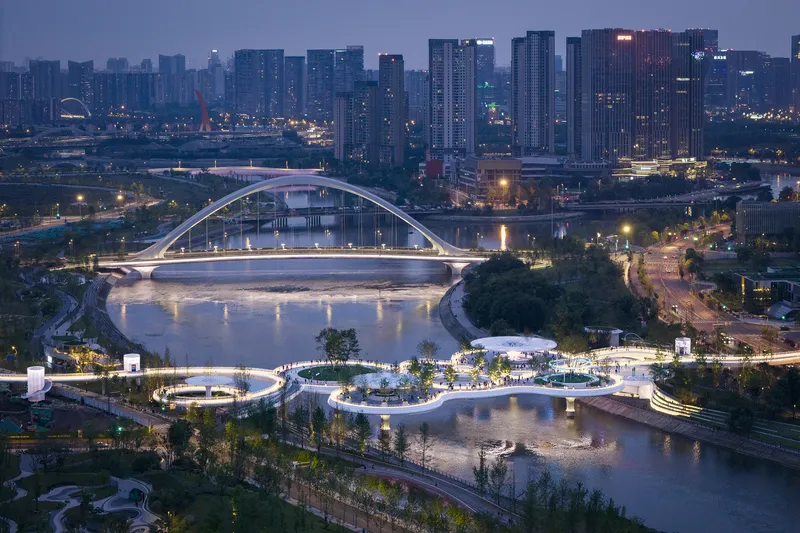
At twilight, the bridge shifts register. The tiered decks glow from integrated lighting, and the riverfront promenade fills with crowds gathering along the water's edge to watch fountain displays. The curved undersides of the concrete decks become luminous ceilings over the lower-level paths. The effect is cinematic without being theatrical: the lighting reveals the structural logic rather than masking it.
From a distance, the dusk aerial views confirm that the bridge operates at two scales simultaneously. At the urban scale, it reads as a continuous green connection across the river, repairing the severed park belt. At the human scale, it dissolves into a series of intimate rooms: a terrace here, a viewing ring there, a shaded bench beneath a canopy of Japanese maple.
Material and Thermal Strategy
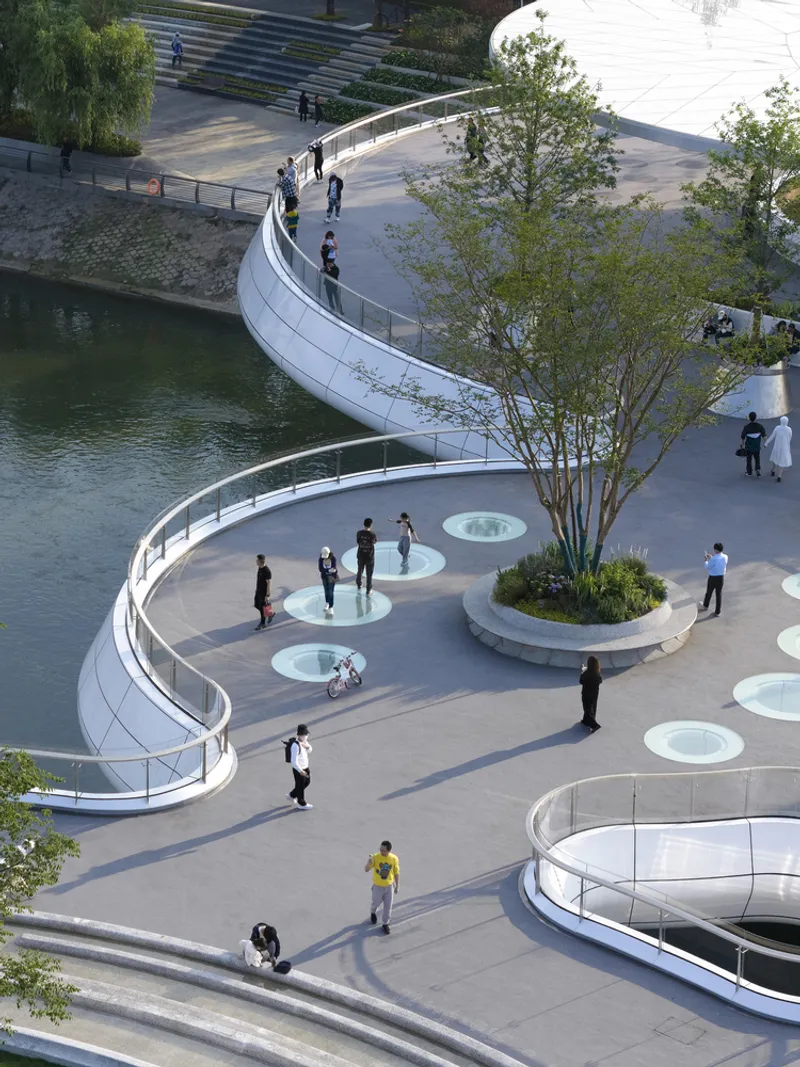
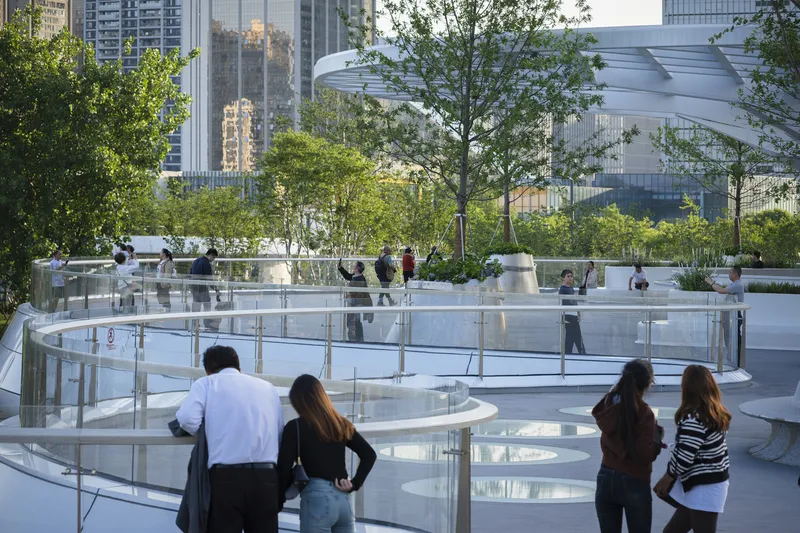
The primary structure is steel, but the deck paving uses ER colored expanded clay aggregate, a calcined ceramsite material chosen specifically for its thermal performance. Expanded clay aggregate controls thermal expansion and contraction, minimizing the cracking risk that plagues large-span bridge decks exposed to Chengdu's humid subtropical climate. It is a technical choice that has aesthetic consequences: the matte, mineral surface of the paving contrasts with the polished stainless steel railings and the reflective pool surfaces on several platforms.
Passive climate strategy is embedded in the geometry. The gaps between discs channel prevailing winds across the deck. Tree foliage provides shade in summer and allows solar gain in winter after leaf drop. The perforations in the deck are sized to let enough light through to maintain biological activity in the river. None of these features are heroic; collectively, they represent a disciplined approach to building over water without killing what lives in it.
Plans and Drawings
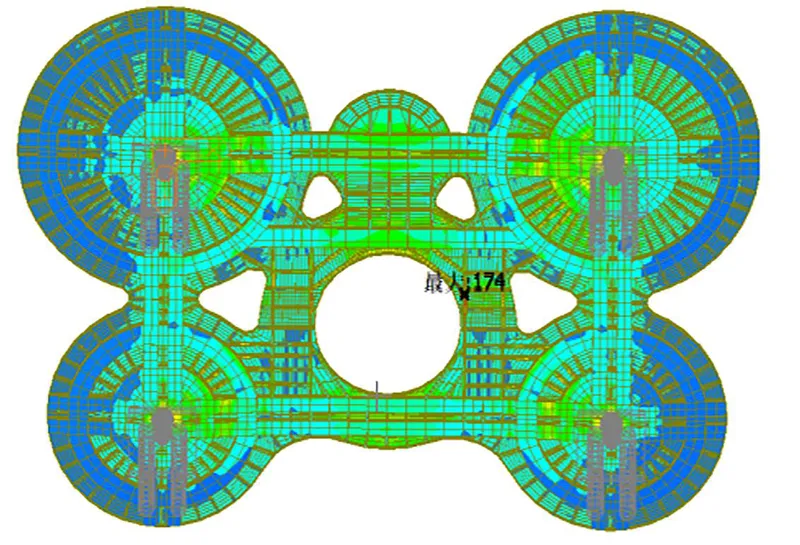
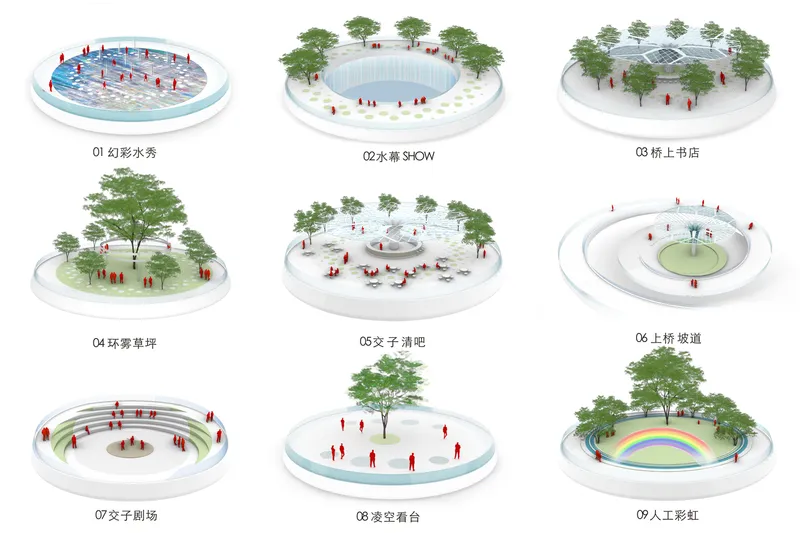
The structural analysis diagram reveals the symmetry underlying the apparently organic plan: four circular zones flanking a central void, with the rigid frame distributing loads outward to the column supports. The axonometric studies of all nine plaza configurations show how each disc accommodates a different mix of trees, seating, and program, confirming that no two platforms are identical despite sharing the same formal vocabulary.
The site plan makes the urban argument plain. The bridge sits precisely where the green belt hits the river, reconnecting two elongated blocks of the financial district. The section drawings expose the three-level circulation in profile: arched spans carrying a tree-lined deck above street level, with columnar supports at regular intervals. The rainbow diagram is the most unusual drawing in the set, plotting the solar angle against the mist-spray trajectory to guarantee that refraction produces a visible spectrum at specific times of day.
Why This Project Matters
Pedestrian bridges are typically the most underfunded, under-designed category of urban infrastructure. Cities build them narrow, utilitarian, and disconnected from the landscape they cross. The Jiaozi Bridge inverts that hierarchy entirely, treating the bridge as the most important piece of public space in the district. By distributing 12,000 square meters of park, library, theater, and play space across nine elevated platforms, the project argues that a bridge can be a destination rather than a corridor.
The deeper lesson is about urban repair. Chengdu's financial district was designed around the car and the tower, and the Jinjiang River became a barrier rather than an amenity. The Jiaozi Bridge does not solve that problem entirely, but it demonstrates a method: use infrastructure budgets to create public landscapes, and let the landscape do the connecting. When the structural system, the planting strategy, the passive climate design, and the program all reinforce the same idea, the result is a piece of city that feels inevitable rather than imposed.
Chengdu Jiaozi Pedestrian Bridge by China Southwest Architectural Design and Research Institute. Chengdu, China. 12,000 m². Completed 2024. Photography by Holi Landscape Photography.
About the Studio
Share Your Own Work on uni.xyz
If projects like this are the kind of work you want to make, uni.xyz is a place to publish your own, find collaborators, and enter design competitions.




Popular Articles
Popular articles from the community


Co-Life: Senior Housing Design That Reconnects Older Adults With the City
Co-Life reimagines senior housing design through healing gardens, shared streets, workshops, and a sustainable community across generations.

Play: Fragments of Their World
Familiar architecture becomes modular playground design, creating safe spaces where displaced children can learn, connect, imagine and play.

Lunar Spiral: Space Architecture Shaped by the Mathematics of the Universe
Lunar Spiral reimagines space architecture through Fibonacci geometry, lunar regolith, levitating habitats, and self-sustaining Moon living.

Hill & Cross Opera: Sculptural Opera House Architecture Shaped by Tallinn’s Landscape and Identity
Hill & Cross Opera reimagines opera house architecture in Tallinn through its sculptural hill, civic plaza, glass wave and a luminous cross.

Similar Reads
You might also enjoy these articles


Hodi-Mandai Geram
Project Function: Preservation and revitalization of the Intangible heritage and socio-spatial identity of the Hodi by Housing, Cultural Memory Center, Sacred Grove, landscape, local tourism economy


Olio Towers: A Mid-Rise for Performers That Fuses Housing, Rehearsal, and Stage
Located blocks from Houston's Theater District, this modular tower stacks living units around a central performance atrium.

Oasis: Modular Green Housing Carved into Dhaka's Urban Fabric
A shortlisted Plugin Housing entry reclaims unauthorized settlements in Dhaka with stepped concrete volumes, green roofs, and ventilation-driven design.

Black Hole: A Floating Megastructure for the Post-Physical Era
Emiliano Mazzarotto envisions a spherical, self-scaling arena where e-sports, digital hotels, and holographic stadiums replace traditional public space.


Explore Pedestrian Bridge Competitions
Discover active competitions in this discipline



Challenge to reimagine the Iron Throne


Photograph architecture without architects


Illustrate the lost glory of Angkor Wat - Render Challenge


Design challenge to reuse E-waste
Comments (0)
Please login or sign up to add comments
No comments yet. Be the first to comment!