
Chess Encounter: Where a Spatial Board Game Becomes Therapeutic Architecture
A competition-winning design transforms community space into an interactive chess-inspired landscape for emotional healing and play.


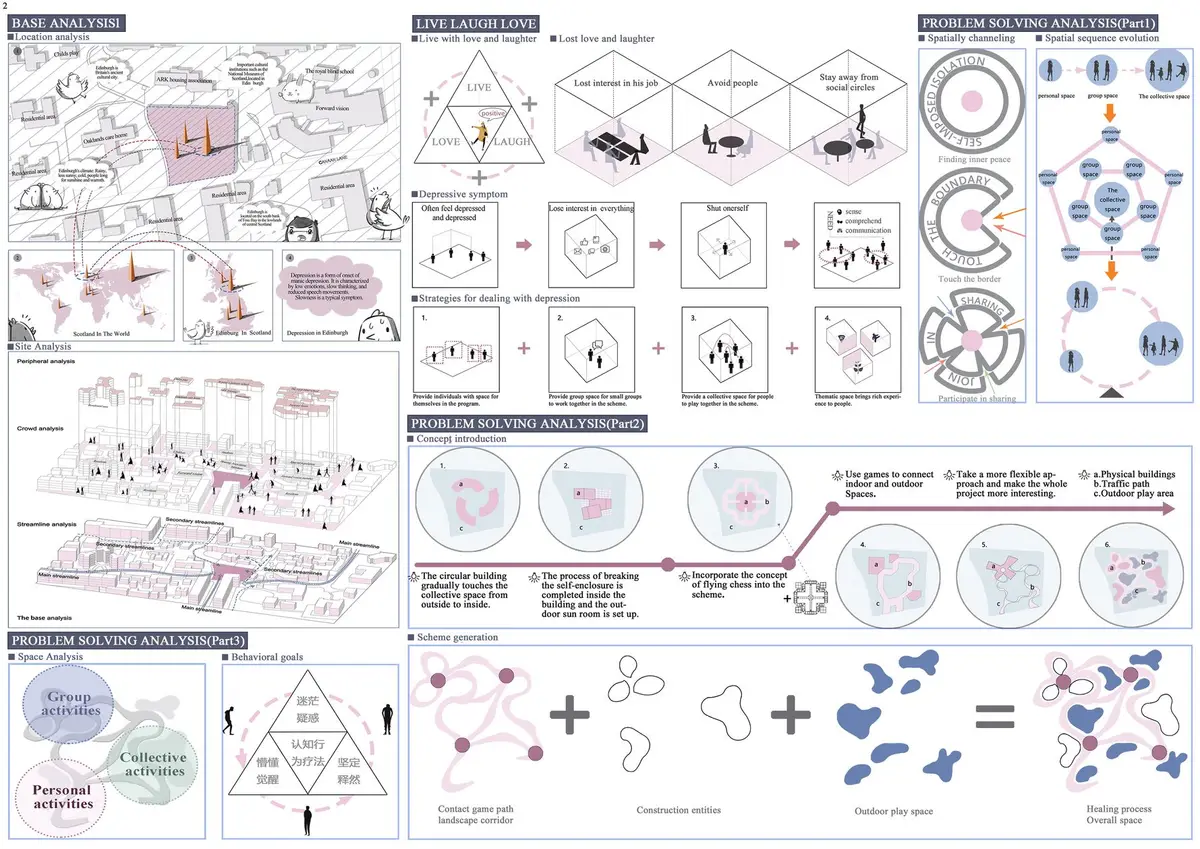
Roll the dice, move through the grid, and land in a pottery studio. Or a counseling room. Or a music lawn. Chess Encounter flattens the hierarchy between play, therapy, and architecture into a single spatial proposition: the floor plan as board game. Every turn through the building is a deliberate emotional beat, designed to surprise, calm, or connect. It is a project that takes the familiar logic of a tabletop game and scales it up to the size of a community building, embedding psychological intention into every grid square.
Designed by MENGYA Huang (Dreama Huang) and Tian Wenhui, Chess Encounter won the Live Laugh Love 2020 competition on uni.xyz. The jury responded enthusiastically; Eleena Jamil, Principal at Eleena Jamil Architect, called it "simply lovely and uplifting," while Juanjo Otero of MOL Arquitectura praised its "detailed programmatic study" made legible through "easy-to-understand graphics." The project reimagines community space as a holistic, inclusive environment built around the central conceit of "Chess Meets Life," where participants navigate colored paths, encounter programmatic surprises, and engage with spaces calibrated for mental wellness and social connection.
Three Lobes, Multiple Entrances, and the Garden Between
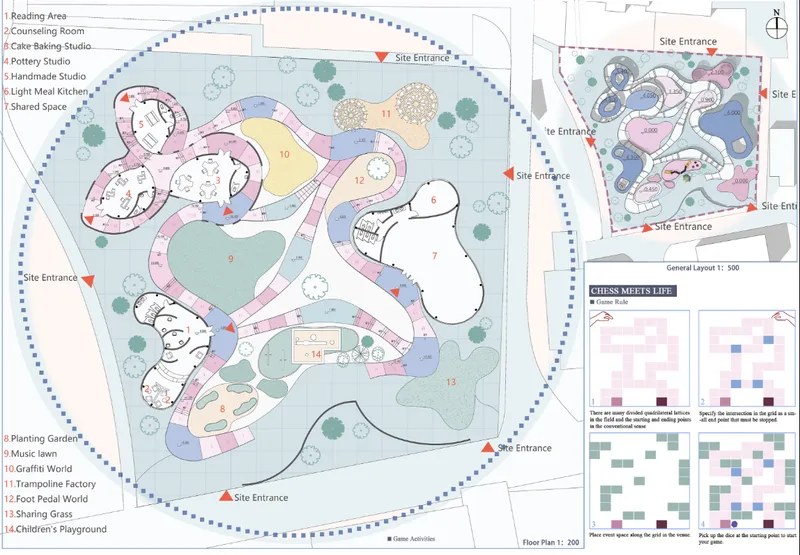
The site plan reveals three curving, lobe-shaped volumes wrapped in landscaped planting gardens, with multiple entrance points dissolving the idea of a single front door. There is no prescribed route in. Instead, users arrive from different edges of the site and immediately begin their own journey through the game-like layout. The lobes create distinct zones of program while the gardens between them act as decompression spaces, soft green thresholds between one emotional register and the next. The organic geometry resists the rigid orthogonal grid that typically governs institutional plans, reinforcing the project's insistence that healing spaces should feel nothing like hospitals or offices.
Curving Circulation as Narrative Thread
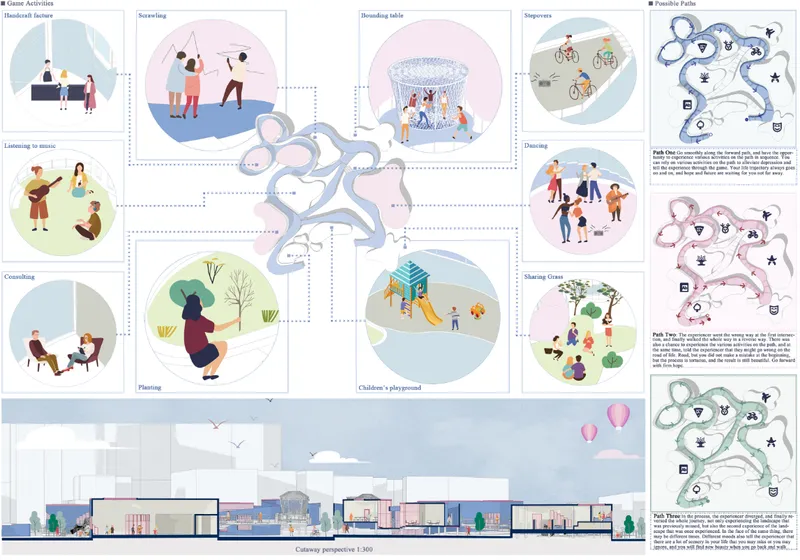
The cutaway perspective section is where the design's ambition becomes clearest. Illustrated activity diagrams populate the drawing, showing people baking cakes, throwing pots, reading, jumping on trampolines, painting graffiti walls, and tending planting beds. Curving circulation paths weave between these program spaces, connecting a reading area and counseling room at one end to a trampoline factory and foot pedal world at another. The section makes visible how the designers choreographed movement: paths are not corridors but spatial events in themselves, bending to create pauses, widening to allow gathering, and narrowing to funnel users toward a specific sensory experience.
Each programmatic zone serves a distinct psychological function. The pottery studio, handmade studio, and cake baking studio offer tactile grounding. The graffiti world and music lawn provide expressive release. The counseling room and shared space facilitate dialogue and introspection. The children's playground and sharing grass invite open-ended social play. Fourteen distinct zones in total, layered across the site to create what the designers describe as a microcosm of emotional experiences. The variety is not decorative; it is the therapeutic mechanism itself, ensuring that wherever the dice take you, something meaningful is waiting.
Pink and Blue Volumes Floating in a Canopy of Trees
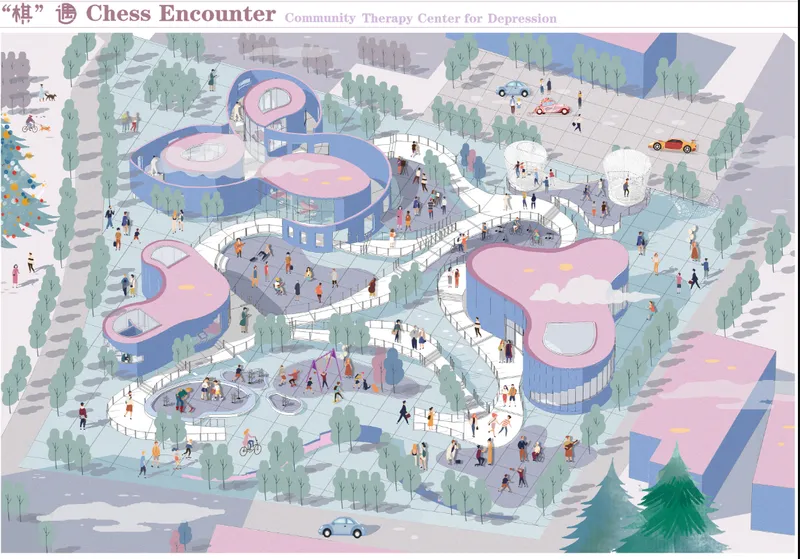
The aerial axonometric rendering gives the project its most seductive image. Pink and blue organic volumes sit arranged around courtyards, populated with tiny human figures and enclosed by a ring of surrounding trees. The color palette is deliberate, soft and inviting without being saccharine, lending the architecture a sense of warmth that institutional buildings rarely achieve. Courtyards between the volumes create outdoor rooms where the planting garden, music lawn, and sharing grass programs spill into open air. The trees surrounding the site provide acoustic and visual shelter, turning the entire complex into a pocket of calm within its urban or suburban context.
What strikes most about this view is the porosity of the plan. There are no fortress walls here, no singular controlled entrance. The architecture breathes. People flow in, through, and around the volumes, finding their own sequence of spaces. It is an architecture that trusts its users to self-direct, guided gently by color, curvature, and the playful logic of the game board embedded underfoot.
Why This Project Matters
Chess Encounter makes a persuasive case that therapeutic architecture does not need to look or feel clinical. By borrowing the structure of a board game, Huang and Tian invented a spatial framework that makes exploration feel spontaneous and healing feel incidental rather than imposed. The genius of the game metaphor is that it gives users permission to wander, to be surprised, and to engage with emotionally calibrated spaces without the stigma that often accompanies mental health infrastructure. In a post-pandemic context increasingly attuned to the spatial dimensions of well-being, this kind of thinking matters.
Beyond the concept, the project demonstrates a rigorous programmatic intelligence. Fourteen distinct zones are not thrown together haphazardly but sequenced along curving paths that modulate between high-energy and contemplative activities, between social and solitary spaces. The clear, illustrative graphic language of the drawings ensures that the design's logic is accessible to non-architects, a quality the jury explicitly praised. Chess Encounter is ultimately a reminder that architecture's most powerful tool may not be form or material but the choreography of human experience.
View the Full Project
About the Designers
Designers: MENGYA Huang (Dreama Huang), Tian Wenhui
Enter a Design Competition on uni.xyz
uni.xyz runs architecture and design competitions year-round that reward proposals with spatial conviction and real site intelligence.
Project credits: Chess Encounter by MENGYA Huang (Dreama Huang), Tian Wenhui Live Laugh Love 2020 (uni.xyz).


Popular Articles
Popular articles from the community


Co-Life: Senior Housing Design That Reconnects Older Adults With the City
Co-Life reimagines senior housing design through healing gardens, shared streets, workshops, and a sustainable community across generations.

The Musturak Paradise: Senior Living Architecture for a Connected Future in Temara, Morocco
The Musturak Paradise reimagines senior living architecture in Temara via private homes, social spaces, culture, community, and shared care.

Co-life: Sustainable Architecture for Age-Friendly Community Living
Co-life reimagines sustainable architecture for seniors through courtyards, rammed earth, shared gardens, and spaces designed for belonging.

ALGAL REALM: A Bio-Integrated Lunar Habitat Design for Life Beyond Earth
ALGAL REALM reimagines lunar habitat design with algae-powered life support, 3D-printed regolith, and vertical living for a lunar future.

Similar Reads
You might also enjoy these articles

Day and Night Park: A Time-Based Urban Newsstand in Beijing
A temporary urban newsstand in Beijing blending travel, light, and reading through poetic colors, compact form, and community-focused design.

Modernist Patio Renovation in El Masnou, Barcelona by Oliver Segura Arquitectura + Cebrià Arquitectura
Modernist patio renovation blending tradition and innovation with a movable pool, leveled floors, and Catalan materials in El Masnou.

Alto Residencial Coop: Cooperative Housing Development in Santiago de Compostela by Carbajo Barrios Arquitectos
A linear cooperative housing complex blending white volumes and perforated metal façades, enhancing community living, natural light, privacy, and urban integration.

Vil Genis School by BPA ARCHITECTURE – Massy, France
Vil Genis School in Massy, France, features sustainable design, south-facing classrooms, community integration, accessible spaces, and modern educational architecture.

Explore Thoughtful Spaces Competitions
Discover active competitions in this discipline

Challenge to reimagine the Iron Throne

Photograph architecture without architects

Illustrate the lost glory of Angkor Wat - Render Challenge

Design challenge to reuse E-waste
Comments (0)
Please login or sign up to add comments
No comments yet. Be the first to comment!