
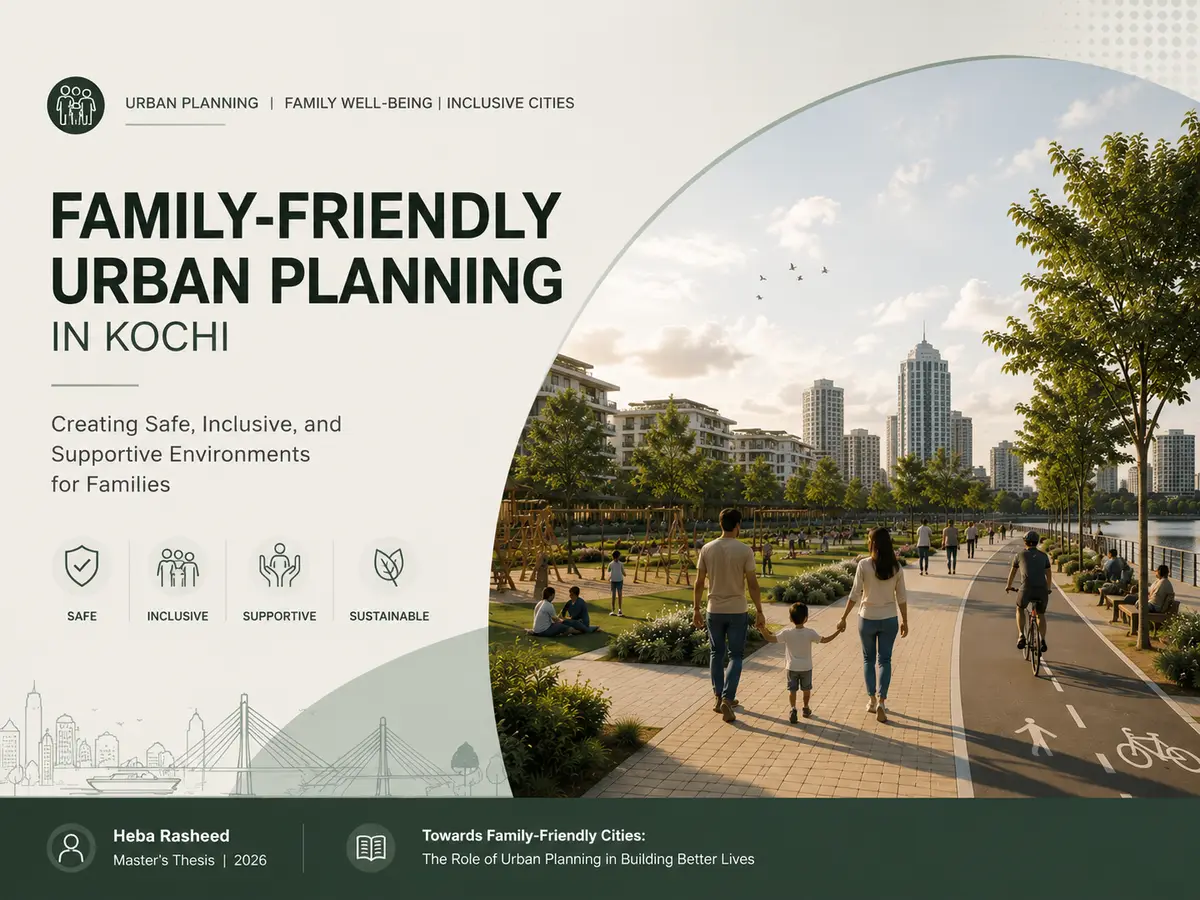
Cities for Every Generation
Planning Kochi for Safer, Inclusive, and Family-Friendly Urban Living By Heba Rasheed

Cities are more than physical environments; they shape the health, safety, and well-being of the people who live in them. As rapid urbanization transforms Indian cities, families increasingly face challenges such as inadequate public spaces, unsafe streets, limited accessibility, traffic congestion, environmental degradation, and unequal access to essential services. These issues particularly affect children, older adults, caregivers, and persons with disabilities, highlighting the need for urban planning approaches that prioritize families as a fundamental unit of society.
This thesis investigates the role of urban planning in creating family-friendly cities, using Kochi, Kerala, as the primary study area. It examines how planning principles, urban design strategies, mobility networks, public open spaces, housing, community facilities, and social infrastructure influence the quality of life for families. Through literature review, policy analysis, case studies, field observations, and spatial assessment, the research identifies the strengths and limitations of Kochi's existing urban environment.
The study proposes a comprehensive planning framework that integrates safety, inclusivity, accessibility, sustainability, and community well-being into future urban development. It emphasizes walkable neighbourhoods, child-friendly public spaces, universal accessibility, mixed-use development, green infrastructure, and equitable access to services as key components of a family-friendly city.
By combining research with practical planning recommendations, this thesis demonstrates how urban planning can create resilient and people-centered cities that support families across different ages, abilities, and socio-economic backgrounds. The findings contribute to the growing discourse on inclusive urban development and provide a framework for integrating family-friendly principles into planning policies and future city-making initiatives.


Popular Articles
Popular articles from the community


Juan García Correa, John González and Claudia Rueda Sink a Circular Amphitheater into a Manizales Engineering Building
On the La Nubia campus in Manizales, Colombia, the S1 Building folds labs and offices into a hillside of ramped lawns that double as a campus route.

Jaramillo Van Sluys Arquitectura and Urbanismo Turn a Demolished Registry Lot in Quito into an Orchard Plaza
In Quito's Centro Histórico, a 2,800 m² plaza exposes the San Agustín convent wall and redraws its lost Augustinian orchard in volcanic stone.

U.GA Architects Wraps an Oval Rooftop Pool in Curved Board-Formed Concrete on Busan's Jeollidan-gil
In Busan's Jeonpo-dong, a 454 m² mixed-use block stacks a neighborhood facility, guest rooms and an oval rooftop pool inside spiraling concrete walls.

Cube Design Draws an Ecological Corridor Between Two Shenzhen Hills with the Nankai Building
Beside Shenzhen's container docks, the Nankai Building pairs stacked balconies with a climbing green screen to connect two hillsides across its height.

Similar Reads
You might also enjoy these articles

The Rhythm of Seasons
A Farmers' Market Connecting Nature and the City


More Than a Building-Designing a Living System
More Than a Building-Designing a Living System
Base Beyond
DESERT COMPOUND ARID: TOURISM OF ABSENCE AND ABUNDANCE


Comments (0)
Please login or sign up to add comments
No comments yet. Be the first to comment!