

Cliffscraper: A Skyscraper Carved from Santorini's Volcanic Cliffs
Instead of building upward with steel and concrete, this project excavates vertical living spaces from the caldera's ancient rock face.


What if a skyscraper required no new structure at all? Cliffscraper starts with a question that borders on the absurd and answers it with precision: carve habitable space directly into the volcanic caldera of Santorini, turning geological history into vertical architecture. No steel frame, no concrete core, no imported superstructure. The cliff itself is the building. Excavated soil gets reused on site, the surrounding seawater becomes both energy source and freshwater supply, and the island's silhouette remains untouched. It is a radical inversion of the conventional high-rise, one that subtracts rather than adds.
Designed by Meltem Yılmaz and Aylin Yıldırım, the Cliffscraper project takes its cue from the vernacular cave dwellings that have existed on Santorini since the catastrophic volcanic eruption of 1600 BC. That event shaped the island's steep calderas, and locals responded by hollowing out homes that proved both sustainable and earthquake-resistant. Cliffscraper scales that tradition to the dimension of a skyscraper, embedding programme ranging from museums to accommodations within the rock, while simultaneously addressing the island's mounting crises of overtourism, water scarcity, and agricultural decline.
A Water Passage Framed by Perforated Stone
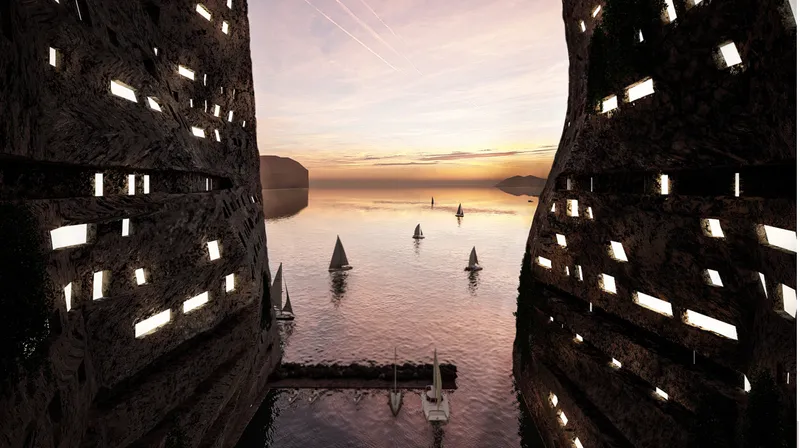
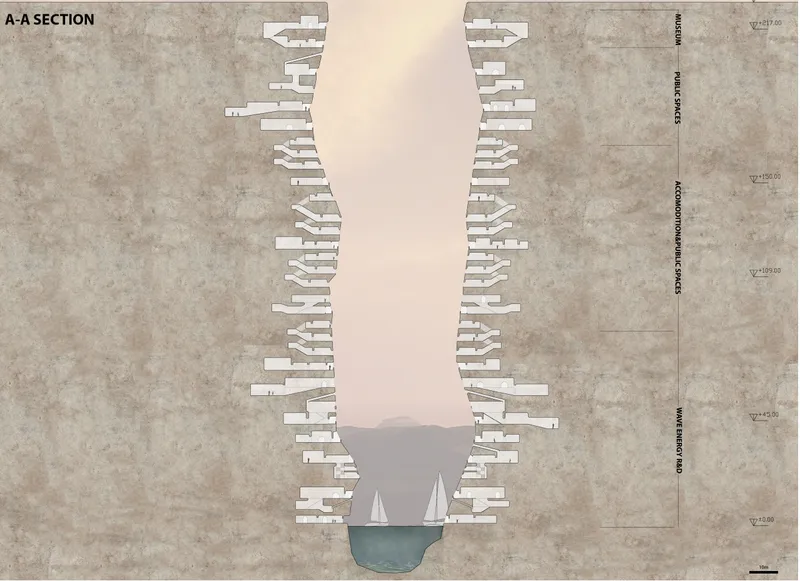
The most striking spatial gesture in Cliffscraper is the water channel that runs between two carved towers. Sailboats pass directly through the architecture, navigating a threshold between the open sea and the caldera's inner world. The section drawing makes the structural logic legible: two perforated stone masses flank this passage, their openings filtering light and air deep into the interior while preserving the mass needed for geological stability. The view at sunset, with boats framed by the twin towers, reveals how the project treats arrival by sea as a primary architectural experience rather than an afterthought.
By following the natural slit in the rock rather than imposing a new geometry, the designers ensure that the intervention reads as an extension of the cliff's own erosion patterns. Nothing is added to the skyline. The perforations in the stone walls serve functional roles: ventilation, daylighting, and visual connection to the water. But they also echo the porous volcanic geology of the site, making the distinction between carved and natural surface deliberately ambiguous.
Inside the Cliff: Light, Stone, and Scale

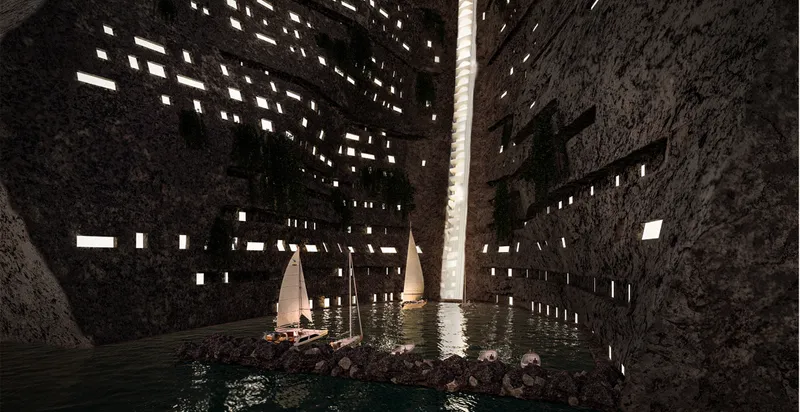
Seen from the exterior at dusk, the dark stone tower emerges between massive cliff walls as if it had always been there, its perforated skin glowing faintly against the rock. The interior view tells a different story: a sailboat glides past illuminated walls and rocky outcrops, turning what could be a claustrophobic passage into a moment of spatial drama. Light enters through the perforations at oblique angles, creating shifting patterns across the rough stone surfaces. The contrast between the raw geology and the precisely carved openings gives the interior its character.
The dual access strategy is key here. Cliffscraper is reachable from both the sea and the land above. Internal vertical circulation replaces the existing donkey-led zigzag roads with an efficient core that connects all levels. Public spaces, museums, and accommodations are distributed along this vertical spine, activating the carved interior rather than leaving it as passive infrastructure. The designers treat movement through the cliff as a sequence of spatial revelations, not just transportation between floors.
Programme Distribution Across the Carved Levels
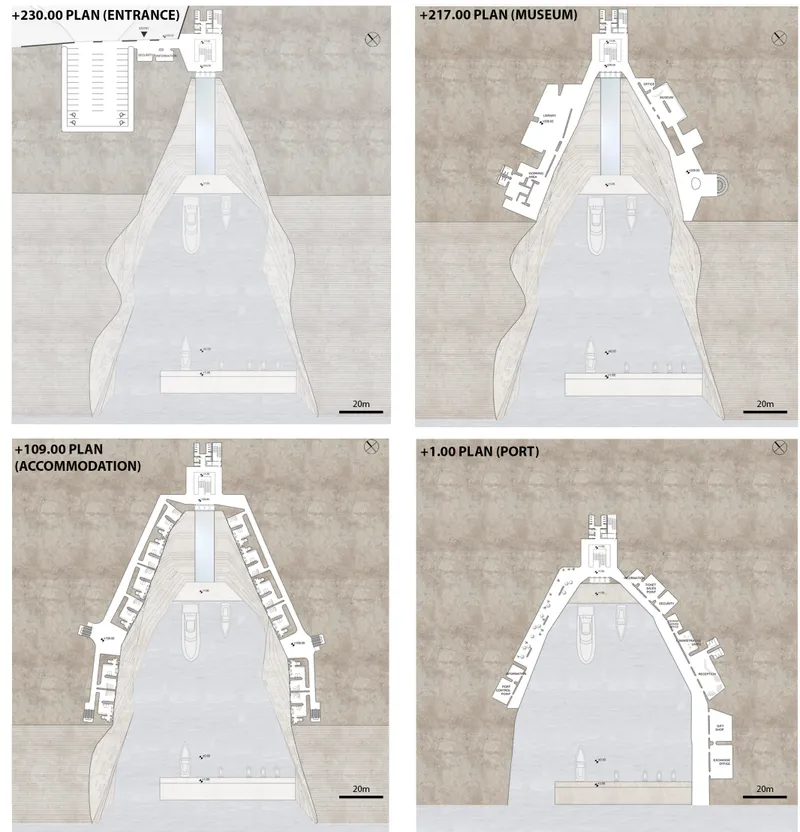
The four floor plans trace a clear vertical logic: entrance zones at upper levels give way to museum and cultural programme in the middle, with accommodation further down and port facilities at the water line. Each level responds to the irregular geometry of the cliff, with room shapes that follow the rock rather than forcing orthogonal grids onto it. The plans reveal how the project consolidates functions that would otherwise sprawl across Santorini's limited horizontal land, a direct response to the island's crisis of vanishing farmland and uncontrolled tourist development.
Caldera as Context: Geology, History, and Energy

The presentation panel maps the full scope of the project's ambition. Historical photographs and geological diagrams trace the caldera's formation from the 1600 BC eruption through centuries of human adaptation. Site maps position Cliffscraper within the island's broader geography, making the case that this is not a singular building but an infrastructural proposition. Wave energy systems positioned at the cliff's edge generate renewable power and desalinate seawater, a strategy the designers argue is more predictable and efficient than solar or wind for this particular location. The surplus energy and fresh water could support agricultural irrigation across the island, directly addressing the economic disparity between tourism and traditional farming.
Santorini's overtourism problem is well documented: seasonal visitor surges overwhelm infrastructure, land, and water resources. Cliffscraper proposes to absorb future vertical development within the cliff itself, preserving horizontal land for agriculture and community use. The removed soil is reused within the project site, eliminating the need for external construction materials and drastically reducing the carbon footprint that conventional high-rise construction would demand. It is a closed-loop proposition embedded in a specific place.
Why This Project Matters
Cliffscraper's strength lies in its refusal to separate architecture from its site. Most sustainable skyscraper proposals start with a conventional tower and bolt on green technologies. Yılmaz and Yıldırım invert that sequence entirely: the site is the structure, and sustainability is not an add-on but a consequence of the design logic itself. Carving rather than constructing eliminates the emissions associated with steel and concrete production. Reusing excavated material closes the material loop. Harvesting wave energy and desalinating seawater make the project operationally self-sufficient. Each decision follows from the previous one with a kind of inevitability.
Beyond its environmental logic, the project offers a model for places where tourism threatens to consume the very qualities that attract visitors in the first place. By consolidating development vertically within existing topography, Cliffscraper protects Santorini's agricultural land, preserves its iconic silhouette, and provides public cultural spaces that serve residents alongside tourists. It is a reminder that the most radical architectural moves sometimes involve taking material away rather than piling it on.
View the Full Project
About the Designers
Designers: Meltem Yılmaz, Aylin Yıldırım
Enter a Design Competition on uni.xyz
uni.xyz runs architecture and design competitions year-round that reward proposals with spatial conviction and real site intelligence.
Project credits: Cliffscraper by Meltem Yılmaz, Aylin Yıldırım.


Popular Articles
Popular articles from the community


Extended Shell: Retrofitting Kolkata's Balconies as Living Urban Thresholds
A modular retrofit system recovers the social and environmental intelligence of Kolkata's historic verandas for contemporary Park Street residents.

Opera by the Sea Estonia: Three Shells Dissolving Architecture into Tallinn's Coastline
A winning opera house proposal replaces monumental form with interconnected shells that blur the boundary between building, park and Baltic Sea.

Tsunami Convergenics: Turning Catastrophic Ocean Forces into Underwater Housing Infrastructure
A speculative underwater settlement off the coast of Onagawa, Japan, treats tsunamis and typhoons as energy sources rather than threats.

Manzana Morphosis: Stretching Barcelona's Grid into a Living Landscape for 2050
A radical reworking of the Eixample manzana turns density into a tool for generous public space, vertical ecology, and environmental performance.

Similar Reads
You might also enjoy these articles

Day and Night Park: A Time-Based Urban Newsstand in Beijing
A temporary urban newsstand in Beijing blending travel, light, and reading through poetic colors, compact form, and community-focused design.

Modernist Patio Renovation in El Masnou, Barcelona by Oliver Segura Arquitectura + Cebrià Arquitectura
Modernist patio renovation blending tradition and innovation with a movable pool, leveled floors, and Catalan materials in El Masnou.

Alto Residencial Coop: Cooperative Housing Development in Santiago de Compostela by Carbajo Barrios Arquitectos
A linear cooperative housing complex blending white volumes and perforated metal façades, enhancing community living, natural light, privacy, and urban integration.

Vil Genis School by BPA ARCHITECTURE – Massy, France
Vil Genis School in Massy, France, features sustainable design, south-facing classrooms, community integration, accessible spaces, and modern educational architecture.

Explore Skyscraper Competitions
Discover active competitions in this discipline

Challenge to reimagine the Iron Throne

Photograph architecture without architects

Illustrate the lost glory of Angkor Wat - Render Challenge

Design challenge to reuse E-waste
Comments (0)
Please login or sign up to add comments
No comments yet. Be the first to comment!