
Design of a Commercial High-Rise Building: Redefining Vertical Architecture
Vertical spaces reimagined: connecting lives and nature through sustainable, innovative architecture overlooking Hatir Jheel.


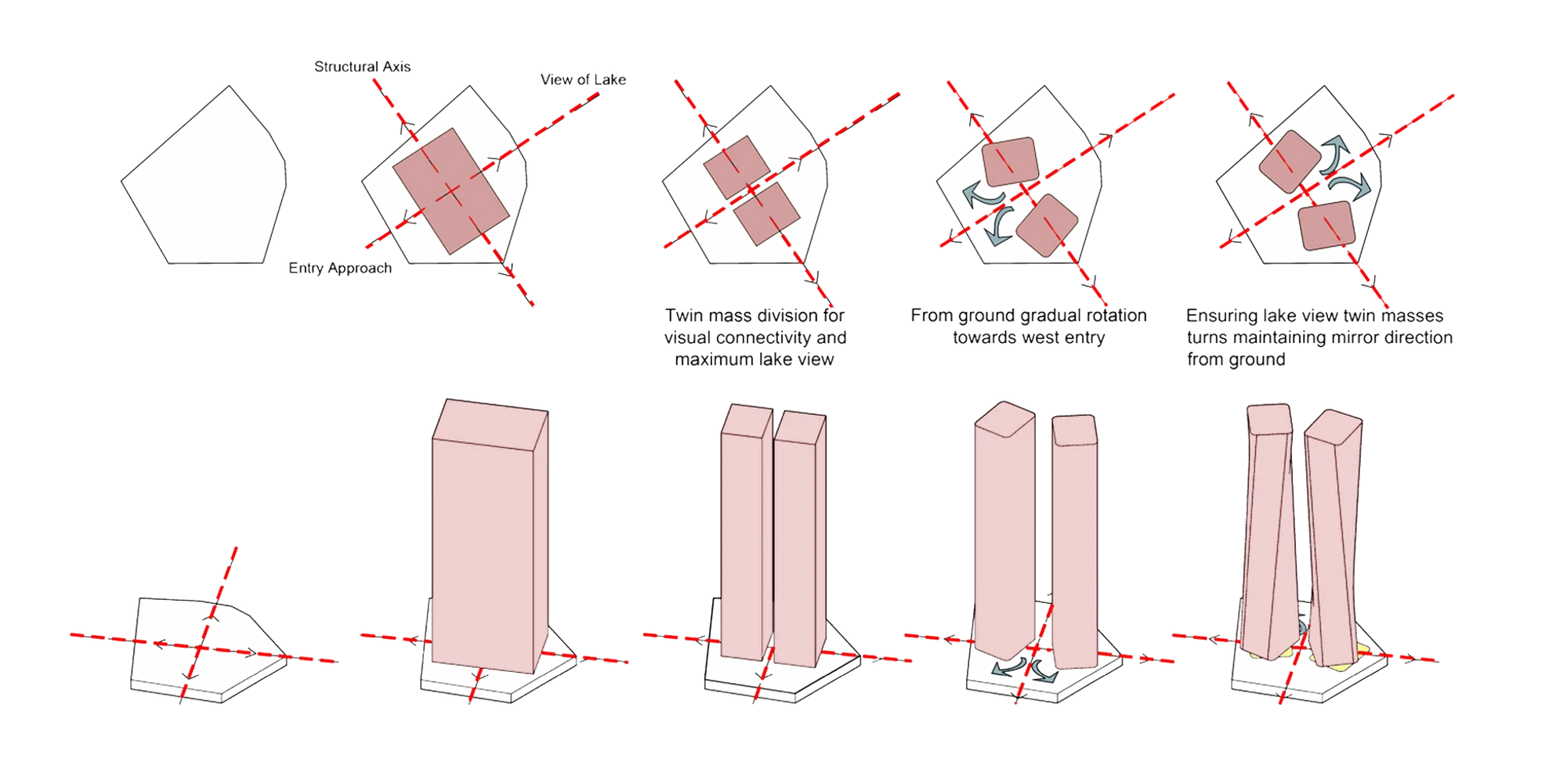
A tower does not have to be a single extrusion. Design of a Commercial High-Rise Building, by Akib Sikder, breaks a commercial tower into three stacked volumes separated by open sky-gardens, each oriented to capture a different view of Hatir Jheel, the lakefront park in central Dhaka. The result is a high-rise that breathes: the facade is louvers, the plan is a bowtie, and the section is a stack of three buildings rather than one.
Published on uni.xyz, the project sits on a triangular waterfront site where the lake, the road, and the dense city fabric meet. The building's formal strategy is driven by two forces: the views outward to the water and the ventilation inward through the plan. Every design decision, the pinched waist, the horizontal louvers, the breakout floors, follows from those two demands.
The Site: A Triangle on Hatir Jheel
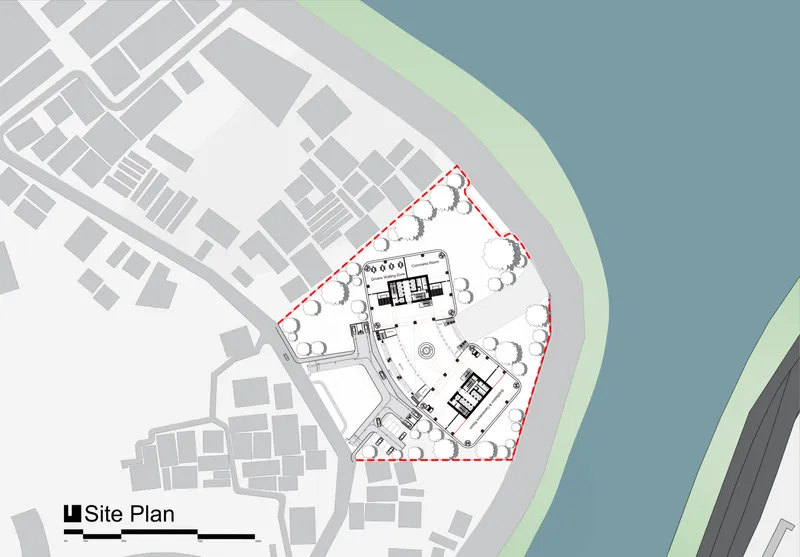
The site plan shows the triangular waterfront plot. Hatir Jheel curves along one edge. Roads bound the other two sides. The building footprint fills the widest part of the triangle, with the remaining area given to tree canopy and landscape. The red dashed lines mark the site boundary. This is not a generic commercial plot. It is a lakefront address, and the building is designed to use that address from every floor.
The triangular geometry of the site is why the plan is a bowtie rather than a rectangle. A rectangular tower would have turned its back on one of the three edges. The bowtie plan, which pinches at the centre, opens toward the water on one side and toward the city on the other. No office faces a blank wall. Every desk has a direction.
The Elevation: Three Volumes, Two Gardens
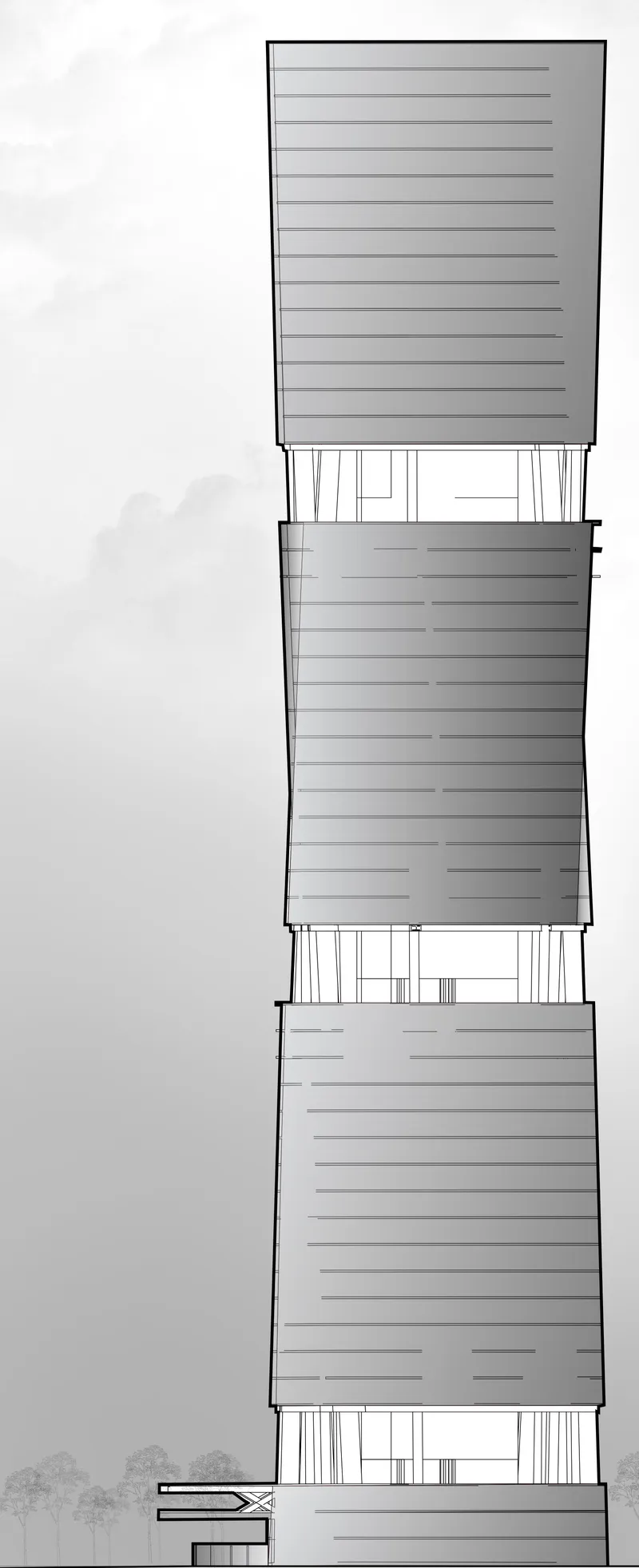
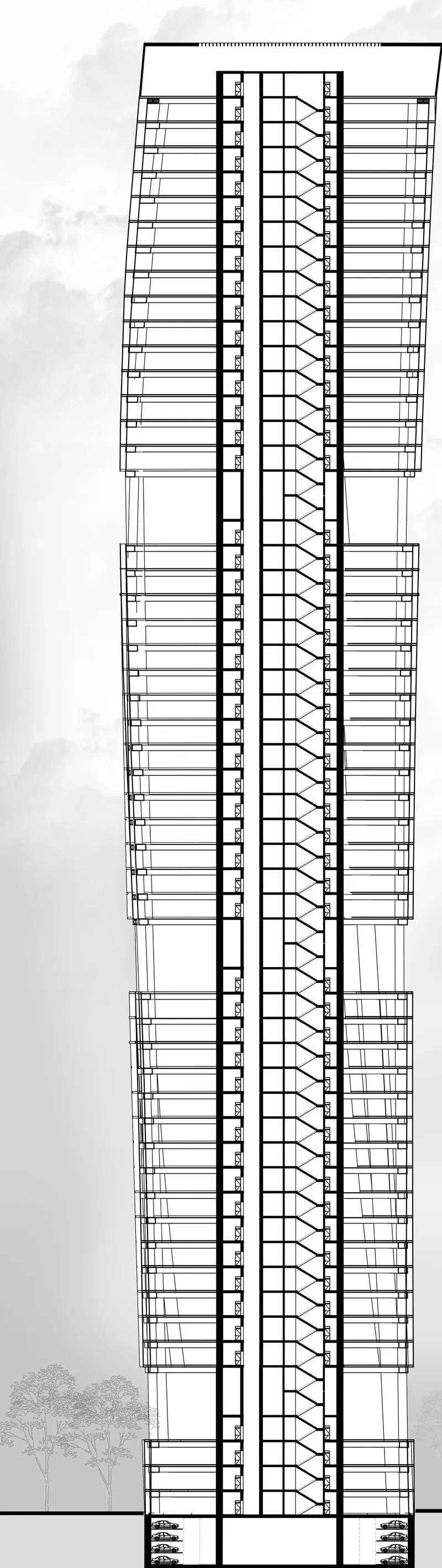
The elevation and the full section tell the same story from two angles. The tower is not one volume. It is three stacked volumes wrapped in horizontal louvers, pinching inward at two sky-garden floors. The sky-gardens are the project's formal and environmental strategy in a single move. Formally, they break the tower's mass so it reads as a cluster rather than a slab. Environmentally, they create cross-ventilation stacks that draw air through the building without mechanical assistance.
The full section confirms the logic. At each pinch point, the floor plate pulls back and the facade opens. These breakout voids are double-height outdoor rooms high above the lake. They are where workers go to eat, talk, or simply look at the water. The tower provides them at regular intervals, which means every tenant, no matter which floor they rent, is within a few stories of an outdoor room.
The Plan: A Bowtie That Shrinks
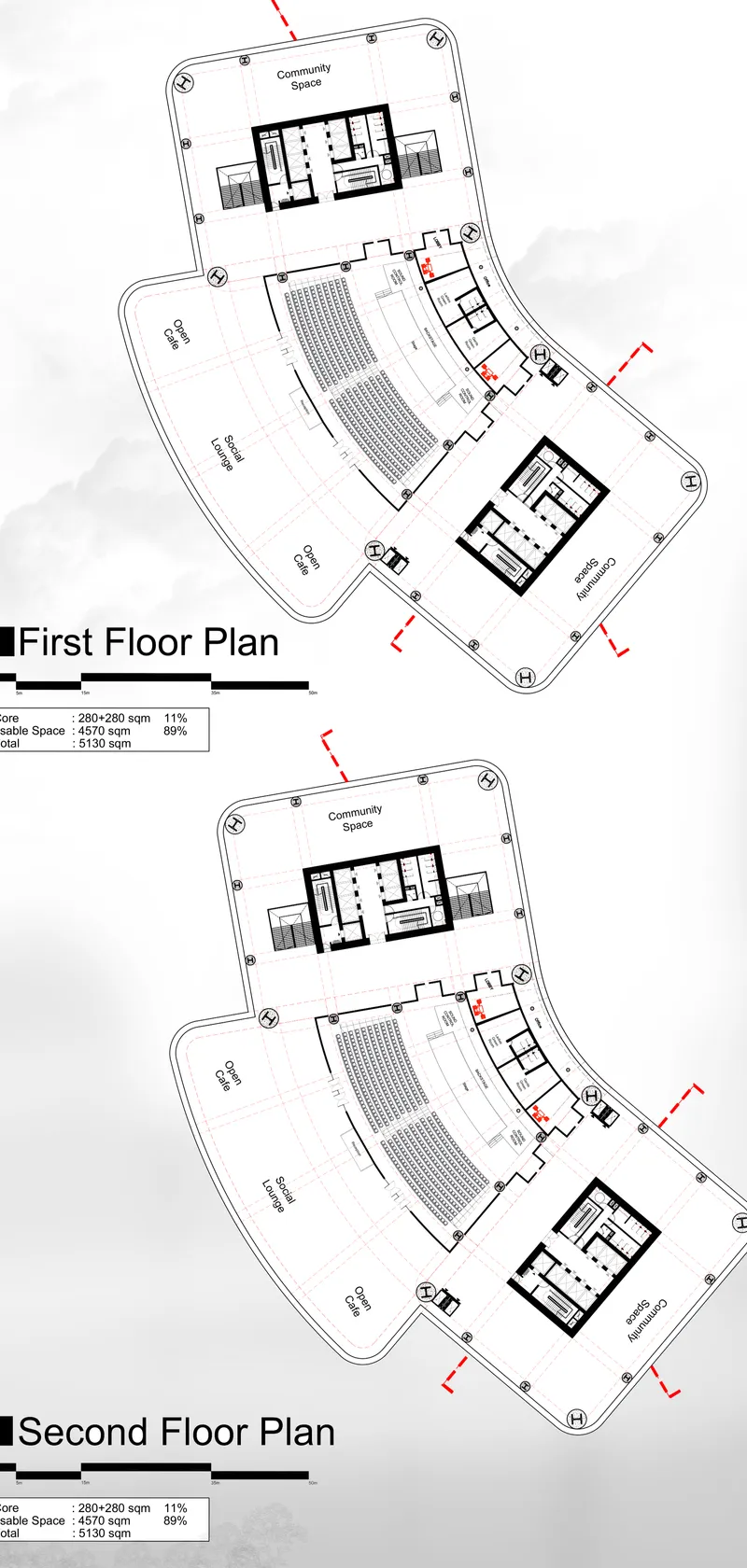
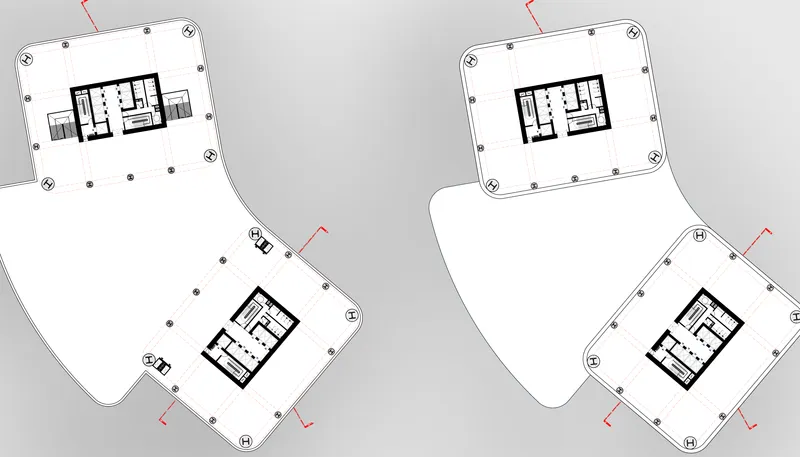
The floor plans show the building at two scales. The lower floors have the widest footprint: a bowtie shape with an auditorium, community space, and a generous landscape edge facing the lake. The upper floors are tighter. The four compact office plates show how the bowtie contracts at each breakout level. The central core stays constant, but the leasable area shrinks as the tower rises, giving upper tenants less floor area but better views and more light.
This tapering is not a stylistic gesture. It is a climate response. A narrower plate at the top catches less direct sun and allows more daylight to reach the desk. A wider plate at the base accommodates the public programmes, the auditorium and the community hall, that need large spans. The plan changes because the programme changes, and the programme changes because the altitude changes. It is an honest section.
The Ground: Entry, Parking, Landscape
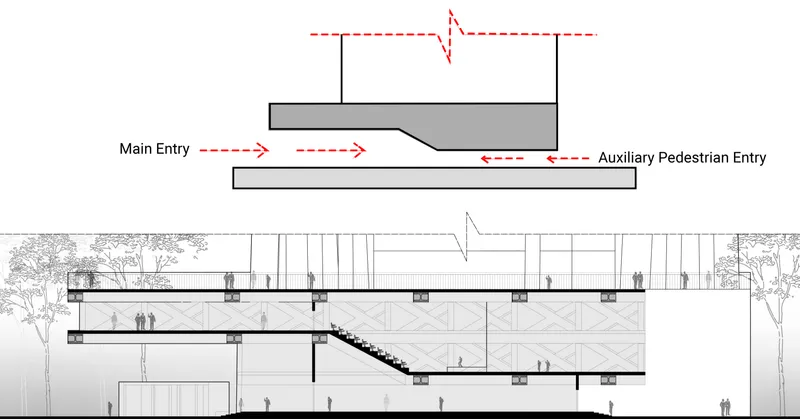
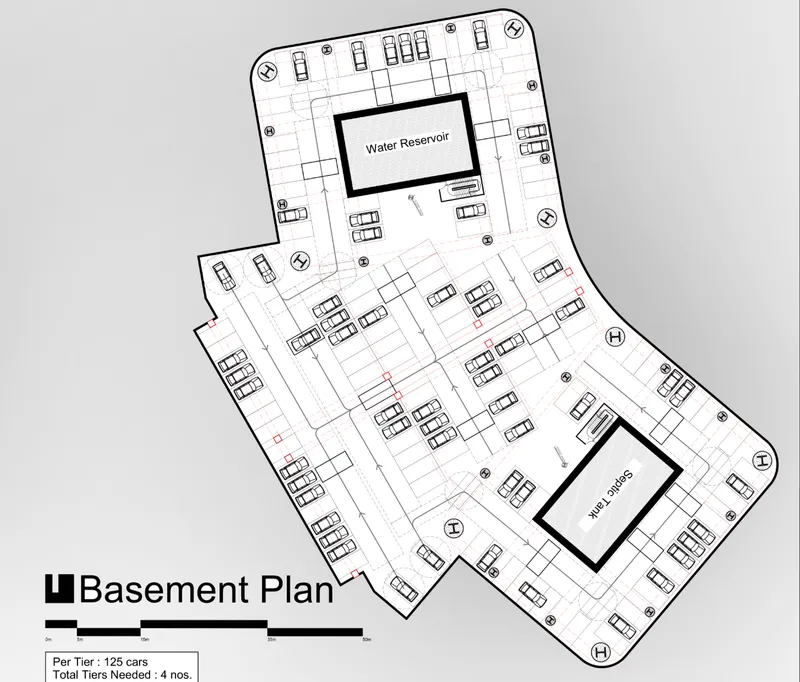
The entry section diagram and the basement plan show how the building meets the ground. The main vehicular entry arrives from one road. An auxiliary pedestrian entry arrives from the lakeside. A raised landscaped deck separates the two, creating a public platform between the tower and the water. Below, four basement tiers park 125 cars with a central water reservoir for the building's plumbing and fire systems.
The raised deck is a small but important move. It lifts the ground floor above the road level, which in Dhaka means above the monsoon flood line. It also gives the pedestrian entry its own landscape: you arrive on foot through the trees and enter the building at a slightly elevated plaza, rather than stepping off the road into a lobby. The building welcomes its two kinds of visitor, the driver and the walker, through two separate rituals.
Why This Project Matters
Most commercial high-rises in Dhaka are sealed boxes with identical floor plates from bottom to top. This project breaks that formula at every level. The plan tapers. The section breathes. The facade is operable louvers, not curtain wall. The sky-gardens give every tenant access to outdoor space, which is rare in a tropical city where the instinct is to seal everything against the heat. The project argues, correctly, that a tropical high-rise should let air in, not shut it out.
For anyone studying tropical commercial architecture, ventilated facades, or the design of high-rise towers on constrained waterfront sites, this Dhaka project is a useful reference. It takes a site that could easily have received a generic glass slab and instead produces a tower that responds to every force around it: the lake, the monsoon, the view, and the city edge. The result is specific, not generic, and that specificity is what makes it architecture.
View the Full Project
About the Designer
Designer: Akib Sikder
Enter a Design Competition on uni.xyz
If tropical high-rise design, ventilated facades, or waterfront commercial architecture is the kind of work you want to explore, uni.xyz runs competitions year-round that reward proposals with real site intelligence and climate awareness.
Project credits: Design of a Commercial High-Rise Building by Akib Sikder. Published on uni.xyz.




Popular Articles
Popular articles from the community


Co-Life: Senior Housing Design That Reconnects Older Adults With the City
Co-Life reimagines senior housing design through healing gardens, shared streets, workshops, and a sustainable community across generations.

Riyadh For All: Intergenerational Urban Design for Active Aging in Rabat
Riyadh For All reimagines urban design in Rabat with intergenerational co-living, adaptive courtyards, and Moroccan cultural exchange today.

The Musturak Paradise: Senior Living Architecture for a Connected Future in Temara, Morocco
The Musturak Paradise reimagines senior living architecture in Temara via private homes, social spaces, culture, community, and shared care.

Lunar Spiral: Space Architecture Shaped by the Mathematics of the Universe
Lunar Spiral reimagines space architecture through Fibonacci geometry, lunar regolith, levitating habitats, and self-sustaining Moon living.

Similar Reads
You might also enjoy these articles

Day and Night Park: A Time-Based Urban Newsstand in Beijing
A temporary urban newsstand in Beijing blending travel, light, and reading through poetic colors, compact form, and community-focused design.

Modernist Patio Renovation in El Masnou, Barcelona by Oliver Segura Arquitectura + Cebrià Arquitectura
Modernist patio renovation blending tradition and innovation with a movable pool, leveled floors, and Catalan materials in El Masnou.

Alto Residencial Coop: Cooperative Housing Development in Santiago de Compostela by Carbajo Barrios Arquitectos
A linear cooperative housing complex blending white volumes and perforated metal façades, enhancing community living, natural light, privacy, and urban integration.
Vil Genis School by BPA ARCHITECTURE – Massy, France
Vil Genis School in Massy, France, features sustainable design, south-facing classrooms, community integration, accessible spaces, and modern educational architecture.


Comments (0)
Please login or sign up to add comments
No comments yet. Be the first to comment!