
DY Patil University Centre of Excellence: A Sustainable Academic Landmark in Navi Mumbai
Innovative sustainable campus in Navi Mumbai combining academic, residential, and social spaces with climate-responsive design, sky gardens, and collaborative environments.


The DY Patil University Centre of Excellence in Navi Mumbai represents a transformative step in contemporary educational architecture. Designed by the globally renowned firm Foster + Partners, this ten-story academic and residential complex redefines how universities can integrate sustainability, innovation, and community-driven learning environments. Completed in 2022, the project spans approximately 75,000 square meters and accommodates around 3,000 students, combining academic facilities, living spaces, and social infrastructure into a unified architectural vision.
This landmark development also marks the firm’s first educational project in India, developed in close collaboration with Chancellor Dr. Vijay Patil. The result is a forward-thinking campus that not only supports modern pedagogical methods but also achieves the prestigious LEED Platinum certification, highlighting its commitment to environmental responsibility.
Collaborative Design and Iterative Construction Process
One of the most distinctive aspects of the DY Patil University Centre of Excellence is its highly collaborative and experimental construction journey. Over a decade, a dedicated team led by Dr. Vijay Patil worked alongside architects, engineers, and local craftspeople to refine building techniques through continuous prototyping.
Full-scale mock-ups of structural and façade components were developed on-site, allowing the design to evolve organically. This iterative process ensured that every architectural element: from shading systems to material finishes: was optimized for performance, aesthetics, and durability. Such an approach reflects a deeper integration between design intent and construction execution, resulting in a building that surpasses its original conceptual framework.
Climate-Responsive and Sustainable Architecture
Sustainability lies at the core of the project’s design philosophy. The building incorporates a range of passive and active environmental strategies to minimize energy consumption and reduce its carbon footprint.
Extensive external shading systems protect the interiors from excessive solar gain, significantly reducing reliance on mechanical cooling. The building envelope is carefully engineered to maximize daylight penetration while controlling glare, creating comfortable and well-lit learning environments.
Innovative wind tower-assisted ventilation systems enhance natural airflow, particularly in high-occupancy areas such as auditoria and concourses. These strategies not only improve indoor environmental quality but also align with energy-efficient design principles suited to India’s tropical climate.
Water conservation is another key priority, with ultra-low water consumption systems integrated throughout the building. Together, these measures contribute to the project’s LEED Platinum rating, positioning it as a benchmark for sustainable campus design in India.
Spatial Organization and Academic Environment
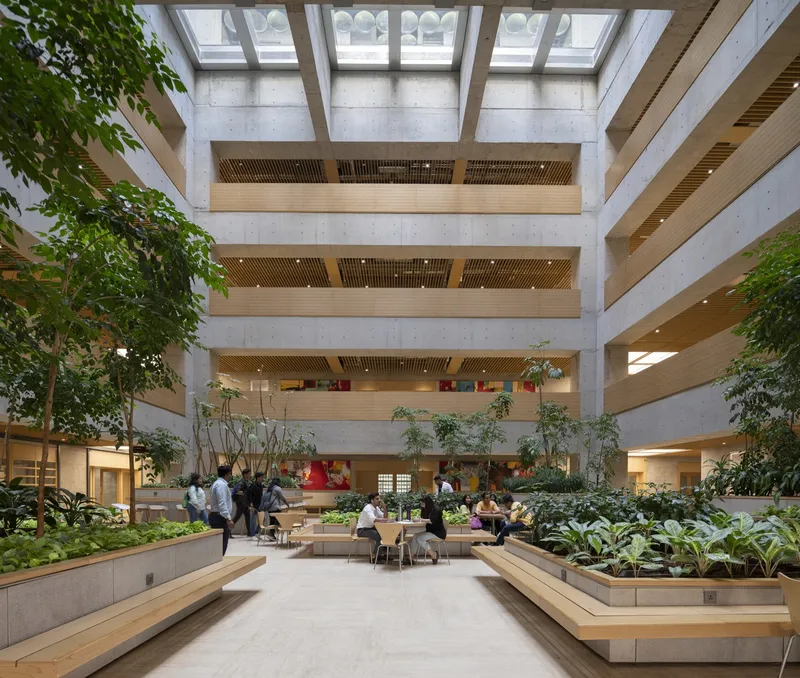
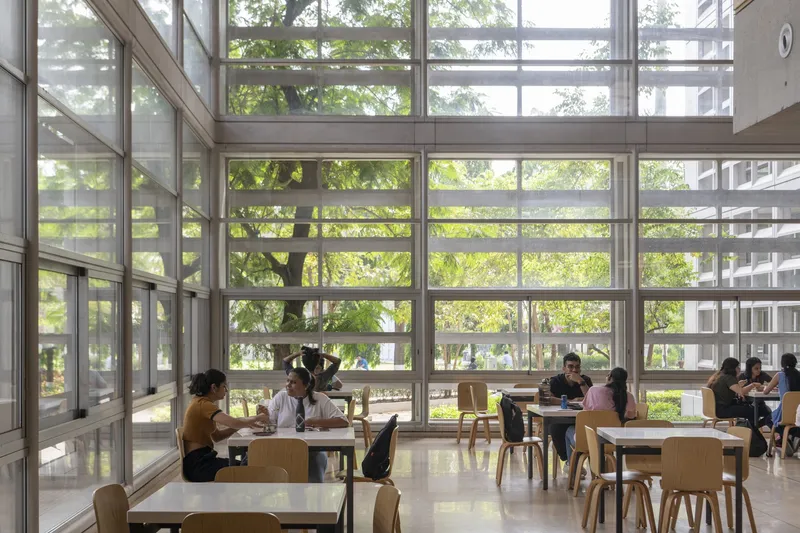
The academic spaces are thoughtfully organized around a series of four-story-high covered courtyards. These communal zones act as social and intellectual hubs, encouraging interaction and collaboration among students and faculty.
The triangular site has been strategically utilized to optimize spatial efficiency and daylight access. Each courtyard is carefully oriented to enhance natural light while maintaining thermal comfort. This arrangement fosters a dynamic learning environment that extends beyond traditional classroom settings.
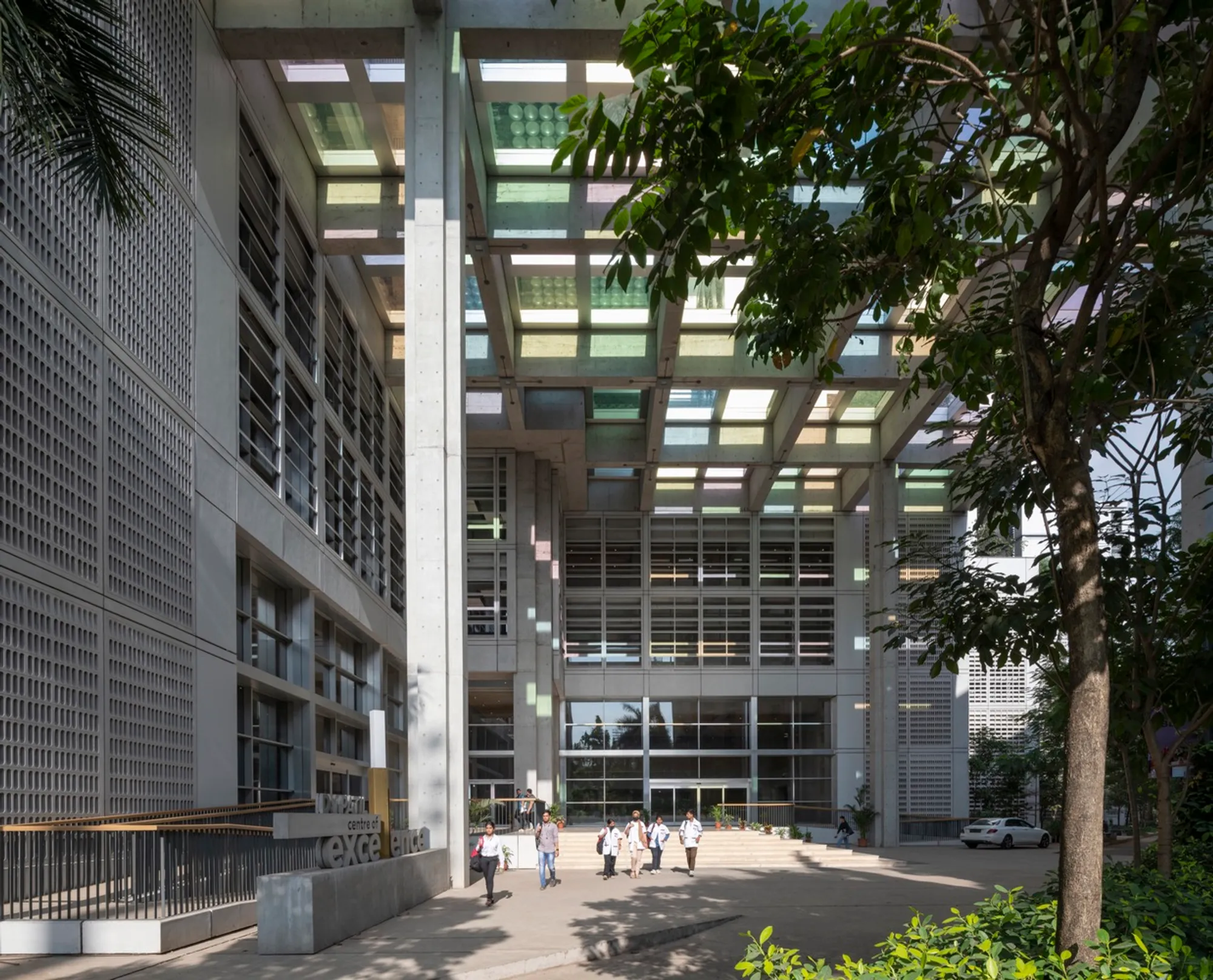
A striking four-story entrance canopy with a glass roof creates a dramatic arrival experience. As sunlight filters through, it casts vibrant, multi-colored shadows across the façade, adding a layer of visual dynamism to the architecture.
Inside, the ground level features an open-plan reception, exhibition areas, a café, and informal workspaces. These flexible zones blur the boundaries between academic and social life, promoting a holistic educational experience.
Centralized Learning and Cultural Spaces
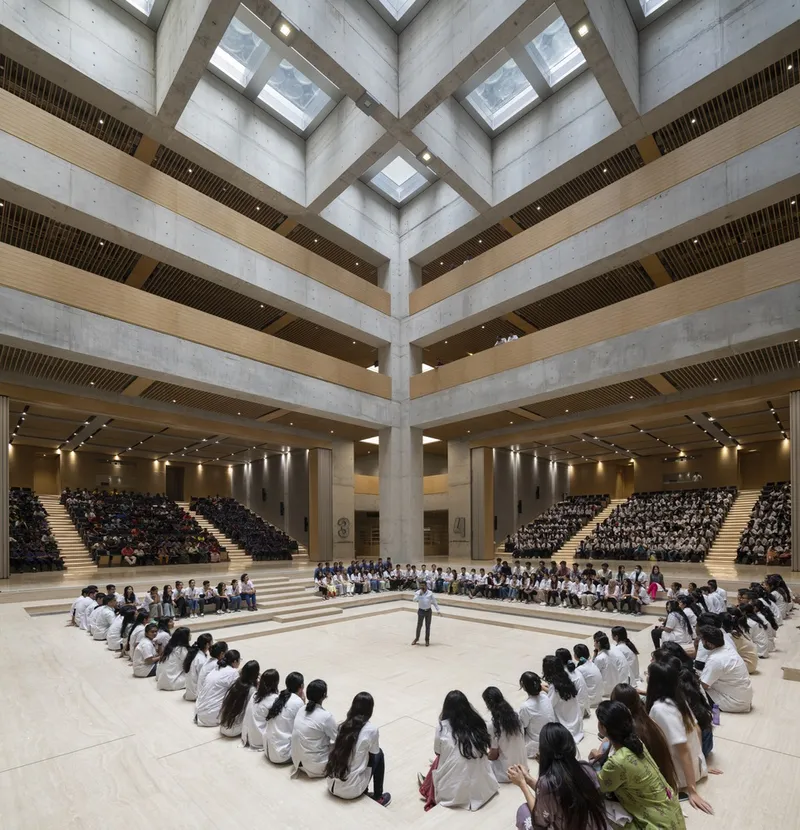
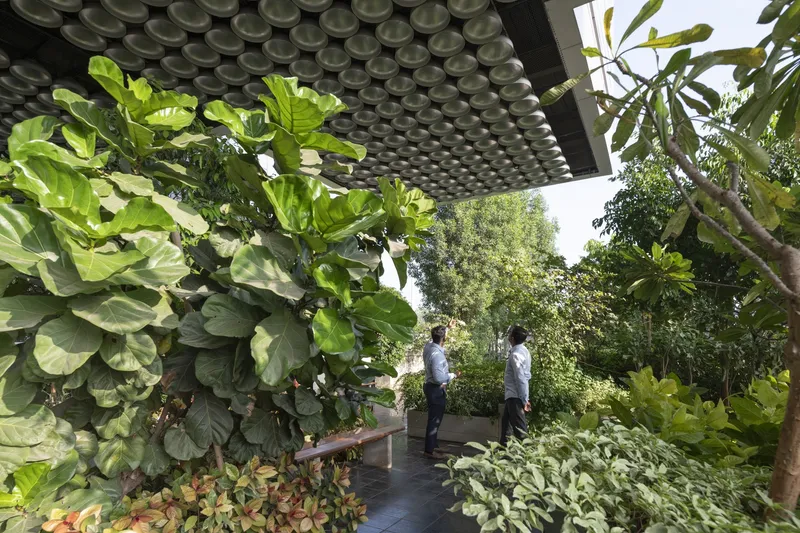
At the heart of the building lies a multifunctional core designed to accommodate large gatherings and academic events. Four major auditoria are arranged around a sunken amphitheater, which serves as a venue for graduation ceremonies, performances, and sports-related activities.
The auditoria are designed with flexibility in mind, allowing them to be opened up for large-scale events or divided into smaller, more intimate spaces. This adaptability ensures that the building can support a wide range of academic and cultural functions.
The library, spread across four levels, acts as a central knowledge hub. Its layered spatial configuration: featuring terraces, balconies, and interconnected stairways, creates a visually engaging and intellectually stimulating environment. The design encourages exploration, interaction, and the free exchange of ideas, reinforcing the university’s academic ethos.
Integration of Nature: The Two-Acre Sky Garden
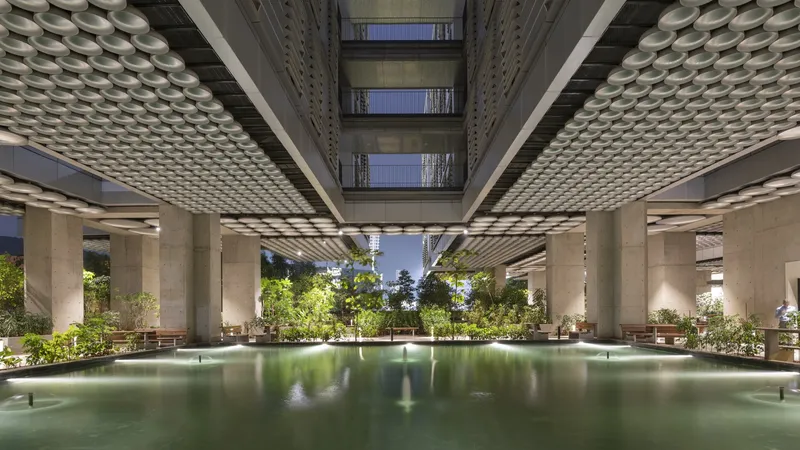
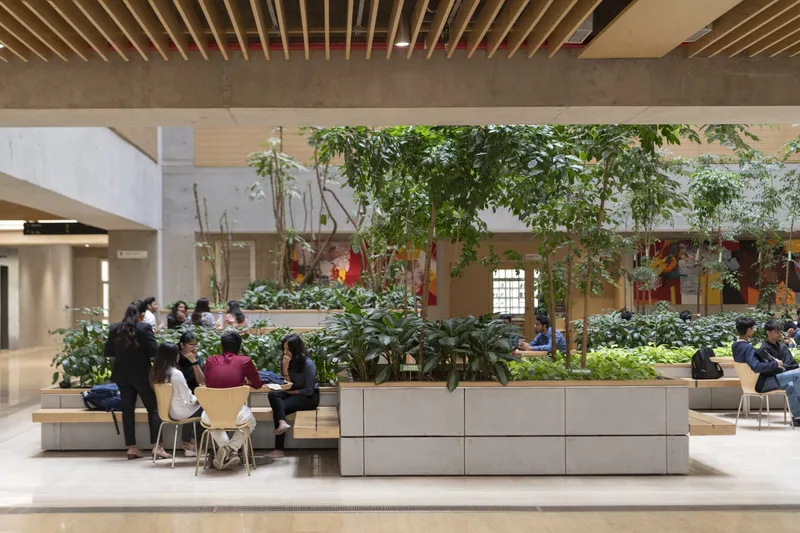
A defining feature of the project is its expansive two-acre sky garden, which introduces a unique biophilic dimension to the campus. This elevated landscape includes native plant species, water features, and tranquil seating areas, offering students a serene environment for relaxation and reflection.
The sky garden not only enhances the aesthetic quality of the building but also contributes to its environmental performance by improving air quality and reducing heat gain. It serves as a vital connection between architecture and nature, reinforcing the importance of well-being in educational spaces.
Material Palette and Construction Innovation
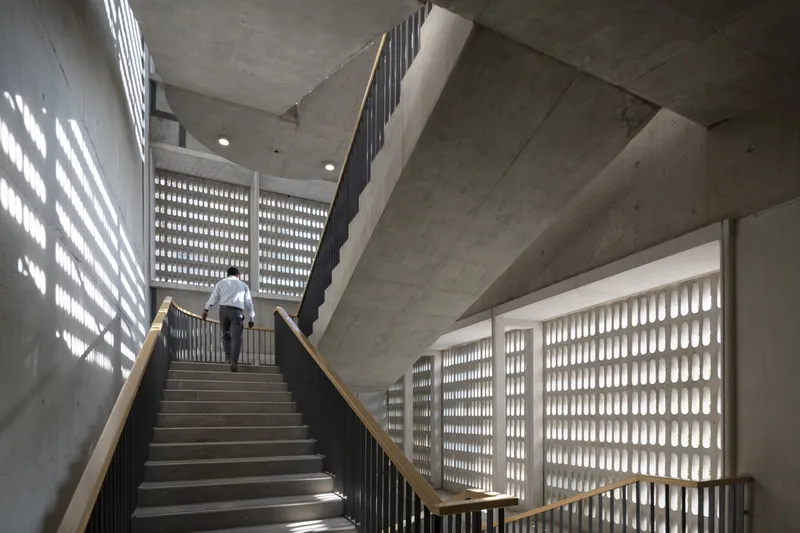
The building showcases a refined palette of materials, including travertine, timber, aluminum, glass-reinforced concrete (GRC), and sealed concrete. These materials are carefully selected to balance durability, aesthetics, and sustainability.
A notable innovation is the use of ground-granulated blast-furnace slag (GGBS) in the concrete mix. By partially replacing cement, GGBS reduces the building’s embodied carbon footprint while producing a lighter-toned concrete finish.
The façade features perforated GRC screens, created using Perspex and wooden molds. These screens allow diffused light to penetrate deeper into the interiors while providing effective shading, enhancing both energy efficiency and visual comfort.
Functional Zoning: Academic and Residential Integration
The building is vertically organized to clearly distinguish between academic and residential functions. The lower four levels are dedicated to teaching and learning spaces, while the upper five floors accommodate residential units for students and faculty.
This transition is expressed architecturally through changes in cladding. The base appears more solid and grounded, reflecting its institutional function, while the upper levels adopt a lighter and more refined aesthetic suitable for living spaces.
Custom-designed furniture by Foster + Partners further enhances the user experience, ensuring comfort, functionality, and consistency with the overall design language.
A Benchmark for Future Educational Architecture
The DY Patil University Centre of Excellence stands as a model for future academic developments in India and beyond. By integrating sustainable design strategies, innovative construction methods, and user-centric spatial planning, the project sets a new standard for university campuses.
It demonstrates how architecture can actively support evolving educational paradigms while addressing environmental challenges. Through its holistic approach, the building not only meets the needs of contemporary students but also anticipates the demands of future generations.
All photograhs are works of
Nigel Young



Popular Articles
Popular articles from the community


The Ocean Hive: Sustainable Architecture for a Self-Sufficient Civilization at Sea
The Ocean Hive imagines sustainable architecture at sea, where modular habitats, algae, wave power and ocean waste sustain a growing colony.

Play: Fragments of Their World
Familiar architecture becomes modular playground design, creating safe spaces where displaced children can learn, connect, imagine and play.

Conexión: Biophilic Design Reimagines High-Rise Living in Hong Kong
Conexión reimagines high-rise living in Hong Kong through biophilic design, green facades, shared spaces, daylight, water and nature within.

Co-Life: Senior Housing Design That Reconnects Older Adults With the City
Co-Life reimagines senior housing design through healing gardens, shared streets, workshops, and a sustainable community across generations.


Similar Reads
You might also enjoy these articles

FAMM Arquitectura Organizes Ten Villas Around Courtyards and Jungle in Nosara, Costa Rica
El Molino pairs two elongated volumes with deep overhangs and timber louvers to build a compact coastal community five minutes from the beach.
Oscar Niemeyer's Ibirapuera Park Pavilions Define São Paulo's Cultural Identity in Concrete and Curve
A constellation of modernist volumes set within São Paulo's most important urban park, conceived for the city's 400th anniversary in 1954.
How Henri Picq's 1889 Paris Pavilion Traveled 11,000 Kilometers to Become Santiago's Artequín Museum
A prefabricated iron and glass pavilion built for the Paris Universal Exposition found a second life as a children's art museum in Chile.
Sanjay Puri Architects Wraps a Jaipur Office Tower in Capsule-Shaped Green Buffers
A nine-level climate-responsive workplace near Jaipur Airport uses stacked planter terraces and aluminium screens to fight 40°C heat.

Explore Architecture Competitions
Discover active competitions in this discipline



Challenge to reimagine the Iron Throne


Photograph architecture without architects


Illustrate the lost glory of Angkor Wat - Render Challenge


Design challenge to reuse E-waste
Comments (0)
Please login or sign up to add comments
No comments yet. Be the first to comment!