
Eazyfit: Modular Architecture For Compact Living
Eazyfit redefines modular furniture architecture with flexible, zero-waste systems designed to adapt, assemble, and evolve with compact urban living.


As urban density increases and living spaces continue to shrink, the relationship between architecture, furniture, and everyday life is being fundamentally redefined. Eazyfit emerges as a thoughtful response to this shift, proposing a modular furniture architecture system designed specifically for people living in compact, compromised, or transitional spaces.
Rather than treating furniture as static objects, Eazyfit approaches it as an architectural framework: one that grows, contracts, and transforms based on user needs. Designed by Ankur Gupta, the project explores how modular construction logic, material efficiency, and user participation can collectively shape more adaptable living environments.

Architecture at the Scale of Furniture
Eazyfit blurs the conventional boundary between architecture and product design. Using a precise grid-based logic, the system is built from repeatable cubic modules that behave like architectural building blocks. Each module forms part of a larger structural language capable of producing furniture, storage systems, spatial partitions, or even temporary shelters.
This architectural approach allows users to think spatially: assembling, stacking, and reconfiguring components to suit changing lifestyles. From a basic table to a complex spatial installation, the same components support multiple scales of use.
Component-Based Design Logic
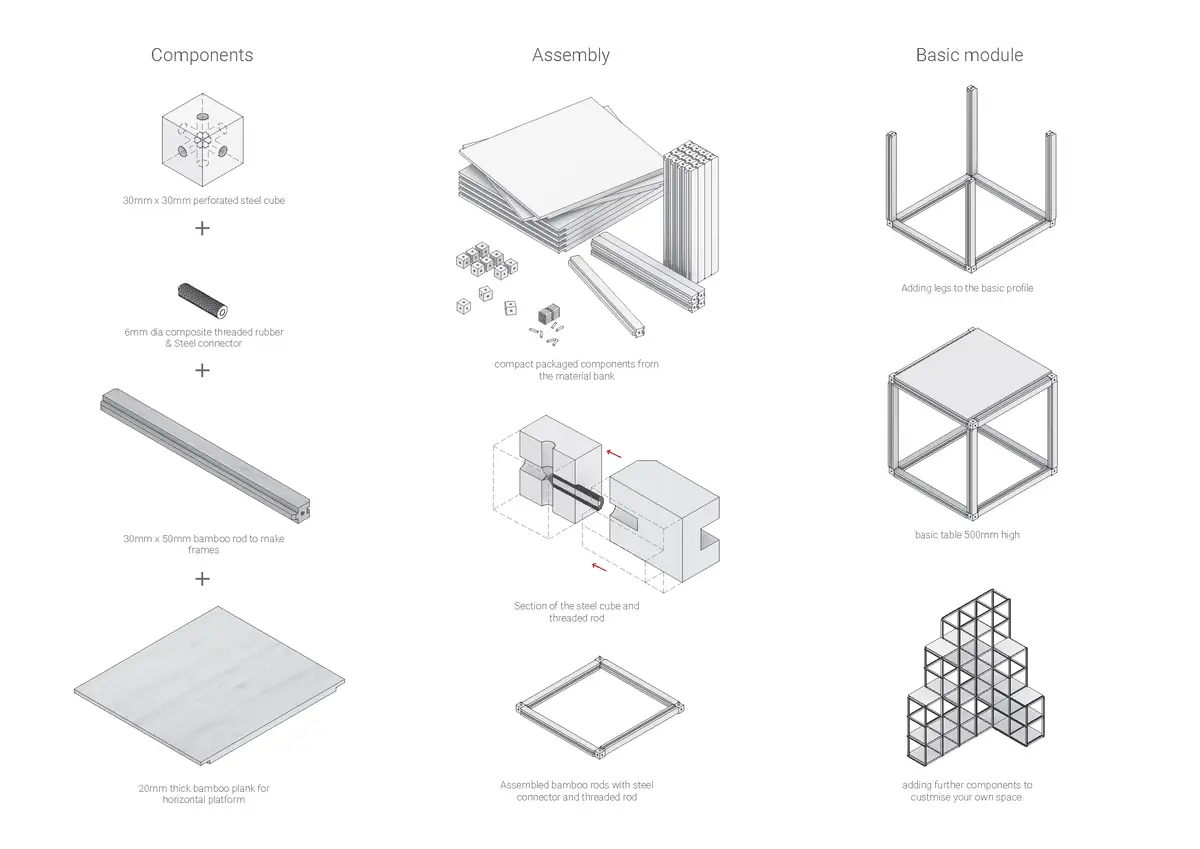
At the core of Eazyfit is a minimal yet highly versatile component set:
- A 30mm x 30mm perforated steel cube that acts as a universal joint
- Threaded composite rubber and steel connectors for secure assembly
- Bamboo rods forming the primary structural frames
- Bamboo planks used as horizontal platforms, surfaces, or panels
These elements are designed for precision fit, ease of handling, and long-term reuse. The standardized dimensions ensure that every component remains compatible across different configurations, reinforcing the system’s architectural consistency.
Self-Assembly as Spatial Empowerment
Eazyfit promotes self-assembly as a form of spatial agency. Users are not passive consumers but active participants in shaping their environment. Components can be assembled without specialized tools, enabling quick transformations, from seating and tables to shelving or room dividers.
This flexibility is especially valuable for first-time renters, students, and young professionals who often inhabit temporary or evolving living situations. As needs change, the furniture adapts, without generating waste or requiring replacement.
Modular Architecture Beyond Furniture
The system’s architectural ambition extends beyond domestic furniture. Eazyfit demonstrates how the same modular logic can be scaled into:
- Flooring modules
- Wall systems
- Roofing structures
- Temporary shelters for immigrants and displaced communities
By reconfiguring the grid vertically and horizontally, Eazyfit becomes a lightweight architectural system capable of rapid deployment, customization, and disassembly. This makes it suitable for humanitarian applications, emergency housing, and temporary community structures.
Material Bank and Circular Design Model
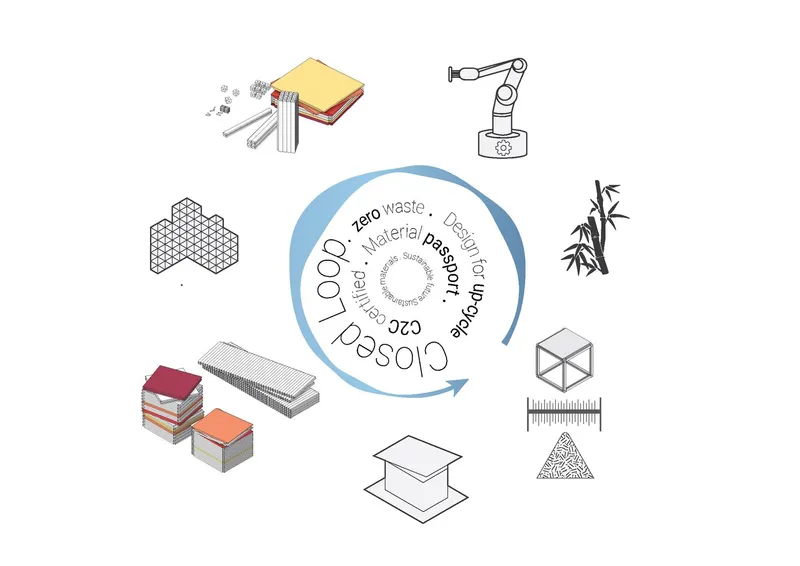
One of Eazyfit’s most forward-looking aspects is its integration with a material bank system. Instead of owning every component permanently, users can lease parts based on current requirements and return them when no longer needed.
This circular model supports:
- Zero-waste construction
- Reduced material consumption
- Shared resource efficiency
- Sustainable lifecycle management
By decoupling use from ownership, Eazyfit introduces a scalable, environmentally responsible alternative to conventional furniture consumption.
Sustainability Through Modularity
The project’s sustainability is not superficial, it is embedded in its architectural logic. Bamboo, a rapidly renewable material, forms the primary structure, while the steel connectors ensure durability and repeated reuse. Standardization minimizes fabrication waste, and modularity extends the lifespan of every component.
Eazyfit demonstrates how sustainable architecture does not always require large buildings; it can begin with intelligent systems that operate at the human scale.
Eazyfit represents a shift in how we think about space, ownership, and adaptability. By merging modular furniture architecture with circular design principles, the project offers a flexible, affordable, and sustainable solution for contemporary living.
Designed by Ankur Gupta, Eazyfit is not just furniture, it is an evolving architectural system that empowers users to shape their environments while minimizing environmental impact.
In an era defined by mobility, constraint, and sustainability, Eazyfit provides a compelling model for architecture that truly adapts to life.


Popular Articles
Popular articles from the community


Faces of the Soviet Avant-Garde: Turning Moscow's Street Names into an Open-Air Museum
A network of sculptural installations across a Moscow residential district transforms forgotten architect names into spatial encounters with cultural memor

The Amber Palace Opera: A Geological Fiction Surfaces on Tallinn's Baltic Waterfront
Pierre Brillard reimagines a Baltic legend as a public landscape, opera house, and waterfront promenade rooted in Tallinn's coastal identity.
Extended Shell: Retrofitting Kolkata's Balconies as Living Urban Thresholds
A modular retrofit system recovers the social and environmental intelligence of Kolkata's historic verandas for contemporary Park Street residents.

Singing Woman: Contemporary Architecture Inspired by Estonia’s Voice and the Sea
Singing Woman turns Estonia’s song culture into flowing opera house architecture, blending public life, landscape, sea, and national memory.

Similar Reads
You might also enjoy these articles

Eco Chapel: A Green Architecture Pavilion Designed in Symbiosis with the Forest
Eco Chapel uses green architecture to weave prayer, learning and reuse into a forest pavilion shaped by modular hexagonal canopies for life.
Kaffeebühnen: Coffee Shop Architecture Designed as a Civic Stage Between Vienna’s City and Park
Kaffeebühnen turns coffee shop architecture into a civic stage, linking Vienna’s park edge, urban life, warm timber yards, and coffee craft.
Healing Façade: Sustainable Architecture for Reforestation, Community, and Sacred Ecology in Ethiopia
Healing Façade reimagines sustainable architecture as a living wall that restores soil, catches water and renews Ethiopia's forest churches.


Urban Forest: A Vertical Ecosystem for 5,000 Workers in Singapore's Changi Business Park
Radially stacked pods and layered green decks turn a 7-acre plot into 47 acres of ecological workspace projected for 2040.

Explore Modular Furniture Competitions
Discover active competitions in this discipline

Design challenge to equip cities with modern furniture

Competition to design a workstation for architects

Packaging challenge - Design meets sustainability
Comments (0)
Please login or sign up to add comments
No comments yet. Be the first to comment!