
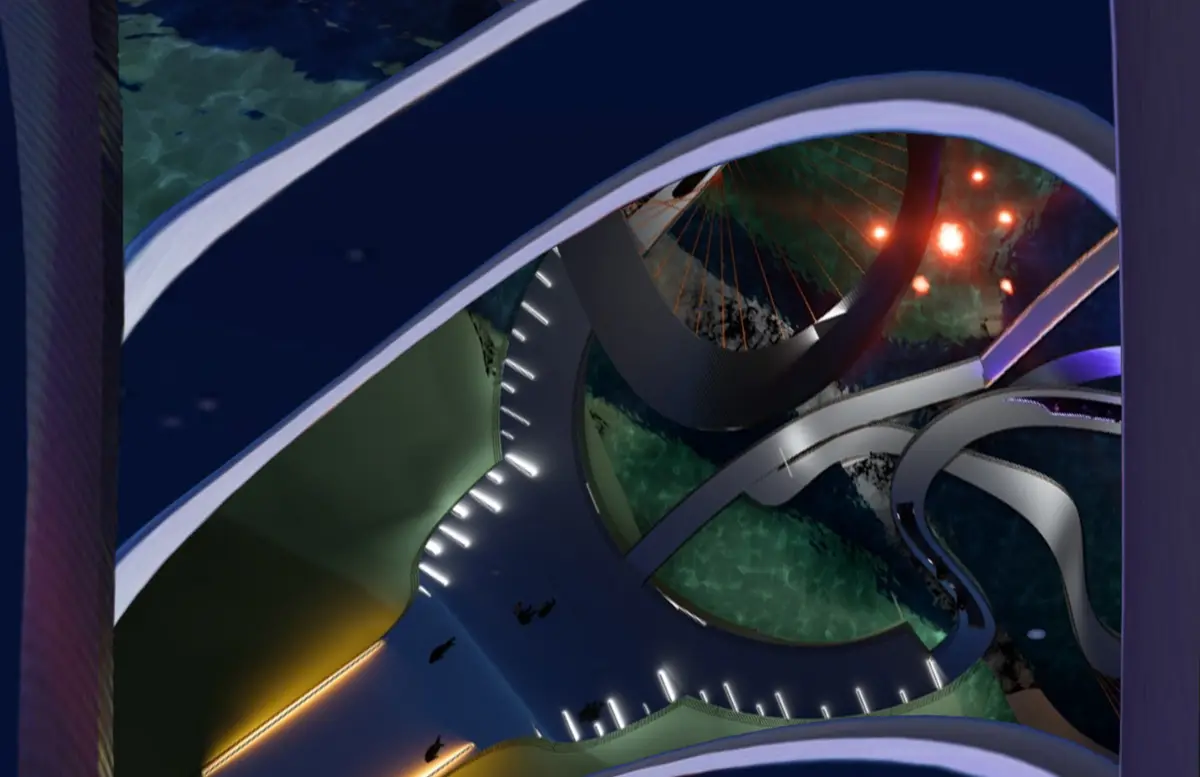
Twilight Crossing: A Pedestrian Bridge That Performs with Light and Water
Angel Gamboa's tensile cable bridge transforms a lakeside crossing into a choreographed sequence of color, reflection, and framed views at dusk.


Most pedestrian bridges treat light as an afterthought, a strip of LEDs bolted to a railing once the structural engineering is settled. Twilight Crossing inverts that hierarchy entirely. Here, light is the primary architectural material: tensile cables double as luminous lines, water surfaces become projection screens, and the bridge's curved geometry exists to shape how color moves through space at dusk. The result is a crossing that refuses to be mere infrastructure.
Designed by Angel Gamboa for the Beacon competition on uni.xyz, the project reimagines a lakeside site as a stage for atmospheric experience. The brief asked entrants to explore the relationship between architecture and light, and Gamboa responded with a structure that only fully reveals itself in the liminal hours between day and night, when artificial illumination and natural twilight overlap.
Overlapping Curves Above a Mirror of Water
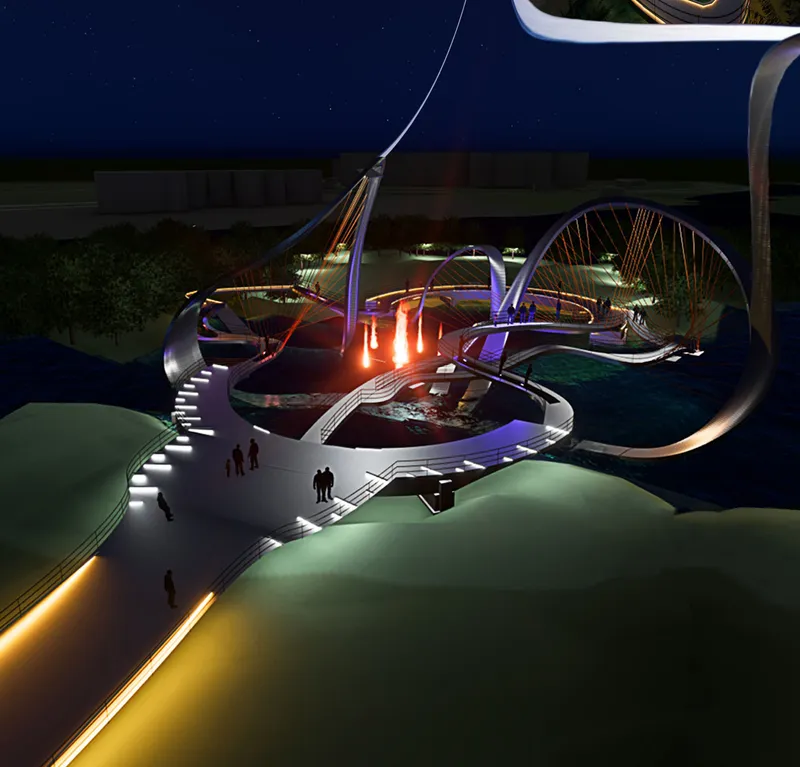
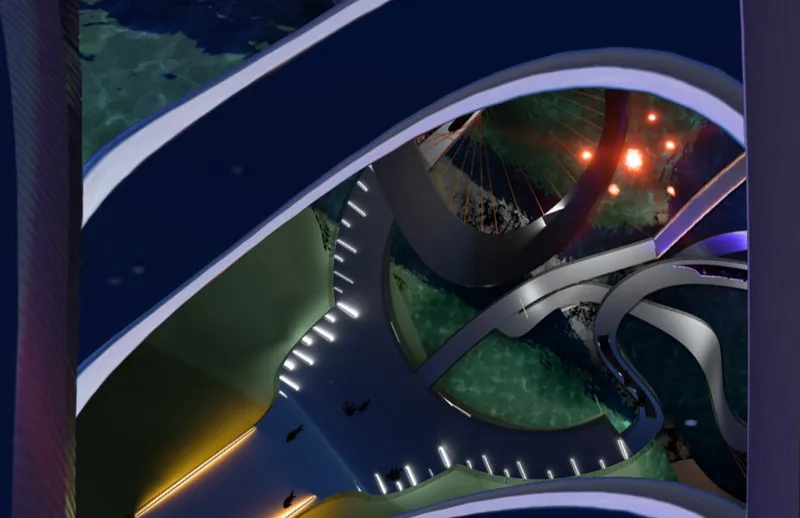
The bridge's plan reads as two sweeping arcs that overlap and diverge, creating a figure-eight flow of pedestrian movement rather than a single linear path. Elevated above a reflective water surface, these ramps multiply every cable and every light source into shimmering doubles below. The aerial rendering reveals how the tensile cable system fans outward from central masts, pulling the deck into tension while simultaneously organizing colored lighting into radial patterns. It is structural logic and scenographic intent collapsed into one gesture.
At twilight, the overlapping ramps generate a layered depth that flat bridges simply cannot produce. Walkers on the upper arc look down through cables to see figures on the lower path, both groups silhouetted against the glowing water. Gamboa understands that a bridge is not just a surface to walk on but a volumetric space to move through, and the curving overlap gives that volume real spatial consequence.
Framed Thresholds That Compress and Release
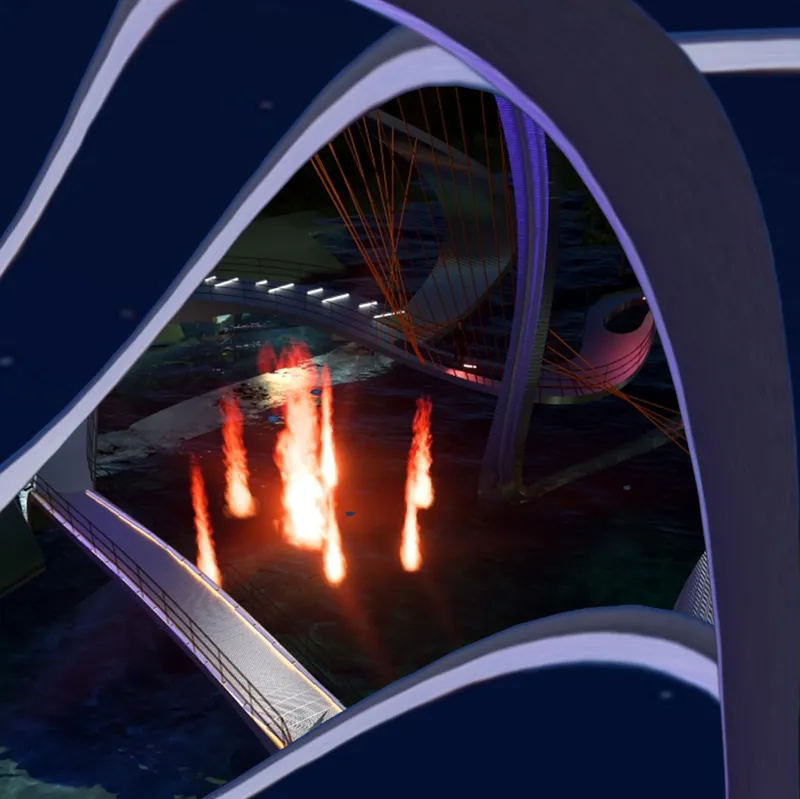
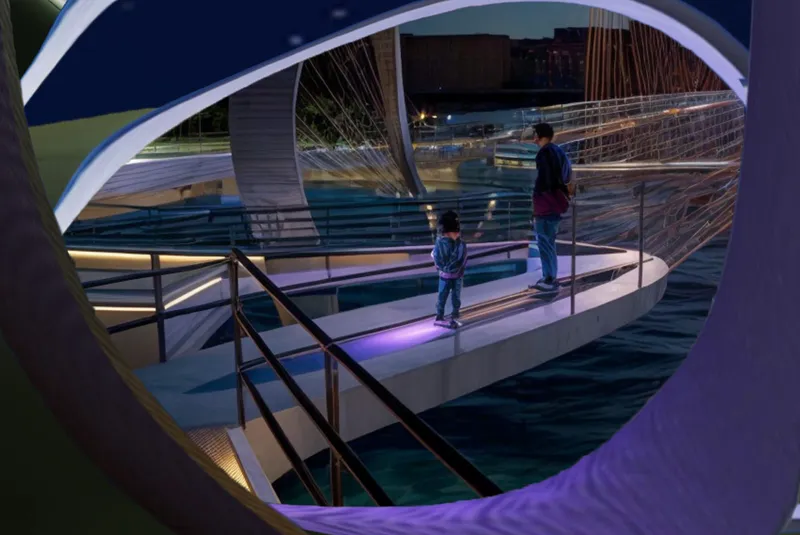
Two of the project's most compelling moments occur where the structure contracts into arched portals before opening back to the sky. The view through the main arch frames the illuminated water features and the cable array beyond, compressing the pedestrian's field of vision into a cinematic slot that then expands dramatically on the other side. It is a classic architectural sequence, threshold to release, executed here with lightweight tensile elements rather than heavy masonry.
The observation platform takes this logic further. A circular opening in an enclosing wall isolates two figures against the night, turning them into participants in a composed tableau. The circle crops out context and focuses attention on the horizon, the water, and the light gradient of the sky. Gamboa is clearly thinking about how people photograph and share architecture. These moments are generous without being cynical; they reward the body in space as much as the camera lens.
Situating the Intervention in the Lakeside Landscape
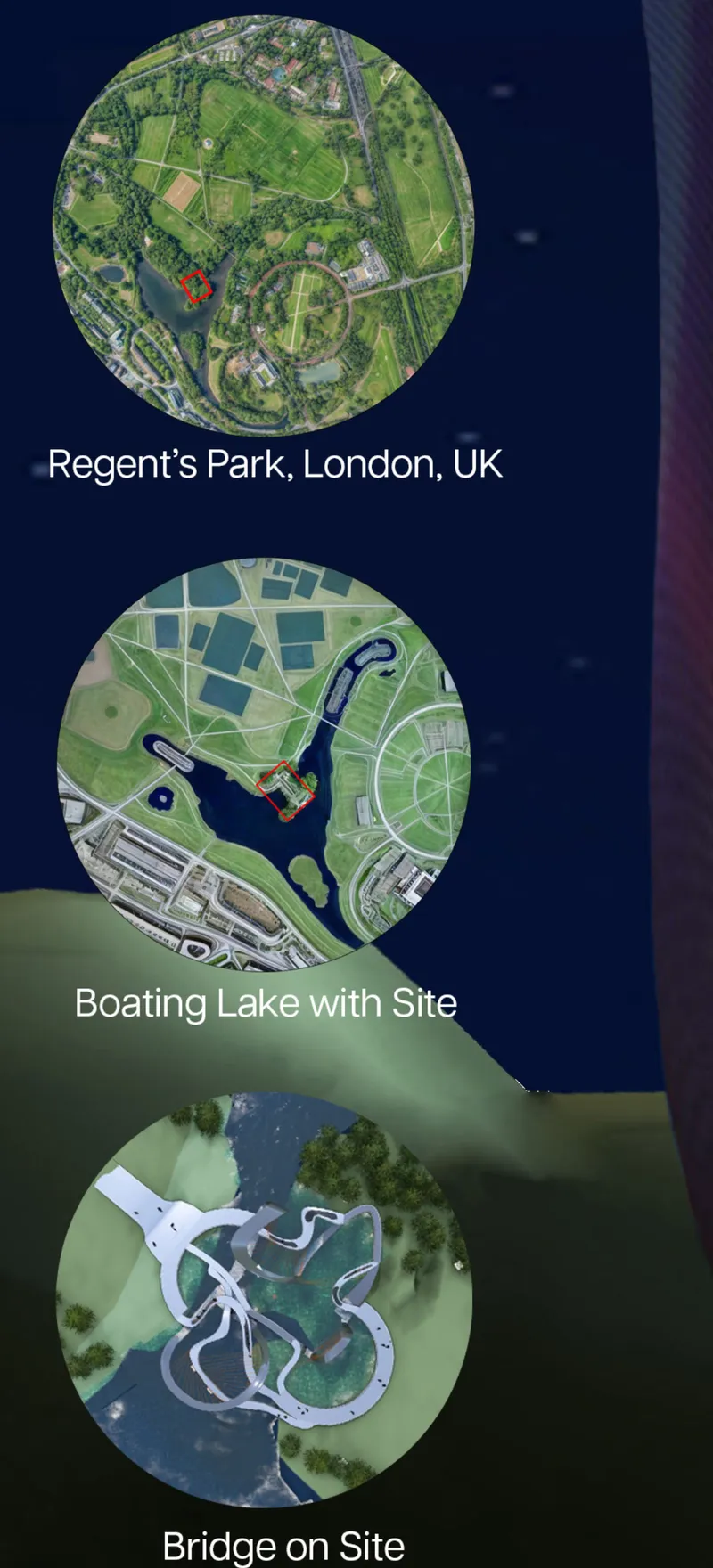
The site plan diagram pulls the camera back to show how Twilight Crossing sits within a broader parkland context along the lake edge. Three aerial views track the intervention's relationship to surrounding green space, pathways, and shoreline, making clear that the bridge is not an isolated object but a connective tissue between existing public zones. The curving geometry, so expressive up close, reads at this scale as a gentle inflection in the landscape rather than an aggressive formal imposition. That restraint matters. A beacon, after all, should draw people toward it without dominating everything around it.
Why This Project Matters
Twilight Crossing demonstrates a sophisticated understanding of when architecture is experienced, not just where. By designing a structure that peaks at dusk, Gamboa ties the project to a specific temporal condition, making the bridge feel almost event-like. Visitors would return not just to cross the water but to witness the crossing at a particular hour, which is exactly the kind of programmatic richness that elevates infrastructure into public space.
The project also shows how tensile cable structures can do more than resolve forces. In Gamboa's hands, every structural line becomes a carrier of light, every reflective surface becomes a collaborator, and every portal becomes a frame for human presence. For a competition titled Beacon, the entry delivers on the metaphor without resorting to a literal tower or lantern. The bridge itself is the beacon: a luminous arc that signals across the lake that something worth crossing toward is happening on the other side.
View the Full Project
About the Designers
Designer: Angel Gamboa
Enter a Design Competition on uni.xyz
uni.xyz runs architecture and design competitions year-round that reward proposals with spatial conviction and real site intelligence.
Project credits: Twilight Crossing by Angel Gamboa Beacon (uni.xyz).


Popular Articles
Popular articles from the community


Lunar Spiral: Space Architecture Shaped by the Mathematics of the Universe
Lunar Spiral reimagines space architecture through Fibonacci geometry, lunar regolith, levitating habitats, and self-sustaining Moon living.

Conexión: Biophilic Design Reimagines High-Rise Living in Hong Kong
Conexión reimagines high-rise living in Hong Kong through biophilic design, green facades, shared spaces, daylight, water and nature within.

Play: Fragments of Their World
Familiar architecture becomes modular playground design, creating safe spaces where displaced children can learn, connect, imagine and play.

ALGAL REALM: A Bio-Integrated Lunar Habitat Design for Life Beyond Earth
ALGAL REALM reimagines lunar habitat design with algae-powered life support, 3D-printed regolith, and vertical living for a lunar future.

Similar Reads
You might also enjoy these articles
ALGAL REALM: A Bio-Integrated Lunar Habitat Design for Life Beyond Earth
ALGAL REALM reimagines lunar habitat design with algae-powered life support, 3D-printed regolith, and vertical living for a lunar future.

Cinema Futurismo: Futuristic Architecture Reimagining the Future of Cinema
Cinema Futurismo merges futuristic architecture, holographic projection, intimate seating, and landscape into a new social cinema.

Little Red Riding Hood: Architectural Design as a Journey Through Fear, Light, and Storytelling
Little Red Riding Hood reimagines the fairy tale through architectural design shaped by fear, light, scale, memory, uncertainty, and choice.
Playducation: Modular Architecture That Turns Play Into a Space for Learning
Playducation transforms modular architecture into a flexible world of play, learning, and healing for children in refugee settlements.


Comments (0)
Please login or sign up to add comments
No comments yet. Be the first to comment!