
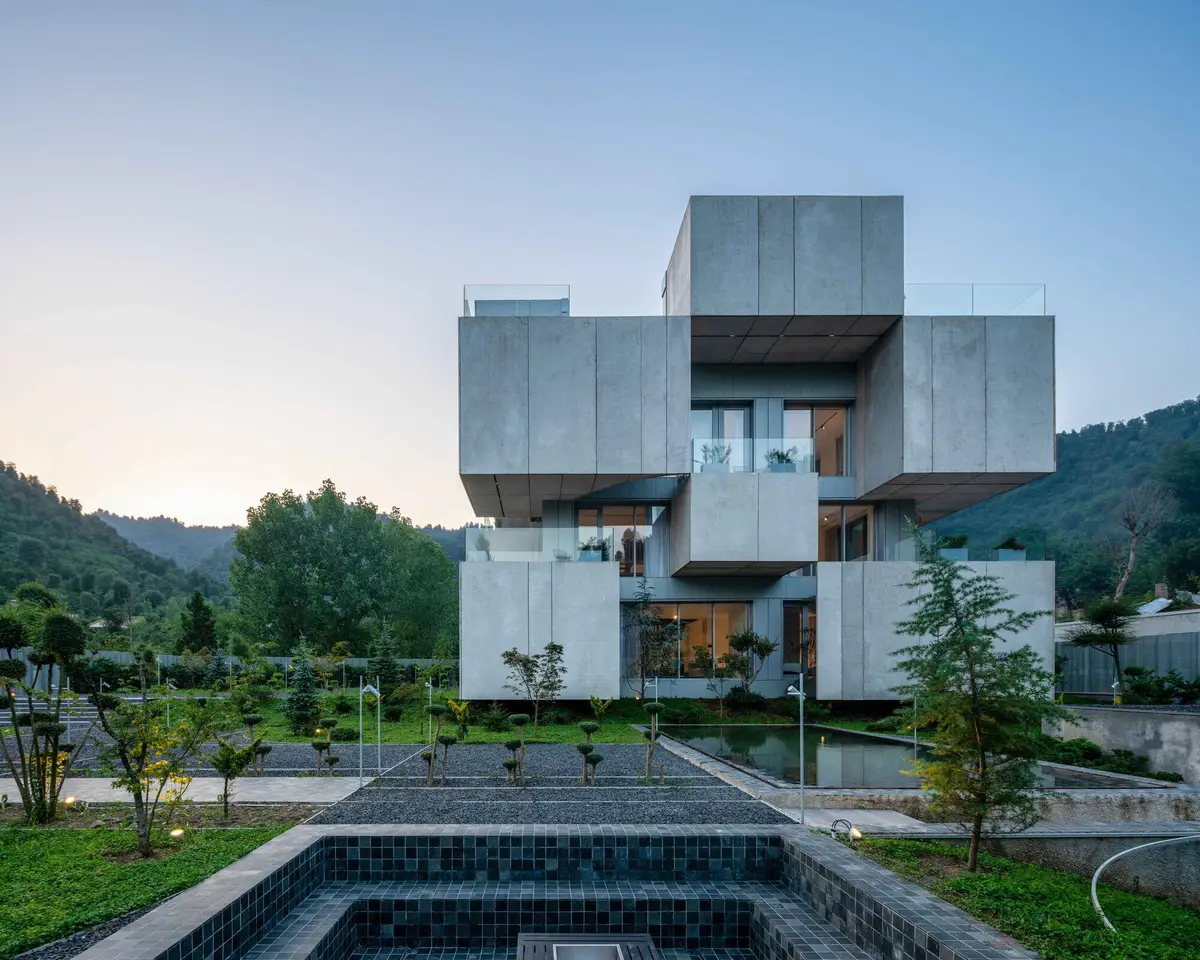
Bood Design Bureau Splits a Gilan Residence in Two to Let the Forest In
Double Side House negotiates privacy and openness through interlocking concrete volumes and planted courtyards in northern Iran's humid Caspian lowlands.


Northern Iran's Gilan province sits below the Alborz mountains along the Caspian Sea, where subtropical humidity and dense forest canopy dictate the terms of habitation. It is not a landscape that invites the hermetically sealed concrete box. Bood Design Bureau, led by Behzad Maneshgar, understood this and responded with a 1,800 square meter residence that is fundamentally organized around a split: two interlocking volumes separated by courtyards, voids, and terraces that pull the surrounding forest into the center of domestic life.
What makes Double Side House worth studying is not simply its sculptural concrete massing, which is admittedly striking, but the way the project weaponizes the section. Every floor redefines the relationship between inside and outside. Ground level opens to reflecting pools and shaded courtyards. Upper levels cantilever outward to frame panoramic views of the forested hillside. The roof becomes a garden. The building does not sit on its site so much as negotiate with it, floor by floor, offering different degrees of exposure and shelter as you move vertically through the house.
Interlocking Volumes
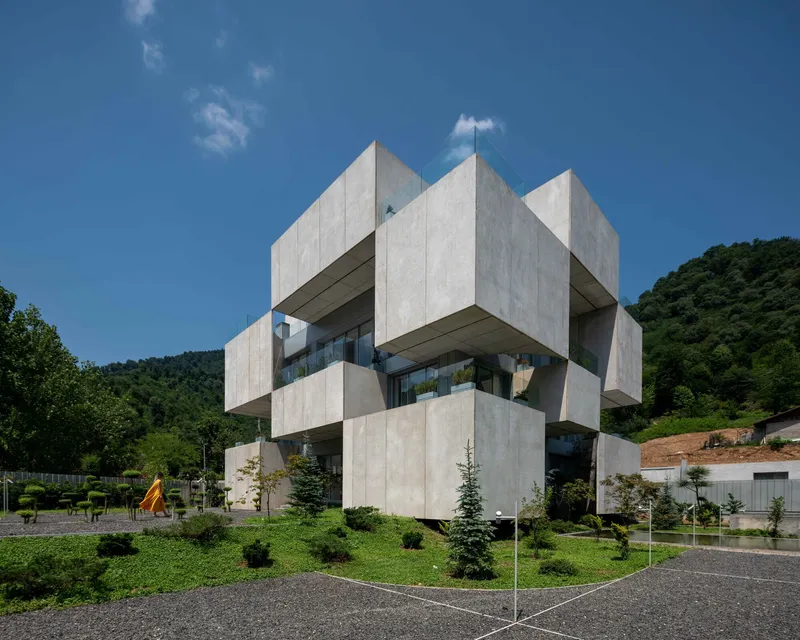
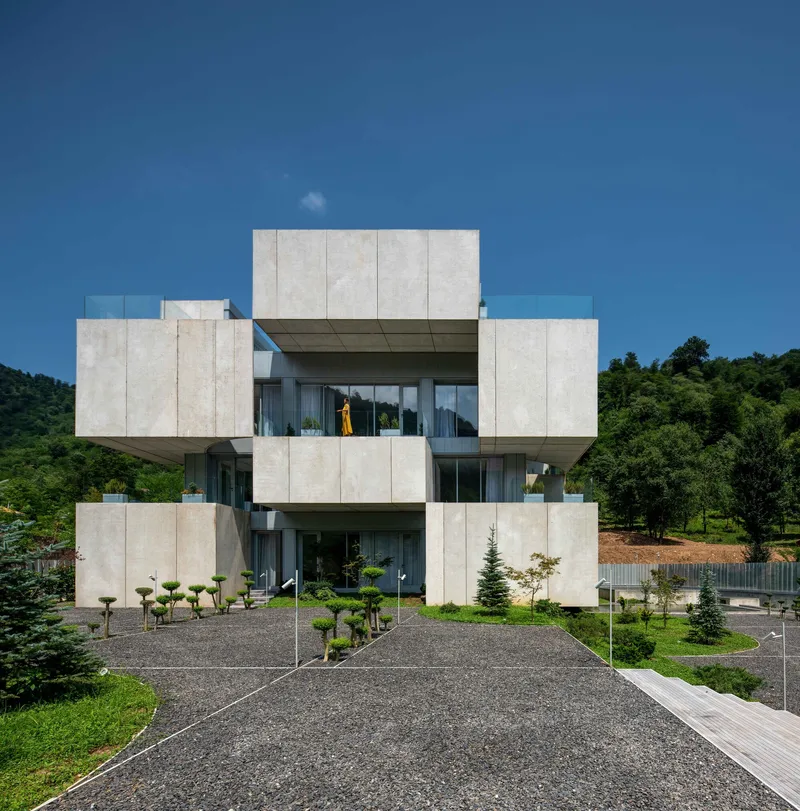
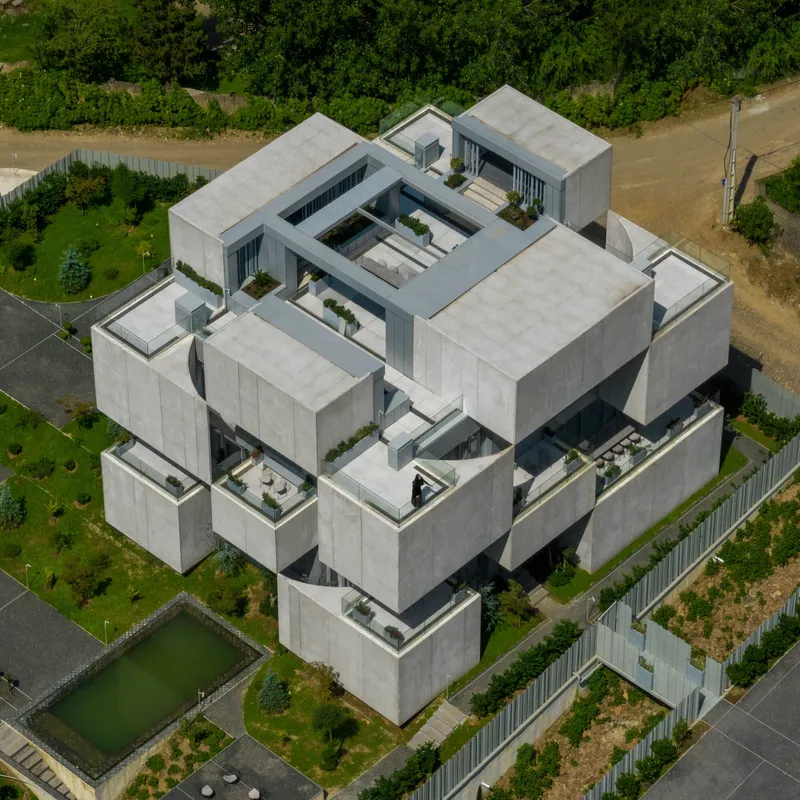
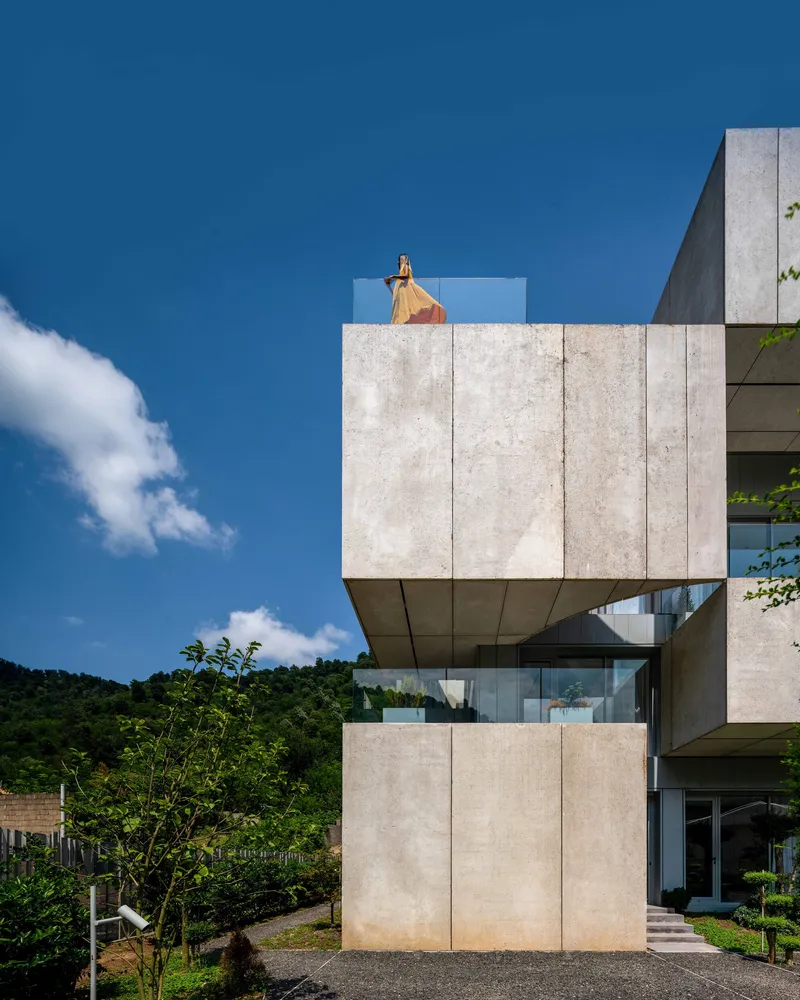
The primary formal move is legible from any angle: stacked cubic volumes shift and interlock, creating cantilevers that overhang the floors below. Viewed head-on, the front elevation reads as nearly symmetrical, with projecting balconies establishing a rhythmic cadence across the facade. From above, the interlocking strategy reveals its purpose. The volumes pull apart to create a central courtyard void that functions as the building's lungs, drawing light and air deep into the plan.
The concrete is raw and unadorned, which in Gilan's wet climate is a practical choice as much as an aesthetic one. The material ages gracefully here, acquiring a patina that roots the building in its context over time. The gravel approach path reinforces the sense of deliberate austerity, keeping the focus on mass, shadow, and the play of volume against sky.
Cantilevers and the Ground Plane
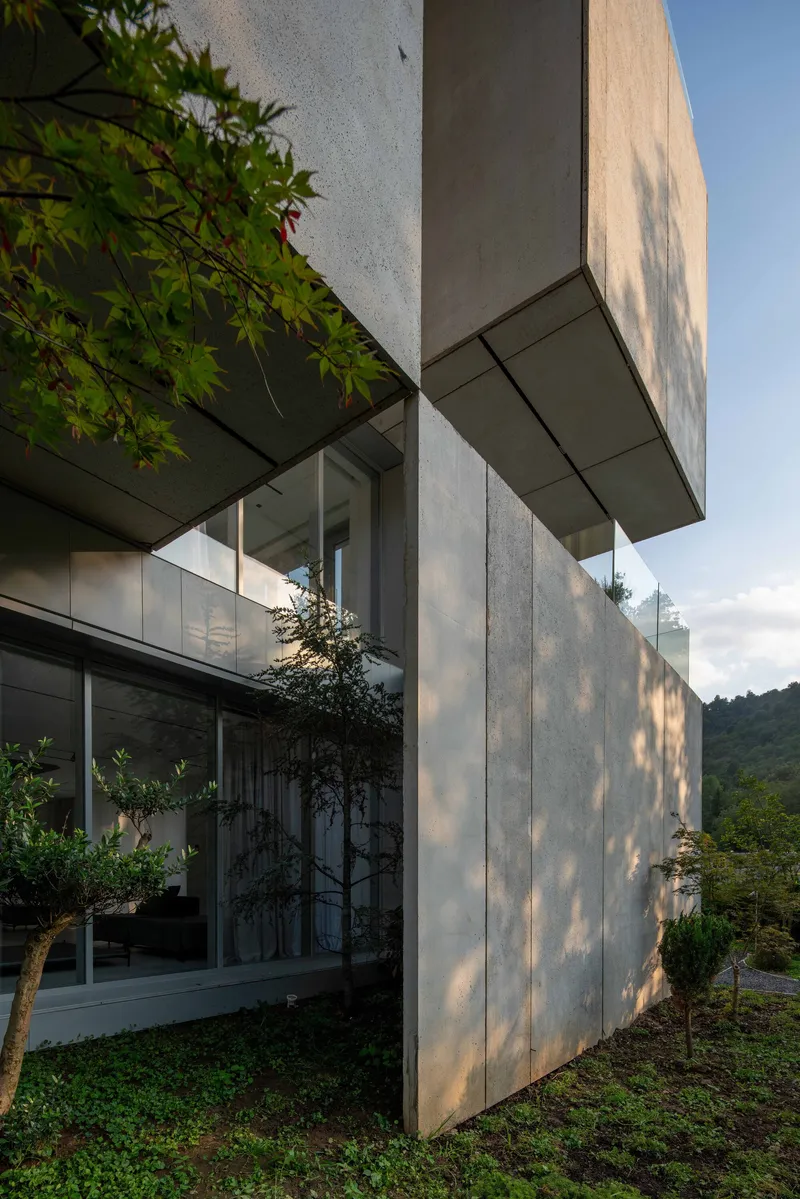
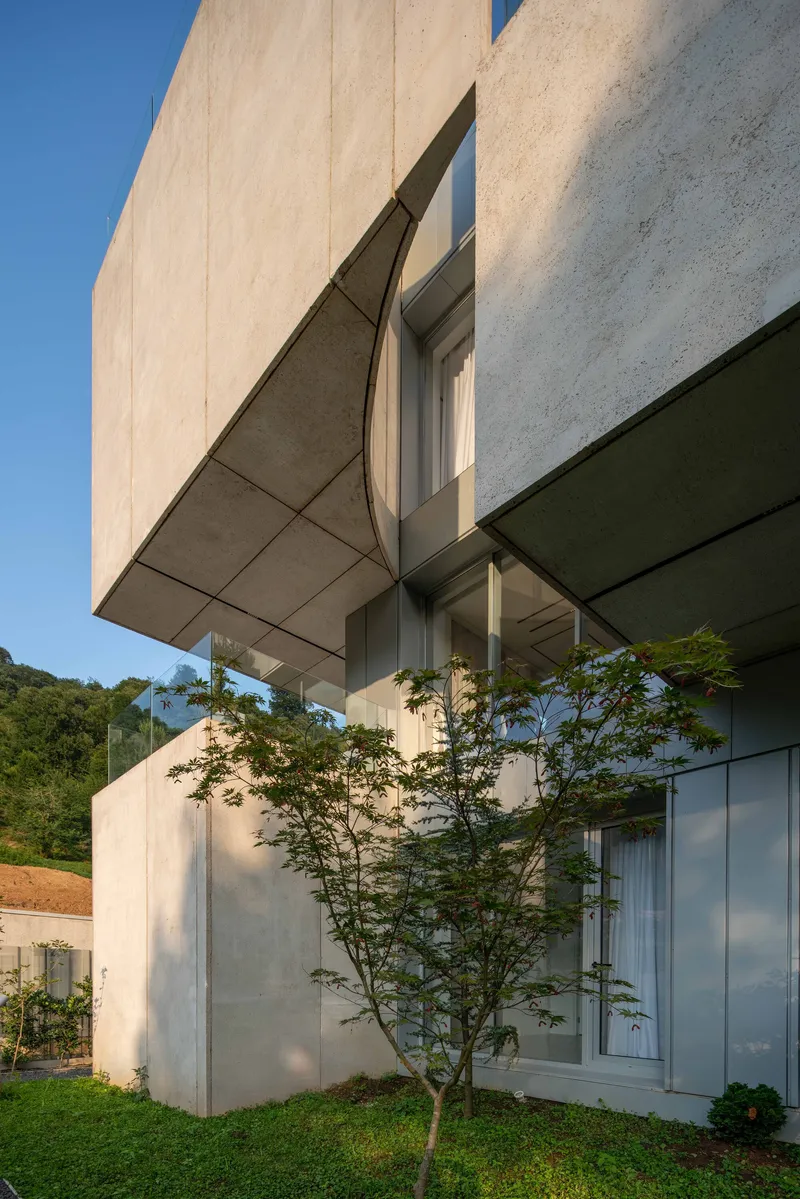
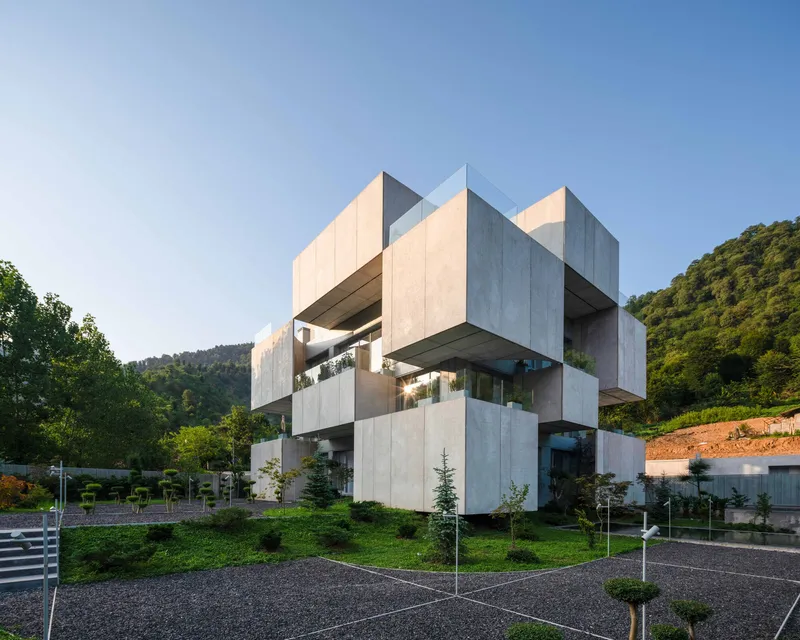
The cantilevers do real work here. They are not gestural overhangs added for drama. Each projecting slab shelters the glazed walls below from Gilan's heavy rainfall while generating deep shadow lines that modulate the facade through the day. At corner conditions, glass meets the underside of the cantilevered concrete in a clean, almost weightless detail that makes the upper volumes appear to float.
Small trees planted at the base of these cantilevers are more than ornamental. They soften the junction between building and ground and, as they mature, will further blur the boundary between architecture and landscape. At dusk, the stacked volumes glow against the hillside, their horizontal emphasis echoing the layered topography of the Alborz foothills beyond.
Courtyards and the Central Void
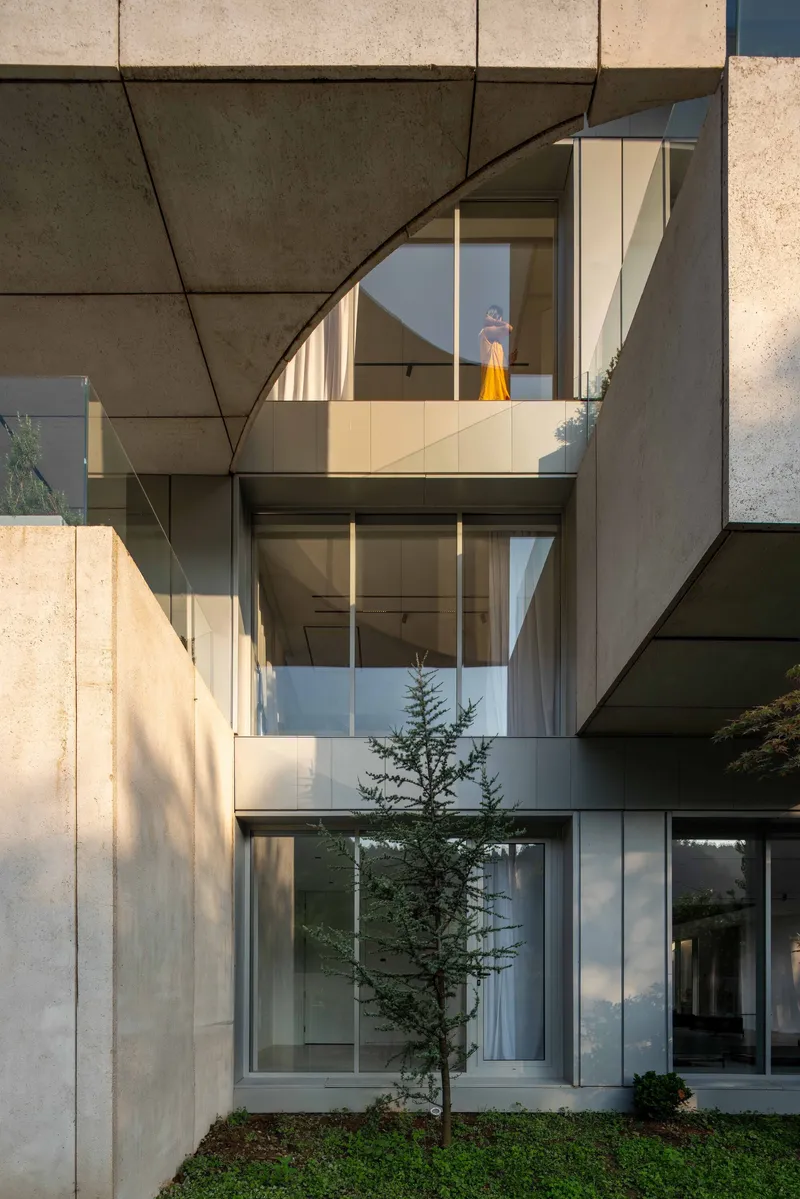
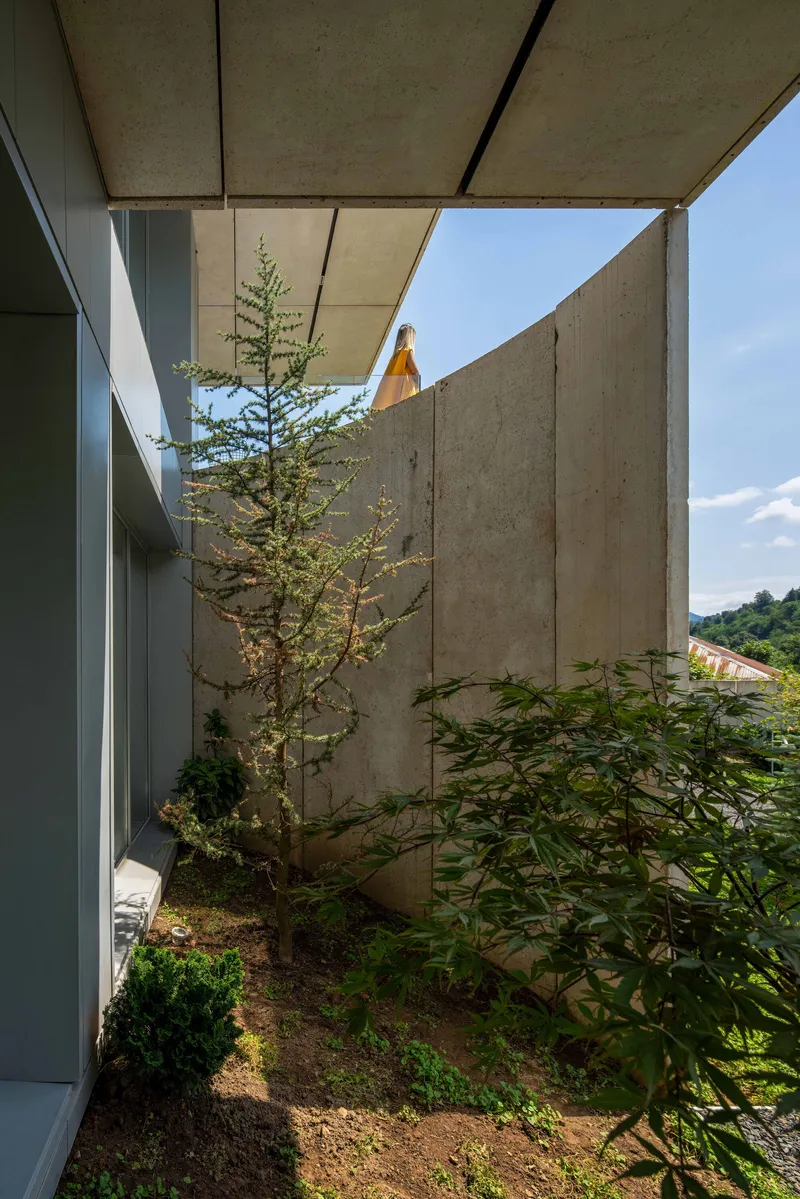
The courtyard is where the project's "double side" logic becomes most tangible. Standing in the planted gap between the two wings, you are simultaneously inside and outside. Glazed corridors connect the halves at lower levels while cantilevered slabs overhead frame a narrow stripe of sky. An evergreen tree grows in the courtyard, establishing a vertical datum that the architecture orbits around rather than dominates.
This strategy of pulling the plan apart to create inhabitable negative space recalls traditional Persian courtyard typologies, but here the void is linear rather than centroidal. The result is a house that breathes: cross-ventilation through the central gap is essential in Gilan's humid summers, and the courtyard's role as a climate device is inseparable from its spatial and experiential qualities.
Water, Reflection, Landscape
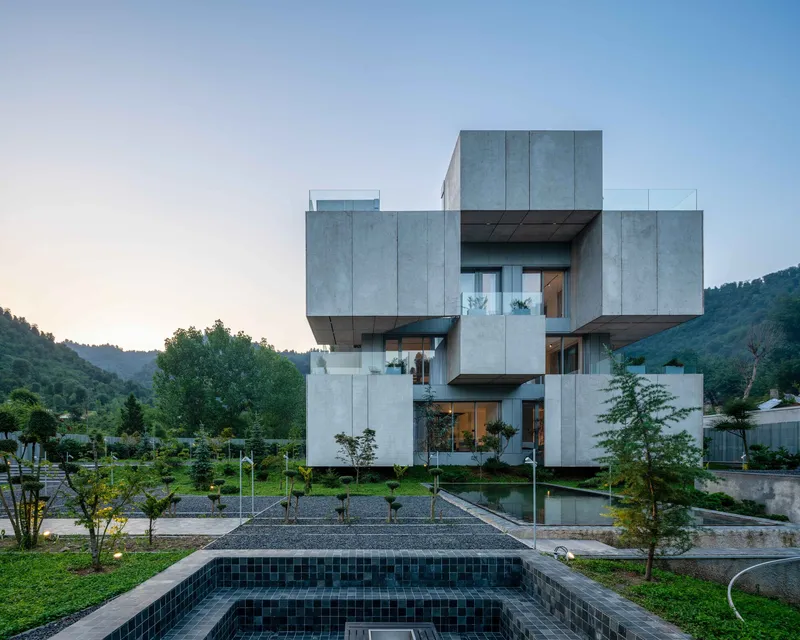
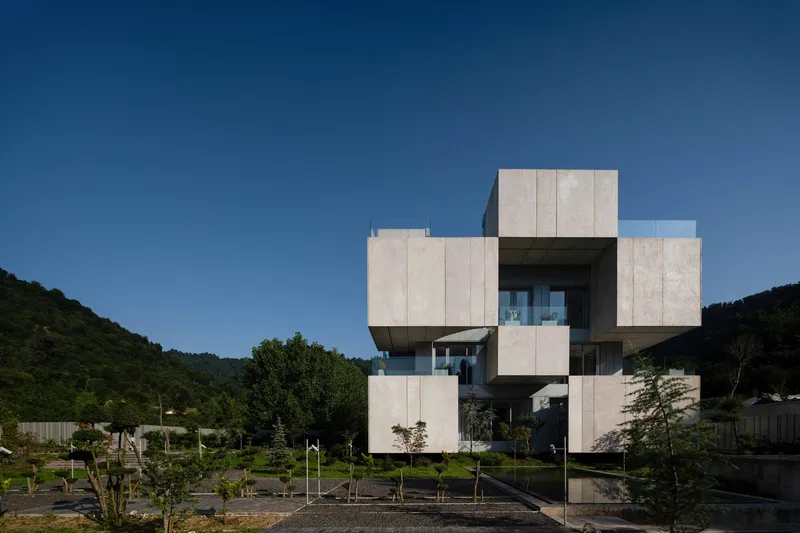
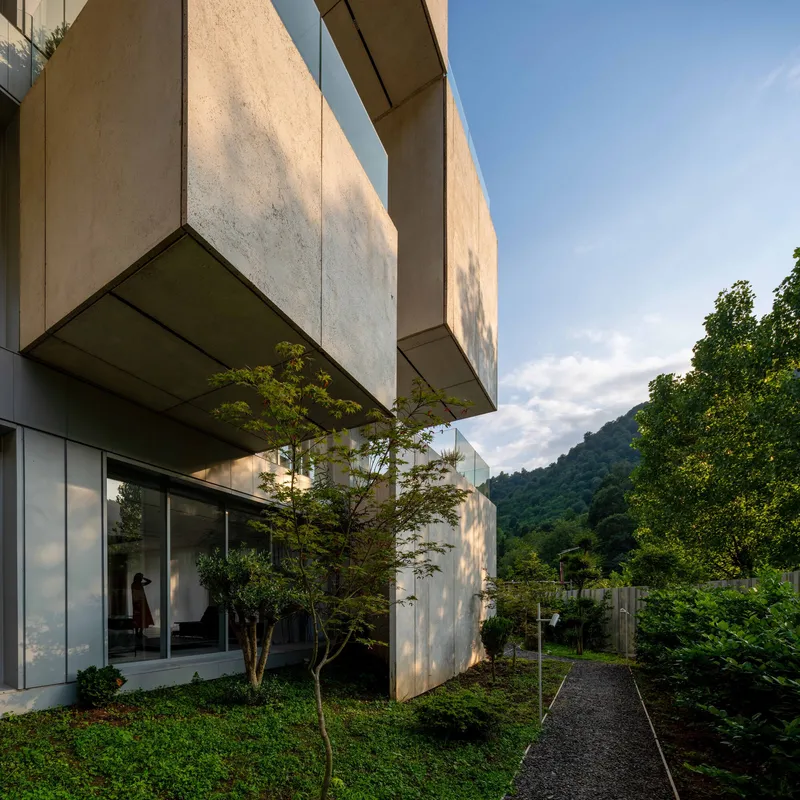
At the rear, a dark-tiled reflecting pool stretches beneath the overhanging concrete, doubling the mass of the building in still water. The effect is cinematic. Trees and the forested hillside beyond are mirrored alongside the facade, collapsing the distinction between built and natural. It is a move with deep roots in Persian garden design, where water channels and pools have always served as instruments for merging architecture with sky and vegetation.
From the opposite side, the garden elevation shows a more relaxed posture. Terraces step down toward a manicured lawn punctuated by young evergreens, framing long views of the hillside. The building here is generous with its landscape, stepping back rather than asserting a hard edge, letting the ground plane run freely beneath the elevated volumes.
Interior Thresholds
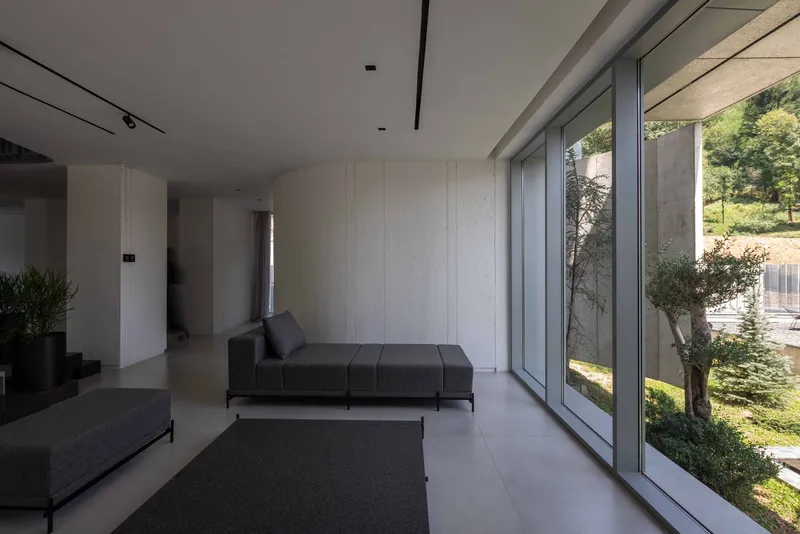
Inside, full-height glazing dissolves the wall between living space and terrace. The interior palette is restrained: pale paneled walls, light flooring, minimal furnishing. The architecture gets out of the way and lets the landscape do the talking. This is not false modesty. In a building with this much volumetric ambition on the outside, the interiors need to be calm. They succeed precisely because they defer to the framed views rather than competing with them.
At the upper terrace, a figure standing at the railing gives scale to the cantilever. The generous depth of the overhang becomes apparent: this is outdoor living space, not a token balcony. The proportions suggest that the terraces were designed as rooms without walls, extending the habitable area of the house significantly while remaining sheltered from sun and rain.
The Roof Garden and Forest Edge
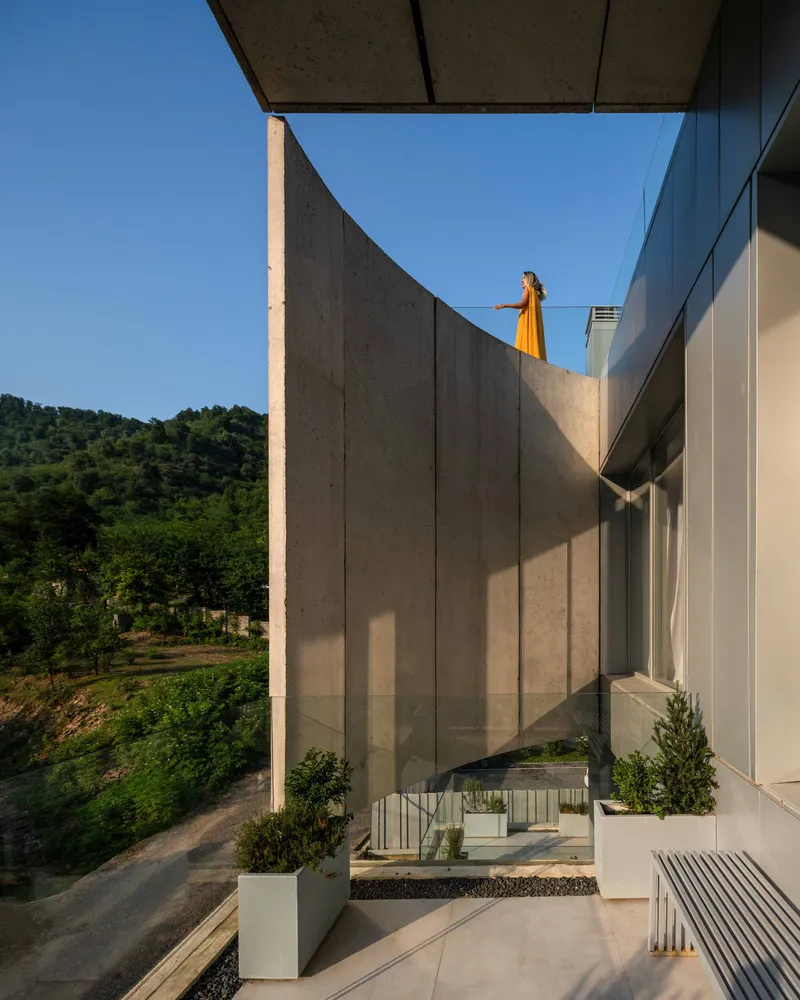
The rooftop terrace, with its curved concrete wall and planted beds, offers the most dramatic vantage in the house. At dusk, the forested hills roll out beneath you, and the architecture recedes to become a viewing platform. The curved wall is an anomaly in a project dominated by orthogonal geometry, and it reads as a deliberate softening, a concession to the organic contours of the landscape it overlooks.
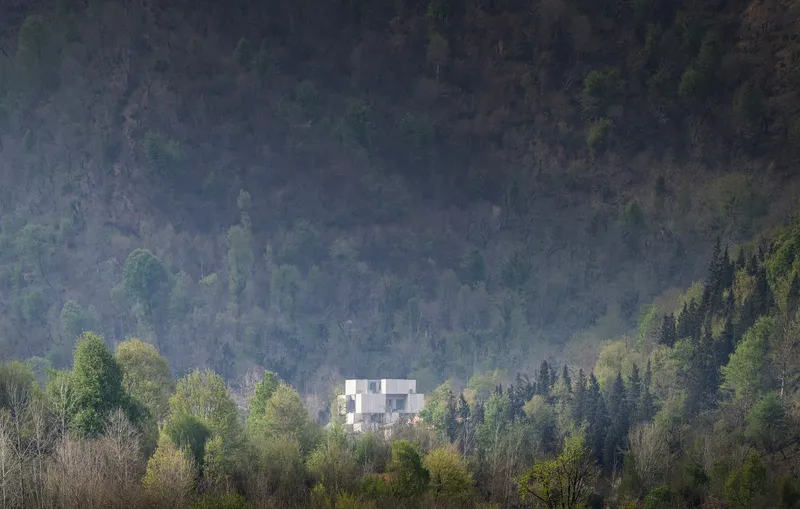
Seen from a distance in morning mist, the white geometric volumes nestle into the deciduous and evergreen forest as though they had always been there. The building's massing fragments into distinct pieces at this scale, and the forest fills the gaps. It is the clearest evidence that the split-volume strategy pays off: the house does not displace the landscape. It coexists with it.
Plans and Drawings
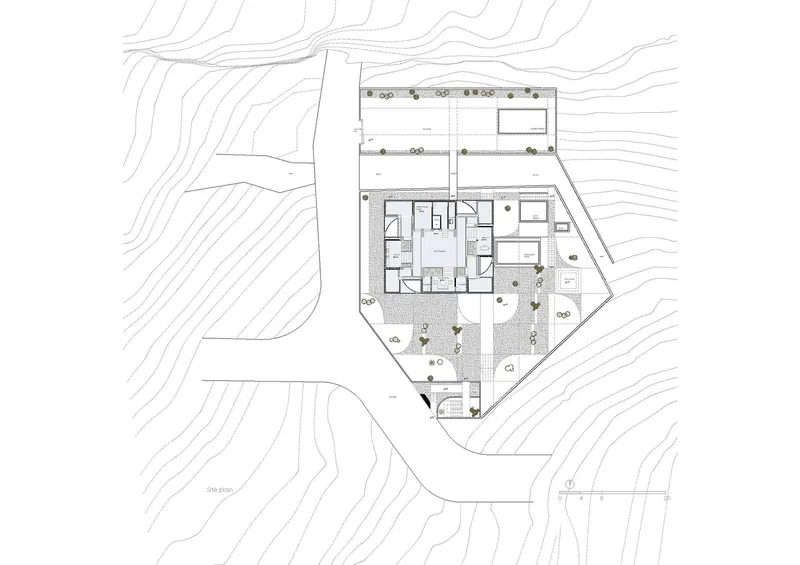
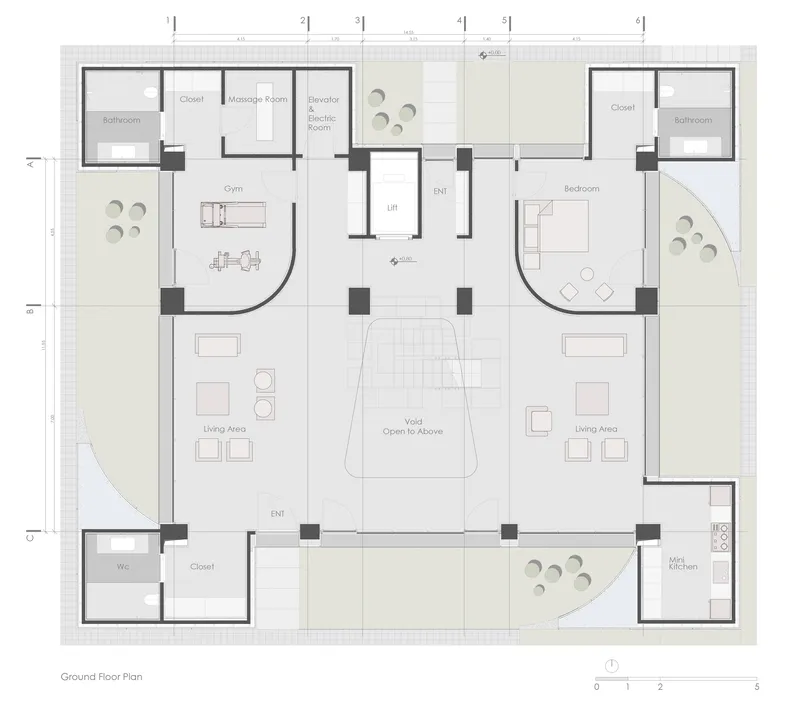
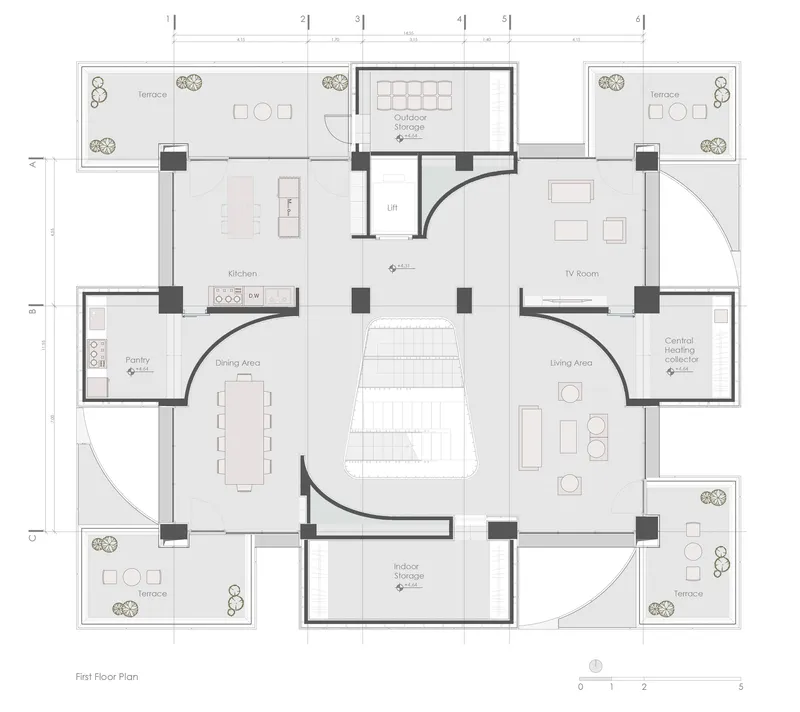
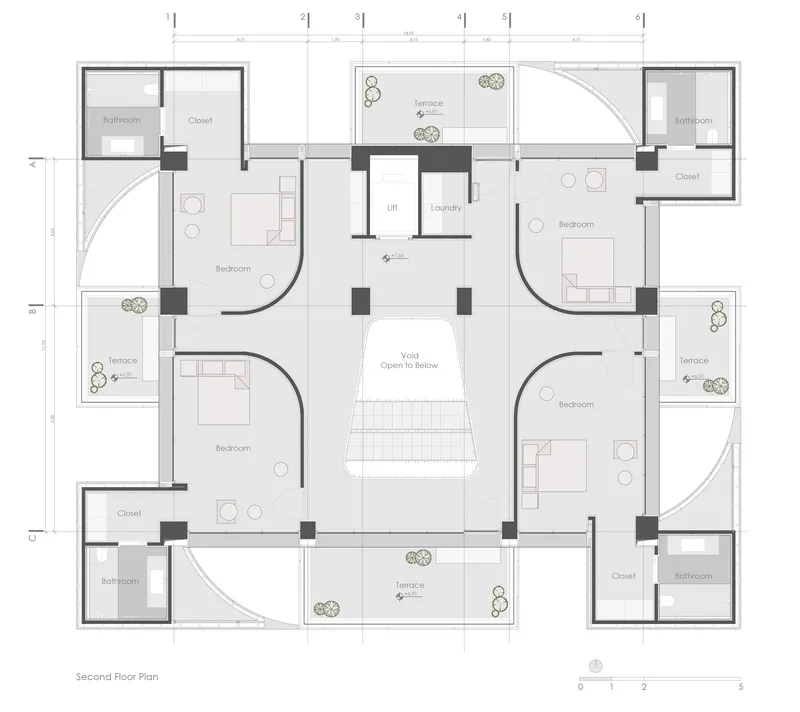
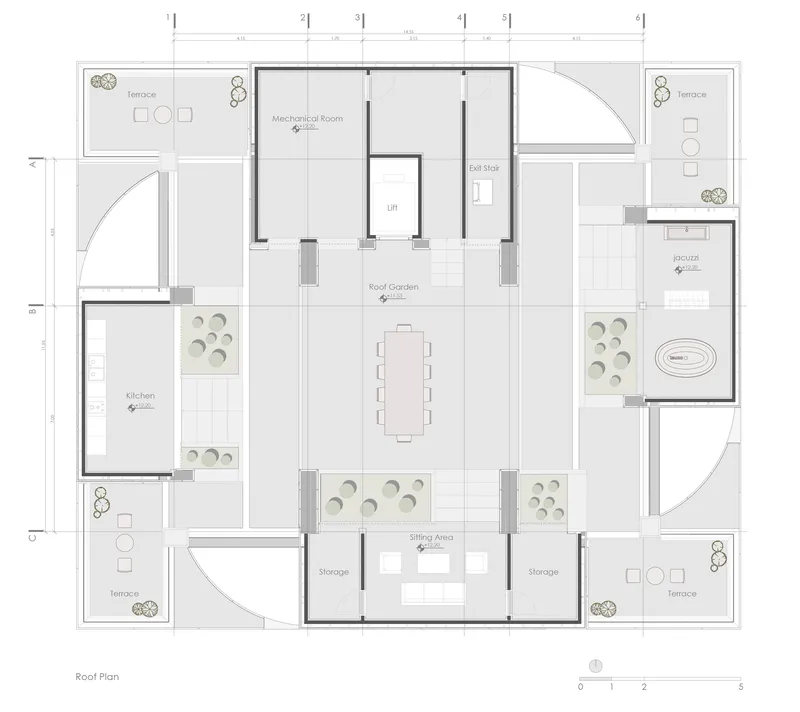
The site plan confirms the building's dialogue with topography: contour lines wrap tightly around the footprint, indicating a sloping site that the architecture navigates through section rather than grading flat. The ground floor plan reveals the symmetrical twin-wing organization, with living areas flanking the central courtyard void. On the first floor, kitchen and living spaces occupy the shifted volumes, with corner terraces providing outdoor access at every turn. The bedroom level arranges four rooms around a central void open to below, maintaining visual connection between floors. The roof plan shows the payoff: a garden dining area flanked by planted beds, turning the top of the house into a cultivated landscape in its own right.
Why This Project Matters
Double Side House deserves attention because it demonstrates that climate-responsive design and formal ambition are not mutually exclusive. Every cantilever, every courtyard void, every reflecting pool serves a dual purpose: experiential and environmental. The project resists the temptation to treat sustainability and aesthetics as separate agendas and instead fuses them into a single spatial strategy. In Gilan's demanding climate, that integration is not optional. It is the difference between a building that performs and one that merely looks interesting in photographs.
More broadly, the project offers a model for how contemporary residential architecture in Iran can draw on deep typological traditions, particularly the courtyard house and the Persian garden, without resorting to nostalgic pastiche. Bood Design Bureau has taken those principles, abstracted them into a muscular concrete language, and proven that they still work. The house is rooted in its place, responsive to its climate, and generous enough to let the forest have the last word.
Double Side House by Bood Design Bureau, led by Behzad Maneshgar. Located in Gilan, Iran. 1,800 m². Completed 2020.
About the Studio
Share Your Own Work on uni.xyz
If projects like this are the kind of work you want to make, uni.xyz is a place to publish your own, find collaborators, and enter design competitions.


Popular Articles
Popular articles from the community


ALGAL REALM: A Bio-Integrated Lunar Habitat Design for Life Beyond Earth
ALGAL REALM reimagines lunar habitat design with algae-powered life support, 3D-printed regolith, and vertical living for a lunar future.

Conexión: Biophilic Design Reimagines High-Rise Living in Hong Kong
Conexión reimagines high-rise living in Hong Kong through biophilic design, green facades, shared spaces, daylight, water and nature within.

Co-Life: Senior Housing Design That Reconnects Older Adults With the City
Co-Life reimagines senior housing design through healing gardens, shared streets, workshops, and a sustainable community across generations.

Little Red Riding Hood: Architectural Design as a Journey Through Fear, Light, and Storytelling
Little Red Riding Hood reimagines the fairy tale through architectural design shaped by fear, light, scale, memory, uncertainty, and choice.

Similar Reads
You might also enjoy these articles

Bao Huynh Watercolor Atelier: A Serene Art Retreat in Hội An
Bao Huynh Watercolor Atelier in Hội An blends multifunctional art spaces, sustainable design, local materials, and family-friendly living in a serene environment.

Atelier Macri Concept Store Interior Design by CASE-REAL
Atelier Macri store features a "ko" counter, walnut wood details, cork displays, blending retail, gallery, and seamless customer experiences.

Manuel Vargas Izquierdo Stadium and High-Performance Sports Center: Architectural Excellence in Jalpa de Méndez
The Manuel Vargas Izquierdo Stadium blends sustainable design, inclusive sports facilities, and cultural-inspired architecture, revitalizing Jalpa de Méndez’s public spaces.

KAKR Buluh Awar Hall: Revitalizing Community and Ecology Through Bamboo Architecture
Community built bamboo hall revitalizes Buluh Awar village, empowering youth, restoring ecology, celebrating vernacular craftsmanship through sustainable architecture and culture.


Comments (0)
Please login or sign up to add comments
No comments yet. Be the first to comment!