

Mixed-Use Commercial Architecture Reimagined: COME THRU: Dixie Drive Thru Mall
A future-ready mixed-use commercial architecture merging drive-through retail, pop-up culture, and flexible urban infrastructure.


Retail architecture is undergoing a radical transformation. As digital commerce reshapes consumer behavior, architects are challenged to create hybrid environments that combine physical experience with online efficiency. COME THRU: Dixie Drive Thru Mall redefines mixed-use commercial architecture by merging drive-through convenience, modular retail systems, and pedestrian engagement into one adaptable urban infrastructure.
Originally inspired by the historical Dixie Square Mall (opened in 1965 and closed in 1978), the project reimagines the future of retail through an architectural system that accommodates both online and offline consumption models. Rather than designing a conventional shopping mall, the proposal introduces a flexible retail ecosystem that prioritizes speed, adaptability, and extensibility.
This visionary project is developed by Eunji JEONG, 지영 문, and 현주 박.

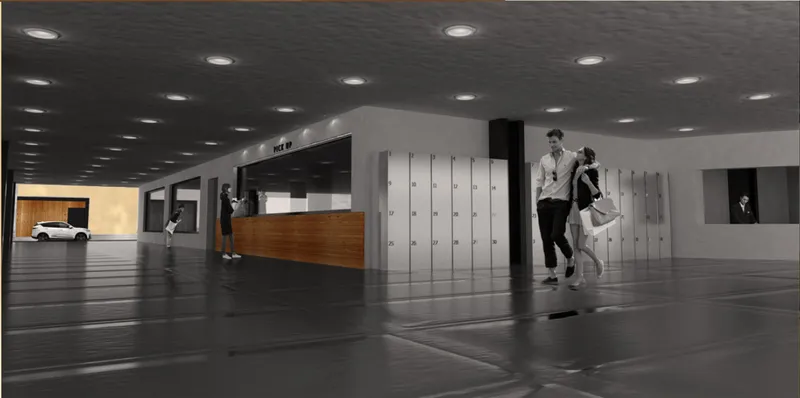
Concept: Retail as Infrastructure
At its core, COME THRU challenges the static nature of traditional malls. Instead of fixed anchor tenants and enclosed corridors, the design proposes a dynamic drive-through retail model where vehicle circulation becomes the primary spatial organizer.
The building mass evolves from a continuous Mobius-strip-inspired geometry. This looping form allows:
- Continuous vehicular movement
- Seamless order and pick-up systems
- Integrated pedestrian circulation
- Expandable retail modules
In this mixed-use commercial architecture, the mass itself becomes traffic infrastructure and retail space simultaneously. The form is not merely sculptural, it is operational.
Online Meets Offline: Hybrid Retail Strategy
The future retail landscape requires integration between digital ordering and physical fulfillment. COME THRU accommodates this shift by providing:
- Drive-through ordering lanes
- Dedicated pick-up offices
- Pop-up retail units
- Information hubs
- Modular container-based shops
Customers can order online and pick up instantly, minimizing time spent while preserving physical brand interaction. Retail units function as temporary or rotating pop-ups, emphasizing brand promotion rather than permanent tenancy. This model reflects changing consumer trends and supports retail flexibility.
The result is a hybrid retail architecture that encourages convenience without eliminating the social dimension of shopping.
Spatial Organization and Program
The project unfolds across multiple levels:
- B2 Level: Large-scale parking infrastructure
- B1 Level: Sunken plazas and storage
- Ground & Upper Floors: Retail units and pick-up offices
- Upper Terraces: Roof gardens and open circulation decks
Vehicular ramps connect floors in a continuous loop, while pedestrian paths intersect through sunken courtyards and elevated walkways. The architecture balances movement and pause, efficiency and experience.
A section through the building reveals layered programming: storage, parking, retail, and terrace spaces are stacked yet interconnected through sloped ramps and open voids.
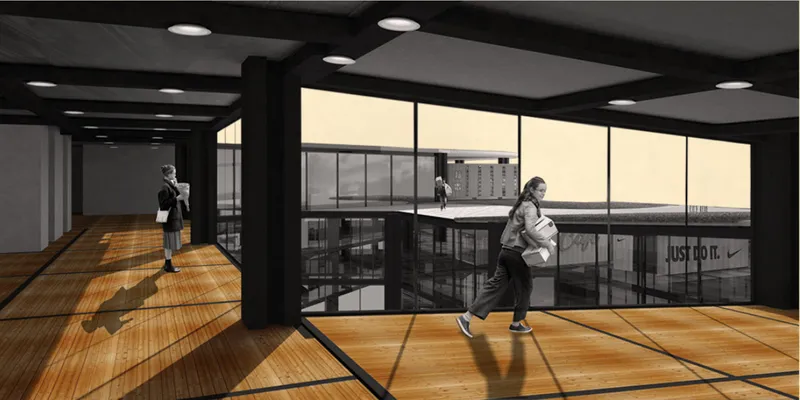

Modular Container System: Infinite Extensibility
One of the most innovative aspects of this mixed-use commercial architecture is its container infill system.
The structural framework consists of:
- Columns
- H-beams
- Plates
- Modular containers
- Stair cores and hallways
Retail spaces are inserted as container units that can be rearranged, expanded, or replaced. This allows infinite extensibility, new modules can be added without disrupting the overall circulation logic.
The system enables:
- Scalability over time
- Temporary brand installations
- Seasonal retail adaptation
- Rapid construction adjustments
Architecture becomes an evolving platform rather than a fixed object.
Drive-Through as Urban Typology
Unlike conventional malls that prioritize internal corridors, COME THRU externalizes circulation. Cars become part of the architectural choreography. Drive-through lanes weave through the mass, offering direct access to retail units.
The design transforms:
- Vehicle flow into spatial form
- Circulation into façade articulation
- Movement into architectural identity
Perforated façade panels provide shading while maintaining visual permeability. The material palette balances industrial robustness with contemporary retail aesthetics.
Social and Urban Impact
By merging drive-through systems with pedestrian-friendly terraces and roof gardens, the project avoids becoming purely automotive infrastructure. Instead, it proposes a layered urban environment where:
- Drivers experience convenience
- Pedestrians enjoy open platforms
- Brands benefit from visibility
- Communities gain adaptable commercial space
COME THRU demonstrates how mixed-use commercial architecture can respond to post-digital retail demands while maintaining spatial quality.
COME THRU, Dixie Drive Thru Mall represents a forward-thinking model for mixed-use commercial architecture in the era of hybrid commerce. By combining modular systems, continuous drive paths, and pop-up retail strategies, the project offers a resilient and expandable framework for future urban retail developments.
Rather than mourning the decline of traditional malls, this proposal reimagines them as adaptable infrastructures: capable of evolving with technology, consumer behavior, and urban growth.
In a rapidly shifting retail landscape, COME THRU stands as a prototype for architecture that moves as fast as the market it serves.




Popular Articles
Popular articles from the community


The Earth Pod: 3D Printed Homes for Resilient Refugee Communities
The Earth Pod reimagines refugee housing through 3D printed homes made from clay, combining resilience, self-sufficiency, and rapid shelter.

The Musturak Paradise: Senior Living Architecture for a Connected Future in Temara, Morocco
The Musturak Paradise reimagines senior living architecture in Temara via private homes, social spaces, culture, community, and shared care.
EW PARK: Sustainable Architecture Reimagines the Future of Urban Parking
EW PARK reimagines city parking as a modular wooden tower combining automation, solar energy, electric mobility, and adaptable urban design.

Co-life: Sustainable Architecture for Age-Friendly Community Living
Co-life reimagines sustainable architecture for seniors through courtyards, rammed earth, shared gardens, and spaces designed for belonging.

Similar Reads
You might also enjoy these articles

Eco Chapel: A Green Architecture Pavilion Designed in Symbiosis with the Forest
Eco Chapel uses green architecture to weave prayer, learning and reuse into a forest pavilion shaped by modular hexagonal canopies for life.
Kaffeebühnen: Coffee Shop Architecture Designed as a Civic Stage Between Vienna’s City and Park
Kaffeebühnen turns coffee shop architecture into a civic stage, linking Vienna’s park edge, urban life, warm timber yards, and coffee craft.
Healing Façade: Sustainable Architecture for Reforestation, Community, and Sacred Ecology in Ethiopia
Healing Façade reimagines sustainable architecture as a living wall that restores soil, catches water and renews Ethiopia's forest churches.


Urban Forest: A Vertical Ecosystem for 5,000 Workers in Singapore's Changi Business Park
Radially stacked pods and layered green decks turn a 7-acre plot into 47 acres of ecological workspace projected for 2040.



Comments (0)
Please login or sign up to add comments
No comments yet. Be the first to comment!