
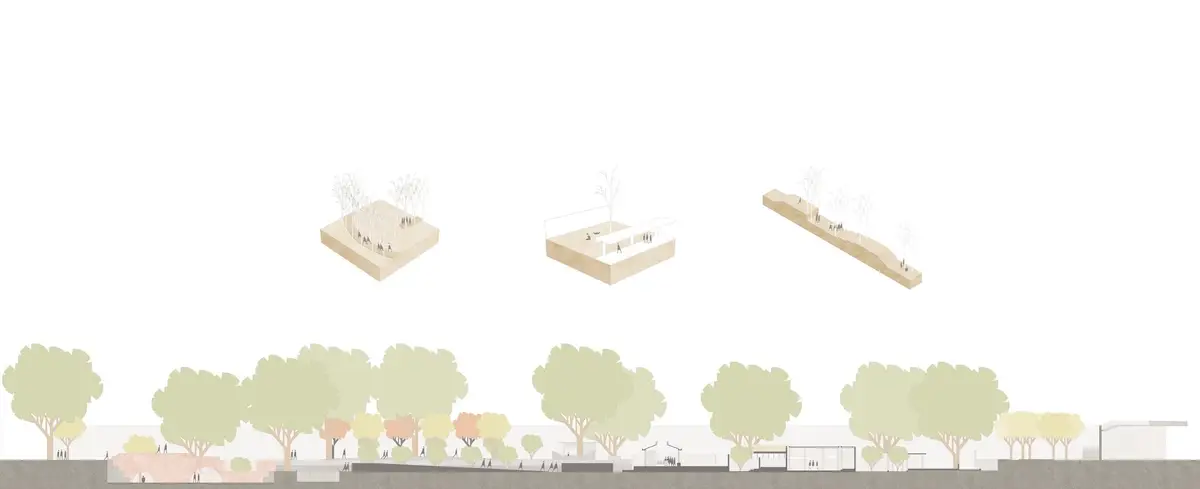
Re-Imagining the Urban Crematorium: A Mumbai Funerary Landscape Where Mourners and the Public Share Ground
A secular crematorium proposal for Mumbai that splits mourners and public into parallel journeys, joined by a park of Gulmohar and Laburnum trees.


In rapidly densifying cities, spaces of death are often pushed to the margins—physically, socially, and psychologically. Crematoriums and cemeteries, once conceived as sacred grounds of reflection, have increasingly become infrastructural necessities shaped by urgency rather than empathy. This project, Re-Imagining the Urban Crematorium by Shravan Suresh, proposes a transformative model of funerary architecture that rethinks how cities engage with grief, ritual, and remembrance.
Located within the dense urban fabric of Mumbai, the proposal challenges the perception of crematoriums as taboo spaces. Instead, it positions them as integrated civic landscapes—open, contemplative, and experientially meaningful.
Urban Crematorium Design Beyond Taboo
Traditional crematorium planning in Indian cities has often been influenced by religious prescriptions, limited land availability, and growing population pressures. The result is typically a grim, utilitarian environment that prioritizes efficiency over emotional sensitivity.
This project reconsiders urban crematorium design through a secular lens—one that studies the psychology of the mourner without religious bias. By understanding grief as a deeply personal yet universal experience, the design proposes spatial strategies that are inclusive, humane, and adaptable.
Rather than isolating cremation and burial functions, the project introduces layered programming that carefully segregates and reconnects user groups through landscape and architectural thresholds.
Two Worlds: Public and Mourner
A central concept in this funerary architecture proposal is the coexistence of two distinct user groups:
- The Mourner (primary user)
- The General Public (secondary user)
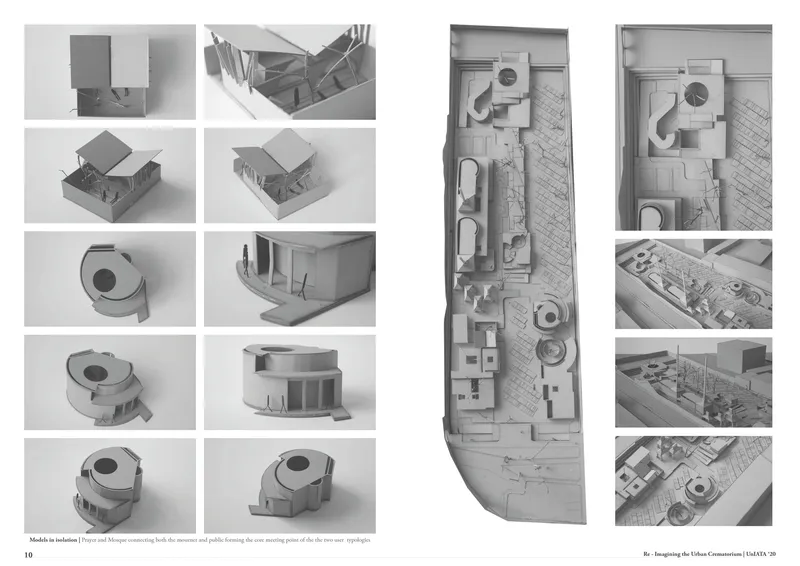
Instead of allowing chaotic overlap, the design creates separate entry points, circulation systems, and spatial hierarchies. This segregation prevents unnecessary crowding and ensures privacy during rituals, while still maintaining civic openness.
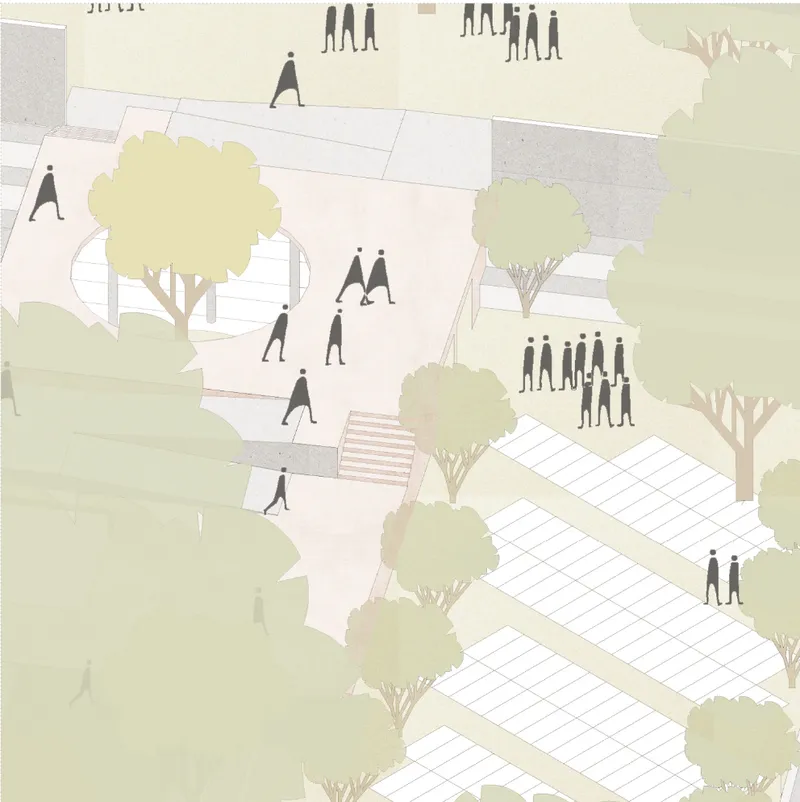
The public is drawn into a landscaped park that cuts across the site, transforming the crematorium from a closed compound into a permeable urban connector. Meanwhile, mourners transition through carefully choreographed spatial sequences that prepare them emotionally and psychologically.
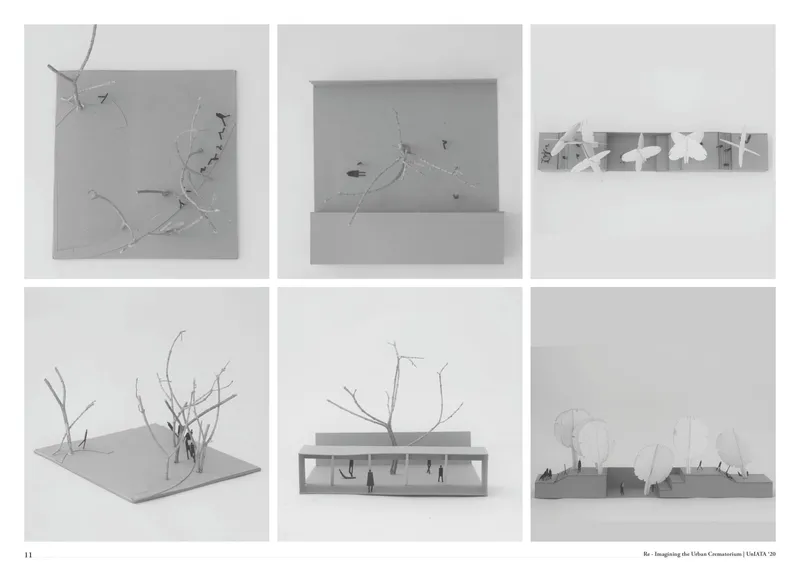
Landscape as Emotional Infrastructure
In this reimagined crematorium, landscape is not decorative—it is infrastructural.
The proposal introduces:
- A Public Park that encourages movement and social engagement.
- A Contemplative Park designed for introspection and ritual transition.
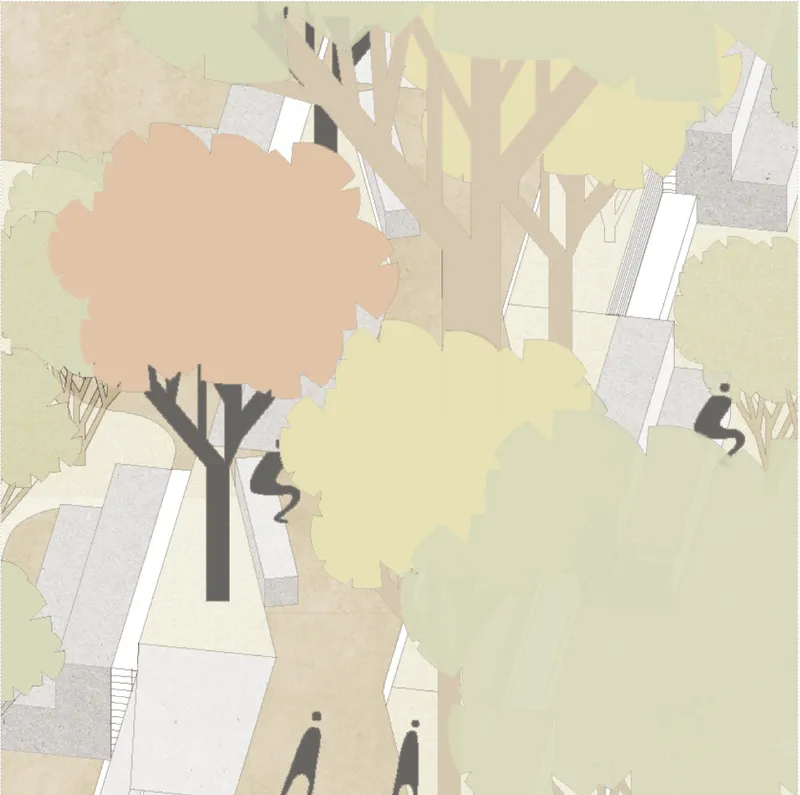
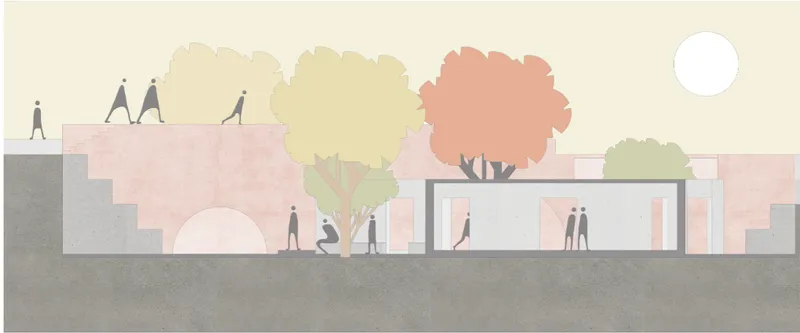
- Tree buffers and level changes to create subtle yet effective segregation.
Vegetation plays a symbolic and ecological role. Indigenous species such as Gulmohar, Indian Laburnum, and Pagoda trees structure the spatial rhythm of the site. Seasonal blooms, filtered light, and shaded walkways contribute to an atmosphere of quiet dignity.
By embedding nature into funerary architecture, the project reframes death as part of a larger ecological cycle—subtly reconnecting urban dwellers with processes of renewal and impermanence.
The Journey: Threshold, Descent, Reflection
The architectural narrative unfolds as a journey.
- Preparation through Threshold – Entry sequences modulate scale, light, and enclosure.
- Descent into Ritual – Subtle level changes signal psychological transition.
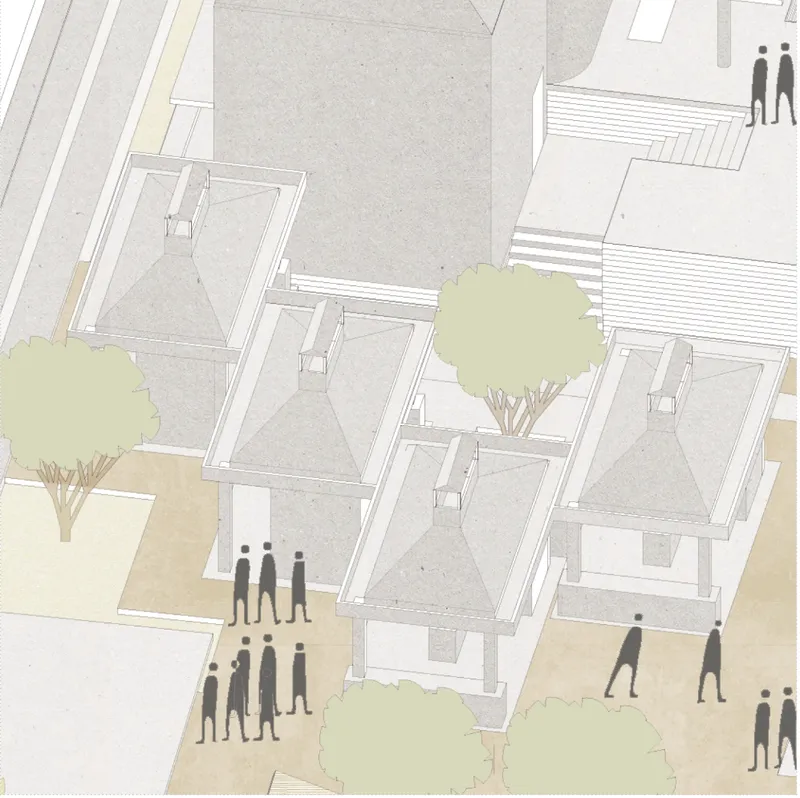
- Framed Courtyards – Internal courtyards offer pause and reflection.
- Prayer and Cremation Spaces – Ritual zones maintain privacy without isolation.
The contemplative pavilion acts as a midpoint—bridging burial grounds and parkland. Filtered openings allow shafts of light to enter, creating alternating patterns of exposure and enclosure. The use of gabion retaining walls reinforces a grounded, earthen character while subtly separating sacred space from urban chaos.
Secular Sacredness in Architecture
One of the most significant contributions of this project is its articulation of secular sacredness. Rather than relying on overt religious symbolism, sacredness emerges from spatial proportion, light modulation, materiality, and silence.
The mosque, prayer rooms, ritual platforms, and burial areas are integrated without dominance. The architecture acknowledges multiple practices while prioritizing shared human experience.
This inclusive approach positions funerary architecture as civic architecture—open, plural, and democratic.
Privacy Through Section and Boundary
Sections reveal a nuanced play of heights and walls. Boundary conditions shift according to programmatic need—higher walls for ritual privacy, lower edges for public permeability. This calibrated enclosure prevents the boundary from becoming oppressive while maintaining sanctity.
The cremation units, ash storage, waiting areas, and prayer halls are carefully embedded within the terrain, reducing visual intrusion and enhancing acoustic quietude.
Master Plan as Urban Connector
The elongated site becomes a linear civic spine connecting Marine Lines to Chandawadi. The crematorium is no longer a dead end—it becomes an urban passage.
By inserting a public park at the center, the project challenges societal perceptions that death-related spaces must remain hidden. Instead, it invites the city to acknowledge mortality within daily life.
This spatial democratization is a critical step in redefining funerary architecture for contemporary India.
Architecture as Catalyst for Emotional Resilience
The project suggests that architecture can influence emotional states—not through spectacle, but through subtle environmental cues. Framed views, shaded corridors, filtered daylight, and layered thresholds create conditions for collective and individual mourning.
In doing so, Re-Imagining the Urban Crematorium becomes more than a design intervention—it becomes a cultural proposition.
Shravan Suresh’s proposal redefines funerary architecture within the constraints of dense urbanism. By combining landscape urbanism, psychological sensitivity, and secular inclusivity, the project transforms the crematorium from a taboo utility into a civic landscape of reflection.
As Indian cities continue to densify, the question is no longer whether crematoriums and cemeteries belong in the city—but how they belong.
This project offers a compelling answer: through empathy, integration, and design intelligence.


Popular Articles
Popular articles from the community


LT2A and OPEN Architectes Thread a Brick and Glass High School Through a Wooded Belgian Campus
In Braine-l'Alleud, a 3,000 m² wing for Collège Cardinal Mercier pairs pale brick with a glazed colonnade, deferring to a small chapel and a dense wood.

David Macias Steps a Doorless Stone and Plaster House Down a Tropical Colombian Hillside
In the humid hills of Colombia, Threshold House replaces the front door with an open void and terraces its 850 m² down the slope instead of fighting it.

Architekt Andreas Gruber Scatters 23 Dark Timber Chalets Across a South Tyrolean Forest Edge
In Molini di Tures, Amonti Chalets breaks a resort into a hamlet of gabled timber houses, with parking, storage and services pushed into the slope.

longwave studio Reorganizes a 112 m² Tainan Apartment Around the Daily Routines of a Family and Two Cats
In Tainan, Taiwan, birch plywood, rust-red furniture and a freestanding plaster wall link arrival, storage, work and family life in one apartment.

Similar Reads
You might also enjoy these articles
Healing Façade: A Modular Chapel System That Restores Ethiopia's Sacred Forests
Winner of the Eco-Chapel competition, this circular timber façade collects water from air to rebuild soil and reforest degraded Ethiopian landscapes.
Kaffeebühnen: Where Coffee Shop Architecture Becomes a Civic Stage in Vienna
A linear sequence of timber boxes, transparent shells, and open yards turns the Viennese café tradition into a public performance space.
Eco Chapel: A Modular Forest Pavilion That Grows Like the Landscape It Protects
Hexagonal timber modules weave through existing trees, turning a chapel into a living system for prayer, education, and reforestation.


Urban Forest: A Vertical Ecosystem for 5,000 Workers in Singapore's Changi Business Park
Radially stacked pods and layered green decks turn a 7-acre plot into 47 acres of ecological workspace projected for 2040.


Comments (0)
Please login or sign up to add comments
No comments yet. Be the first to comment!