
The Experiential Bridge: A Timber Crossing That Turns Waterfront Infrastructure Into a Place to Stay
A Viking-hull timber bridge stacks a hammock deck, a revolving café and a 3-metre cycle lane, so crossing the water becomes a reason to linger.


Most bridges are designed to be forgotten the moment you step off them. They are measured in spans, loads and minutes saved, and their success is judged by how little they interrupt the journey. The Experiential Bridge takes the opposite position. It treats the crossing as the destination, folding a social deck, a revolving café and a cycling route into a single timber structure that asks people to slow down, sit and watch the water rather than hurry across it.
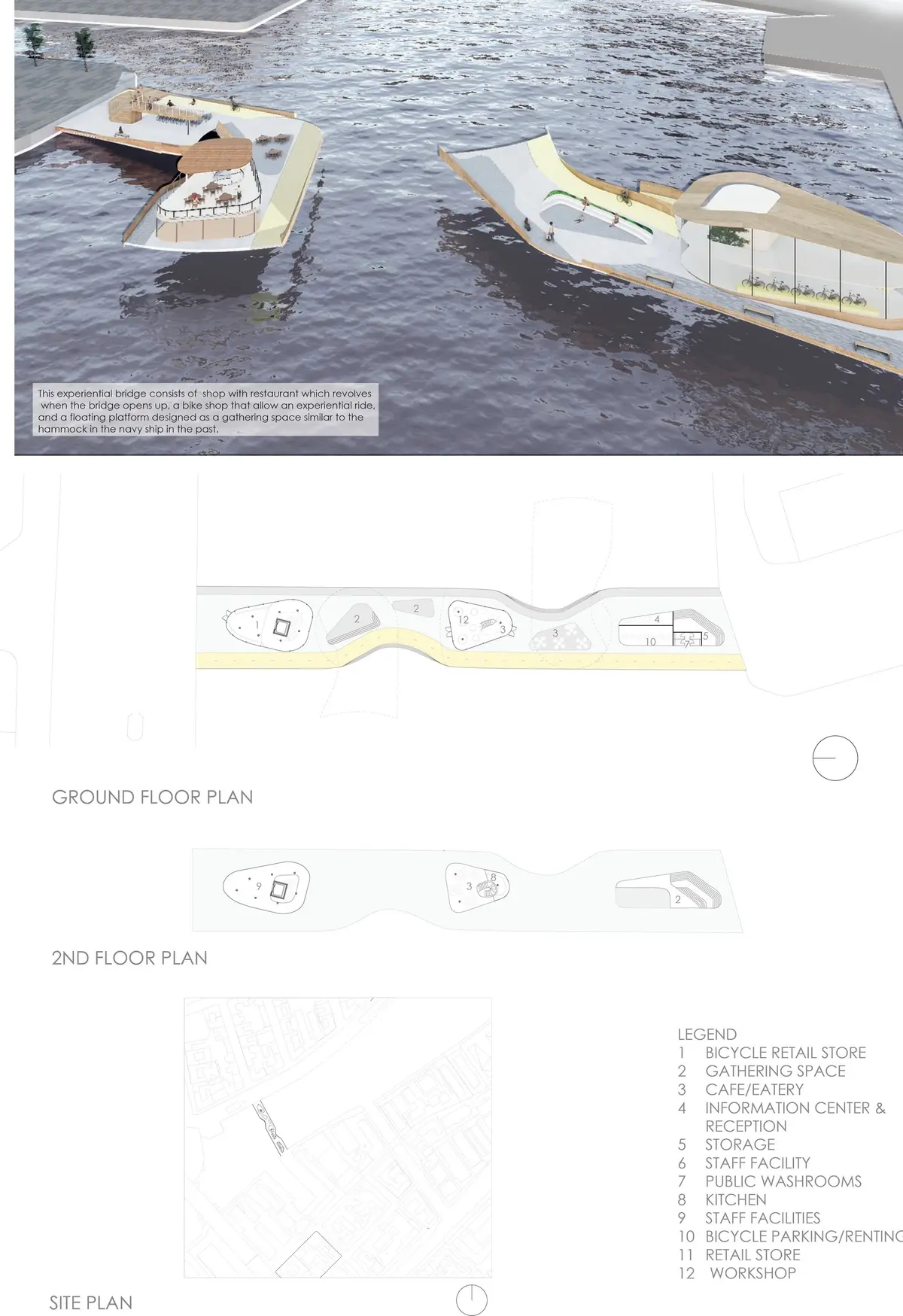
Published on uni.xyz by Khor Wanxuan, the project sits where mobility, leisure and public life overlap. Its argument is that sustainable pedestrian infrastructure should be judged on social and experiential terms as well as environmental ones. The bridge's form borrows the arched hull of a Viking ship, which ties it to its waterfront setting. Its programme is layered so that each stretch of the deck offers a different reason to stop. The result reads less like a piece of engineering and more like a linear public park built over water.
A Hammock Deck Lifted Above the Bike Racks
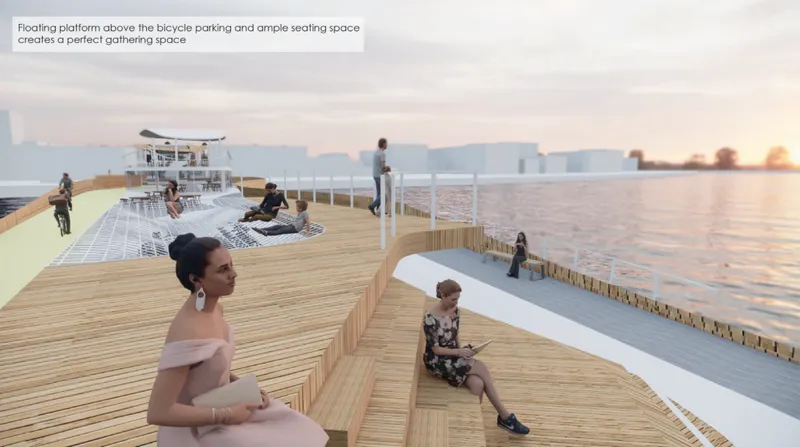
The most persuasive move in the project is the floating platform, a contemporary take on the hammock spaces once strung below deck on navy ships. In the render, a stepped timber platform fills with seated visitors while a netted deck hangs above the water, catching the low sunset light. The platform rises over bicycle parking and integrated seating, so the ground plane handles storage and arrival while the upper level is given over entirely to rest. Stacking the programme this way keeps the footprint compact and stops the social space from fighting with circulation.
The netting matters as much as the timber. It turns a viewing deck into something closer to furniture, inviting people to recline rather than lean on a railing. The warm wooden decking reinforces the maritime reference and gives the platform a tactile comfort that steel or concrete would not. This is where the bridge most clearly earns its name: circulation space becomes dwell space, and dwell time is what turns infrastructure into a civic landmark.
A Café That Turns Whenever the Bridge Opens
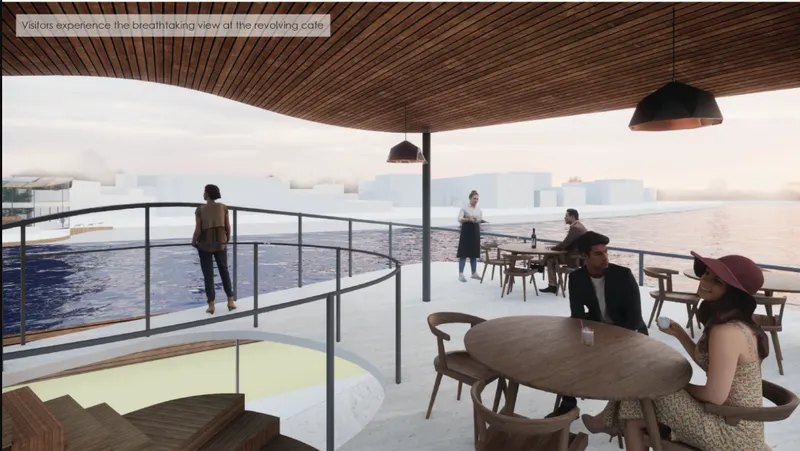
At the centre of the bridge sits a revolving café and restaurant, and its rotation is tied directly to the bridge's own movement: whenever the bridge opens, the building turns. It is a clever piece of choreography. A mechanical event that usually means waiting at a barrier becomes a spectacle, and diners get a shifting panorama of the waterfront from a circular room framed by wide glazing.
The interior render shows a terrace sheltered by a curved timber slatted canopy, with round tables and pendant lamps that keep the space intimate despite its exposed position. The slats echo the ribbing of a hull and filter light without closing off the view. Lightweight in form, the café contrasts with the solidity of the deck. It also gives the bridge an economic engine, which is a pragmatic argument for keeping a public structure maintained and occupied after dark.
A Yellow Lane That Steers Cyclists Without Walls
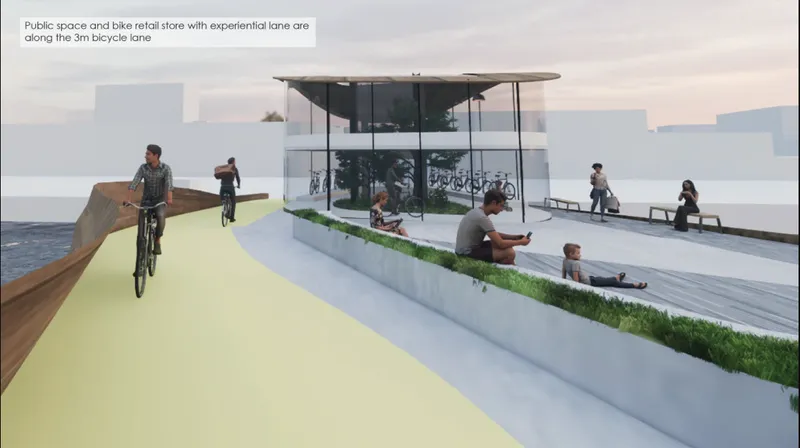
Cycling is built into the concept rather than added as a lane marking. A dedicated 3-metre bicycle lane runs the length of the bridge, linking a bike retail store with an experiential ride path. The render shows the glass-walled shop under a curved roof, set beside the bright yellow lane and a planted edge, with cyclists moving through dusk light. The colour does the wayfinding work, telling riders where to go without hard barriers between them and pedestrians.
Separating speeds through shifts in material and level, rather than fences, is a mature urban design decision. It keeps the deck feeling open and shared while still giving clarity and safety. Seating terraces and landscaped edges along the corridor soften the line of movement, so fast and slow users coexist on the same structure. The retail pavilion's transparency keeps its edge active and lets the shop read as part of the promenade rather than a box parked on it.
One Winding Hull, Many Places to Stop
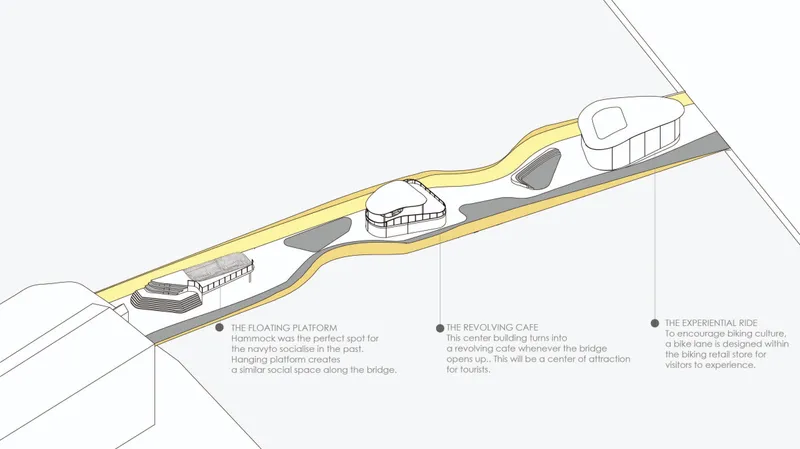
The axonometric drawing brings the whole sequence together. A winding deck threads the floating platform, the revolving café and the bike retail pavilion along the yellow lane, and the curve of the route makes each programme appear in turn rather than all at once. Seen in elevation, the bridge rises as a gently arched timber form recalling a Viking hull cutting through water, a reference that anchors the structure to its maritime context instead of applying ornament to it.
In section, the upper wooden deck rests lightly on its structural supports, which keeps the structural logic legible while letting the sweeping profile soften the bridge's mass. That lightness is important. A crossing carrying this much programme could easily become heavy and crowded, but the continuous curve gives it visual continuity across the water and makes the varied uses read as a single gesture.
Why This Project Matters
The Experiential Bridge reframes a familiar question. Rather than asking how quickly people can get from one bank to the other, it asks what they might do in between. By layering rest, dining and cycling onto a single timber deck, Khor Wanxuan shows that a bridge can carry public life as well as traffic, and that sustainability includes the social value of spaces people actually want to occupy.
Its strongest ideas are the ones that turn constraints into events: a hammock deck stacked above bike parking, a café that rotates when the bridge opens, a coloured lane that replaces fences. Questions remain about structure, mechanics and maintenance as the concept develops, but the project's core proposition holds up. Waterfront infrastructure is some of the most visible public space a city owns, and this proposal makes a convincing case for designing it as a place to stay.
View the Full Project
About the Designers
Designer: Khor Wanxuan
Enter a Design Competition on uni.xyz
uni.xyz runs architecture and design competitions year-round that reward proposals with spatial conviction and real site intelligence.
Project credits: Experiential Bridge by Khor Wanxuan.


Popular Articles
Popular articles from the community


The Amber Palace Opera: A Geological Fiction Surfaces on Tallinn's Baltic Waterfront
Pierre Brillard reimagines a Baltic legend as a public landscape, opera house, and waterfront promenade rooted in Tallinn's coastal identity.

Opera on the Sea: Driftwood Logic Shapes a Timber Opera House on Estonia's Coast
Trevor Orgill's opera house translates the entangled drift of floating timber into a civic building where wood, water, and music converge.


FCC Arquitectura Expands a Portuguese Granite House with a Board-Marked Concrete Wing
In Portugal, JV House pairs a cleaned-up whitewashed and granite dwelling with a timber-shuttered concrete extension, courtyards and a garden pool.

Cube Design Draws an Ecological Corridor Between Two Shenzhen Hills with the Nankai Building
Beside Shenzhen's container docks, the Nankai Building pairs stacked balconies with a climbing green screen to connect two hillsides across its height.

Similar Reads
You might also enjoy these articles
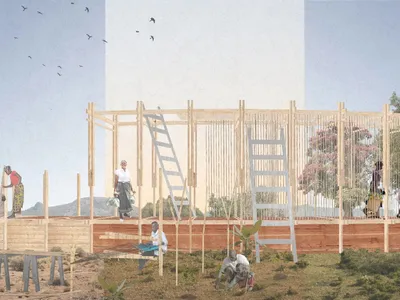
Healing Façade: A Modular Chapel System That Restores Ethiopia's Sacred Forests
Winner of the Eco-Chapel competition, this circular timber façade collects water from air to rebuild soil and reforest degraded Ethiopian landscapes.
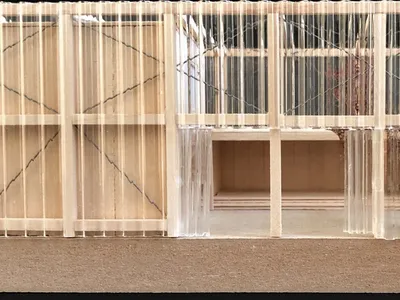
Kaffeebühnen: Where Coffee Shop Architecture Becomes a Civic Stage in Vienna
A linear sequence of timber boxes, transparent shells, and open yards turns the Viennese café tradition into a public performance space.
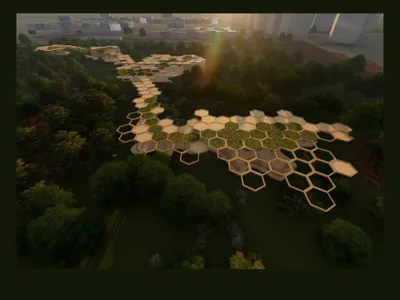
Eco Chapel: A Modular Forest Pavilion That Grows Like the Landscape It Protects
Hexagonal timber modules weave through existing trees, turning a chapel into a living system for prayer, education, and reforestation.


Urban Forest: A Vertical Ecosystem for 5,000 Workers in Singapore's Changi Business Park
Radially stacked pods and layered green decks turn a 7-acre plot into 47 acres of ecological workspace projected for 2040.

Comments (0)
Please login or sign up to add comments
No comments yet. Be the first to comment!