
Gunawarman 35: Jakarta's Corner of Quiet Complexity
WOFF's mixed-use building in Jakarta pairs translucent glass block walls with a buff brick cylinder to hold coffee, wellness, and work under one roof.


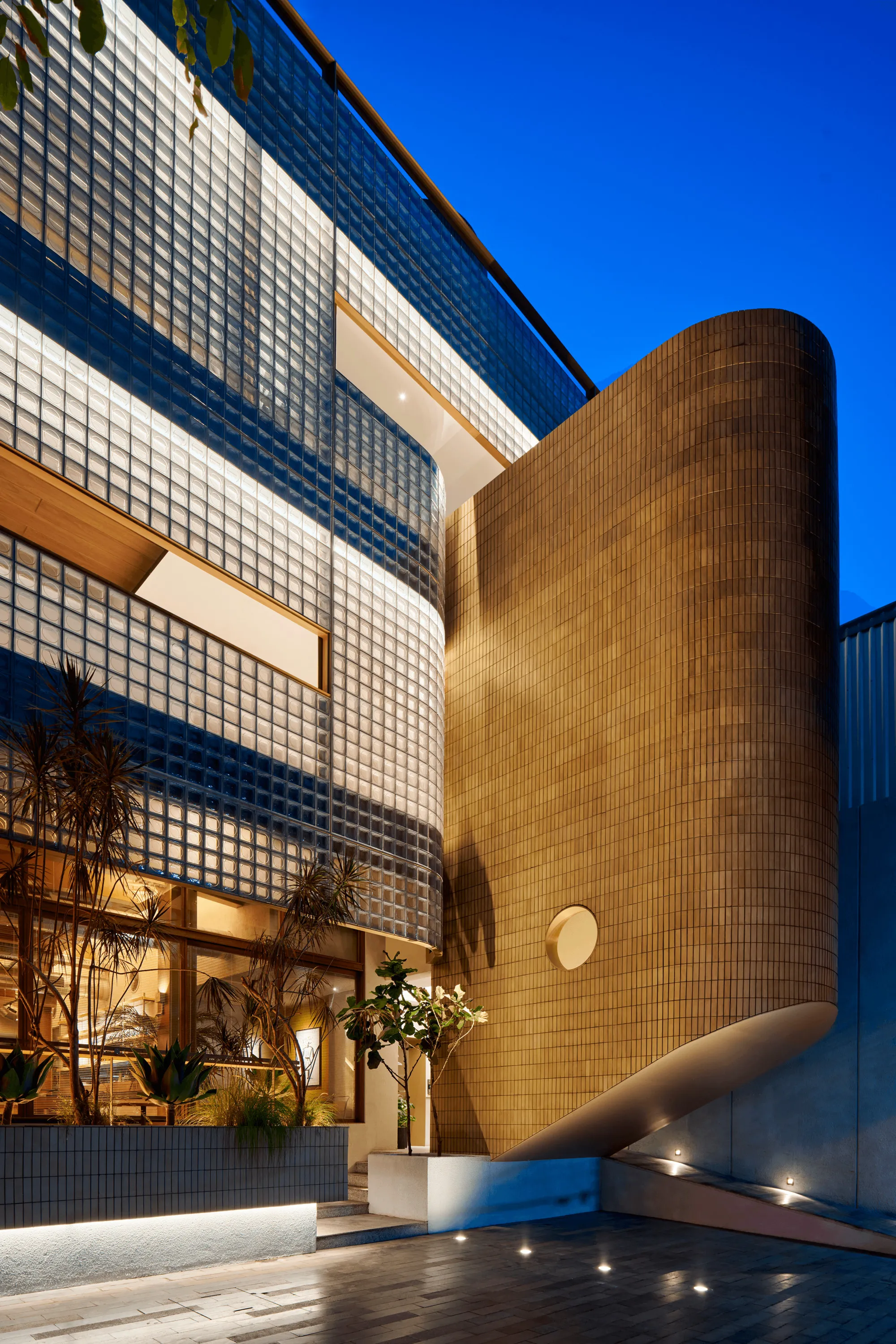
Corner sites are gifts and tests in equal measure. They offer two faces to the street but demand that a building resolve two orientations, two scales, and often two entirely different urban conditions at once. At Gunawarman 35 in Jakarta's well-heeled Gunawarman district, WOFF led by Joe Willendra embraces the duality head-on, splitting the building into two distinct but connected volumes: a luminous, curved glass block mass and a solid cylindrical tower clad in buff brick. The pairing reads like a deliberate argument about transparency versus enclosure, each volume holding its own character while leaning into the other.
What makes the project genuinely interesting is how it stacks wildly different programs, a ground-floor café, a first-floor wellness center, and a second-floor office, into a compact 450 square meters without making any one use feel subordinate. The architectural language stays consistent across these programs, but the spatial experience shifts floor by floor. WOFF treats the building's skin not as a wrapper but as the primary architectural event, letting light, material, and geometry do the work of differentiating inside from outside, public from private, day from night.
Two Volumes, One Corner
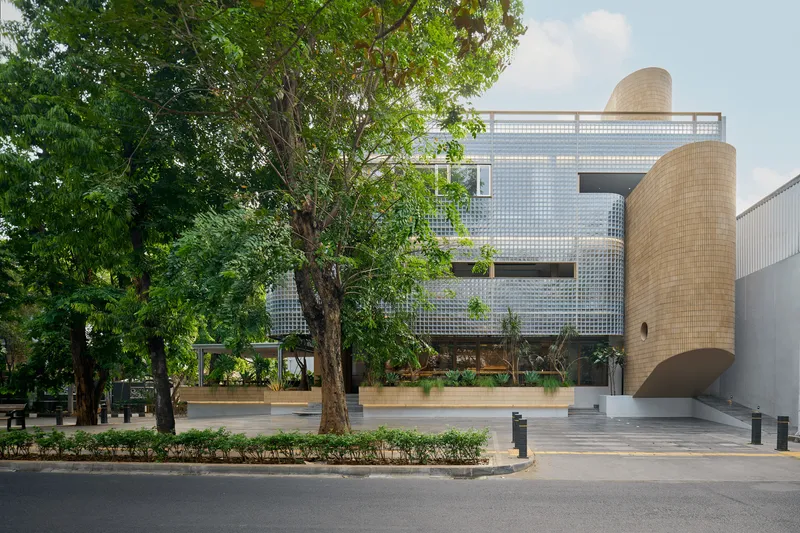

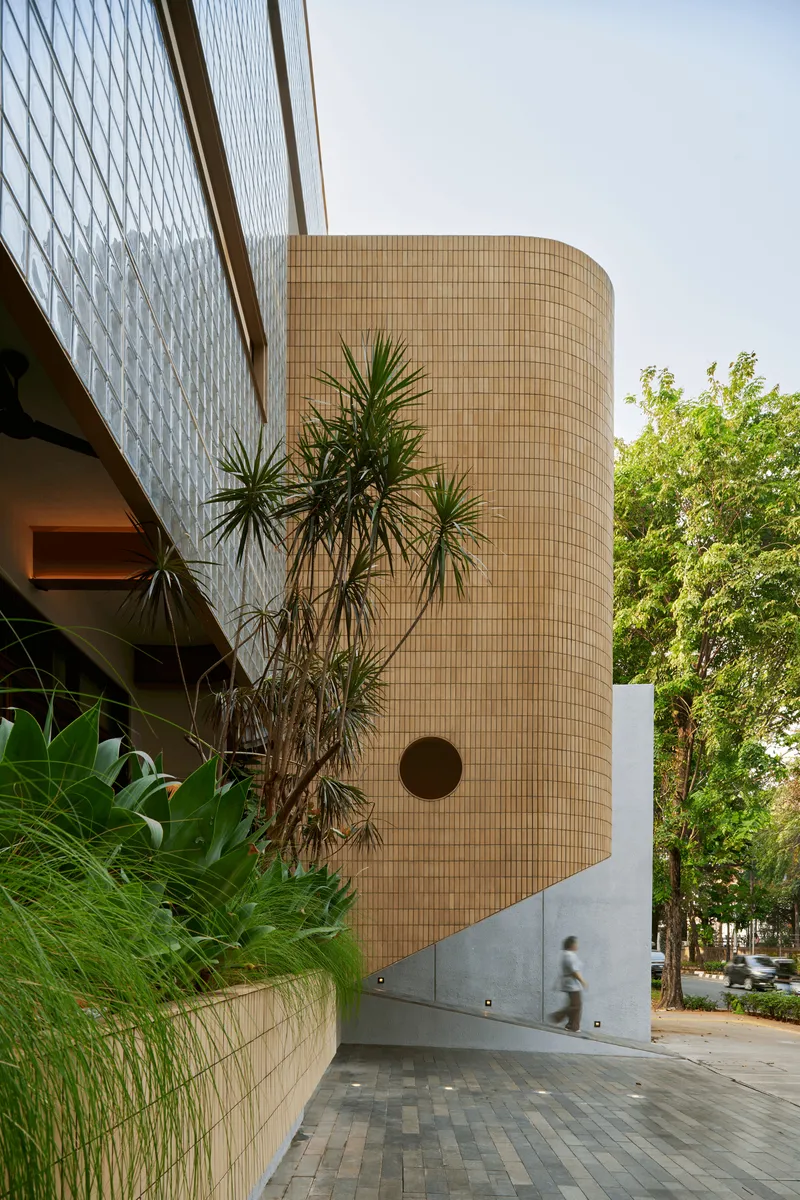
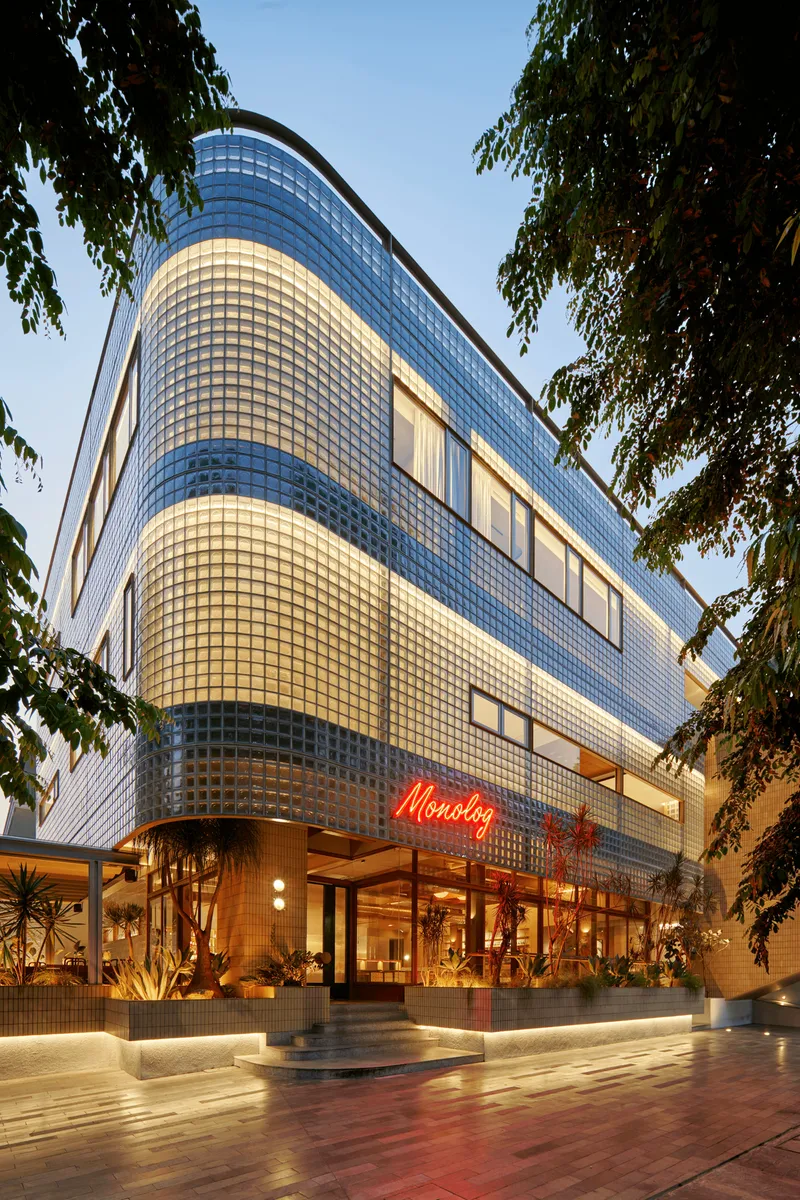
The compositional logic is immediately legible from the street. The glass block volume sweeps in a generous curve along the corner, three stories of translucent wall that soften the boundary between interior and sidewalk. Beside it, a cylindrical tower in vertically laid buff brick anchors the composition with weight and opacity. The contrast is not decorative. It encodes the building's programmatic split: the glass block wraps the more public, outward-facing spaces while the brick cylinder houses vertical circulation and services.
Mature trees line the street edge, and WOFF clearly designed with them in mind. Branches filter and frame both volumes, lending a dappled, almost residential quality to what is functionally a commercial building. The white base wall running beneath the brick tower grounds the whole assembly, giving pedestrians a clean datum to walk alongside while the sculptural volumes rise above.
Glass Block as Event
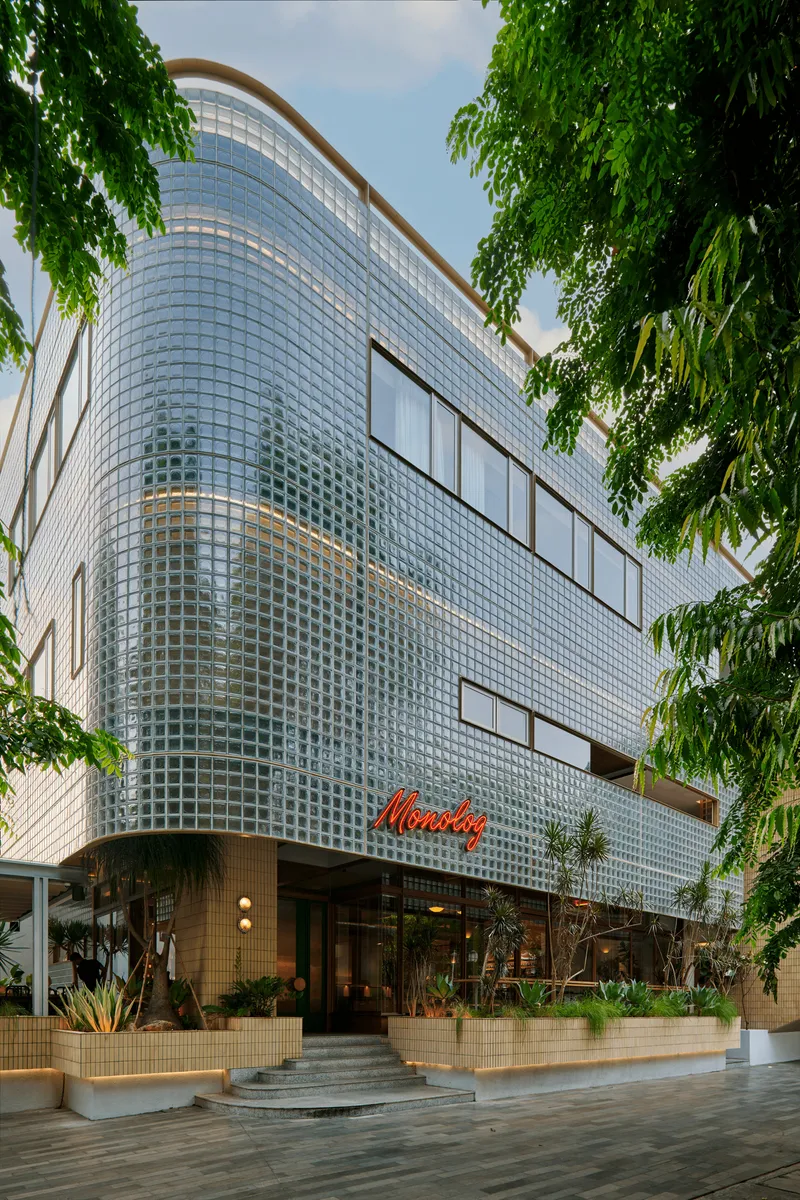
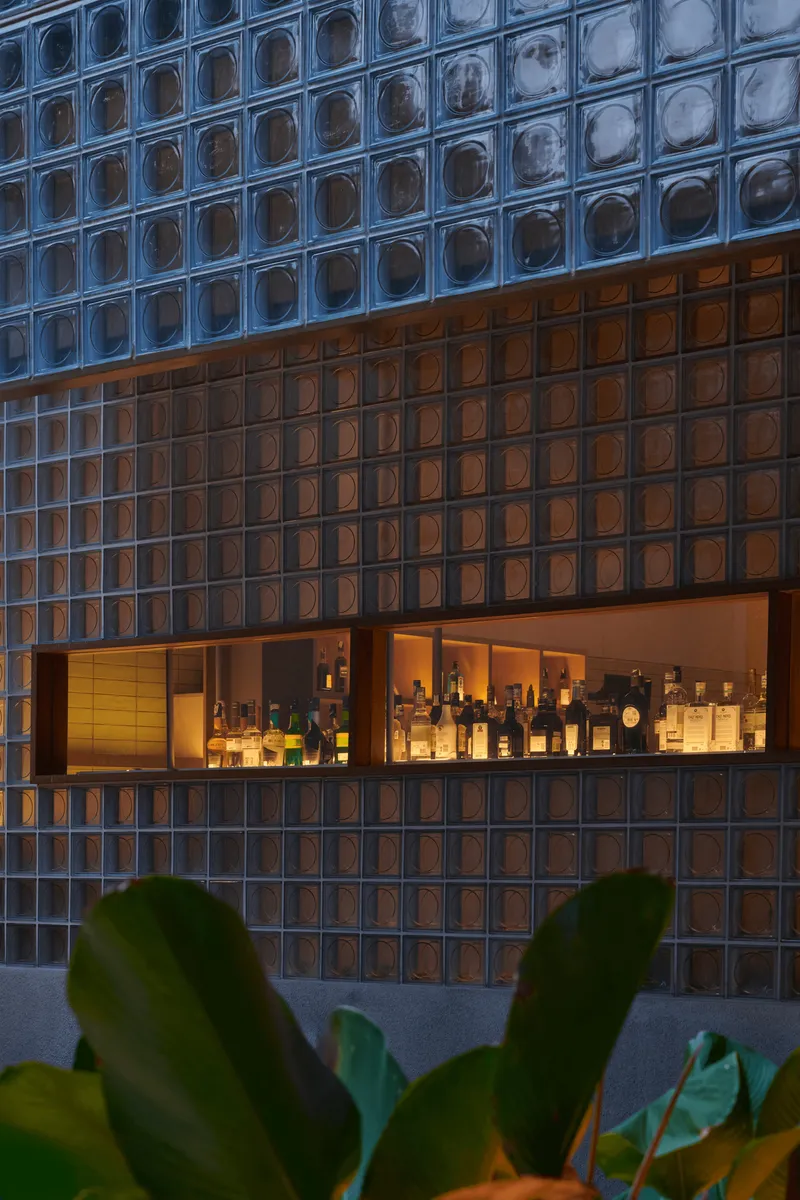
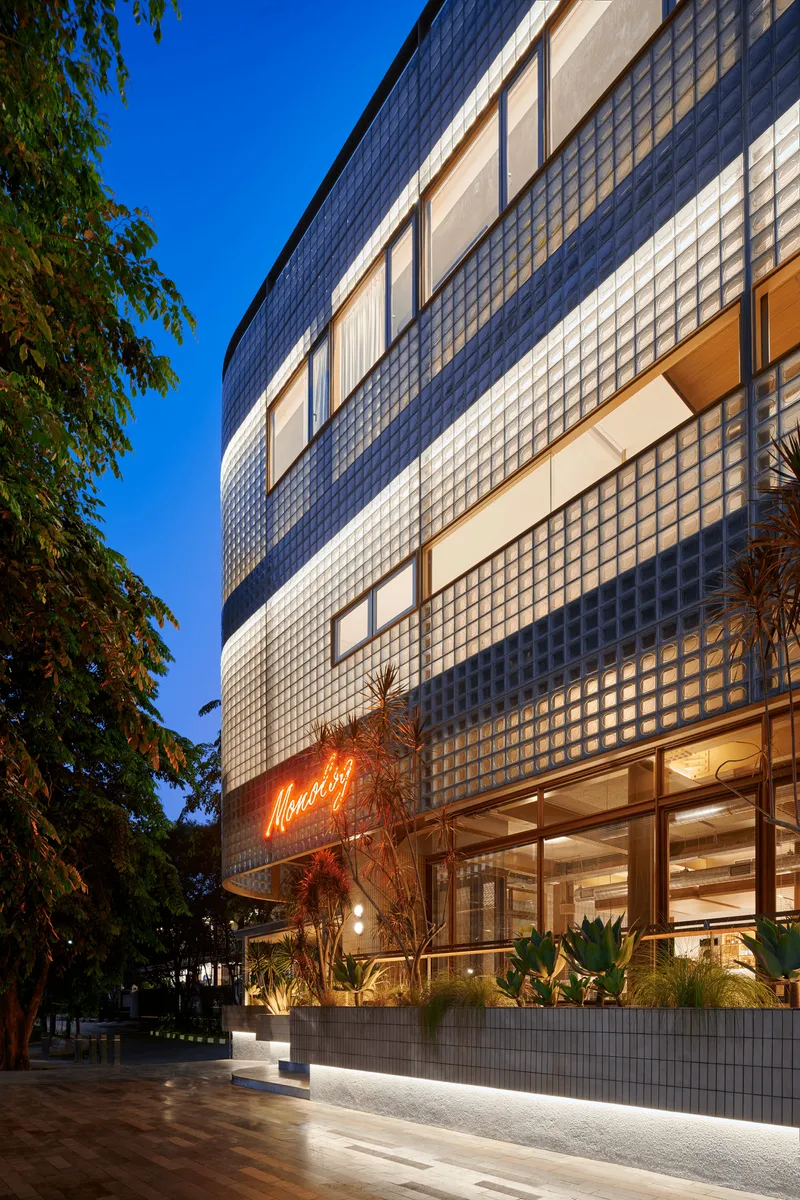
Glass block has had a complicated reputation in architecture, cycling between utilitarian industrial staple and postmodern cliché. WOFF rehabilitates the material here by deploying it at a scale and curvature that genuinely earns its presence. The three-story curved wall glows at dusk, turning the facade into a lantern. Rectangular openings punched through the glass block field create moments of direct visual connection: a horizontal slot at the ground level reveals backlit bar shelves, telegraphing the café program to passersby without resorting to floor-to-ceiling glazing.
The translucency does real work for climate as well as atmosphere. In Jakarta's equatorial heat, a fully transparent facade would demand massive mechanical cooling. Glass block admits diffused daylight while rejecting direct solar gain, a passive strategy embedded in the material choice rather than applied as an afterthought. The result is interiors bathed in a soft, even glow during the day and a striking luminosity from the street at night.
The Brick Cylinder
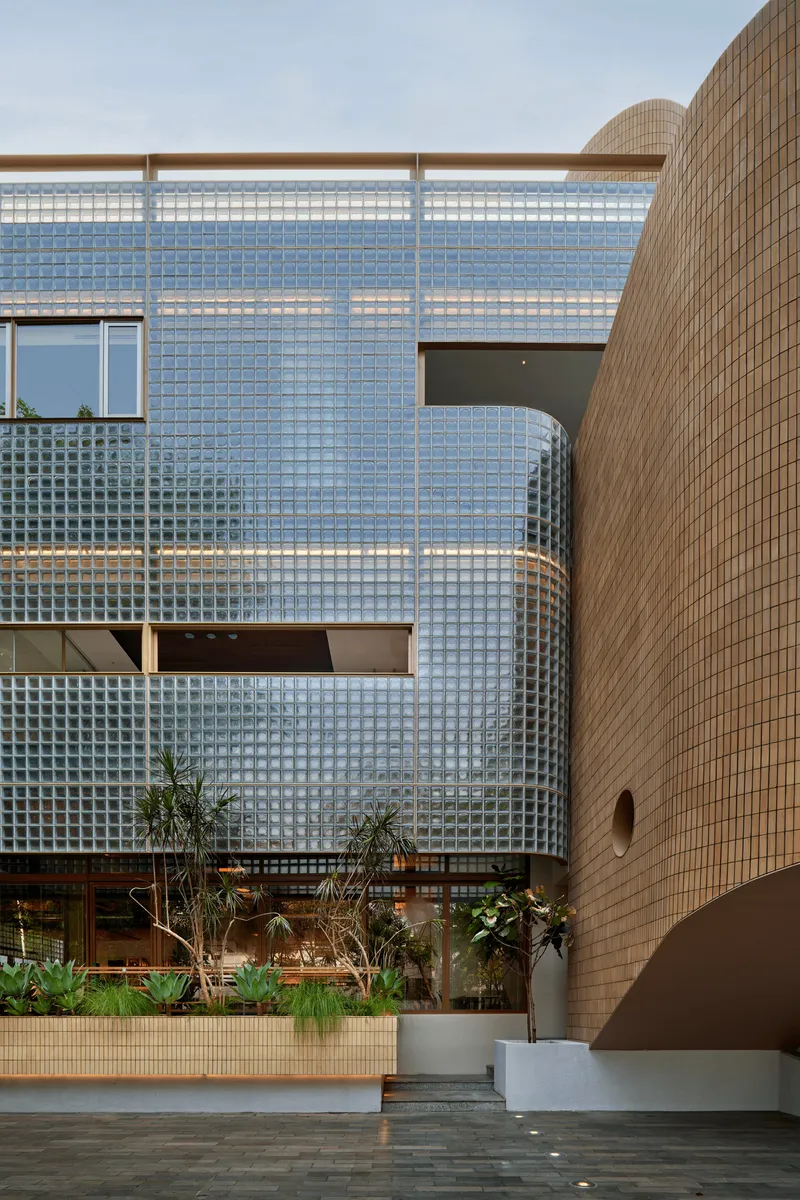
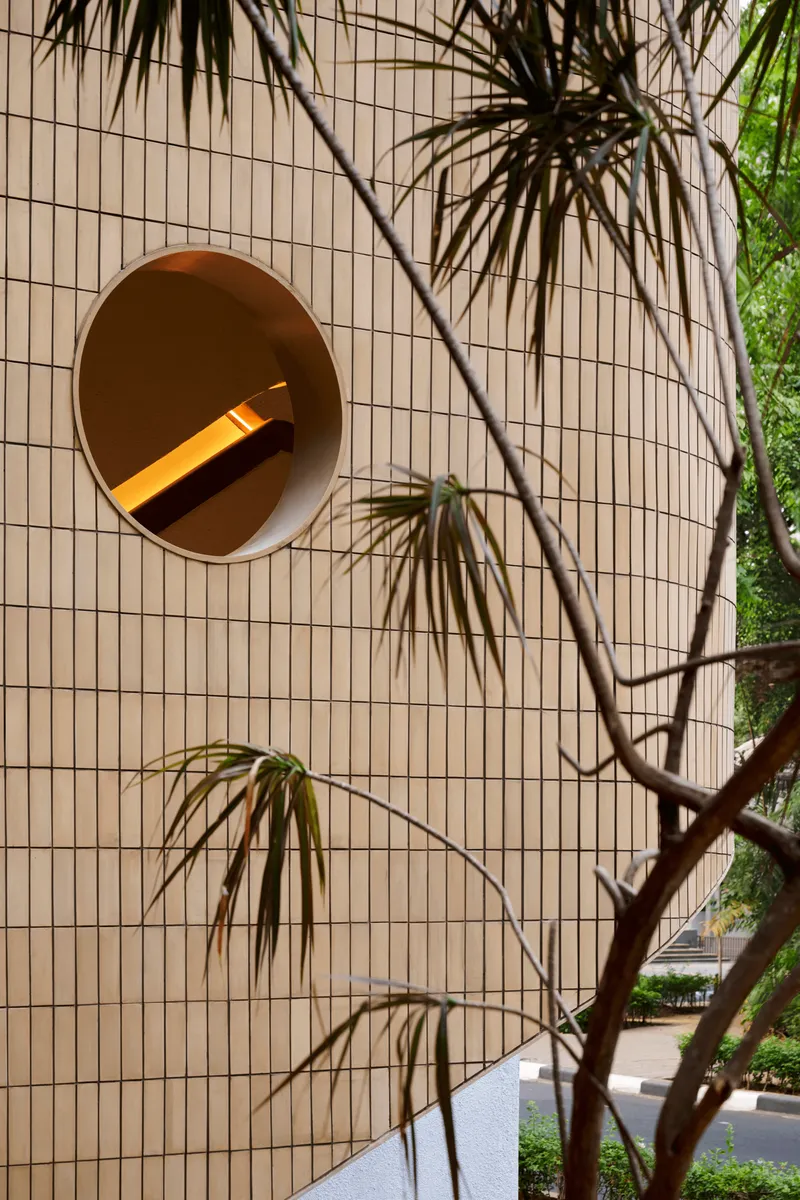
If the glass block volume is all about diffusion and permeability, the cylindrical brick tower is its grounded counterpoint. A single circular window punched high in the brick wall acts almost like a porthole, framing sky rather than street. Vertical tile cladding wraps an adjacent surface, and a circular portal at ground level invites entry through a deliberately compressed threshold. Palm fronds cast shadows across the tile, adding a layer of organic pattern that the architects clearly anticipated.
The tower reads as a piece of infrastructure made monumental. It houses the lift core, stairs, and service runs that keep the three distinct floor programs connected. Rather than hiding this functional spine behind the main facade, WOFF celebrates it as a co-equal architectural element. The cylinder's solidity gives the composition a center of gravity without which the glass block wall would risk feeling too light, too provisional.
Ground Level: Threshold and Terrace
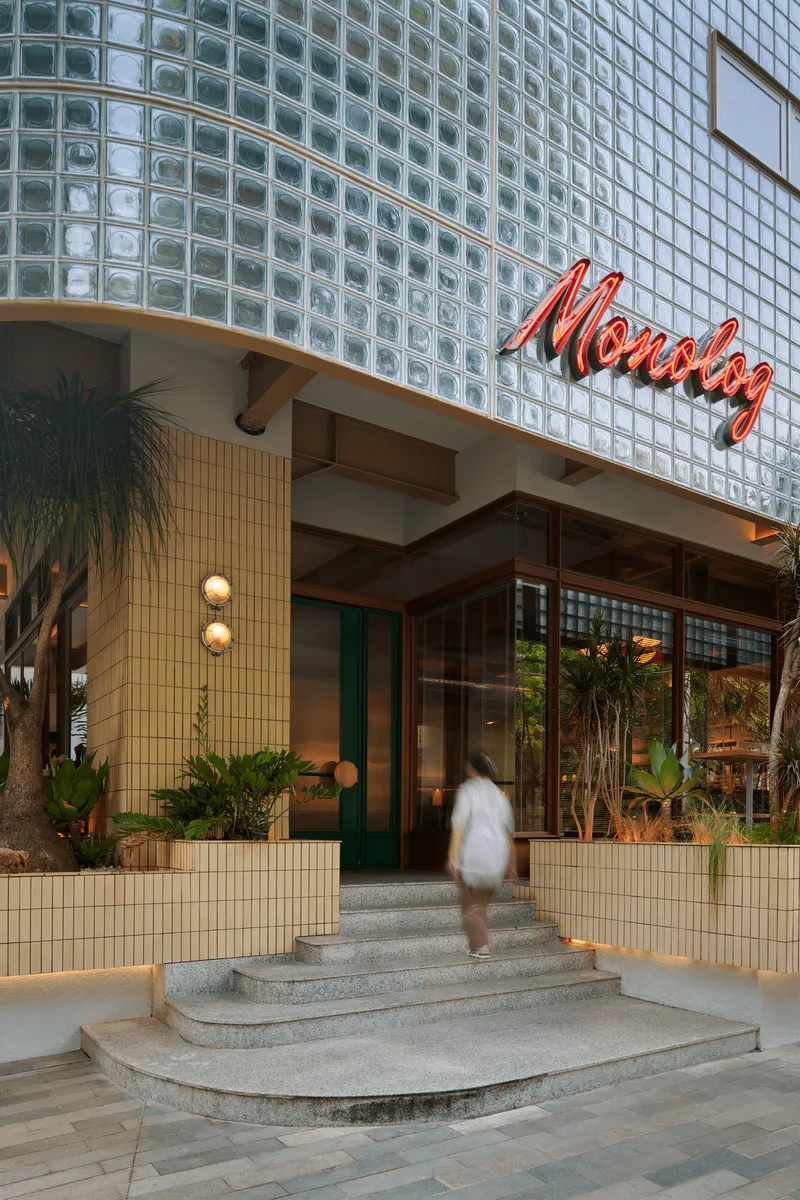


Arrival happens gradually. A set of broad steps rises through planted beds to reach glazed entrance doors, with the glass block wall curving overhead to form a subtle canopy. A red neon sign marks the café at dusk, the only overtly commercial gesture on the exterior. WOFF keeps the signage minimal and lets the architecture do the advertising; the glowing facade is its own beacon.
Planted terraces at the base blur the line between building and landscape, pulling greenery up close enough to soften the concrete and glass. The overhanging branches of existing street trees complete the framing, so the entrance always feels like a passage through foliage rather than a confrontation with a hard commercial facade. It is a small but consequential move in a city where ground-level hostility to pedestrians is common.
Upper Levels and Rooftop

A covered balcony at one of the upper levels shows how the interiors translate the facade's material warmth into usable space. Timber benches and stools sit beneath exposed ceiling beams, creating a casual social zone that benefits from the building's corner position: cross-ventilation and views in two directions. The furniture is deliberately low-key, rough timber rather than polished millwork, reinforcing the building's identity as a relaxed neighborhood hub rather than a prestige commercial address.
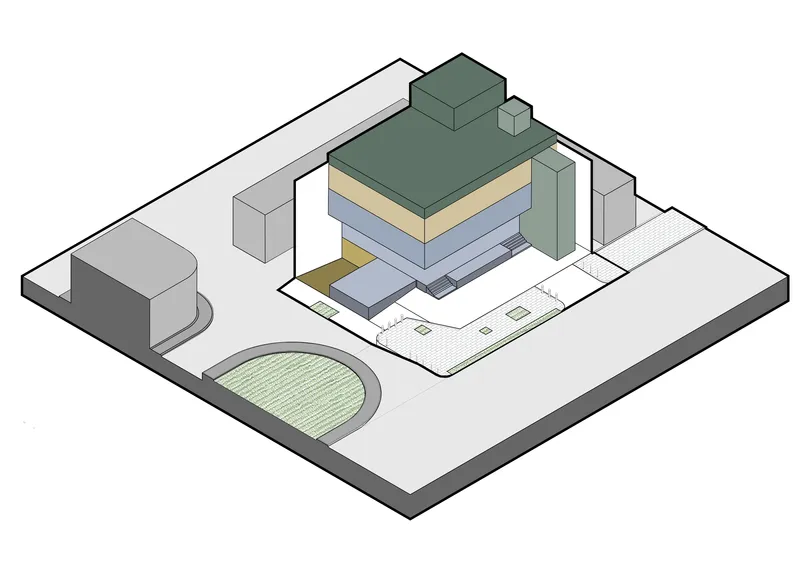
The rooftop, visible in the axonometric diagrams, introduces an oval lawn and what appears to be a small plunge pool, a private amenity for the wellness and office programs that occupy the upper floors. It is a compact tropical roofscape that takes full advantage of the building's modest footprint by stacking recreational space above productive space.
Plans and Drawings

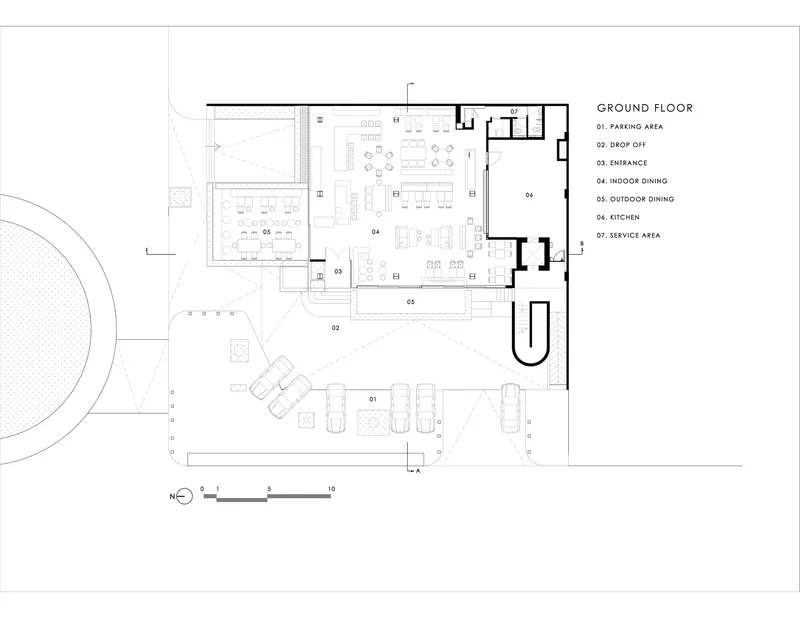
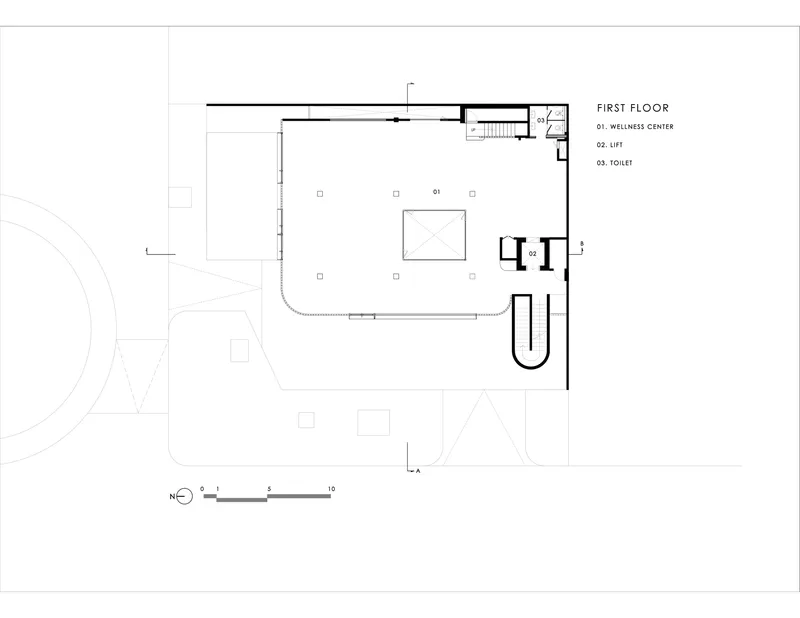
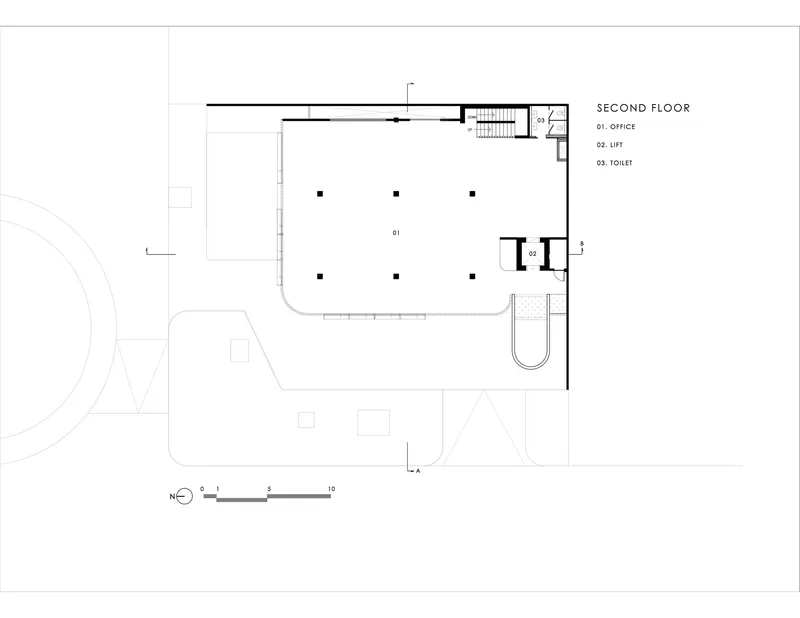
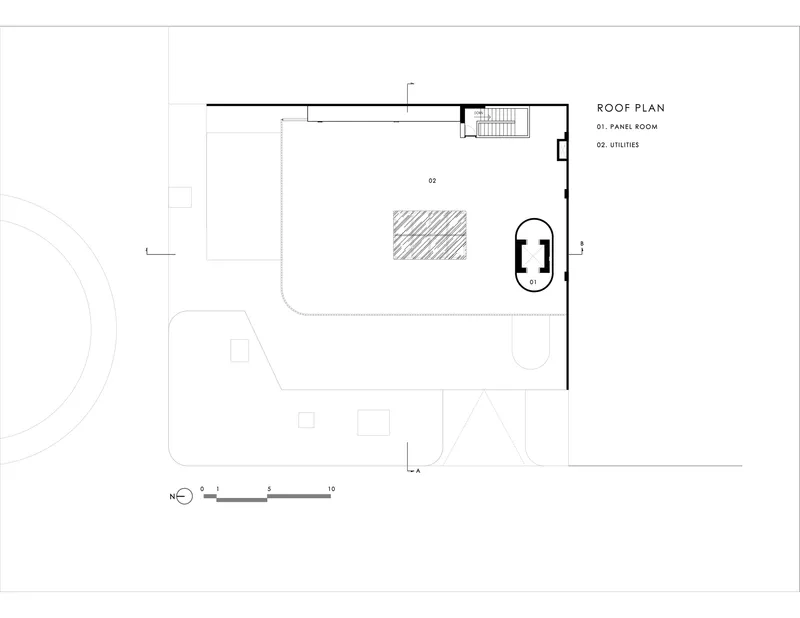


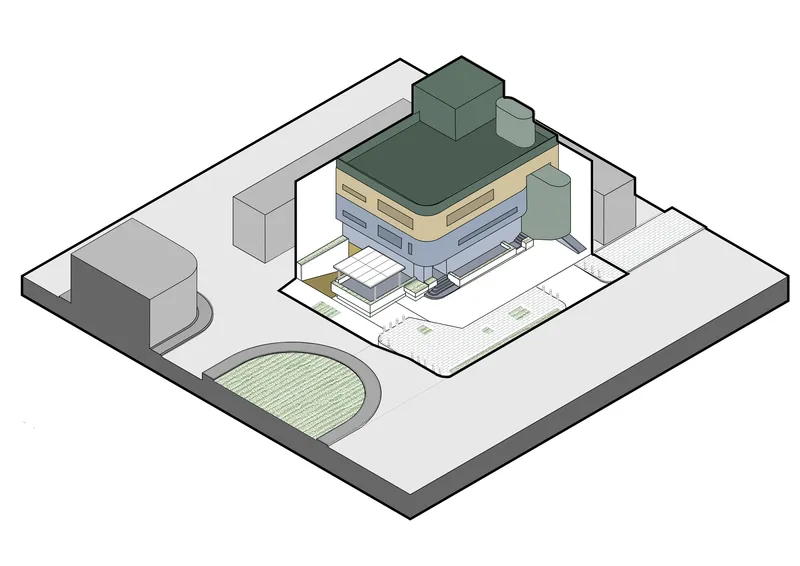
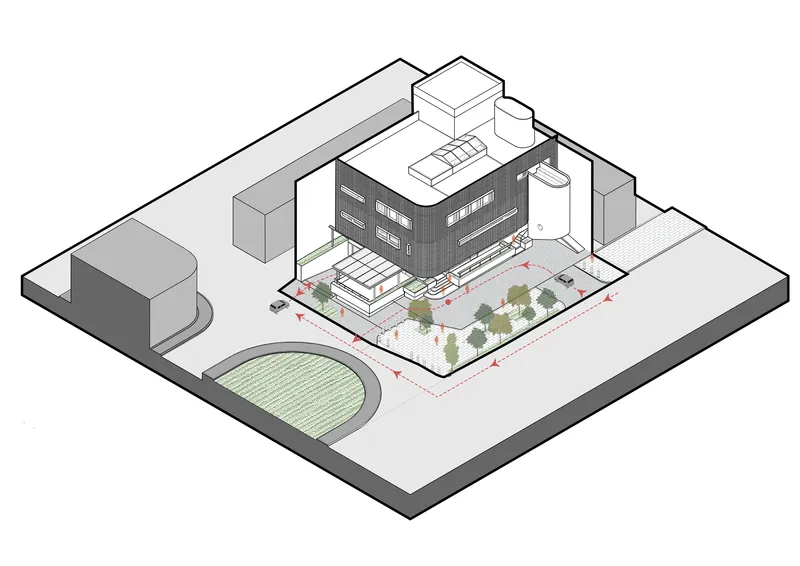
The floor plans reveal the clarity behind the building's compact footprint. The basement accommodates parking and services beneath a tight structural grid. At ground level, the kitchen and dining areas radiate outward from the core toward the street and courtyard edges, maximizing the cafe's social perimeter. The first floor carves out a wellness center around the cylindrical volume, using the curved circulation to create a sense of continuous flow rather than corridor-and-room subdivision. The second floor opens into a column-grid office plate, rational and flexible.
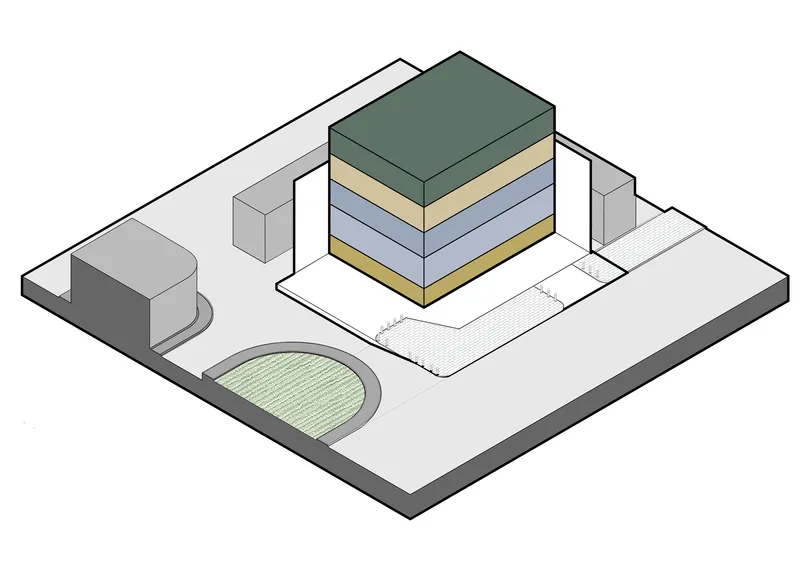
WOFF's section drawings are particularly instructive. They show how the building negotiates a sloping ground plane, tucking the parking level partially below grade and stepping the public entrance up from the sidewalk. The two sections also illustrate the vertical relationship between the cafe, wellness center, and office: each program gets its own ceiling height and spatial character despite sharing a single structural system. The axonometric series pulls the building apart layer by layer, making the programmatic stacking legible. Green, tan, and blue color coding on the exploded diagrams map precisely onto the cafe, wellness, and office zones.
Why This Project Matters
Gunawarman 35 is a compact argument for how much a small commercial building can accomplish when material choices, massing, and program are treated as a single design problem. WOFF does not rely on spectacle. The glass block and brick cylinder are common enough materials, but their deployment here, at this scale, with this curvature and these proportions, produces a building that feels specific to its corner without resorting to novelty. In a district caught between residential heritage and commercial ambition, the building mediates by being both: a lantern and a tower, open and closed, neighborhood and city.
For Jakarta, the project offers a useful counterexample to the glass curtain wall towers and gated retail complexes that dominate commercial development. It proves that a 450 square meter mixed-use building can hold its own on a major street through architectural intelligence rather than sheer size. The lesson is worth exporting: corner sites everywhere deserve this level of attention, and modest programs do not require modest ambitions.
Gunawarman 35 by WOFF (lead architect: Joe Willendra), Jakarta, Indonesia. 450 m², completed 2023. Photography by Arti Pictures, William Sutanto.
About the Studio
Share Your Own Work on uni.xyz
If projects like this are the kind of work you want to make, uni.xyz is a place to publish your own, find collaborators, and enter design competitions.


Popular Articles
Popular articles from the community


Riyadh For All: Intergenerational Urban Design for Active Aging in Rabat
Riyadh For All reimagines urban design in Rabat with intergenerational co-living, adaptive courtyards, and Moroccan cultural exchange today.

AL-JANNAH: Sustainable Architecture and Permaculture for Afghan Widows
AL-JANNAH uses sustainable architecture and permaculture to create resilient oasis of housing, learning, work and renewal for Afghan widows.

The Musturak Paradise: Senior Living Architecture for a Connected Future in Temara, Morocco
The Musturak Paradise reimagines senior living architecture in Temara via private homes, social spaces, culture, community, and shared care.

Hill & Cross Opera: Sculptural Opera House Architecture Shaped by Tallinn’s Landscape and Identity
Hill & Cross Opera reimagines opera house architecture in Tallinn through its sculptural hill, civic plaza, glass wave and a luminous cross.

Similar Reads
You might also enjoy these articles

Bao Huynh Watercolor Atelier: A Serene Art Retreat in Hội An
Bao Huynh Watercolor Atelier in Hội An blends multifunctional art spaces, sustainable design, local materials, and family-friendly living in a serene environment.

Atelier Macri Concept Store Interior Design by CASE-REAL
Atelier Macri store features a "ko" counter, walnut wood details, cork displays, blending retail, gallery, and seamless customer experiences.

Manuel Vargas Izquierdo Stadium and High-Performance Sports Center: Architectural Excellence in Jalpa de Méndez
The Manuel Vargas Izquierdo Stadium blends sustainable design, inclusive sports facilities, and cultural-inspired architecture, revitalizing Jalpa de Méndez’s public spaces.

KAKR Buluh Awar Hall: Revitalizing Community and Ecology Through Bamboo Architecture
Community built bamboo hall revitalizes Buluh Awar village, empowering youth, restoring ecology, celebrating vernacular craftsmanship through sustainable architecture and culture.


Comments (0)
Please login or sign up to add comments
No comments yet. Be the first to comment!