
Ecatepec Bicentennial Park by Taller Capital: A Model of Urban Regeneration and Water Infrastructure in Mexico
Terraced urban park in Ecatepec integrates water retention, flood control, social programs, and landscape design to restore community connectivity.


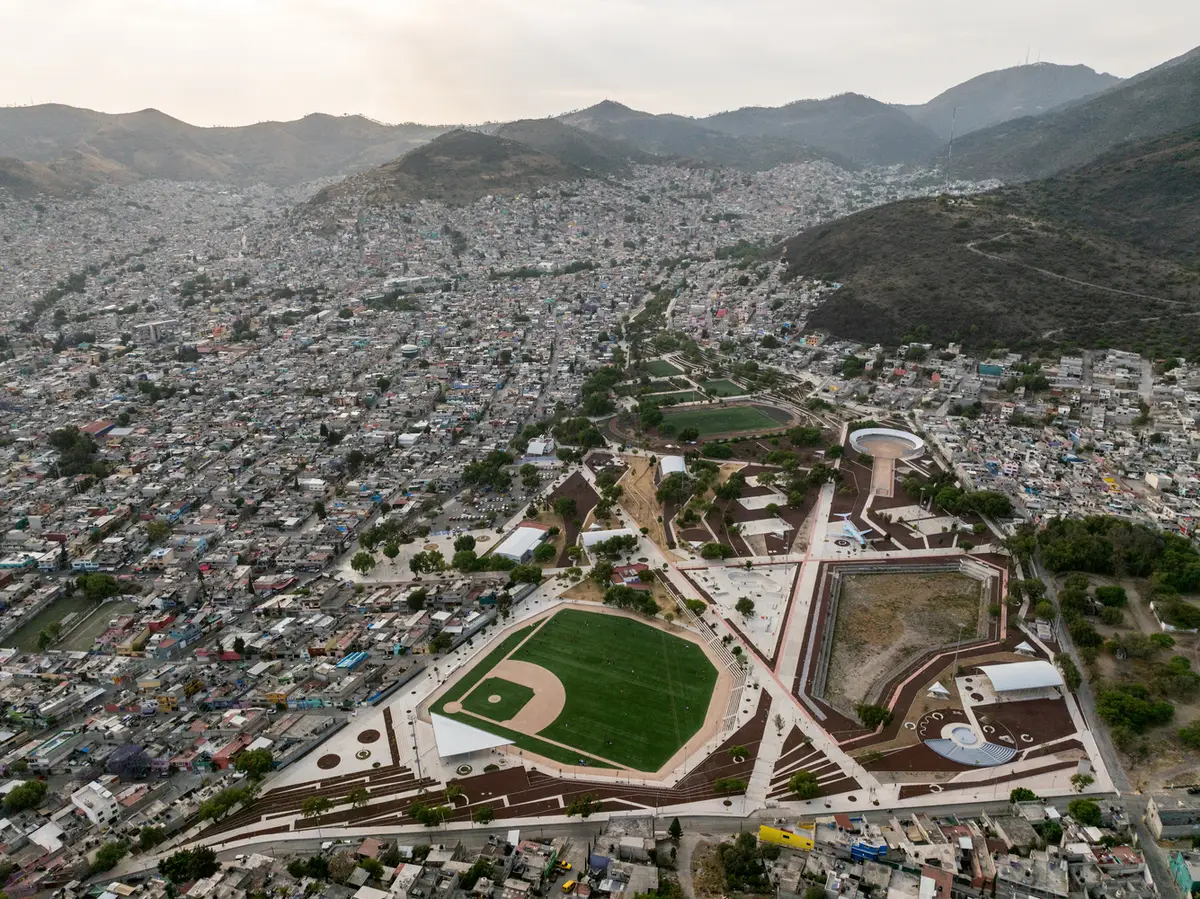
Located in Ecatepec de Morelos, part of the greater metropolitan area of Mexico City, Ecatepec Bicentennial Park is a groundbreaking 20-hectare landscape and urban design intervention completed in 2023. Designed by Taller Capital, the project reclaims a formerly enclosed and abandoned public space, transforming it into a resilient urban park that integrates water management infrastructure, ecological restoration, and social programming.
Positioned in one of Mexico’s most densely populated and environmentally vulnerable municipalities, the park addresses critical issues including flooding, aquifer depletion, erosion, insecurity, and lack of quality public space. The result is a powerful example of sustainable urban design that merges architecture, landscape architecture, and environmental engineering into a cohesive civic strategy.
A Soft Infrastructure Strategy for Water Management
Terraced Landscape Design for Erosion Control and Aquifer Recharge
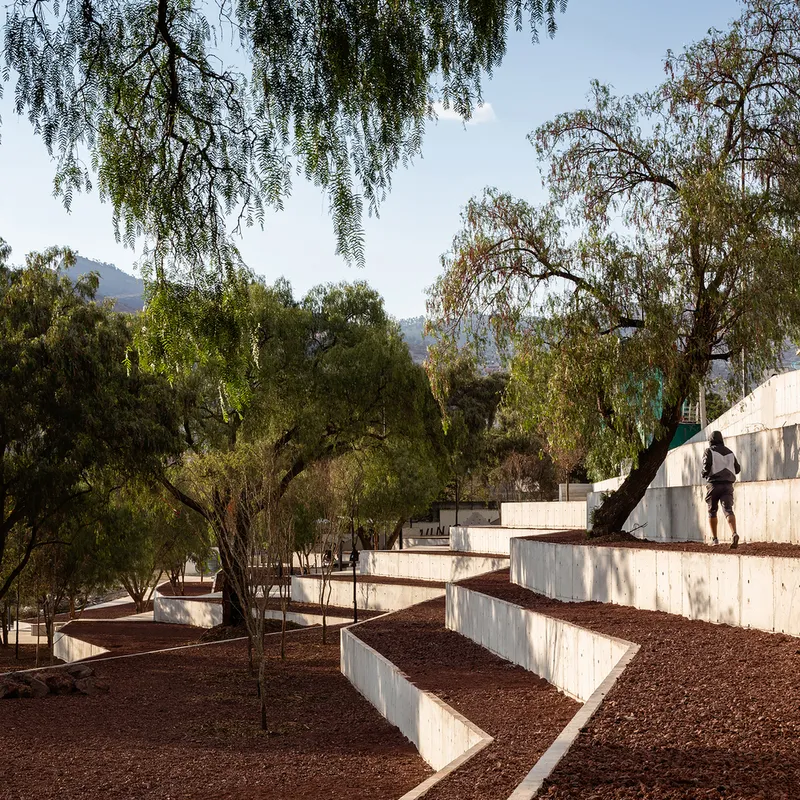
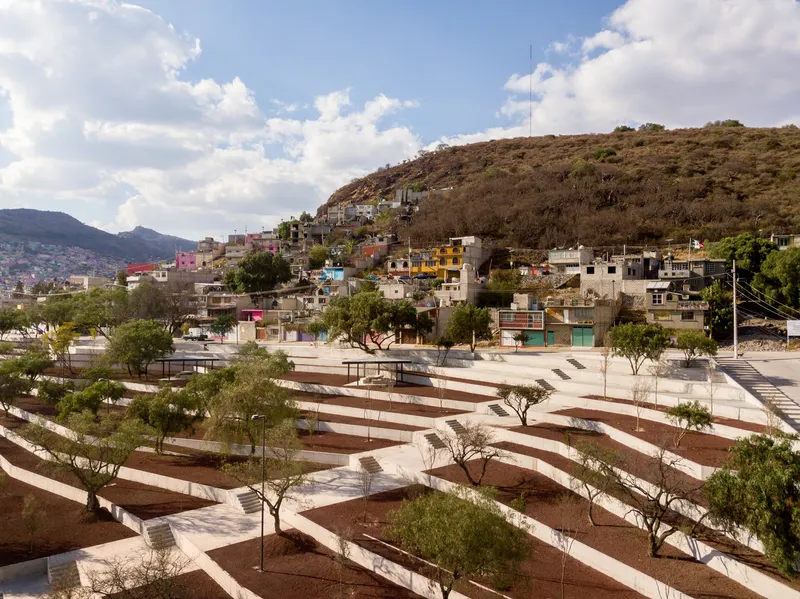
The core concept of Ecatepec Bicentennial Park lies in its soft infrastructure approach to stormwater management. Situated on sloped terrain, the design transforms the hillside into a system of water retention terraces, reviving a historical method used to mitigate erosion and retain soil.
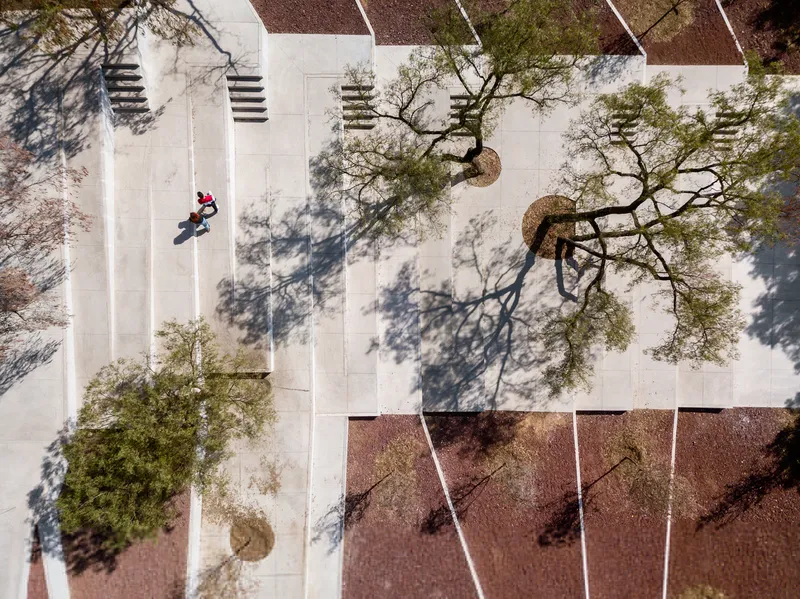
The terraces are structured with L-shaped concrete retaining walls, forming a minimal yet highly efficient construction system. These terraces are filled with tezontle, a local porous volcanic gravel known for its sponge-like properties. This material allows rainwater and runoff to slowly infiltrate into the subsoil, replenishing the overexploited aquifer of the Mexico City basin.
Key water management features include:
- Natural infiltration terraces filled with porous volcanic stone
- Soil stabilization and erosion mitigation strategies
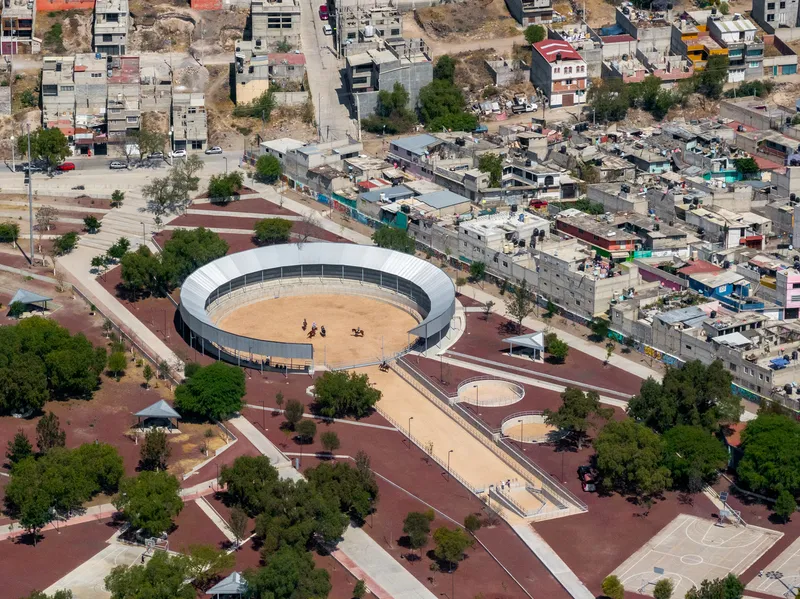
- A 17,500 m³ regulating basin capturing runoff from a seasonal stream
- Flood mitigation systems protecting downstream urban areas
This integrated ecological design reduces flood risks while transforming the park into an active environmental agent within the metropolitan watershed.
Urban Connectivity and Public Safety Through Design
Reconnecting a Fragmented Urban Fabric
Before intervention, the park was surrounded by fencing and perceived as unsafe. The design strategy directly addressed insecurity and social fragmentation by removing barriers and reconnecting neighborhoods to the north and south.
Former dead-end streets were extended into the park, becoming pedestrian corridors that structure circulation and public programming. These cross streets activate the site and improve urban permeability, turning the park into a connector rather than an isolated enclave.
To enhance safety:
- A lookout tower was introduced in previously underused areas
- A comprehensive lighting system enables safe nighttime use
- Low-lying vegetation was removed to improve cross visibility
- 450 new trees were planted to increase shaded areas and canopy cover
The result is a public space that fosters surveillance through activity, visibility, and accessibility, demonstrating how landscape architecture can address social resilience.

Programmatic Activation and Community Engagement
Designing for Recreation, Movement, and Social Interaction
Ecatepec Bicentennial Park goes beyond environmental repair. It introduces diverse programming elements that encourage daily use and social cohesion.
Newly integrated features include:
- Playgrounds and children’s areas
- Calisthenics and fitness zones
- Parkour spaces
- Rest areas and kiosks distributed throughout the site
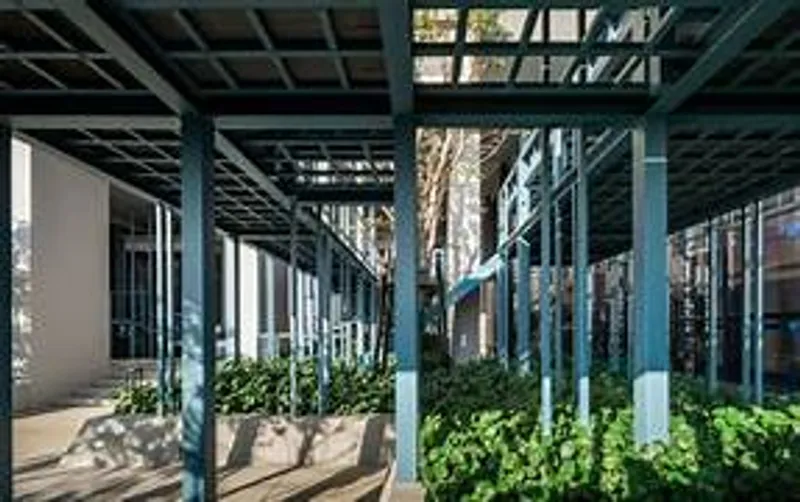
Additionally, deteriorated sanitary structures were recycled and transformed into open, naturally ventilated buildings that allow light and sound permeability. This adaptive reuse strategy reinforces sustainability while reducing maintenance costs.
The park is no longer a neglected void: it is now a vibrant civic landscape supporting physical activity, informal gathering, and community life.
Landscape Architecture as Ecological Infrastructure
The project exemplifies how landscape architecture can function as climate-responsive infrastructure. By integrating hydrological systems into public space design, the park improves both environmental performance and social value.
Its terraced topography:
- Encourages rainwater infiltration
- Reduces surface runoff
- Prevents soil erosion
- Supports native vegetation growth
By multiplying tree coverage and improving canopy density, the park contributes to urban cooling and microclimate regulation, essential strategies in rapidly urbanizing regions.
This design demonstrates that parks can serve as urban water infrastructure, not merely recreational green areas.

Architecture as a Catalyst for Urban Transformation
Ecatepec Bicentennial Park stands as a compelling example of how architecture and urban design can retroactively repair fragmented territories. In a context characterized by informal growth, limited public investment, and environmental stress, the project introduces a replicable model for sustainable public space development in Latin America.
The intervention shifts the perception of the site from neglected land to ecological asset. It improves community safety, strengthens neighborhood connections, and restores environmental balance.
By merging hydrology, topography, and social programming, Taller Capital positions architecture as a proactive tool for climate adaptation and urban regeneration.
All photographs are works of
Rafael Gamo, Alejandra Romo, Loreta Castro Reguera


Popular Articles
Popular articles from the community


U.GA Architects Wraps an Oval Rooftop Pool in Curved Board-Formed Concrete on Busan's Jeollidan-gil
In Busan's Jeonpo-dong, a 454 m² mixed-use block stacks a neighborhood facility, guest rooms and an oval rooftop pool inside spiraling concrete walls.

Jaramillo Van Sluys Arquitectura and Urbanismo Turn a Demolished Registry Lot in Quito into an Orchard Plaza
In Quito's Centro Histórico, a 2,800 m² plaza exposes the San Agustín convent wall and redraws its lost Augustinian orchard in volcanic stone.

LT2A and OPEN Architectes Thread a Brick and Glass High School Through a Wooded Belgian Campus
In Braine-l'Alleud, a 3,000 m² wing for Collège Cardinal Mercier pairs pale brick with a glazed colonnade, deferring to a small chapel and a dense wood.

GROUP A Strips a 1969 Rotterdam Harbor Headquarters to Its Frame and Wraps It in Timber Louvers
In Rotterdam's M4H harbor district, Ferro Offices reuses a 1969 frame, adds one timber storey and reaches BREEAM-NL Outstanding.

Similar Reads
You might also enjoy these articles

Gil Mello Arquitetura Tilts a Single Roof Toward the Waterfalls on a Plateau Above Aiuruoca, Brazil
In Aiuruoca, Minas Gerais, a 200 m² house of local labor and reclaimed poles pairs a low valley veranda with a tall mountain one.
U.GA Architects Wraps an Oval Rooftop Pool in Curved Board-Formed Concrete on Busan's Jeollidan-gil
In Busan's Jeonpo-dong, a 454 m² mixed-use block stacks a neighborhood facility, guest rooms and an oval rooftop pool inside spiraling concrete walls.

Felipe Hess Arquitetos Turns a Blind Stone Wall to the Street and Opens a Brazilian House onto a Courtyard and Canal
A canal-front house in Brazil hides behind painted stone and planting, then opens to an olive-tree courtyard, a reed-ceilinged porch and a curving pool.

David Macias Steps a Doorless Stone and Plaster House Down a Tropical Colombian Hillside
In the humid hills of Colombia, Threshold House replaces the front door with an open void and terraces its 850 m² down the slope instead of fighting it.

Explore Blocs Competitions
Discover active competitions in this discipline

Challenge to reimagine the Iron Throne

Photograph architecture without architects

Illustrate the lost glory of Angkor Wat - Render Challenge

Design challenge to reuse E-waste
Comments (0)
Please login or sign up to add comments
No comments yet. Be the first to comment!