

Ecotopia: A Cylindrical Tower and Timber Network Rooted in Colombia's San Nicolás Valley
Elevated pavilions, mesh-clad towers, and agricultural loops form a speculative settlement in Antioquia's highlands.


A cylindrical tower wrapped in dark mesh screening stands on stilts in a Colombian highland valley, a horse grazing beneath it as though the building were simply another feature of the terrain. That image captures the central ambition of Ecotopia: architecture that occupies the landscape without displacing it, lifting habitable volume above the ground plane so that ecology, agriculture, and human settlement can coexist on the same parcel of land.
Designed by Juanes Rodriguez for the Etopia competition, the project is sited in the San Nicolás Valley of Antioquia, a region where expanding urbanization pressures some of Colombia's richest biodiversity corridors. Rodriguez proposes a hybrid settlement, part vertical farm, part residential cluster, part ecological bridge, that threads through the valley's forested hillsides via a network of elevated timber walkways and clustered green-roofed pavilions.
The Tower as Vertical Landscape
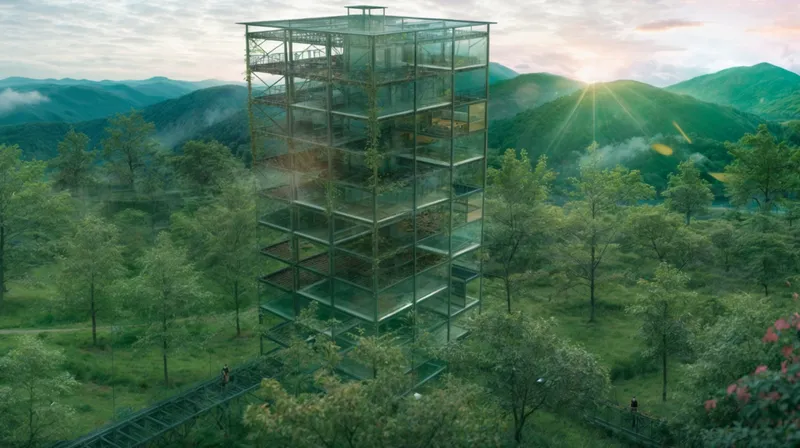
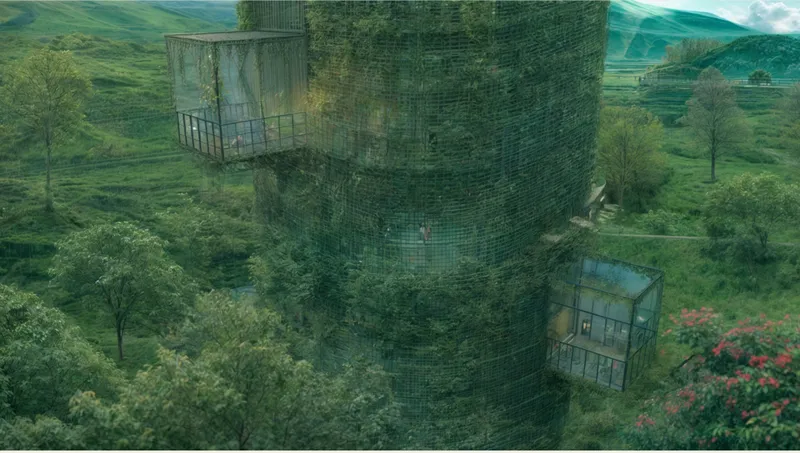
The project's most striking element is a glass and mesh tower whose floor slabs are planted with vegetation, creating a stack of miniature landscapes rising above the canopy. From a distance at sunrise, the structure reads as a luminous column of green against the hillside. Up close, the cylindrical form reveals protruding glazed box volumes that break the uniform skin, giving individual units distinct identities and framing specific views of the surrounding mountains. The mesh cladding tempers solar gain while lending the tower a porous, almost textile quality that softens its presence among the trees.
A Ground Plane Returned to Ecology

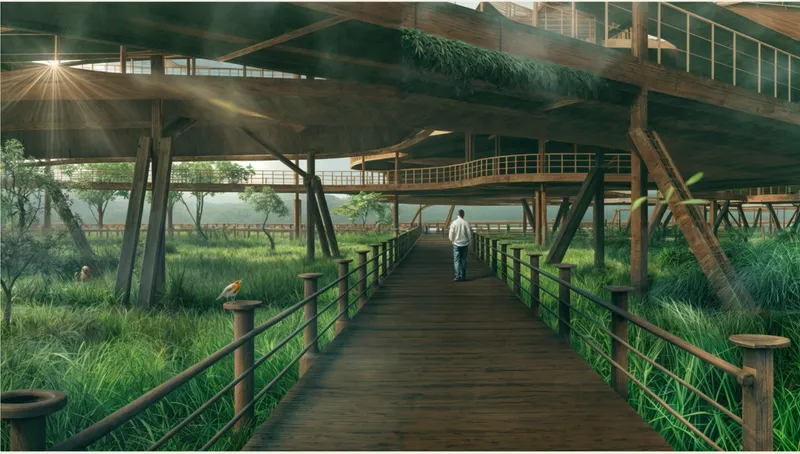
At the settlement's horizontal layer, clustered pavilions with planted roofs are connected by timber boardwalks that lift circulation off the ground entirely. The aerial view reveals how tightly the built fabric and planted courtyards are interwoven; the rooftops are essentially extensions of the valley floor, pushed up a few meters. Below these elevated paths, the soil is left intact for root systems, water infiltration, and the movement of small wildlife. A lone figure walking a boardwalk beneath the structures conveys the intended experience: human inhabitation happens above, while the ecology continues below, undisturbed.
Sectional Thinking: Bridge, Terrain, Habitat


Rodriguez's section drawings are where the ecological argument becomes most legible. An arched vehicular bridge spans a valley depression with native planting layered into its abutments, revealing how infrastructure and landscape restoration are treated as a single design operation. The broader landscape section distributes trees, bird silhouettes, and wildlife across the drawing as co-equal inhabitants of the project, not decorative additions. These sections make a clear case: the architecture is a framework for habitat, not a replacement of it.
Productive Landscapes and Food Sovereignty

A hand-drawn sketch of agricultural produce, a chicken, corn, vegetables, and fruit, signals that Ecotopia is as much about food production as it is about shelter. The inclusion of subsistence agriculture in the project's program challenges the common competition tendency to treat sustainability as a purely technological problem. Here, the settlement's viability depends on its capacity to feed its residents from the surrounding land, closing the loop between inhabitation and cultivation in a way that echoes pre-industrial land use patterns while deploying contemporary structural systems.
Terrace Life Against the Andes


The multi-level glass and steel terrace structure overlooking mountain ranges at sunset is the project's most seductive render, and deliberately so. Figures visible on the walkways give the image scale and suggest a communal life oriented outward toward the landscape. Paired with the more austere view of the mesh-clad tower on its stilted base, these two images frame the project's tonal range: from the social warmth of shared terraces to the quiet autonomy of a structure that barely touches the ground. The rolling hillside and grazing horse in the foreground reinforce the premise that architecture here is a guest, not a landlord.
Why This Project Matters
Ecotopia's strength lies in its refusal to treat sustainability as a checklist. Rather than bolting photovoltaic panels onto conventional building forms, Rodriguez rethinks the fundamental relationship between settlement and terrain, lifting structures off the ground, weaving food production into daily life, and designing infrastructure that doubles as ecological corridors. The San Nicolás Valley setting grounds these ideas in a real place with real pressures, giving the proposal teeth that purely abstract speculations lack.
Competitions like Etopia often produce glossy renderings of green towers that evaporate under scrutiny. What distinguishes this entry is its sectional rigor and its willingness to engage with agriculture, wildlife movement, and ground hydrology as primary design inputs. The project does not resolve every technical question it raises, but it asks the right ones, and it does so with a spatial imagination that makes the answers feel worth pursuing.
View the Full Project
About the Designers
Designer: Juanes Rodriguez
Enter a Design Competition on uni.xyz
uni.xyz runs architecture and design competitions year-round that reward proposals with spatial conviction and real site intelligence.
Project credits: "Ecotopia in San Nicolas Valley by Juanes Rodriguez Etopia (uni.xyz).


Popular Articles
Popular articles from the community


GROUP A Strips a 1969 Rotterdam Harbor Headquarters to Its Frame and Wraps It in Timber Louvers
In Rotterdam's M4H harbor district, Ferro Offices reuses a 1969 frame, adds one timber storey and reaches BREEAM-NL Outstanding.

longwave studio Reorganizes a 112 m² Tainan Apartment Around the Daily Routines of a Family and Two Cats
In Tainan, Taiwan, birch plywood, rust-red furniture and a freestanding plaster wall link arrival, storage, work and family life in one apartment.

Juan García Correa, John González and Claudia Rueda Sink a Circular Amphitheater into a Manizales Engineering Building
On the La Nubia campus in Manizales, Colombia, the S1 Building folds labs and offices into a hillside of ramped lawns that double as a campus route.

U.GA Architects Wraps an Oval Rooftop Pool in Curved Board-Formed Concrete on Busan's Jeollidan-gil
In Busan's Jeonpo-dong, a 454 m² mixed-use block stacks a neighborhood facility, guest rooms and an oval rooftop pool inside spiraling concrete walls.

Similar Reads
You might also enjoy these articles


Vereda Arquitetos Renovates a 40-Square-Meter Apartment Inside Niemeyer's Copan Building
A compact unit in São Paulo's most iconic residential tower gets a material overhaul that pairs exposed concrete with bold blue Formica.

Shakur's House: Exposed Brick as an Interior Organiser in a 168 m² Mashhad Residence
Brick moves indoors in this Mashhad residence, where masonry walls, glass partitions and teal planes sequence a compact home without closing it off.

Day and Night Park: A Time-Based Urban Newsstand in Beijing
A temporary urban newsstand in Beijing blending travel, light, and reading through poetic colors, compact form, and community-focused design.

Modernist Patio Renovation in El Masnou, Barcelona by Oliver Segura Arquitectura + Cebrià Arquitectura
Modernist patio renovation blending tradition and innovation with a movable pool, leveled floors, and Catalan materials in El Masnou.

Explore Eco-System Competitions
Discover active competitions in this discipline

Design a brochure to showcase the effects of the technosphere

Challenge to illustrate ‘A tale of Two Cities’

Deconstructivism - Illustration Design Challenge
Comments (0)
Please login or sign up to add comments
No comments yet. Be the first to comment!