

Epicurus: A Vertical Necropolis That Refuses to Exile the Dead
In Shanghai's dense Hongkou district, three architects stack memory, ritual, and civic life into a monumental urban deathscape for 65,000 souls.


Cemeteries have been pushed to the margins of cities for so long that we've forgotten they were once at the center. Epicurus reverses that exile. Situated in the Hongkou district of Shanghai, one of the most spatially constrained urban contexts on the planet, the project proposes a vertical necropolis capable of memorializing up to 65,000 individuals within a dense footprint. It is organized into three monumental strata, each calibrated to a different register of human experience: the civic, the transitional, and the sacred. The provocation is direct: if cities can build upward for the living, why not for the dead?
Epicurus is the work of Xavier Silva, Manuel Villalaín González, and Hazem Elshafei, and it won the Circle of Life competition on uni.xyz. The project takes its name from the Greek philosopher whose thinking reframed death as an absence of sensation rather than something to fear. That philosophical stance runs through every spatial decision here: rather than treating funerary architecture as a monument to grief, the designers position it as a framework for civic life, cultural inclusivity, and long-term urban adaptation.
Three Strata: Tempus, Initium, Aletheia
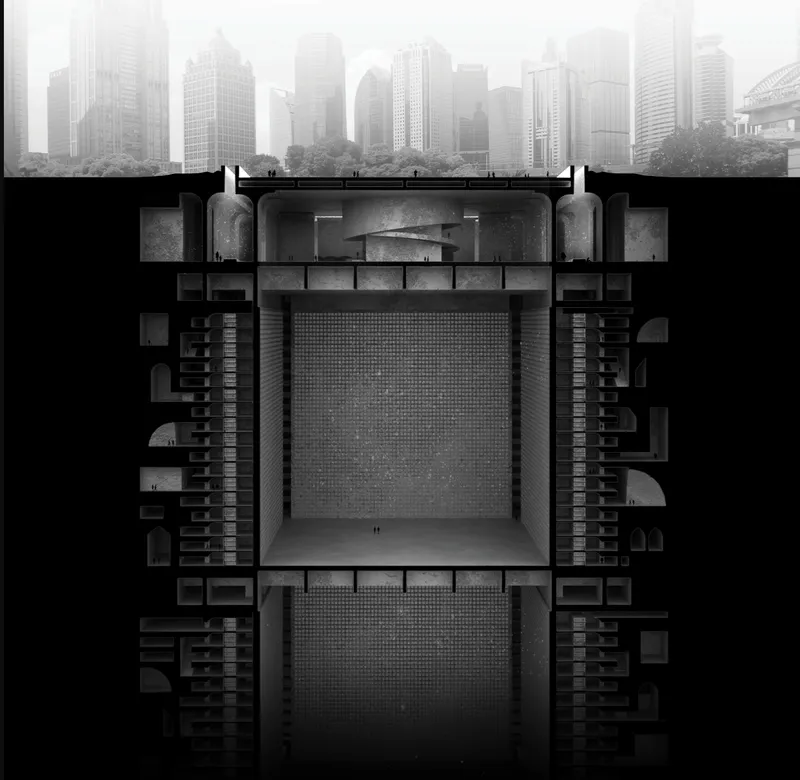
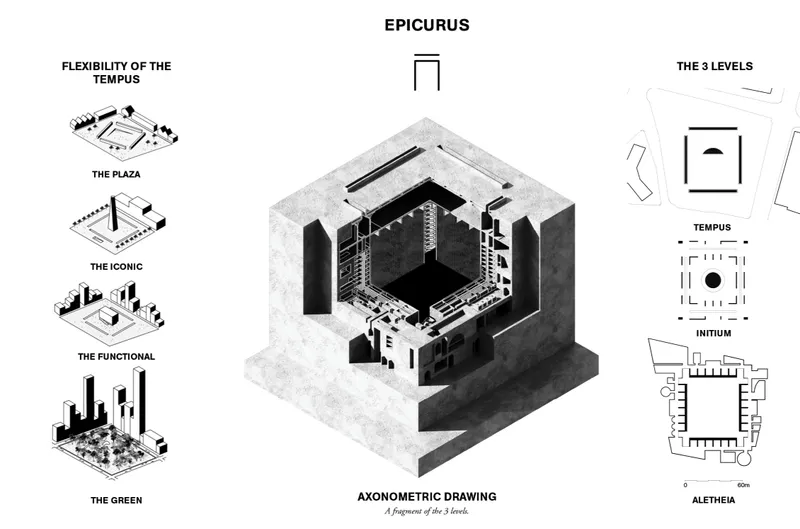
The section drawing slices through the building's core logic: a symmetrical structure organized around a central courtyard, flanked by programmatic wings that rise into Shanghai's foggy skyline. The vertical stratification is legible in the drawing. At the base sits Tempus, an open urban plaza designed for the living, hosting public gatherings, reflection, and everyday civic activity. Above it, Initium functions as a transitional corridor marked by solemn architectural rhythms and filtered light, bridging the public realm below with the sacred spaces above. At the summit, Aletheia serves as a contemplative chamber where silence, scale, and permanence converge to house memory itself.
The axonometric drawing reinforces the courtyard's role as an organizational device. The square plan radiates outward from this void, and surrounding spatial concepts, annotated in the drawing, reveal how cremation, burial, and diverse ritualistic needs are accommodated within the same envelope. The courtyard is not decorative. It is the hinge between the world of the living and the architecture of remembrance, allowing natural light and air to penetrate the deepest ritual spaces.
Silence Made Architectural: The Reflecting Pool and the Threshold
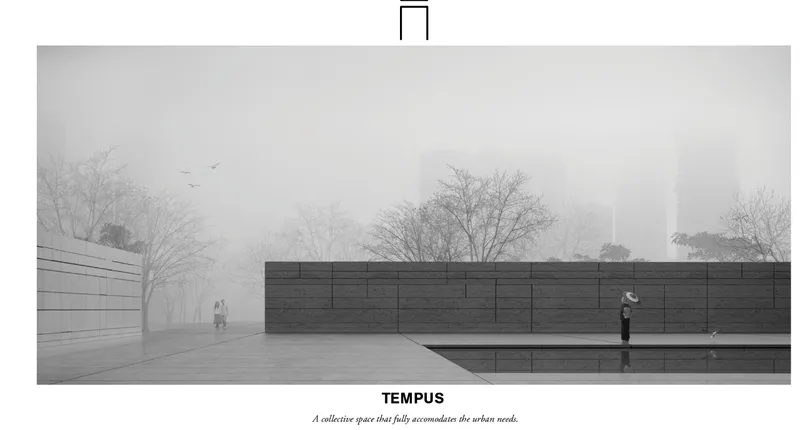
A long horizontal wall of paneled surfaces flanks a reflecting pool, bare trees standing like sentinels in the mist. The image captures the quality of threshold that defines Initium: the space between the city outside and the necropolis within. The material palette is restrained. The horizontality of the wall, its repetitive paneling, and the stillness of the water work together to slow the visitor's pace and shift their mental register. There is no ornamentation to decode, no symbolism to unpack. The architecture operates through proportion, material weight, and atmospheric control.
What makes this transitional space effective is its refusal to impose a singular emotional reading. The designers describe the project as accommodating "a range of emotions and experiences," from serenity and grief to contemplation and connection. The reflecting pool is a device that allows each visitor to project their own state onto the space. It requires, as the team puts it, "little mediation to be felt."
Vaulted Halls Where Light Becomes Ritual
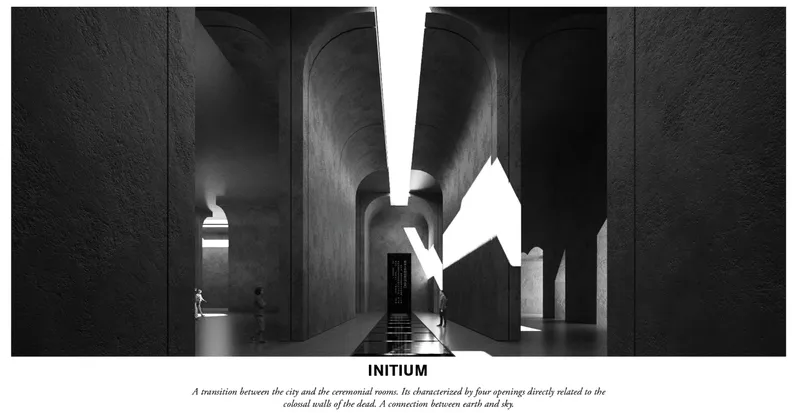
The interior rendering of Aletheia is the project's most arresting image. Vaulted concrete halls stretch upward, cut by dramatic angular light openings that cast sharp geometric patterns across the floor. Solitary figures move through the space, dwarfed by its scale. The design invokes the cosmic while remaining calibrated to the human body. This tension, between the daily and the eternal, is precisely what the designers sought. The light openings are not merely structural punctures; they are choreographed to create shifting illumination throughout the day, tying the sacred interior to the passage of time outside.
Concrete, used here in its raw monolithic form, carries associations with permanence and solemnity that are difficult to achieve with lighter materials. The vaulted geometry amplifies sound and silence in equal measure. A footstep resonates; a whisper carries. The space asks visitors to be present, to slow their breathing, to acknowledge the weight of the architecture around them. It is monumental without being oppressive, a distinction that separates considered funerary architecture from mere spectacle.
65,000 Memories in a Grid of Small Squares
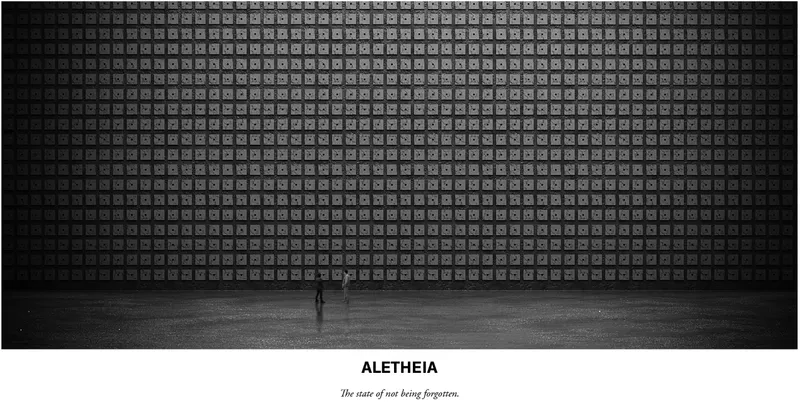
The final image is perhaps the most conceptually loaded. A single person stands before a massive grid wall composed of hundreds of small square panels, each one a memorial unit. The scale is overwhelming. The grid communicates the sheer capacity of the necropolis, its ability to hold 65,000 individuals within a vertical format that would be impossible in a conventional cemetery. But the grid also works at the intimate scale: each panel is a discrete marker, a single life, a name. The oscillation between the collective and the individual is the emotional engine of the entire project.
The designers built scalability into the system from the outset. Epicurus incorporates both vertical stratification and horizontal expansion, allowing the structure to grow as Shanghai's needs evolve and cultural practices shift. The grid wall is not a finished composition; it is an open framework that accepts new entries over decades. The architecture anticipates its own incompleteness, treating growth and change not as problems to be solved but as conditions to be designed for.
Why This Project Matters
Epicurus challenges a deeply entrenched urban assumption: that the infrastructure of death belongs at the periphery. In megacities like Shanghai, where land scarcity forces every square meter to justify its existence, that assumption has real consequences. It means bereaved families travel hours to visit graves. It means cemeteries become invisible, and with them, the social rituals that bind communities to their histories. By folding funerary space into the civic core, Epicurus proposes that remembrance is not a retreat from urban life but an integral part of it.
What elevates the project beyond provocation is its commitment to adaptability. The three-strata system, the culturally inclusive programming, the capacity for expansion: these are not theoretical gestures. They are design decisions that respond to specific demographic, spatial, and cultural pressures in 21st-century Shanghai. Silva, Villalaín González, and Elshafei have produced a competition entry that functions simultaneously as architectural proposal, urban strategy, and philosophical argument. It asks whether the architecture of death can become, paradoxically, one of the most vital forms of civic infrastructure a city can build.
View the Full Project
About the Designers
Designers: Xavier Silva, Manuel Villalaín González, Hazem Elshafei
Enter a Design Competition on uni.xyz
uni.xyz runs architecture and design competitions year-round that reward proposals with spatial conviction and real site intelligence.
Project credits: Epicurus by Xavier Silva, Manuel Villalaín González, Hazem Elshafei Circle of Life (uni.xyz).


Popular Articles
Popular articles from the community


Opera by the Sea Estonia: Three Shells Dissolving Architecture into Tallinn's Coastline
A winning opera house proposal replaces monumental form with interconnected shells that blur the boundary between building, park and Baltic Sea.
Extended Shell: Retrofitting Kolkata's Balconies as Living Urban Thresholds
A modular retrofit system recovers the social and environmental intelligence of Kolkata's historic verandas for contemporary Park Street residents.

Opera on the Sea: Driftwood Logic Shapes a Timber Opera House on Estonia's Coast
Trevor Orgill's opera house translates the entangled drift of floating timber into a civic building where wood, water, and music converge.
Faces of the Soviet Avant-Garde: Turning Moscow's Street Names into an Open-Air Museum
A network of sculptural installations across a Moscow residential district transforms forgotten architect names into spatial encounters with cultural memor

Similar Reads
You might also enjoy these articles

Bao Huynh Watercolor Atelier: A Serene Art Retreat in Hội An
Bao Huynh Watercolor Atelier in Hội An blends multifunctional art spaces, sustainable design, local materials, and family-friendly living in a serene environment.

Atelier Macri Concept Store Interior Design by CASE-REAL
Atelier Macri store features a "ko" counter, walnut wood details, cork displays, blending retail, gallery, and seamless customer experiences.

Manuel Vargas Izquierdo Stadium and High-Performance Sports Center: Architectural Excellence in Jalpa de Méndez
The Manuel Vargas Izquierdo Stadium blends sustainable design, inclusive sports facilities, and cultural-inspired architecture, revitalizing Jalpa de Méndez’s public spaces.

KAKR Buluh Awar Hall: Revitalizing Community and Ecology Through Bamboo Architecture
Community built bamboo hall revitalizes Buluh Awar village, empowering youth, restoring ecology, celebrating vernacular craftsmanship through sustainable architecture and culture.

Explore Vertical Cemetery Competitions
Discover active competitions in this discipline

Design a brochure to showcase the effects of the technosphere

Challenge to illustrate ‘A tale of Two Cities’

Deconstructivism - Illustration Design Challenge
Comments (0)
Please login or sign up to add comments
No comments yet. Be the first to comment!