

Exoditorium: A Tower for Architectural Education Beyond Earth
Spherical volumes stacked along a slender tower frame a speculative school where space technology meets Bauhaus-inspired pedagogy.


What happens when you take the pedagogical ambition of the Bauhaus and aim it at interplanetary settlement? You get a building that looks less like a school and more like a launch vehicle: a slender, tapered tower punctuated by spherical volumes, drawn against a starry void as if it already left the atmosphere. Exoditorium is a speculative educatorium, a facility designed to train architects and designers for extraterrestrial construction by immersing them in the very spatial conditions they would one day build for.
Designed by Draško Nikolić, Exoditorium was shortlisted in the Bauhaus Neue competition, which challenged entrants to reimagine the legacy of the Bauhaus for a new era. Nikolić responded not by updating the Dessau campus but by transplanting its spirit into a vertical research tower rooted in aerospace engineering, biotechnology, and sustainable construction. The project draws on developments from the Israeli Space Agency as a technological foundation, positioning the building as a bridge between current space science and future architectural practice.
A Vertical Campus Rendered Against the Cosmos

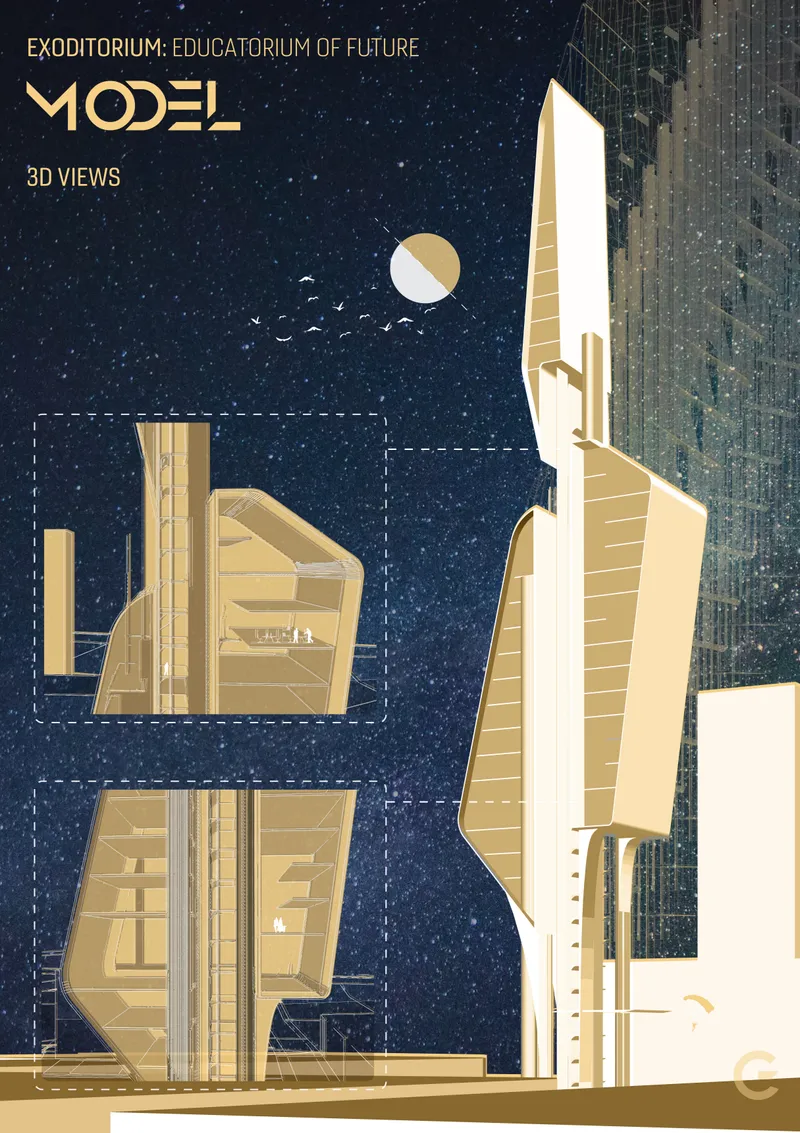
The axonometric drawing sets the tone immediately: a needle-like tower with circular, spherical volumes clustered along its height, floating against a deep black background studded with stars. The composition is deliberate. By removing any terrestrial horizon, Nikolić forces the viewer to read the building as an autonomous object, a self-contained habitat rather than a conventional campus building. The spheres suggest pressurized enclosures, the kind of geometry that performs well under differential pressure loads, hinting at environments designed for conditions beyond Earth's atmosphere.
The elevation and section drawings reveal what those spheres contain: curved interior spaces with layered floor plates, suggesting lecture halls, laboratories, and observation decks stacked within each globe. The tower tapers as it rises, reducing its structural footprint at height while concentrating mass and program at mid-levels. The sections show how circulation threads vertically through the narrow core, connecting spherical volumes that bulge outward like nodes on a stem.
Geometric Domes and Programmatic Layering
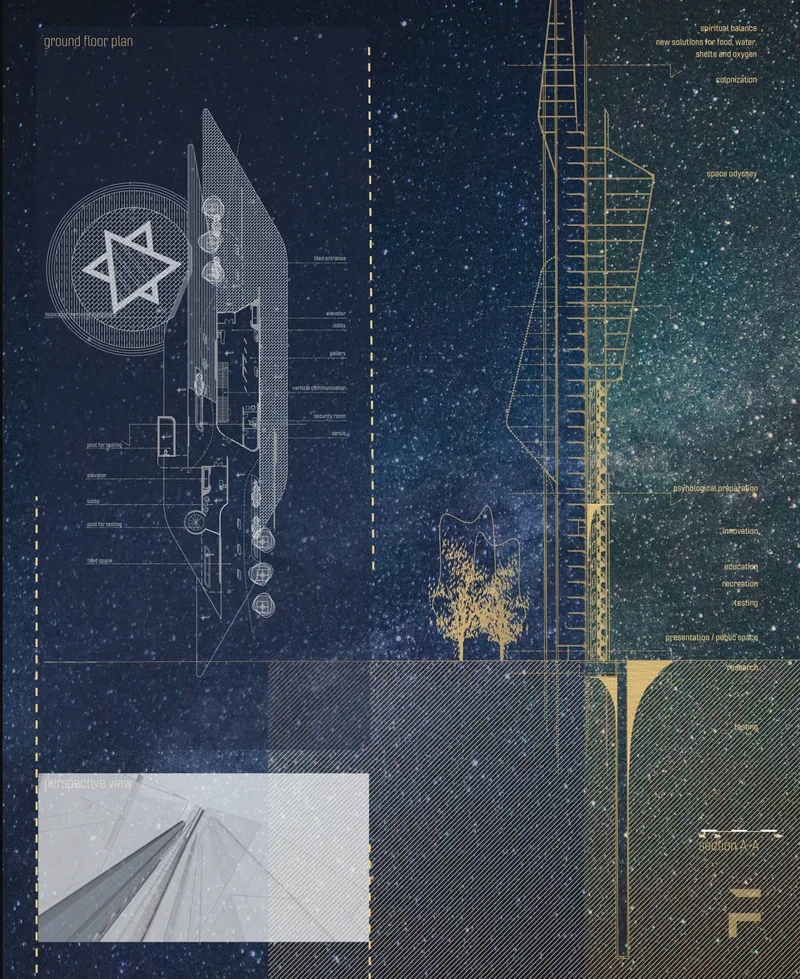
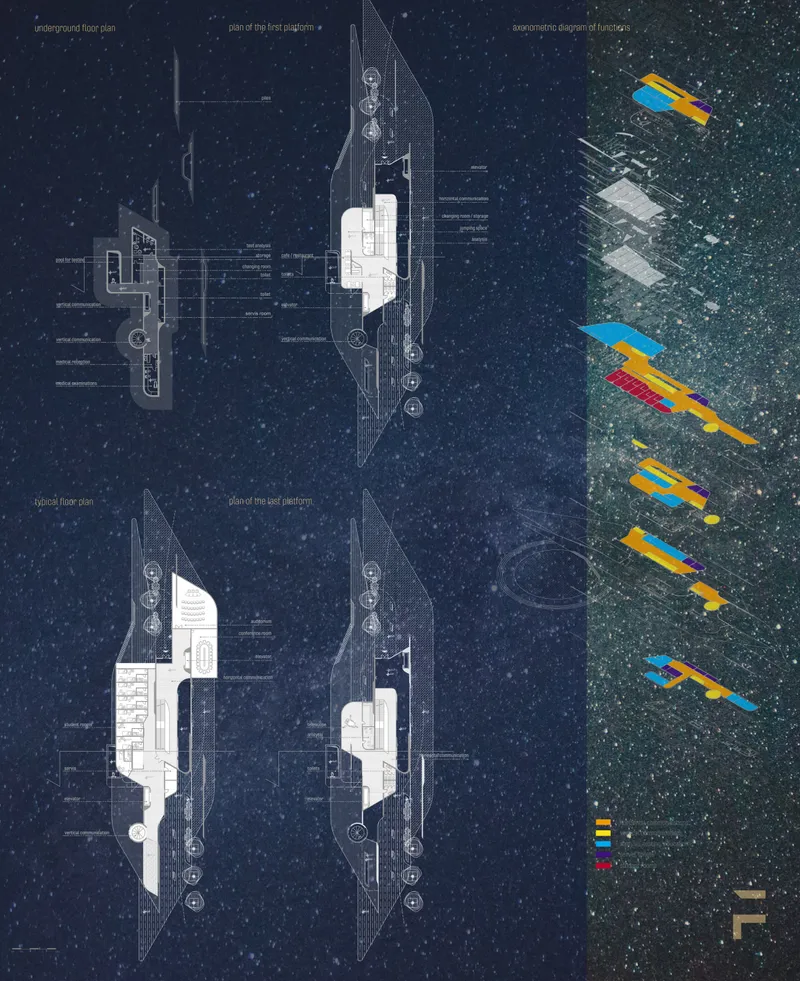
At ground level, a geometric dome pattern governs the plan, its triangulated surface recalling geodesic structures long associated with lightweight, high-performance enclosures. The plan and section drawings at this level show how the base anchors the tower while providing a generous, column-free interior under the dome. This is where the building meets its urban context, offering a publicly accessible threshold before the vertical journey begins.
Higher up, the floor plans multiply and compress. Axonometric diagrams map circulation routes and programmatic zones across multiple levels, revealing a building organized around three interlocking systems: research-driven learning environments, biotechnological laboratories for environmental sustainability, and immersive simulation spaces where students confront the physical constraints of off-world construction. The diagrams read like orbital mechanics charts, each ring and pathway calculated for efficiency within a tight structural envelope.
Angled Facades and the Tension of Surface

The aerial axonometric view introduces another layer of complexity: angled facade planes that slice across the tower's profile, creating sharp geometric overlays against the smooth spherical volumes. These planes are not decorative. They suggest adaptive skin systems, surfaces that could modulate solar gain, radiation shielding, or atmospheric exchange depending on the building's operating environment. The tension between the organic curvature of the spheres and the hard-edged facets of the facade panels gives the tower a restless, prototypical quality, as though it is still being calibrated for deployment.
Grounding the Speculative in Urban Context
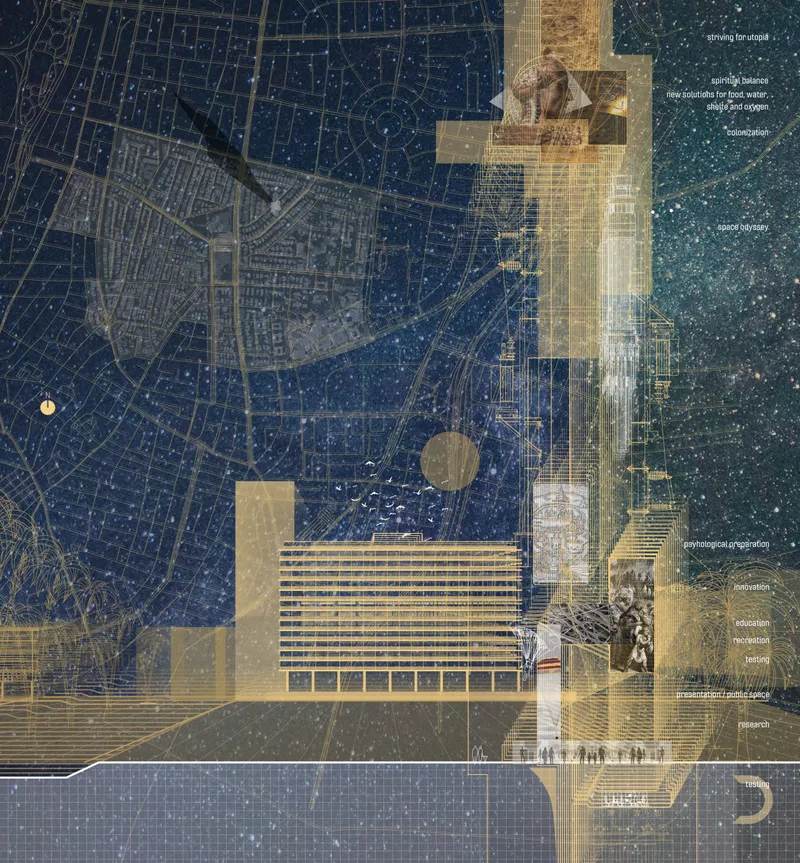
The final composite drawing pulls the camera back, layering site plans, urban context, building elevations, and historic imagery into a single dense sheet. It is a reminder that Exoditorium, for all its extraterrestrial ambition, begins on the ground. The collage technique connects Nikolić's proposal to the Bauhaus tradition of integrating art, craft, and industry, while the urban footprint shows how the tower negotiates its immediate surroundings. Historic imagery woven into the drawing sheet anchors the project in a lineage: from Gropius's workshops to orbital habitats, the through-line is a belief that architecture schools should build the conditions they teach.
Why This Project Matters
Exoditorium does not attempt to solve the practical engineering of space colonization. Its value lies in the question it poses to architectural education itself: if the next frontier of human settlement is extraterrestrial, should the schools training those architects not already operate under those spatial, structural, and environmental assumptions? By designing a building whose geometry, enclosure systems, and program are all derived from aerospace and biotechnological logic, Nikolić argues that the answer is yes, and that the Bauhaus model of learning by making remains the right framework for getting there.
As a shortlisted entry in Bauhaus Neue, Exoditorium stands out for its refusal to treat the competition brief as a renovation problem. Instead of updating a historic pedagogical model for a familiar context, Nikolić relocates the entire premise, asking what a school of design looks like when its graduates will practice on another planet. The tower, with its pressurized spheres and angled shield planes, is both a provocation and a blueprint: speculative enough to spark debate, detailed enough to hold up under scrutiny.
View the Full Project
About the Designers
Designer: Draško Nikolić
Enter a Design Competition on uni.xyz
uni.xyz runs architecture and design competitions year-round that reward proposals with spatial conviction and real site intelligence.
Project credits: Exoditorium: Educatorium of the Future by Draško Nikolić Bauhaus Neue (uni.xyz).


Popular Articles
Popular articles from the community


LT2A and OPEN Architectes Thread a Brick and Glass High School Through a Wooded Belgian Campus
In Braine-l'Alleud, a 3,000 m² wing for Collège Cardinal Mercier pairs pale brick with a glazed colonnade, deferring to a small chapel and a dense wood.

Cube Design Draws an Ecological Corridor Between Two Shenzhen Hills with the Nankai Building
Beside Shenzhen's container docks, the Nankai Building pairs stacked balconies with a climbing green screen to connect two hillsides across its height.

Jaramillo Van Sluys Arquitectura and Urbanismo Turn a Demolished Registry Lot in Quito into an Orchard Plaza
In Quito's Centro Histórico, a 2,800 m² plaza exposes the San Agustín convent wall and redraws its lost Augustinian orchard in volcanic stone.

GROUP A Strips a 1969 Rotterdam Harbor Headquarters to Its Frame and Wraps It in Timber Louvers
In Rotterdam's M4H harbor district, Ferro Offices reuses a 1969 frame, adds one timber storey and reaches BREEAM-NL Outstanding.

Similar Reads
You might also enjoy these articles


Vereda Arquitetos Renovates a 40-Square-Meter Apartment Inside Niemeyer's Copan Building
A compact unit in São Paulo's most iconic residential tower gets a material overhaul that pairs exposed concrete with bold blue Formica.

Shakur's House: Exposed Brick as an Interior Organiser in a 168 m² Mashhad Residence
Brick moves indoors in this Mashhad residence, where masonry walls, glass partitions and teal planes sequence a compact home without closing it off.

Day and Night Park: A Time-Based Urban Newsstand in Beijing
A temporary urban newsstand in Beijing blending travel, light, and reading through poetic colors, compact form, and community-focused design.

Modernist Patio Renovation in El Masnou, Barcelona by Oliver Segura Arquitectura + Cebrià Arquitectura
Modernist patio renovation blending tradition and innovation with a movable pool, leveled floors, and Catalan materials in El Masnou.

Explore Neo Futurism Competitions
Discover active competitions in this discipline

Challenge to design public laboratory

Challenge to reimagine the Iron Throne

Photograph architecture without architects

Illustrate the lost glory of Angkor Wat - Render Challenge
Comments (0)
Please login or sign up to add comments
No comments yet. Be the first to comment!