

Exploring the Future of Lunar Architecture: The FLOCK Project
The innovative FLOCK lunar habitat project, revolutionizing lunar architecture with modular, adaptive construction methods.


The FLOCK (Fully Lunar Operational Construction Kinematics) project, created by Mizuguchi Takashi, stands as a groundbreaking concept in the field of lunar architecture. This innovative proposal was shortlisted entry in the prestigious Moon Base 2124 competition, showcasing its potential to revolutionize the way humans might live and work on the Moon. Utilizing advanced geometric shapes and cutting-edge technologies, FLOCK aims to provide a sustainable and adaptable habitat for future lunar explorers. In this article, we delve into the intricate details of the FLOCK project, exploring its design, deployment, and the technologies that make it a viable solution for lunar habitation.
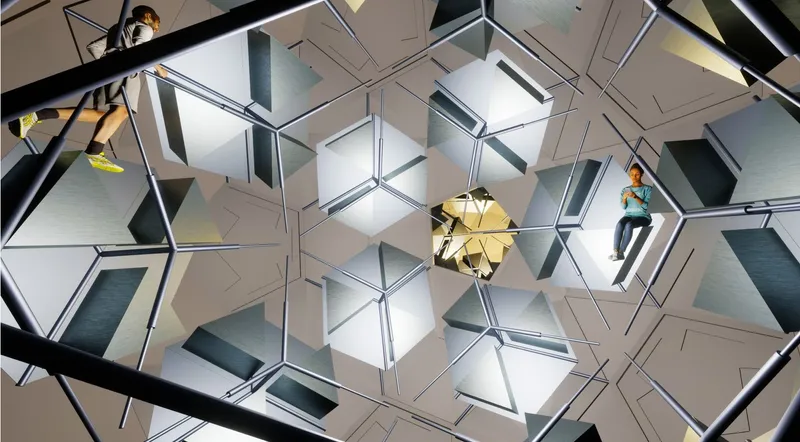
The Concept of FLOCK
Multi-Directional Architecture
The core concept of FLOCK is its multi-directional architecture, which is crucial in the low-gravity environment of the Moon. The Moon's gravity, which is only one-sixth that of Earth's, significantly impacts how structures and movement are conceived. Traditional architectural elements like stairs and floors become impractical due to reduced frictional force against human movement. Instead, FLOCK proposes a system where movement is facilitated by skipping, climbing walls, and utilizing handrails placed along the pressurized walls of the habitat. This unique approach ensures that inhabitants can move efficiently within the habitat, leveraging the Moon's low gravity.

Kinematic Architecture
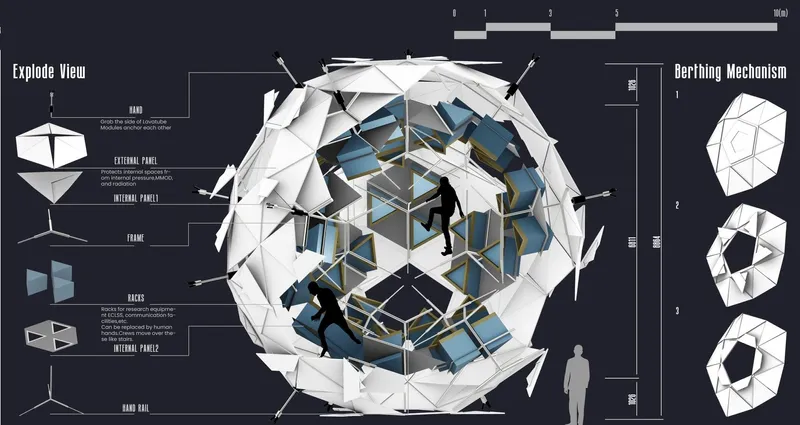
The second pivotal concept of FLOCK is its kinematic architecture. The design is based on the rhombic icosahedron, a geometric shape with a sphericity close to that of a sphere, which allows the modules to roll easily. Each module is equipped with a "hand" at the apex, enabling it to grip the ground, adjust its rolling speed, and interact with other modules. This mechanism allows the modules to move autonomously and form larger structures by connecting with other modules. This dynamic and adaptive system is essential for exploring the lunar surface and establishing expansive habitats.
Site Selection: The Lavatube Advantage
FLOCK is designed to be deployed in lunar lavatubes—large tunnels formed by ancient volcanic activity. These structures offer several advantages:
Protection from Radiation and Meteorites: Located more than 40 meters below the lunar surface, lavatubes provide excellent shielding from harmful space radiation and micrometeorite impacts.
Thermal Stability: The subterranean environment of lavatubes ensures a more stable temperature, making it more comfortable for human habitation.
Spacious and Expandable: Some lavatubes are over 50 meters in diameter and stretch for several kilometers, offering ample space for building extensive habitats.
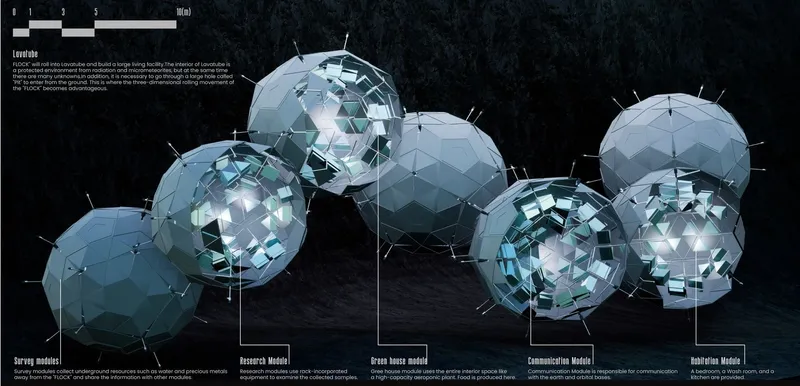
Accessing these lavatubes involves descending through a large pit on the lunar surface. FLOCK modules are designed to act like a single robotic arm, gripping the sides of the pit and rolling down to the bottom, where they can then deploy and expand.

Innovative Construction Technologies
FLOCK leverages two major technological advancements to achieve its goals:
Folding Structure Technology
Each module in the FLOCK system is composed of panels with a folding mechanism, allowing the structure to be compact during transportation and then unfold upon deployment. This design ensures that the modules can be efficiently packed into payload fairings of transport rockets, such as the SpaceX Starship, and then expand to form large living spaces once they reach the lunar surface.
Swarm Robotics
The use of swarm robotics is a key innovation in the FLOCK project. These modular robots can self-assemble in three dimensions and navigate large, complex terrains. The Moon's low gravity makes it feasible to employ these large-scale swarm robotics for construction. The modules can move autonomously, adjusting to unstable ground conditions and ensuring that the habitat remains secure and functional.

Detailed Module Design and Deployment
Sectional Views and Movement
The sectional views of the FLOCK modules reveal the intricate design that supports autonomous movement and modular connectivity. Each module includes internal panels for equipment and handrails for human mobility. The modules can couple in 12 different directions, allowing for flexible configurations and easy reconfiguration as needed. This multi-directional coupling also provides numerous routes for movement and evacuation, enhancing safety.
Deployment Process
The deployment process of FLOCK modules is a marvel of engineering. Transported in a folded state, the modules fit snugly into rocket payloads. Once on the lunar surface, the folding structure allows the modules to unfold in 12 directions, forming a three-dimensional space. This deployment strategy not only maximizes space but also ensures rapid and efficient construction of the habitat.
Mobile Construction and Adaptability
FLOCK modules are designed for mobility, capable of rolling over the lunar surface like dumplings. This mobility is critical for adapting to the uneven and unpredictable terrain of the Moon. The modules can change their geometry and move as a cohesive unit, providing a flexible and responsive living environment. This adaptability is particularly important in the unstable conditions of lavatubes, where the modules must adjust to shifts in the ground and potential collapses.
Interior and Greenhouse Views
The interior views of the FLOCK modules highlight the innovative use of space and technology. The modules are equipped with racks and handrails, enabling inhabitants to move efficiently in the low-gravity environment. The greenhouse module, in particular, showcases a high-capacity aeroponic system that allows for sustainable food production. This integration of living and agricultural spaces ensures that the habitat can support long-term human presence on the Moon.
The FLOCK project represents a visionary approach to lunar architecture, combining advanced geometric design with cutting-edge technologies to create a sustainable and adaptable habitat for future lunar explorers. By leveraging the unique conditions of the Moon and employing innovative construction methods, FLOCK paves the way for the next generation of space habitats. As we look towards the future of space exploration, projects like FLOCK will play a crucial role in making long-term human presence on the Moon a reality.


Popular Articles
Popular articles from the community


Opera on the Sea: Driftwood Logic Shapes a Timber Opera House on Estonia's Coast
Trevor Orgill's opera house translates the entangled drift of floating timber into a civic building where wood, water, and music converge.

Temporary Home for Dogs: A Reversed Zoo Rethinks Animal Shelter Architecture
In Bucharest, a sinuous corridor and freed landscape flip the logic of containment, designing a shelter that works to make itself unnecessary.

Cloaked Colonization: A Mobile Underwater Habitat That Moves Like a Fish
Micah Abaya's shortlisted EHC Pacific entry reimagines ocean settlement as a dispersed network of self-sustaining architectural organisms.

Opera by the Sea Estonia: Three Shells Dissolving Architecture into Tallinn's Coastline
A winning opera house proposal replaces monumental form with interconnected shells that blur the boundary between building, park and Baltic Sea.

Similar Reads
You might also enjoy these articles

Day and Night Park: A Time-Based Urban Newsstand in Beijing
A temporary urban newsstand in Beijing blending travel, light, and reading through poetic colors, compact form, and community-focused design.

Modernist Patio Renovation in El Masnou, Barcelona by Oliver Segura Arquitectura + Cebrià Arquitectura
Modernist patio renovation blending tradition and innovation with a movable pool, leveled floors, and Catalan materials in El Masnou.

Alto Residencial Coop: Cooperative Housing Development in Santiago de Compostela by Carbajo Barrios Arquitectos
A linear cooperative housing complex blending white volumes and perforated metal façades, enhancing community living, natural light, privacy, and urban integration.

Vil Genis School by BPA ARCHITECTURE – Massy, France
Vil Genis School in Massy, France, features sustainable design, south-facing classrooms, community integration, accessible spaces, and modern educational architecture.

Explore Space Architecture Competitions
Discover active competitions in this discipline

Challenge to reimagine the Iron Throne

Photograph architecture without architects

Illustrate the lost glory of Angkor Wat - Render Challenge

Design challenge to reuse E-waste
Comments (0)
Please login or sign up to add comments
No comments yet. Be the first to comment!