
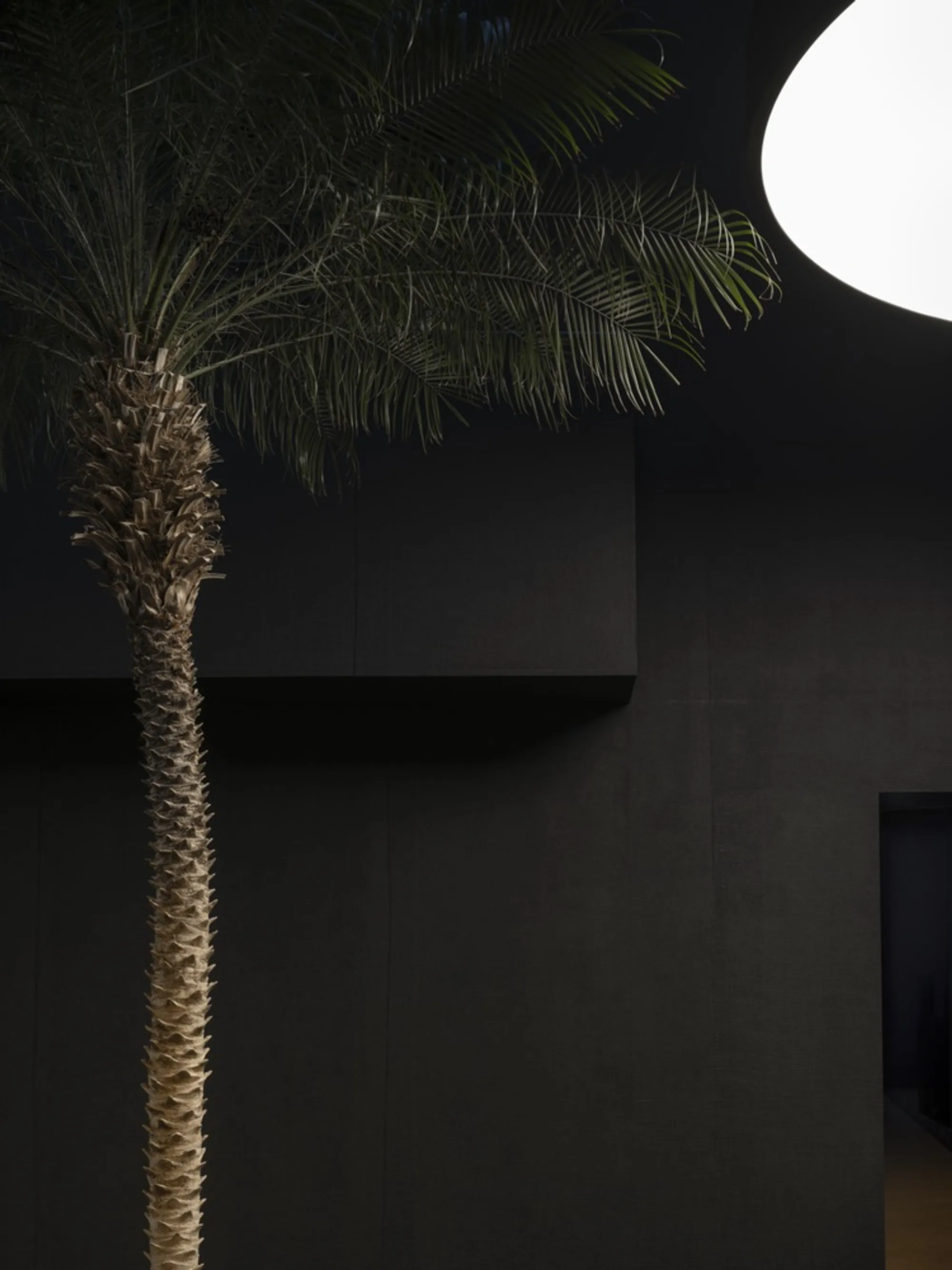
Leopold Banchini Architects Conjures a Film Noir Studio in Shadow and Light
A cinematic architecture where deep canopies, luminous slots, and nocturnal atmospheres dissolve the line between set design and building.


There is a genre of architecture that borrows its logic from cinema rather than construction. Film Noir Studio by Leopold Banchini Architects belongs to that genre without apology. Every surface, every shadow, every sliver of artificial light feels calibrated not for comfort or efficiency but for atmosphere, the kind of charged spatial tension that classic noir cinematographers spent decades perfecting on celluloid.
What makes the project genuinely interesting is its refusal to treat "cinematic" as a mood board adjective. The building is not styled to look like a movie set. It is structured like one: deep canopies that frame darkness overhead, luminous vertical slots that function like key lights, a palette of dark panels and gridded tiles that gives every room a graphic density most architects would sand down to nothing. Leopold Banchini has built a spatial argument that mood is not decoration. It is structure.
The Nocturnal Facade
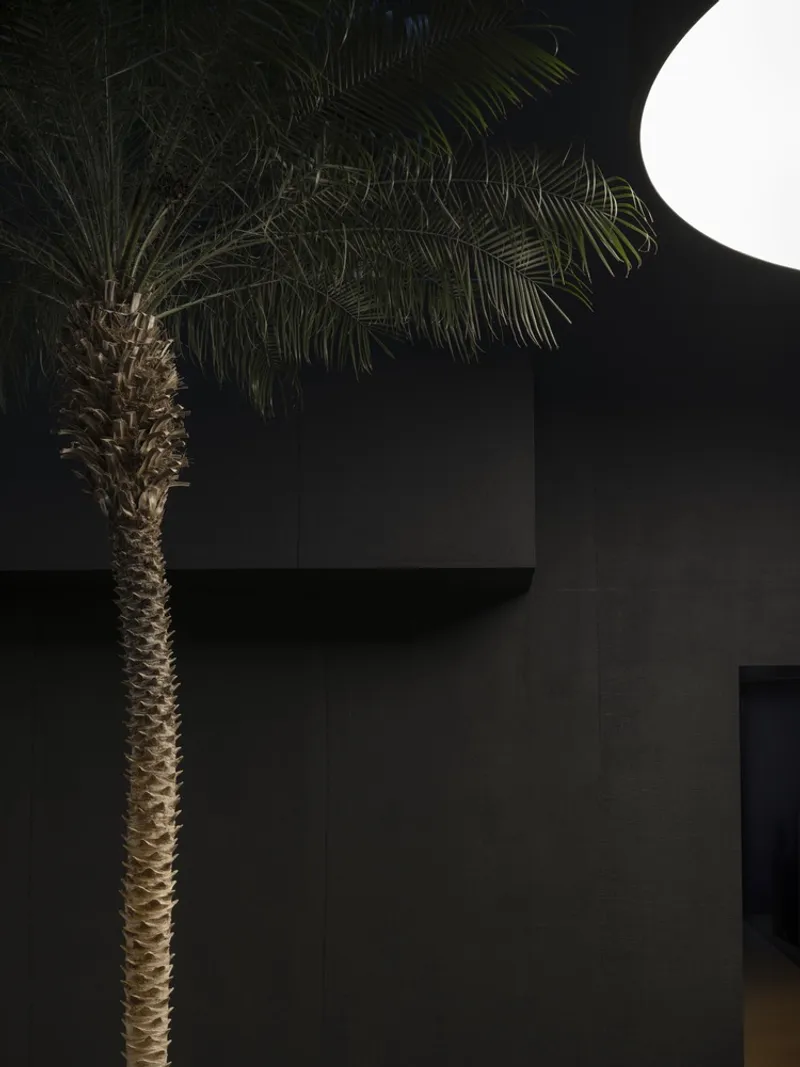
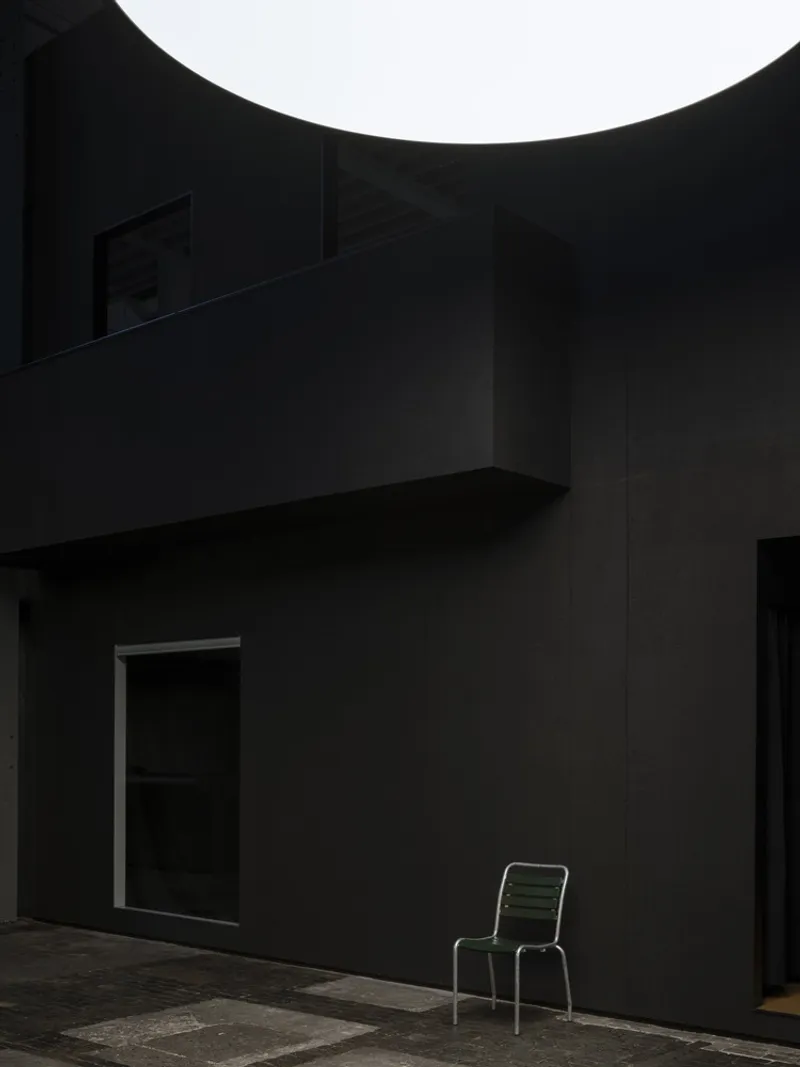
The building reveals its character best at dusk. Textured dark panels clad the exterior in a material that absorbs ambient light rather than reflecting it, turning the facade into a near-silhouette against the sky. A lone palm tree stands against this surface like a prop placed by a director who understands negative space. The corner courtyard, framed by an overhanging balcony and furnished with a single metal chair, reads less as outdoor amenity and more as a stage waiting for its actor.
This is deliberate restraint. Where most commercial buildings flood their exteriors with signage and illumination, Film Noir Studio withholds. The result is a building that gains presence through darkness, an inversion of the standard architectural impulse to celebrate transparency and openness.
Canopy as Controlled Darkness
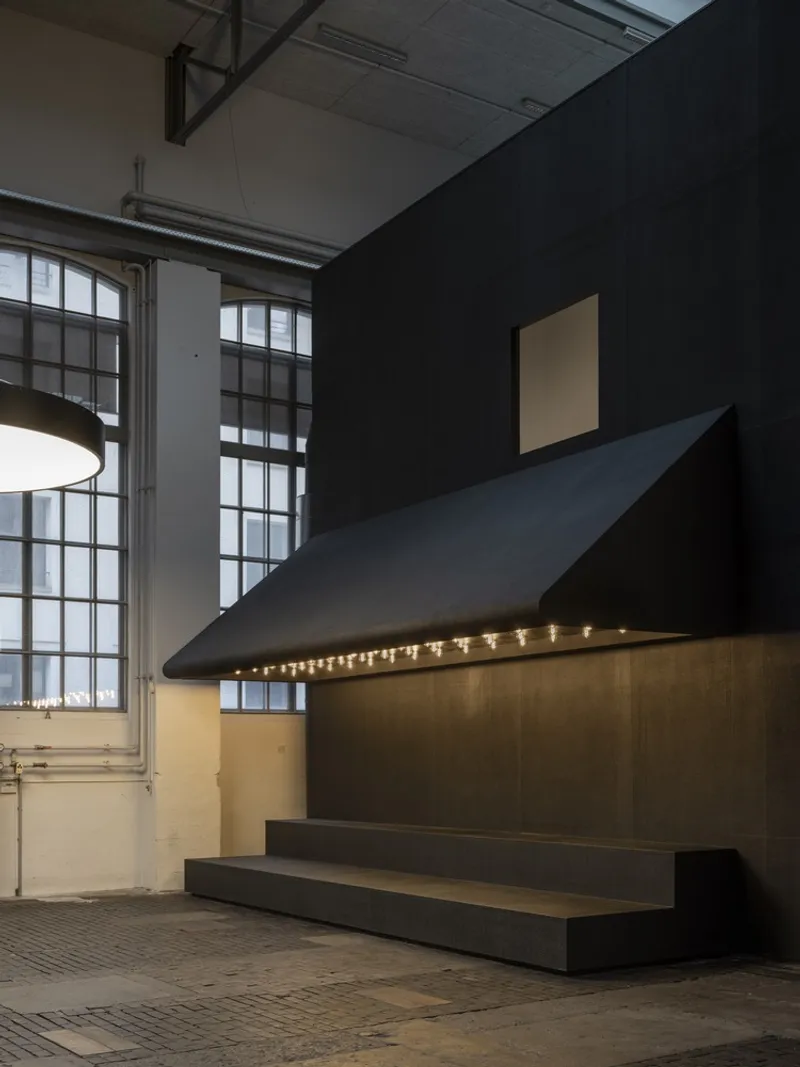
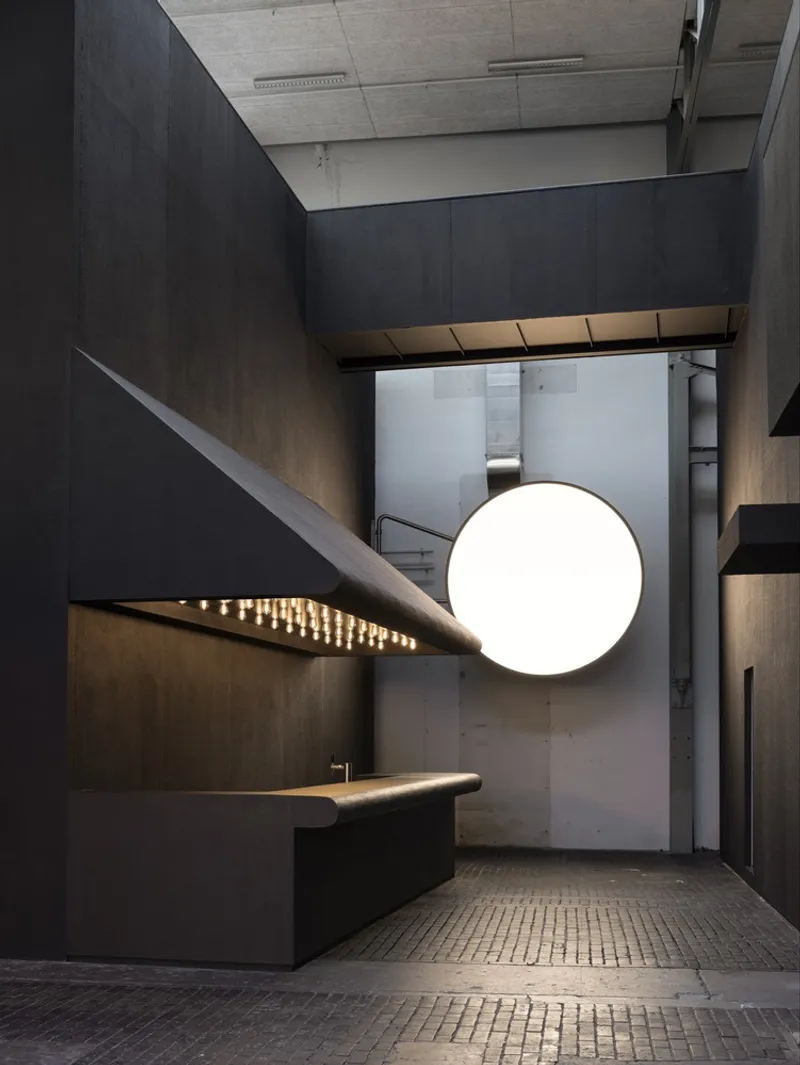
Step inside and the canopy system takes over. At the reception, a cantilevered volume hovers above the counter with integrated lighting recessed into its underside, casting a pool of warm illumination onto the surface below while leaving the ceiling in near-total shadow. Exposed ductwork above the canopy is not hidden but allowed to recede into the darkness, an honest admission that the mechanical systems exist but do not need to compete for attention.
Viewed from the gridded tile floor, the layered canopy volumes create a series of horizontal planes at varying heights, each with its own recessed light strip. The effect is closer to a theatrical lighting rig than a conventional ceiling. You are always aware of which zone you are standing in because the light tells you. Banchini treats the canopy not as a practical element that keeps rain off but as a device for manufacturing controlled darkness, something architects rarely admit they want.
The Lobby's Gravitational Center
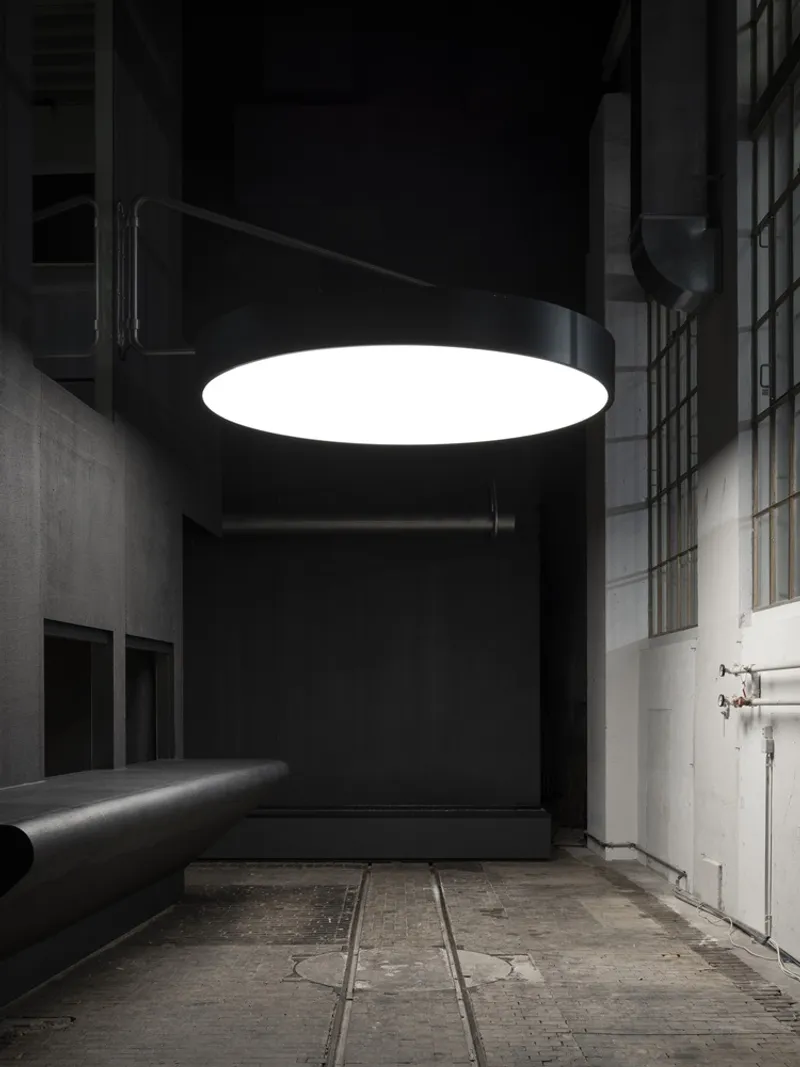
The double-height lobby anchors the interior sequence. A large circular pendant light hangs at its center, massive enough to command the volume without trying to fill it. Below, the same gridded tile floor extends from the canopy zone inward, creating visual continuity between exterior and interior thresholds. The pendant is not decorative. It is the spatial equivalent of a key light in a close-up: it tells you exactly where to look and lets everything else fall into a tonal gradient.
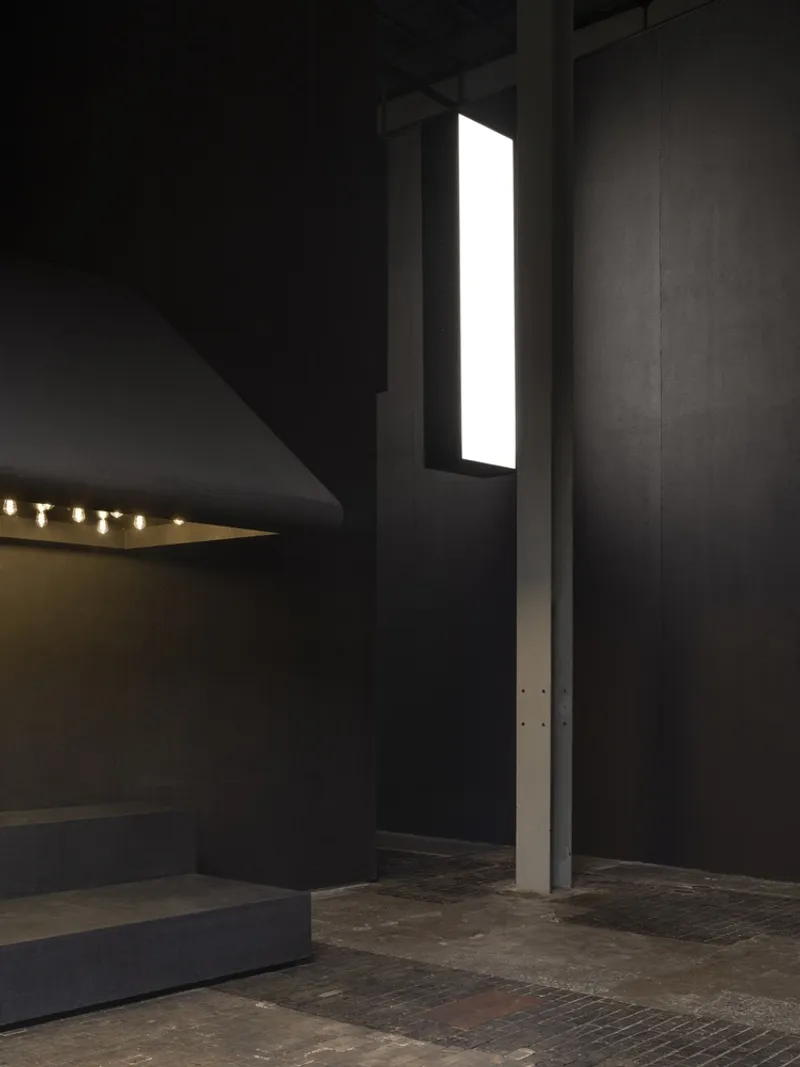
Elsewhere in the gallery space, a vertical luminous slot carved between dark wall panels operates on the opposite principle. Instead of a broad overhead source, this is a razor-thin line of light that draws the eye vertically, compressing the viewer's focus into a single bright seam. It is the architectural translation of a shaft of light through venetian blinds, and it works precisely because the surrounding panels are so dark and featureless. The contrast is everything.
Materiality Without Excess
The material palette is narrow and deliberate: dark textured panels, gridded floor tiles, raw metal, exposed services. There is no stone feature wall, no timber warmth introduced to soften the mood. Banchini trusts the composition enough to let it sit in its own register. The single metal chair in the courtyard is not an afterthought but a statement about the sufficiency of a single object in a well-proportioned space.
What holds the project together is consistency of intent. Every material decision reinforces the same atmospheric proposition. The tiles provide a reflective ground plane that bounces the recessed light sources. The dark panels absorb that same light at the walls. The metal elements, from ductwork to furniture, catch it at unpredictable angles. Nothing breaks rank.
Why This Project Matters
Architecture that claims cinematic inspiration usually means little more than a moody render and a few spotlights. Film Noir Studio is rarer: a built project where the entire spatial logic, from facade strategy to ceiling structure to material selection, serves a coherent atmospheric agenda. Leopold Banchini Architects has demonstrated that darkness is a legitimate architectural material, not the absence of design but its most potent instrument.
In a discipline increasingly dominated by performative lightness, transparency, and biophilic softness, this project is a welcome dissent. It proves that restraint, shadow, and graphic precision can produce spaces of real intensity. Not every building needs to let the sunshine in. Some are better when they keep it out.
Film Noir Studio by Leopold Banchini Architects. Photography by Dylan Perrenoud.
About the Studio
Share Your Own Work on uni.xyz
If projects like this are the kind of work you want to make, uni.xyz is a place to publish your own, find collaborators, and enter design competitions.




Popular Articles
Popular articles from the community


Riyadh For All: Intergenerational Urban Design for Active Aging in Rabat
Riyadh For All reimagines urban design in Rabat with intergenerational co-living, adaptive courtyards, and Moroccan cultural exchange today.

Hill & Cross Opera: Sculptural Opera House Architecture Shaped by Tallinn’s Landscape and Identity
Hill & Cross Opera reimagines opera house architecture in Tallinn through its sculptural hill, civic plaza, glass wave and a luminous cross.

The Musturak Paradise: Senior Living Architecture for a Connected Future in Temara, Morocco
The Musturak Paradise reimagines senior living architecture in Temara via private homes, social spaces, culture, community, and shared care.

Play: Fragments of Their World
Familiar architecture becomes modular playground design, creating safe spaces where displaced children can learn, connect, imagine and play.

Similar Reads
You might also enjoy these articles


Hodi-Mandai Geram
Project Function: Preservation and revitalization of the Intangible heritage and socio-spatial identity of the Hodi by Housing, Cultural Memory Center, Sacred Grove, landscape, local tourism economy


Olio Towers: A Mid-Rise for Performers That Fuses Housing, Rehearsal, and Stage
Located blocks from Houston's Theater District, this modular tower stacks living units around a central performance atrium.

Oasis: Modular Green Housing Carved into Dhaka's Urban Fabric
A shortlisted Plugin Housing entry reclaims unauthorized settlements in Dhaka with stepped concrete volumes, green roofs, and ventilation-driven design.

Black Hole: A Floating Megastructure for the Post-Physical Era
Emiliano Mazzarotto envisions a spherical, self-scaling arena where e-sports, digital hotels, and holographic stadiums replace traditional public space.


Explore Office Building Competitions
Discover active competitions in this discipline



Challenge to reimagine the Iron Throne


Photograph architecture without architects


Illustrate the lost glory of Angkor Wat - Render Challenge


Design challenge to reuse E-waste
Comments (0)
Please login or sign up to add comments
No comments yet. Be the first to comment!