

Fire Pit Tower 2022 by Atelier Guo: A Tensegrity Installation Rooted in Ritual and Landscape
A tensegrity fire tower installation blending ritual, wind-responsive veils, and symbolic burning, redefining temporary architecture through movement, culture, and landscape.


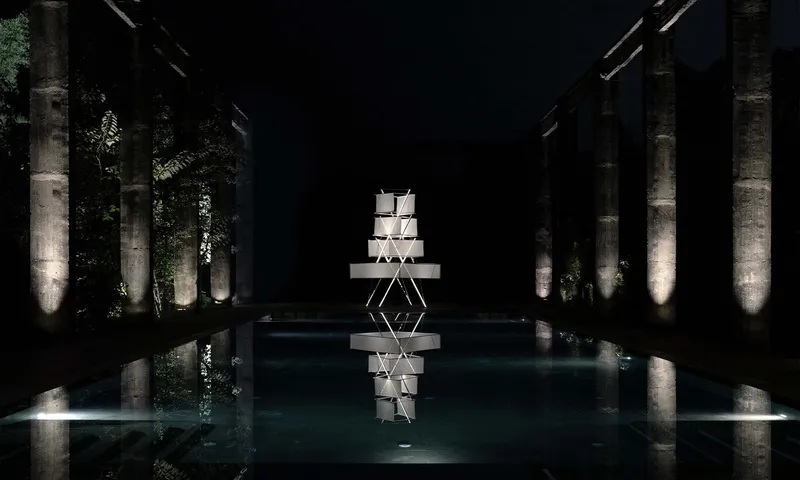
The Fire Pit Tower 2022 by Atelier Guo emerges as a poetic architectural installation set within the dramatic riverside landscape of Yangshuo, China. Designed as a temporary yet symbolic structure, this experimental tower bridges art, ritual, and structural innovation. Positioned on the historic terrace of the former Yangshuo Sugar Factory, now transformed into a cultural and hospitality destination, the project reflects both memory and transformation, turning an industrial relic into a ceremonial focal point.


Concept and Cultural Narrative
Conceived as the White Bloom Tower, the installation was created as the centerpiece for a New Year celebration, where it would ultimately be set ablaze to mark renewal and transition. This ephemeral lifecycle is central to the project’s identity. Rather than existing as a permanent object, the tower embraces impermanence, echoing traditions of ritual burning found in various cultures. After the ceremonial burning, the structure is intended to be reconstructed within a forested hillside nearby, symbolizing rebirth and continuity.
The project’s location along the Li River reinforces its iconic presence. Once a loading dock for industrial goods, the site now frames a scenic and contemplative environment, allowing the tower to act as a bridge between past and present, industry and nature, permanence and ephemerality.


Structural Innovation and Tensegrity System
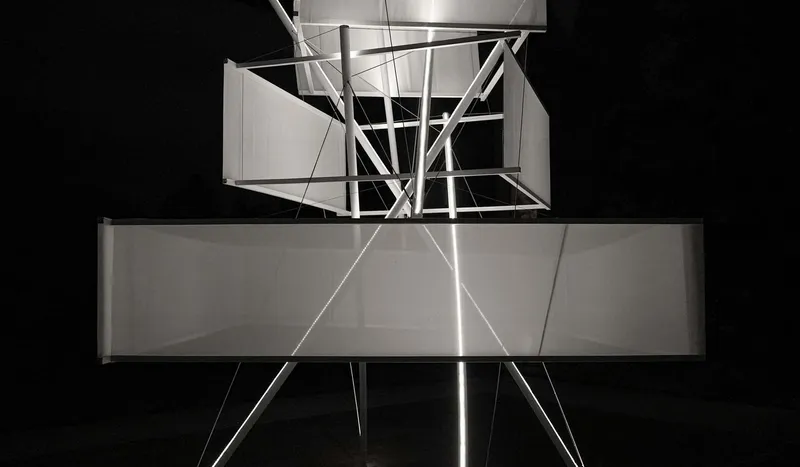
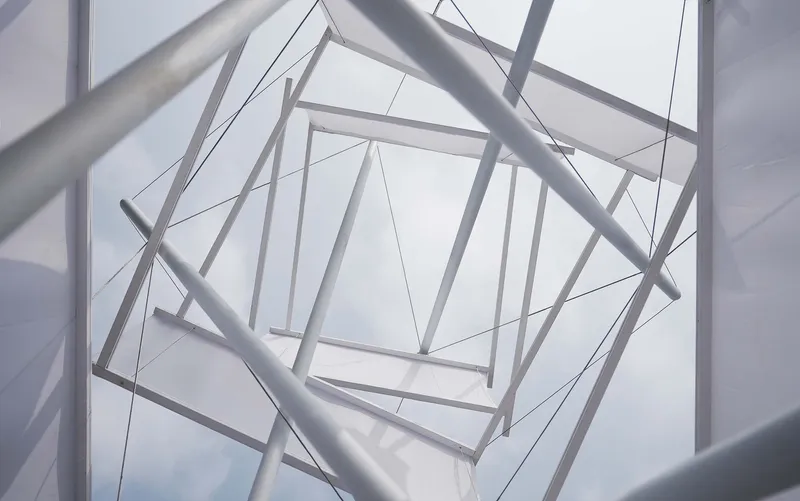
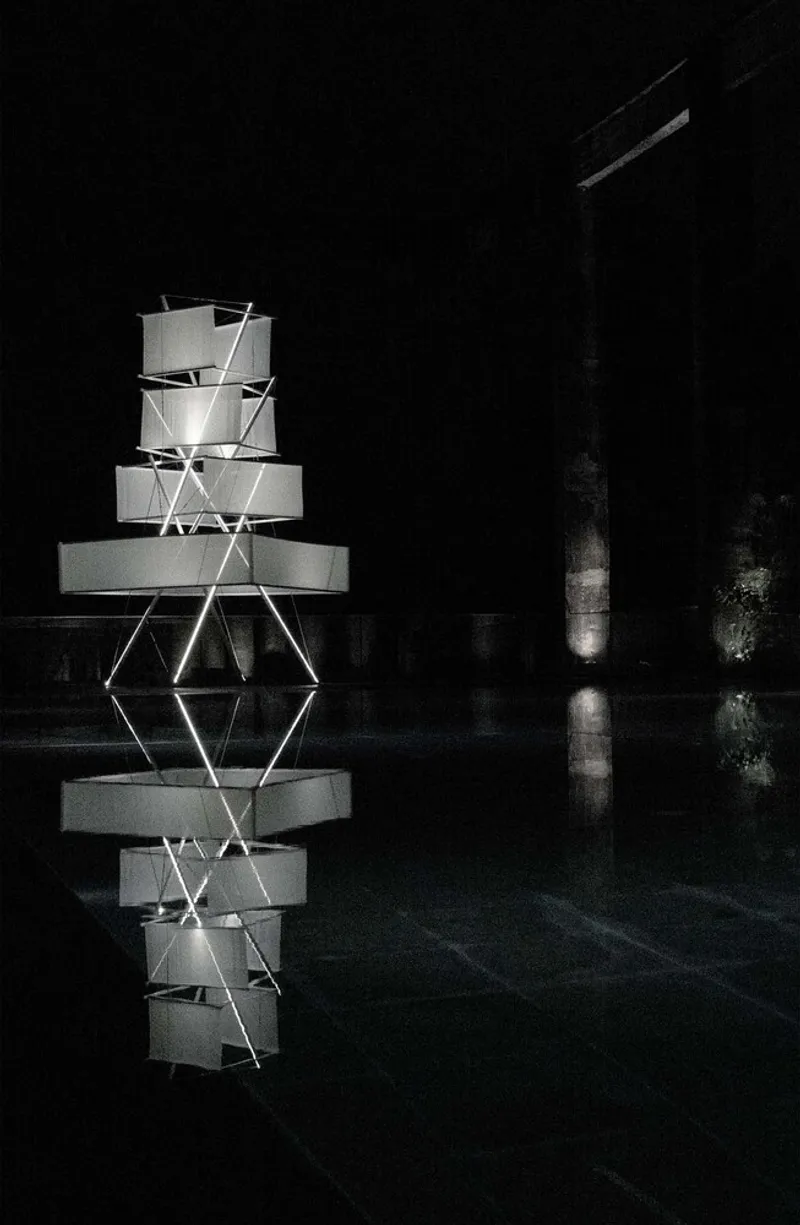
At the core of the Fire Pit Tower’s design is a tensegrity structural system, a sophisticated engineering approach where isolated components are held together through a network of tension rather than direct compression. The tower is composed of three groups of rods that are spatially separated and stabilized by tension cables. These elements rotate along both horizontal and vertical axes, creating a dynamic, non-linear geometry that challenges conventional structural layering.
This configuration eliminates traditional horizontal stratification, resulting in a lightweight yet stable framework. The interplay of tension and compression allows the tower to maintain structural integrity while appearing delicate and almost floating. This innovative use of tensegrity not only defines the tower’s aesthetic but also enhances its conceptual narrative of balance and impermanence.

Spatial Experience and Veil System
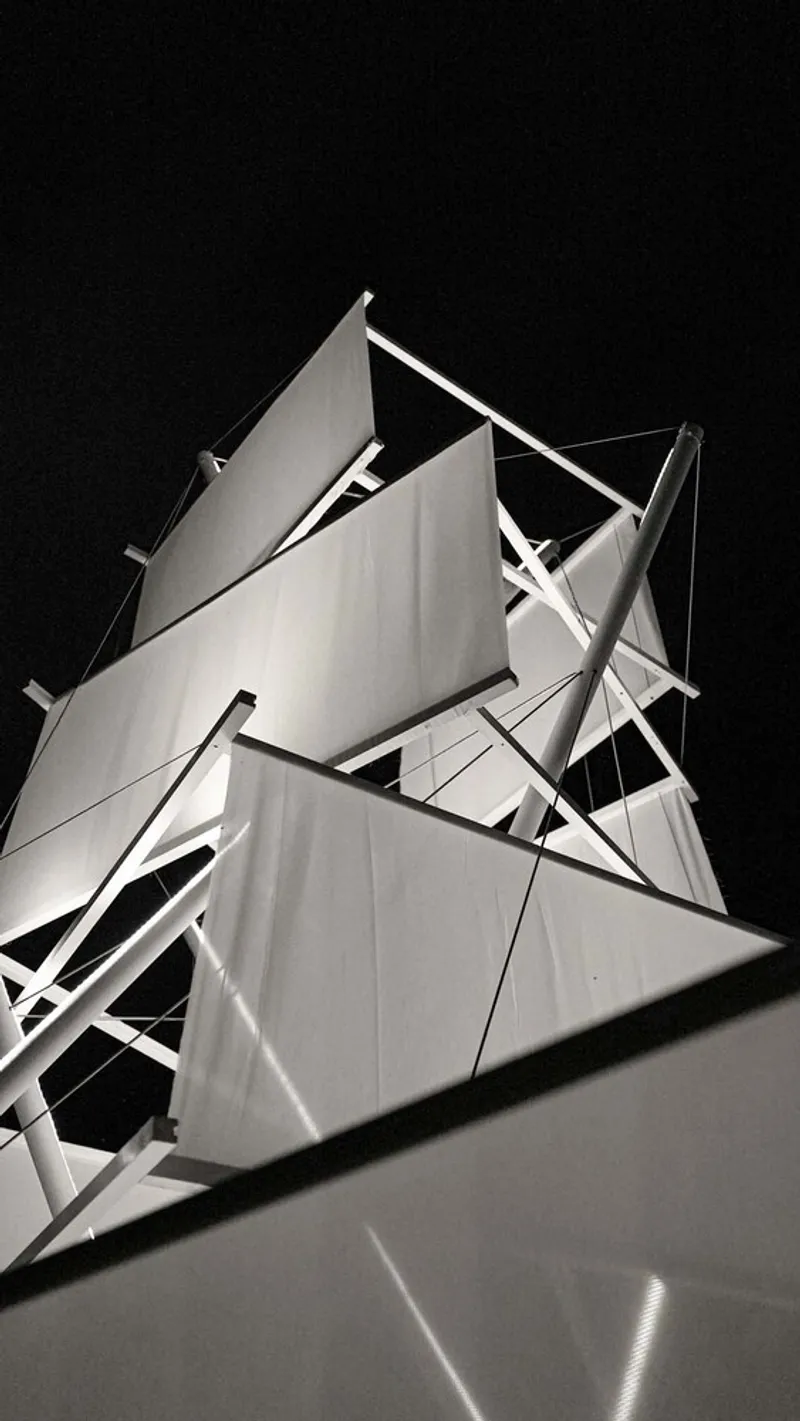
Encasing the structural skeleton are four layers of translucent veils that spiral upward, gradually diminishing in scale. These veils serve multiple purposes: spatial, visual, and experiential. At the ground level, the first veil is positioned at eye height, inviting visitors to step inside and detach from the surrounding environment. This creates an introspective spatial condition where attention is directed inward toward the structure itself.
As the veils ascend, they subtly reveal the rotational movement of the underlying rods. The layered fabric softens the structural rigidity, producing a sense of motion and fluidity. The veils act as filters of light and perception, transforming the tower into an immersive architectural experience rather than a static object.

Interaction with Nature and Environmental Forces
The Fire Pit Tower is designed to respond sensitively to its natural surroundings. The veil system behaves like sails, capturing wind and allowing the structure to sway gently. This movement introduces a kinetic quality, giving the tower a lifelike presence reminiscent of a tree. The subtle oscillation reinforces the project’s connection to nature, aligning it with the spiritual symbolism of sacred wood in local minority cultures.
By integrating environmental forces into its design, the tower transcends traditional architecture, becoming an interactive installation that evolves with changing conditions. The dialogue between wind, structure, and fabric enhances the sensory experience, making the tower both visually and physically dynamic.

Materiality and Minimal Footprint
With a compact footprint of just 10 square meters, the Fire Pit Tower demonstrates how minimal interventions can create powerful spatial and cultural impact. The use of lightweight materials: steel rods, tension cables, and fabric veils, ensures both efficiency and adaptability. This minimalism aligns with contemporary architectural trends focused on sustainability, temporary structures, and low-impact design.
The project’s small scale contrasts with its conceptual depth, proving that architecture does not require monumental size to achieve significance. Instead, it leverages precision, innovation, and narrative to create a meaningful experience.
The Fire Pit Tower 2022 by Atelier Guo stands as a compelling example of experimental architecture that merges structure, ritual, and environment. Through its tensegrity system, layered veils, and ceremonial purpose, the installation explores themes of impermanence, transformation, and cultural memory. Its ability to exist both as a physical structure and as a symbolic act of renewal makes it a unique contribution to contemporary installation architecture.
All photographs are works of
Yuhui Xue, Yue Ma, Zhiyuan Jiang



Popular Articles
Popular articles from the community


The Earth Pod: 3D Printed Homes for Resilient Refugee Communities
The Earth Pod reimagines refugee housing through 3D printed homes made from clay, combining resilience, self-sufficiency, and rapid shelter.

Hill & Cross Opera: Sculptural Opera House Architecture Shaped by Tallinn’s Landscape and Identity
Hill & Cross Opera reimagines opera house architecture in Tallinn through its sculptural hill, civic plaza, glass wave and a luminous cross.

Co-Life: Senior Housing Design That Reconnects Older Adults With the City
Co-Life reimagines senior housing design through healing gardens, shared streets, workshops, and a sustainable community across generations.

Riyadh For All: Intergenerational Urban Design for Active Aging in Rabat
Riyadh For All reimagines urban design in Rabat with intergenerational co-living, adaptive courtyards, and Moroccan cultural exchange today.


Similar Reads
You might also enjoy these articles

Bamboo Housing Challenge 2026: Design Affordable, Sustainable Homes Using Bamboo
An international design competition by Bamboo U and IBUKU inviting architects and designers to reimagine affordable housing using bamboo — with the winning design built full-scale in Bali.

Computational Design & Education: Beegraphy Design Awards Introduces 7th Category (Featuring Jiyun's Innovative Approach)
Dive into Beegraphy’s 7th Design Awards category, where computational design meets education to create immersive, interactive learning tools, inspired by Jiyun’s work.
From Parametric Lighting to Urban Furniture: Join the 2nd Workshop in Beegraphy’s Computational Design Series
Dive into Cutting-Edge Design Techniques and Practical Applications with Industry Experts

Last Call: Unleash Your Architectural Genius in SHAK's Kindergarten Design Competition
Urgent call for architects to join SHAK's kindergarten design competition before the looming deadline

Explore Architecture Competitions
Discover active competitions in this discipline


Challenge to design a portable theatre

Challenge to design a portable music platform

Challenge to design an open learning module for the elderly


Challenge to reimagine the Iron Throne
Comments (0)
Please login or sign up to add comments
No comments yet. Be the first to comment!