

Fjord Eco-Revival: Sustainable Architecture for Marine Ecosystems
Exploring sustainable architecture for fjord ecosystems through innovative mobile labs, research centers, and educational collaboration.


Fjords, recognized for their breathtaking landscapes, hold more than just aesthetic value. These deep, glacially-carved inlets are crucial for biodiversity, carbon storage, and climate regulation. Despite their importance, fjords are often overlooked in global warming discussions. Oscar Romero's Fjord Eco-Revival project, a shortlisted entry of the At Sea competition, seeks to address this gap. This innovative project combines sustainable architecture with advanced marine research to "Analyze, Mitigate, and Educate," aiming for the ecological revival of fjords.

The Importance of Fjords
Fjords are unique ecosystems that provide vital habitats for diverse marine species, including cold-water corals and various fish species. They play a significant role in carbon storage, acting as sinks for atmospheric carbon, and influence local weather patterns. Additionally, fjords support sustainable fisheries, ensuring the well-being of both marine life and the communities that depend on them. The Fjord Eco-Revival project underscores the need to preserve these ecosystems amidst the growing impacts of climate change and human activities.
Innovative Mobile Lab and Deployable Units
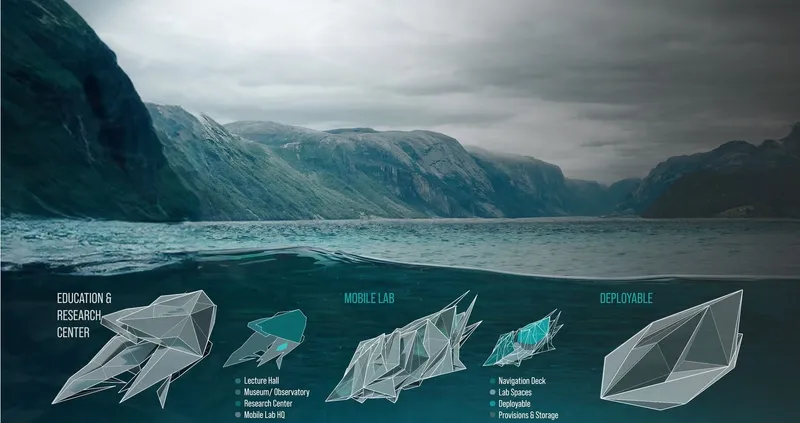
Central to the Fjord Eco-Revival project is the creation of a mobile lab that works in tandem with a research and education center. This mobile lab, equipped with cutting-edge technology, is designed to settle in unrecovered regions of the fjord. It collects specimen and sediment samples, providing crucial data for ecological restoration. The mobile lab also utilizes a unique mechanism that repairs and promotes marine habitats. When approaching a surface, the lab deploys cannon-like limbs that excrete a specialized liquid cement-like fluid. This fluid not only firmly attaches the vehicle to the substrate but also serves as a nutrient-rich medium for marine plants and coral.
Deployable Units and Sensor Networks
The project features deployable units resembling sleek aquatic drones. These units separate from the mobile lab and navigate semi-autonomously through the fjord. Equipped with advanced sensors, they measure and transmit real-time data on salinity, oxygen levels, and temperature. This dynamic network of oceanic monitoring devices allows scientists to gather detailed information on the fjord marine environment, offering insights into climate patterns, marine life behavior, and potential environmental changes. The adaptability of these deployable units ensures comprehensive coverage of the Trondheimsfjord ecosystem.

Hybrid Education and Research Center
The project's centerpiece is the hybrid education and research center located on Munkholmen Island in Norway. This facility balances Trondelag’s historic culture with a focus on sustainability for present and future generations. The center comprises a museum and marine observatory on the east side and a headquarters for the deployable hubs on the west. A lecture hall and learning center sit atop the museum, fostering a collaborative environment for education and research.
Restoration and Sustainable Design
The restoration of Munkholmen Island involves sediment infill and the aggregation of rocky barriers to increase buildable surface area and redirect the fjord’s water flow. This process enhances the island’s sustainability and creates a stable foundation for the research center. The sustainable design of the facility promotes a harmonious integration with the natural environment, contributing to the preservation and restoration of marine ecosystems.

Educational Collaboration and Innovation
Proximity to established academic and research centers allows for shared resources, expertise, and collaborative projects. This fosters a dynamic exchange of ideas, methodologies, and technologies, promoting a comprehensive and interdisciplinary approach to marine research. Educational collaboration facilitates joint programs, workshops, and training initiatives, providing students and researchers with diverse perspectives and skill sets. This collaborative framework enriches the research conducted on Munkholmen Island and contributes to the broader scientific community, promoting a culture of knowledge-sharing and innovation.
Oscar Romero's Fjord Eco-Revival project exemplifies the potential of sustainable architecture to address pressing environmental issues. By combining advanced technology with innovative design, the project aims to restore and preserve the unique ecosystems of fjords. The integration of a mobile lab, deployable units, and a hybrid education and research center highlights the importance of interdisciplinary collaboration and education in tackling the challenges posed by climate change. The Fjord Eco-Revival project is a beacon of hope for the future of fjords and the global effort to mitigate environmental degradation.


Popular Articles
Popular articles from the community


LT2A and OPEN Architectes Thread a Brick and Glass High School Through a Wooded Belgian Campus
In Braine-l'Alleud, a 3,000 m² wing for Collège Cardinal Mercier pairs pale brick with a glazed colonnade, deferring to a small chapel and a dense wood.

Architekt Andreas Gruber Scatters 23 Dark Timber Chalets Across a South Tyrolean Forest Edge
In Molini di Tures, Amonti Chalets breaks a resort into a hamlet of gabled timber houses, with parking, storage and services pushed into the slope.

Cube Design Draws an Ecological Corridor Between Two Shenzhen Hills with the Nankai Building
Beside Shenzhen's container docks, the Nankai Building pairs stacked balconies with a climbing green screen to connect two hillsides across its height.

Jaramillo Van Sluys Arquitectura and Urbanismo Turn a Demolished Registry Lot in Quito into an Orchard Plaza
In Quito's Centro Histórico, a 2,800 m² plaza exposes the San Agustín convent wall and redraws its lost Augustinian orchard in volcanic stone.

Similar Reads
You might also enjoy these articles


Vereda Arquitetos Renovates a 40-Square-Meter Apartment Inside Niemeyer's Copan Building
A compact unit in São Paulo's most iconic residential tower gets a material overhaul that pairs exposed concrete with bold blue Formica.

Shakur's House: Exposed Brick as an Interior Organiser in a 168 m² Mashhad Residence
Brick moves indoors in this Mashhad residence, where masonry walls, glass partitions and teal planes sequence a compact home without closing it off.

Day and Night Park: A Time-Based Urban Newsstand in Beijing
A temporary urban newsstand in Beijing blending travel, light, and reading through poetic colors, compact form, and community-focused design.

Modernist Patio Renovation in El Masnou, Barcelona by Oliver Segura Arquitectura + Cebrià Arquitectura
Modernist patio renovation blending tradition and innovation with a movable pool, leveled floors, and Catalan materials in El Masnou.

Explore Ocean Architecture Competitions
Discover active competitions in this discipline

Design a brochure to showcase the effects of the technosphere

Challenge to illustrate ‘A tale of Two Cities’

Deconstructivism - Illustration Design Challenge

Challenge to reimagine the Iron Throne
Comments (0)
Please login or sign up to add comments
No comments yet. Be the first to comment!