

Fluid Spaces: Magnetic Architecture That Moves
A tower whose floors, walls, and openings reconfigure in real time through magnetic field control, derived from ferrofluid physics experiments.


What if a building could change shape while you were inside it? Not renovate, not adapt over years, but physically reconfigure its floors, walls, and openings in real time, responding to who is there, what they need, and what time of day it is. Fluid Spaces, a project by Hoda Ghoreyshi, Vahid Khabazan, Soroush Attarzade, and Surush Ameli, proposes exactly this: architecture driven by magnetic fields that reshape space continuously.
Shortlisted in the Hybrid Futures '19: Work x Fly competition on uni.xyz, this is the most scientifically grounded speculative entry in the series. The design logic comes not from architectural precedent but from physics: ferrofluid, magnetic field control, and fluid mechanics.
The Science: Ferrofluid as a Design Tool
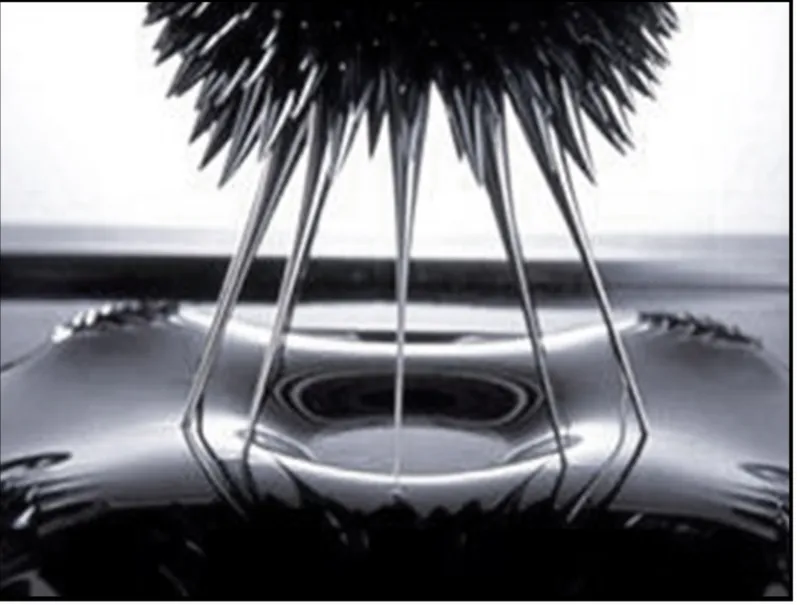
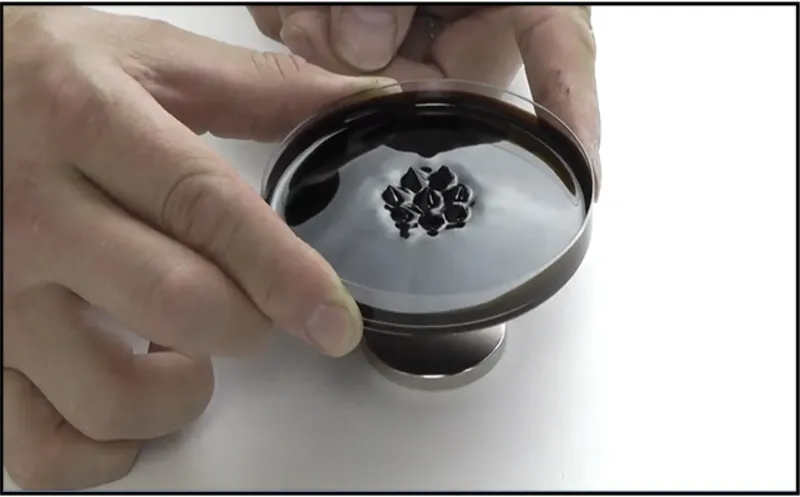

The project begins with ferrofluid: a liquid that contains suspended magnetic nanoparticles. When exposed to a magnetic field, ferrofluid does not just move. It forms structure. Spines, clusters, surfaces, and voids appear and disappear as the field changes. The material is simultaneously liquid and architectural.
The physical experiments shown in the project boards are not illustrations. They are the design method. A dish of ferrofluid forms a cluster under a magnet. A test tube of fluid shapes itself around an external field. These experiments generate the spatial logic that the building scales up. The architecture is derived from material behaviour, not from a drawing.
The Building: Organic Structure in Manhattan


The tower is sited in the Manhattan skyline, rising among Midtown's existing skyscrapers. Its form is a skeletal structural frame filled with organic, porous spatial infill that changes over time. Green terraces punctuate the structure. Drones circle. The building reads as something between a tower and a living organism: its surfaces are perforated, irregular, and visibly different from any conventional facade.
The porous quality is not decorative. It is the direct translation of the ferrofluid logic to architectural scale. Where the magnetic field concentrates, material gathers. Where it weakens, voids open. The building breathes, expands, and contracts based on the invisible forces running through its structure.
Reconfigurable Plans: A Building That Never Repeats
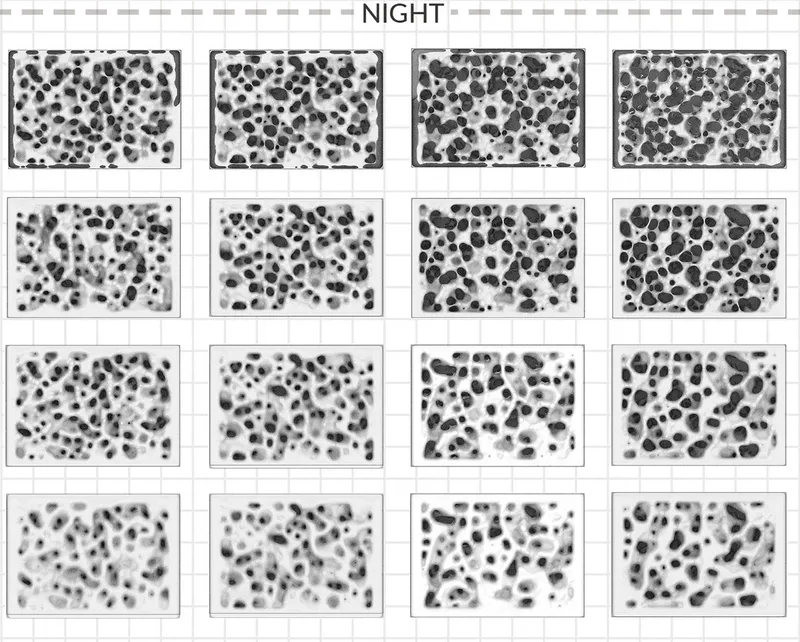
The floor plan grid is one of the project's most revealing images. It shows the same floor at different times during a night cycle. The cellular layout shifts between each frame: openings appear, walls dissolve, rooms merge and split. No two moments produce the same plan. The building is never the same building twice.
This is a radical proposition. Every building in history has had a fixed plan. Fluid Spaces proposes a plan that is a variable. The implications for how we think about programme, ownership, privacy, and spatial identity are enormous. If the walls move, who owns the room?
The Topology: Bone, Foam, and Void
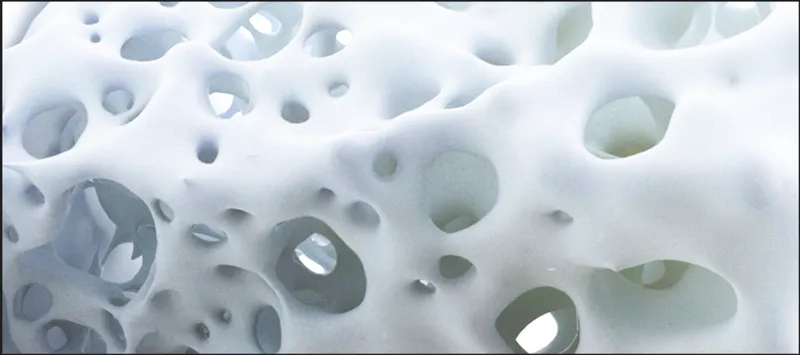
The white organic 3D model shows the spatial topology the project imagines: a bone-like porous volume where solid and void are continuous. There are no walls in the conventional sense. There are thickenings and thinnings of a single material surface. Space is not divided. It is carved.
This topology comes from the same optimisation logic as biological bone. Material concentrates where loads and functions demand it. It dissolves where they do not. The result is a structure that is simultaneously minimal (using the least material) and maximal (providing the most spatial variety).
Why This Project Matters
Most speculative architecture proposes new forms. Fluid Spaces proposes a new relationship between form and time. The building is not a shape. It is a process. This is a genuinely original contribution to architectural thinking, and it comes from outside the discipline's usual references: from physics labs, not from design studios.
For anyone interested in responsive architecture, smart materials, or the intersection of science and spatial design, Fluid Spaces is one of the most intellectually ambitious competition entries on the uni.xyz platform. It does not try to be beautiful. It tries to be true to its material, and the beauty follows from that.
View the Full Project
About the Designers
Designers: Hoda Ghoreyshi, Vahid Khabazan, Soroush Attarzade, Surush Ameli
Enter a Design Competition on uni.xyz
If responsive architecture, smart materials, or science-driven spatial design is the kind of work you want to pursue, uni.xyz runs competitions year-round that reward interdisciplinary thinking.
Project credits: Fluid Spaces by Hoda Ghoreyshi, Vahid Khabazan, Soroush Attarzade, Surush Ameli. Shortlisted, Hybrid Futures '19: Work x Fly (uni.xyz).


Popular Articles
Popular articles from the community


The Musturak Paradise: Senior Living Architecture for a Connected Future in Temara, Morocco
The Musturak Paradise reimagines senior living architecture in Temara via private homes, social spaces, culture, community, and shared care.

The Ocean Hive: Sustainable Architecture for a Self-Sufficient Civilization at Sea
The Ocean Hive imagines sustainable architecture at sea, where modular habitats, algae, wave power and ocean waste sustain a growing colony.

Lunar Spiral: Space Architecture Shaped by the Mathematics of the Universe
Lunar Spiral reimagines space architecture through Fibonacci geometry, lunar regolith, levitating habitats, and self-sustaining Moon living.

Co-Life: Senior Housing Design That Reconnects Older Adults With the City
Co-Life reimagines senior housing design through healing gardens, shared streets, workshops, and a sustainable community across generations.

Similar Reads
You might also enjoy these articles

Day and Night Park: A Time-Based Urban Newsstand in Beijing
A temporary urban newsstand in Beijing blending travel, light, and reading through poetic colors, compact form, and community-focused design.

Modernist Patio Renovation in El Masnou, Barcelona by Oliver Segura Arquitectura + Cebrià Arquitectura
Modernist patio renovation blending tradition and innovation with a movable pool, leveled floors, and Catalan materials in El Masnou.

Alto Residencial Coop: Cooperative Housing Development in Santiago de Compostela by Carbajo Barrios Arquitectos
A linear cooperative housing complex blending white volumes and perforated metal façades, enhancing community living, natural light, privacy, and urban integration.
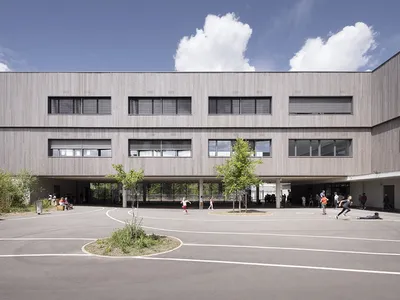
Vil Genis School by BPA ARCHITECTURE – Massy, France
Vil Genis School in Massy, France, features sustainable design, south-facing classrooms, community integration, accessible spaces, and modern educational architecture.

Comments (0)
Please login or sign up to add comments
No comments yet. Be the first to comment!