
VON M Architects Wrap a Tübingen Office Building in Weathered Timber and Raw Concrete
The GWG Tübingen headquarters pairs a disciplined timber facade with a skylit concrete atrium in southern Germany.


There is a particular kind of building that announces its convictions from the street but only reveals its full character once you step inside. The GWG Tübingen office by VON M architects is exactly that kind. From the sidewalk you register a taut grid of weathered timber and vertical glazing, almost austere in its repetition. Walk through the concrete entry portal, though, and you find yourself in a multi-story atrium lined with board-formed concrete and timber balconies, crowned by a generous skylight that turns the building's core into a vertical garden of filtered daylight.
What makes this project worth studying is the way it refuses to choose between warmth and rigor. The material palette is narrow: timber cladding, board-formed concrete, terrazzo, perforated metal. Yet every junction between those materials has been calibrated to do real work, acoustically, spatially, and atmospherically. Nothing is decorative. Nothing is accidental. The result is an office headquarters that feels both civic and intimate, a public face for Tübingen's municipal housing company that also functions as a genuinely pleasant place to spend a working day.
A Facade Built on Repetition and Restraint
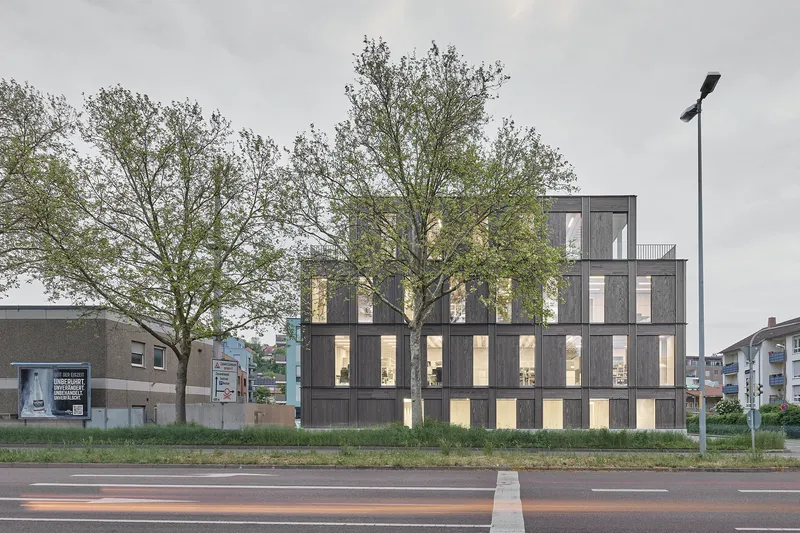
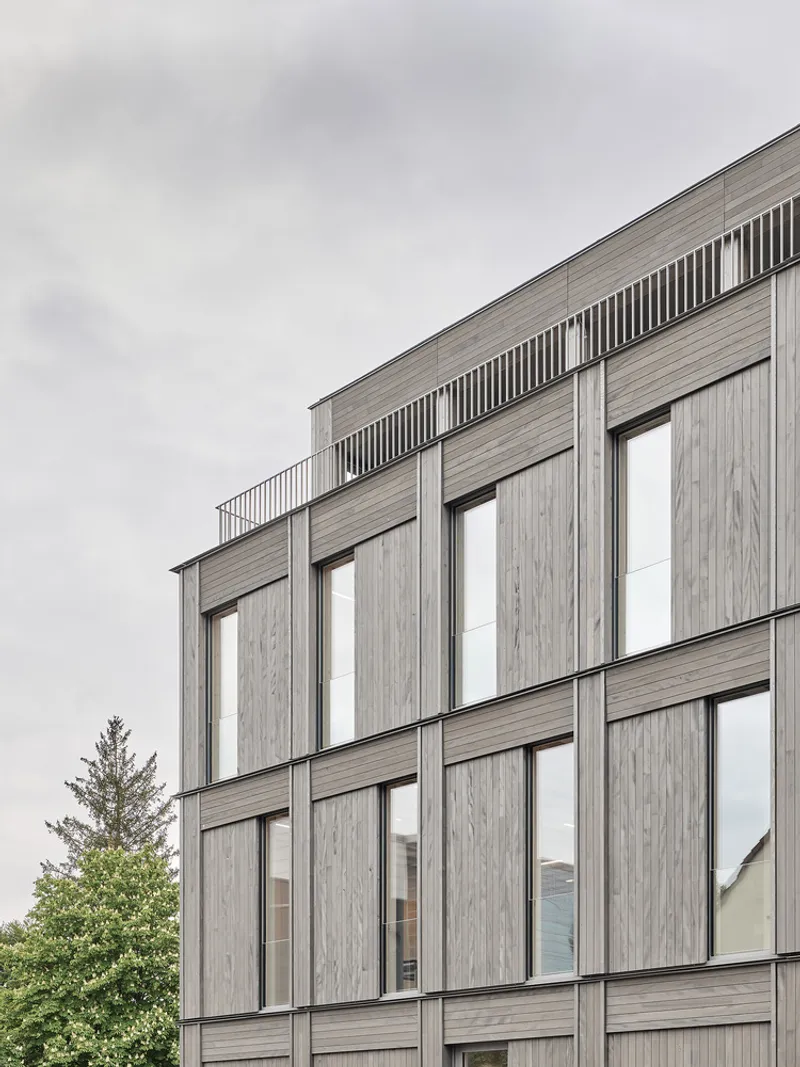
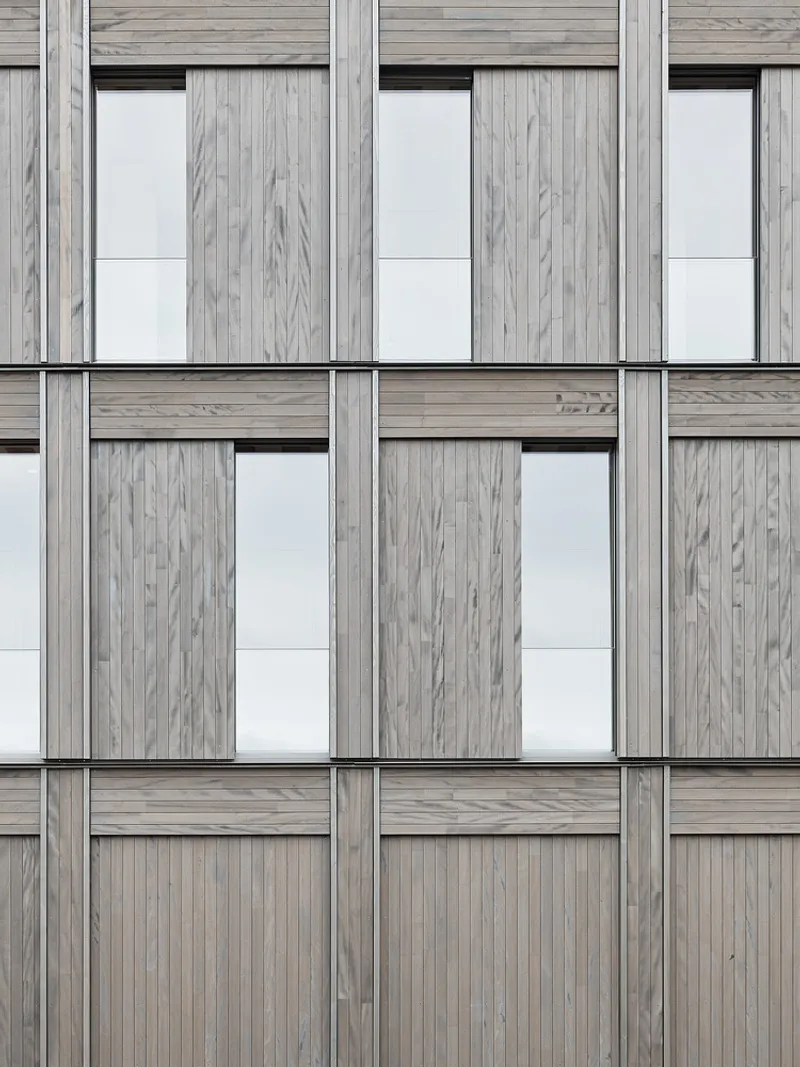
The street elevation operates as a single, unbroken composition of vertical timber panels and tall, narrow windows. The cladding will silver and shift over time, a deliberate choice that ties the building to the seasonal rhythms of its tree-lined street. Seen at dusk through bare branches, the facade has the quality of a lantern: the deep window reveals glow softly while the timber field recedes into shadow.
Look more closely and the grid reveals its logic. Alternating solid and glazed bays create a rhythm that is strict but never monotonous, partly because the timber's natural grain introduces micro-variations that a rendered or metal-clad facade could never achieve. The slim window frames sit flush with the cladding plane, producing clean shadow lines rather than heavy mullion profiles. It is a system, not a pattern, and that distinction matters.
Concrete Thresholds and the Art of Arrival
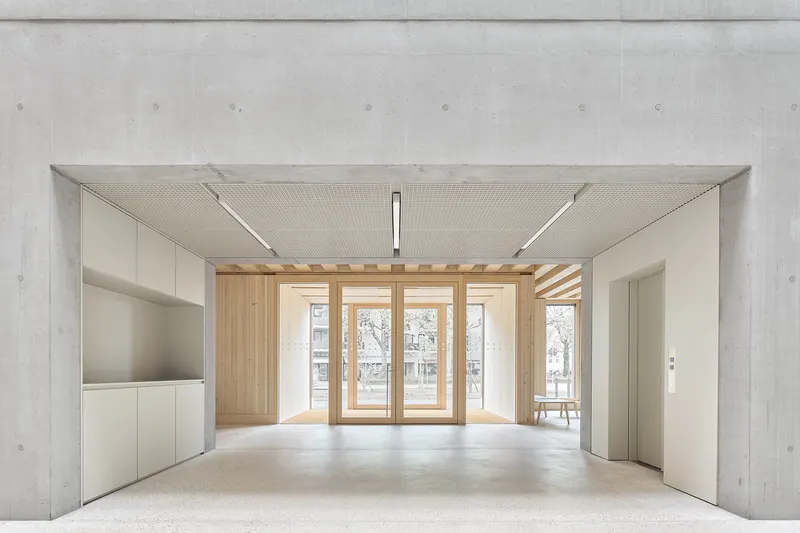
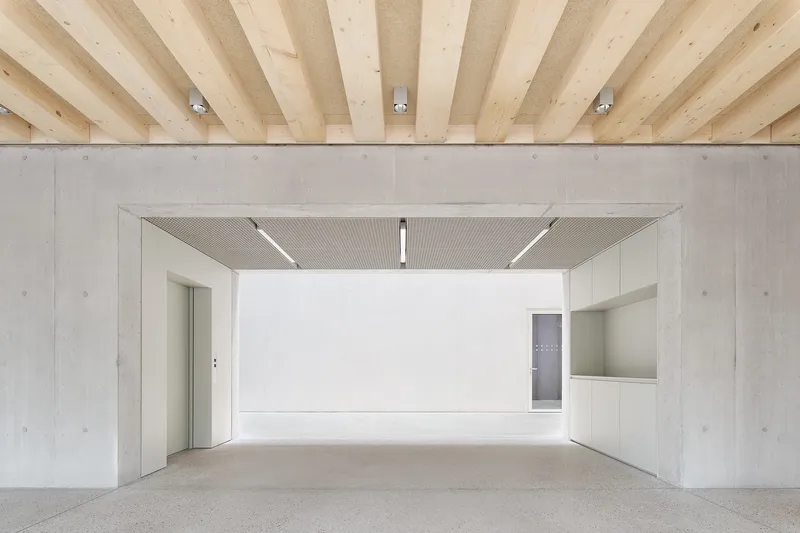
Entry is handled through a deep concrete portal that frames a view straight through to a courtyard beyond. The lobby walls are left as raw, board-formed concrete, their texture a deliberate echo of the timber outside. Timber-framed glass doors provide a visual bridge between the two materials, so the transition from street to interior reads as a gradual shift in scale rather than an abrupt change of scenery.
Secondary thresholds throughout the building deploy the same strategy. Concrete portals frame passages into white-walled rooms where perforated ceiling soffits and recessed lighting take over. The effect is cinematic: each doorway compresses the view before releasing it into a different spatial register. VON M understand that an office building's corridors are not leftover space but connective tissue that shapes the daily experience of every occupant.
The Atrium as Civic Room
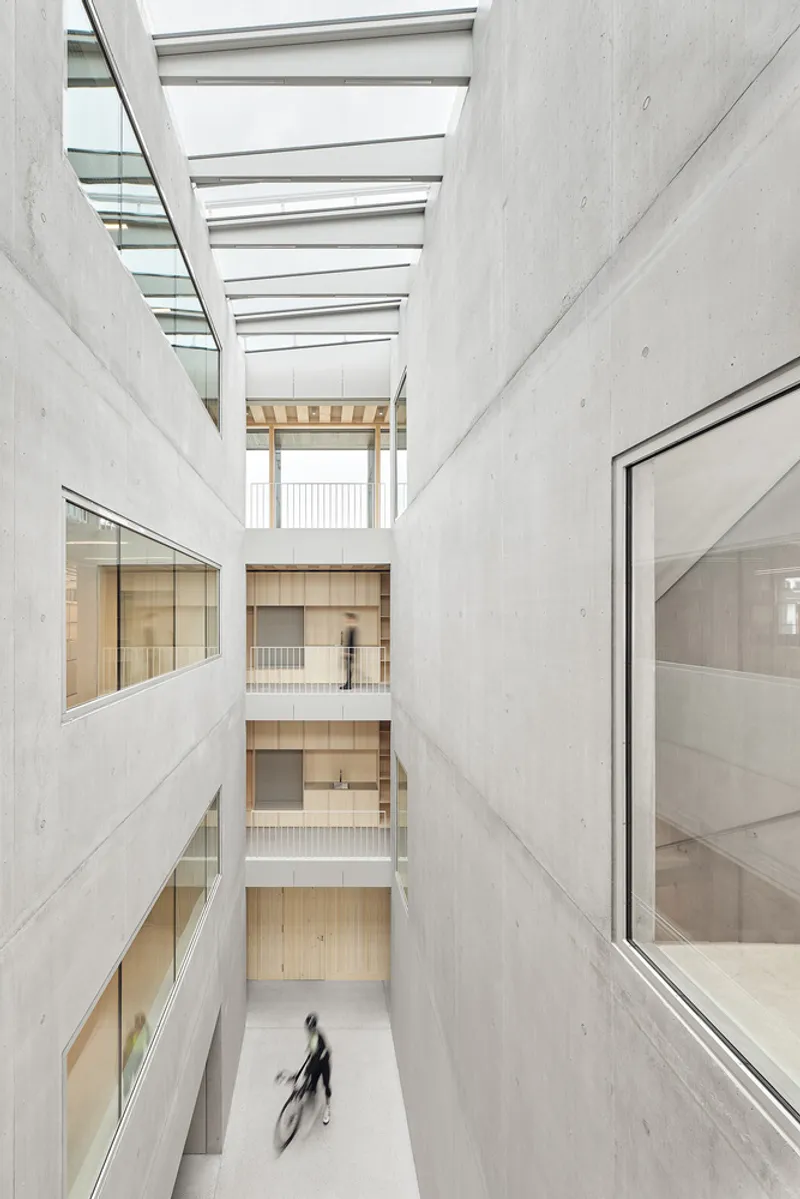
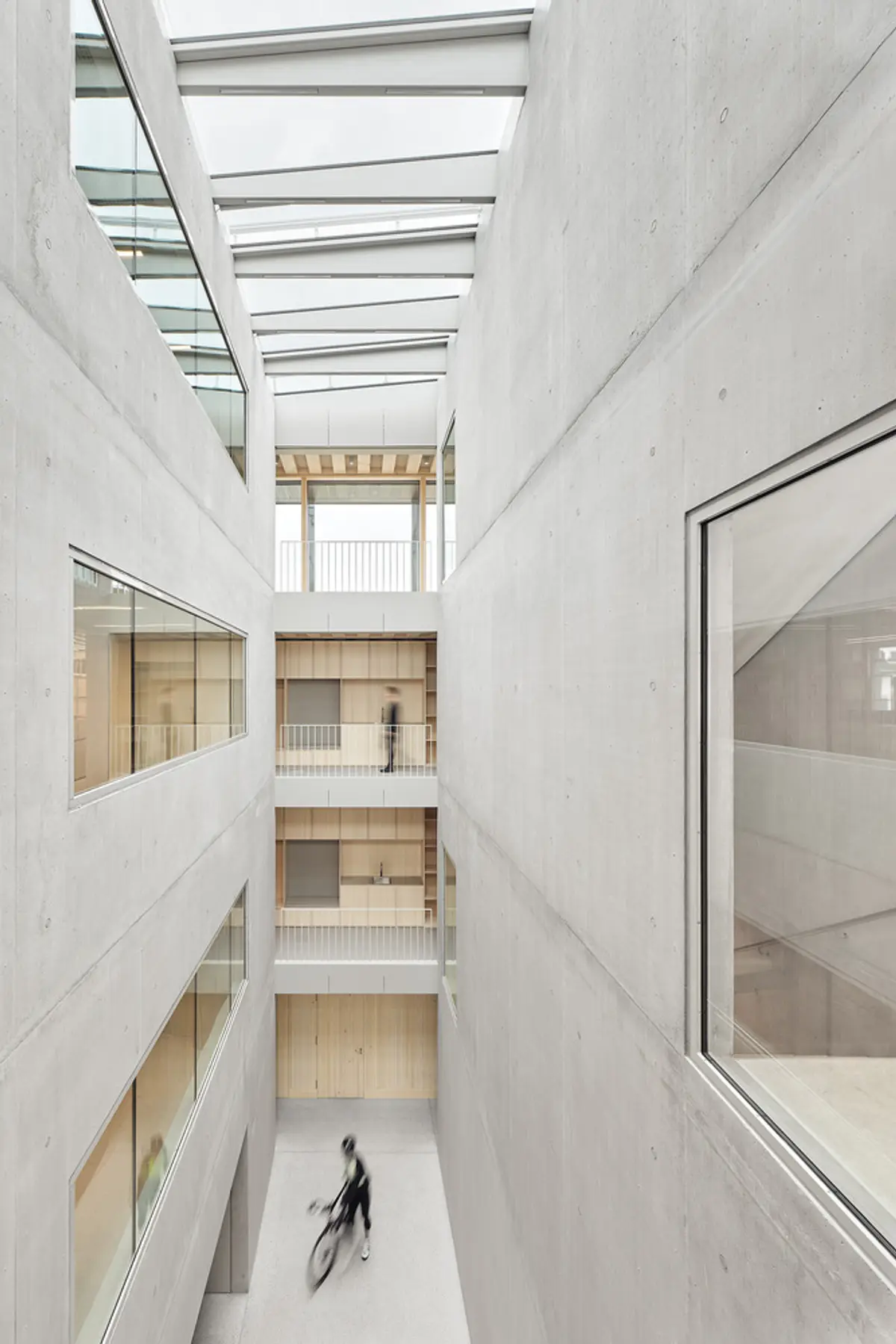
The heart of the building is a multi-story atrium that functions as a shared interior street. Board-formed concrete walls rise through the full height, their rough grain catching light from a large glazed skylight above. Timber-clad balconies project into the void at each level, giving the section a layered quality that prevents the atrium from feeling like a simple shaft.
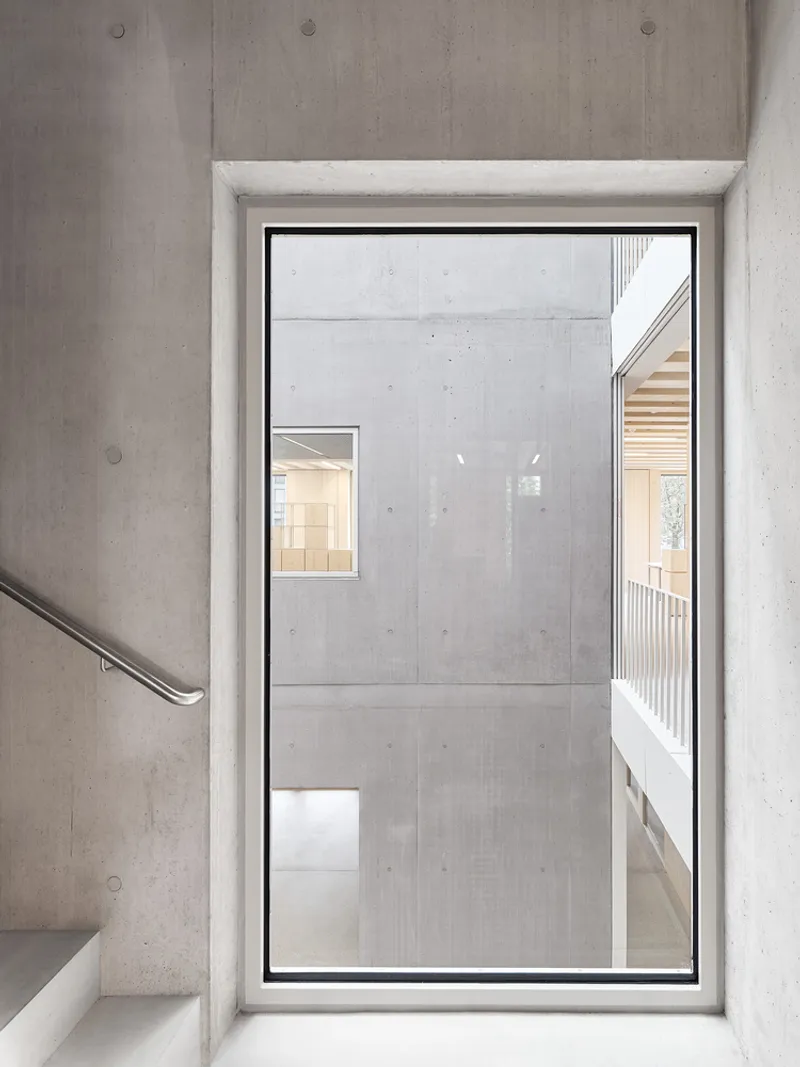
From the concrete stairwell, floor-to-ceiling windows offer diagonal views across the atrium and onto the opposite balconies. These sightlines are not incidental; they create moments of visual connection between floors that a conventional corridor layout would eliminate. For a housing company whose mission is building community, an office organized around shared visibility is a quietly persuasive statement of values.
Timber Structure as Interior Identity
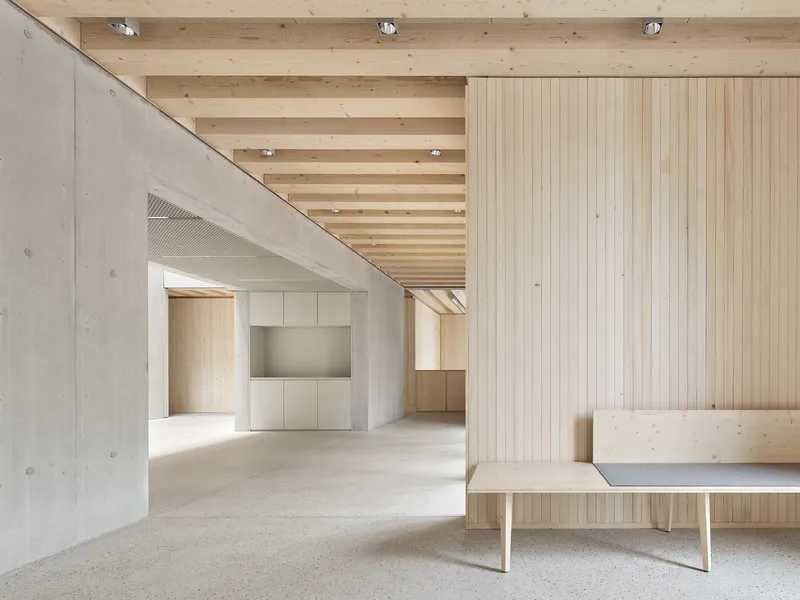
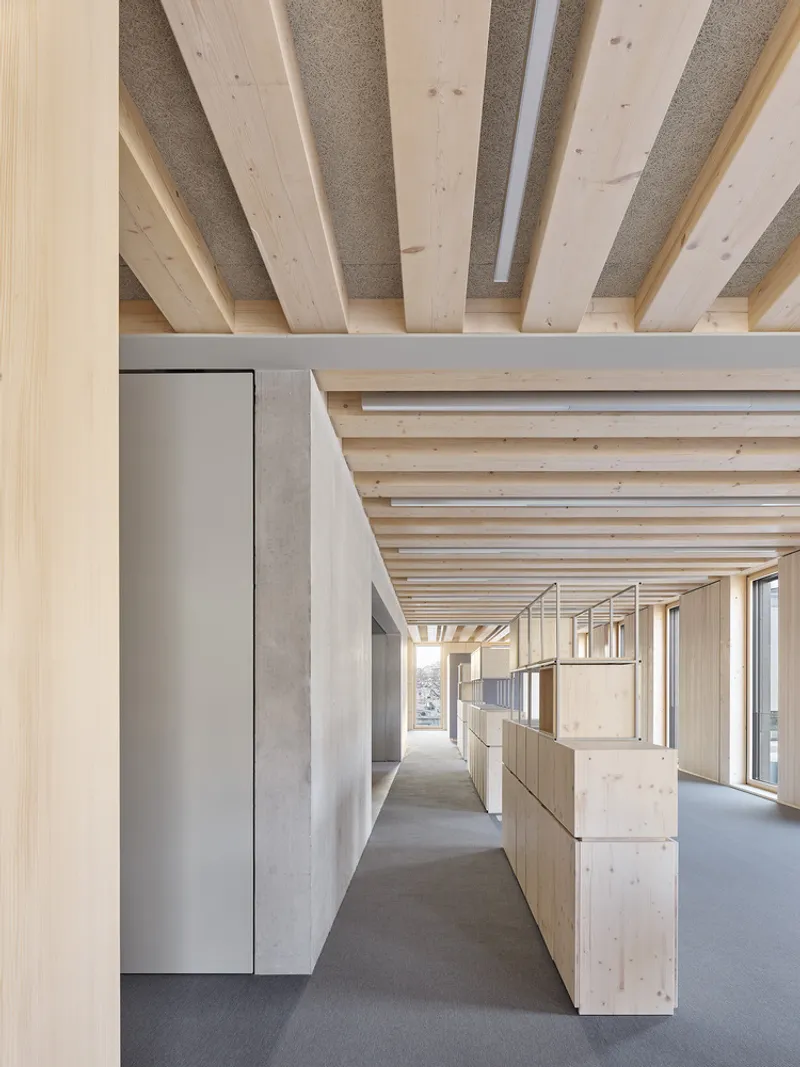
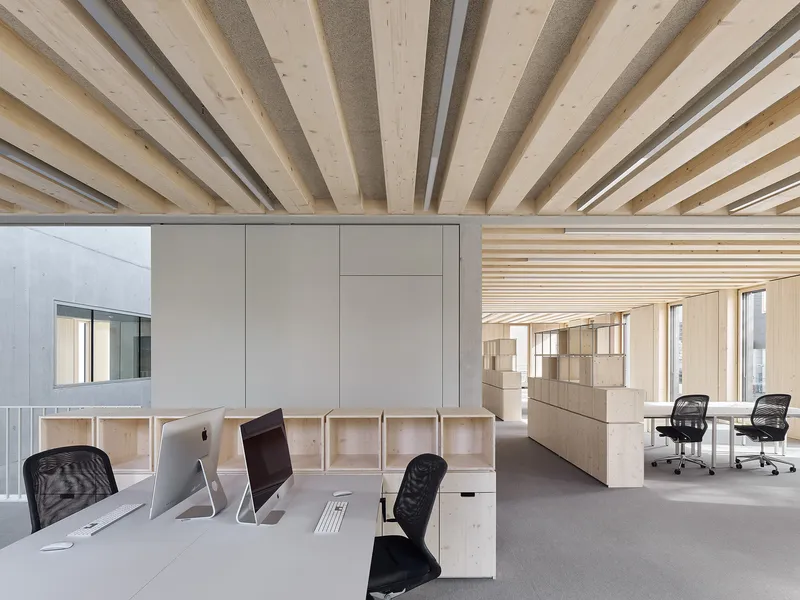
Inside the office floors, exposed timber joists run in parallel bands above terrazzo and polished flooring. The structure is left visible not for novelty but because it establishes the ceiling as an active surface: acoustic panels slot between the beams, absorbing sound without concealing the construction logic. The honesty is refreshing. You see exactly how the building holds itself up and how it manages noise, all in one glance.
Workspace partitions in plywood pick up the timber tone from above, creating a warm, low-key palette that avoids the sterile neutrality of many open-plan offices. Where a concrete angled partition appears, it reads as a deliberate counterpoint, a wayfinding cue that signals a change of zone. The interplay between timber warmth and concrete coolness gives each floor a clear spatial narrative without relying on color coding or signage.
Corridors and Circulation as Experience
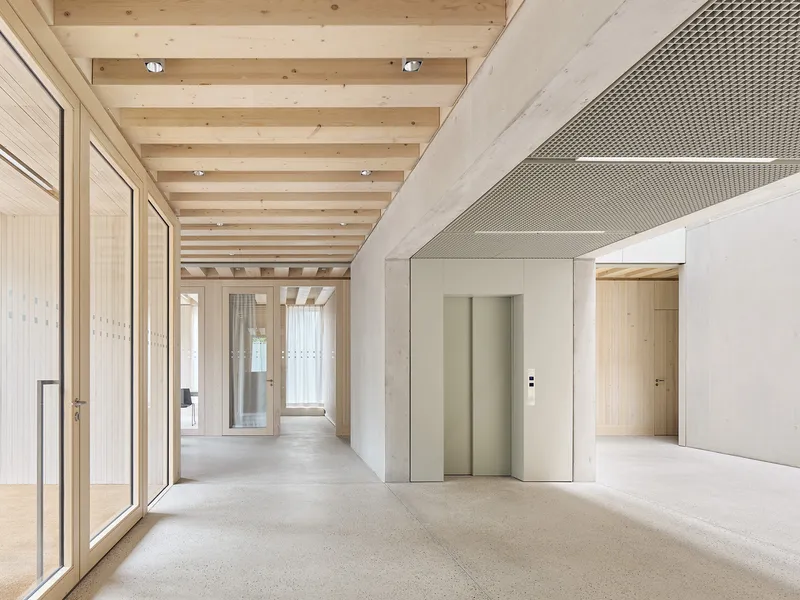
VON M treat the corridors as inhabited spaces in their own right. Exposed timber ceiling beams continue from the offices into the hallways, maintaining material continuity. At the elevator core, perforated metal ceiling panels replace the acoustic infill, introducing a cooler, more industrial register that subtly signals the shift from workspace to vertical circulation.
The effect is that moving through the building never feels like passing through generic back-of-house territory. Every surface is resolved, not lavish, just considered. That kind of consistency is difficult to achieve in a mid-scale office project where budgets tend to concentrate on the lobby and abandon the corridors to suspended tile ceilings. Here, the commitment runs wall to wall, floor to floor.
Plans and Drawings
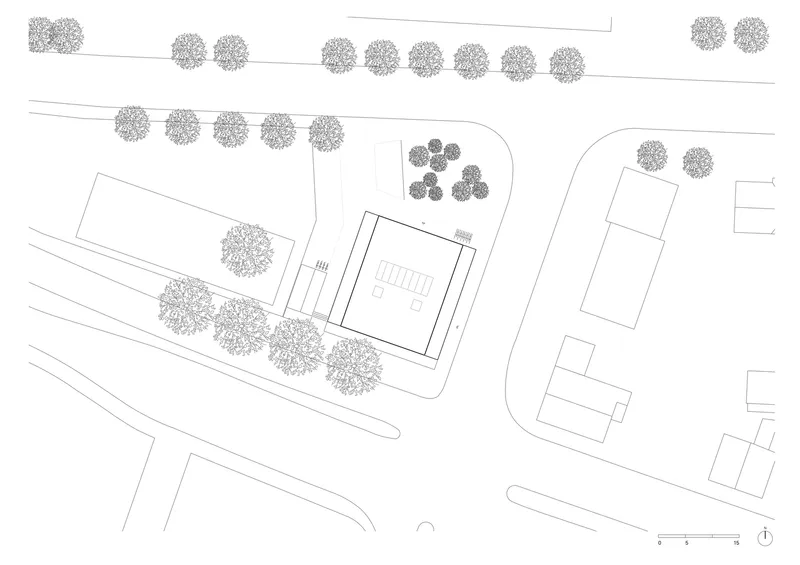
The site plan confirms what the interior experience suggests: the building is organized around a compact, roughly rectangular footprint that holds the street edge firmly while opening toward an internal courtyard. Street trees are retained along the sidewalk, reinforcing the dialogue between the weathering timber facade and its leafy context. Neighboring structures are kept at a respectful distance, giving the GWG headquarters a clear civic presence without overshadowing its surroundings.
Why This Project Matters
Office buildings for municipal agencies rarely attract serious architectural attention. They tend to default to safe, anonymous envelopes that communicate nothing beyond bureaucratic efficiency. The GWG Tübingen headquarters pushes back against that default by committing to a narrow material palette, an expressive structural system, and a central atrium that elevates routine circulation into genuine spatial experience. It proves that a public client and a limited budget are not obstacles to architectural quality; they are constraints that, when embraced honestly, produce better buildings.
VON M's contribution here is not a single dramatic gesture but a sustained level of care across every scale, from the macro rhythm of the facade grid to the detailing of a perforated ceiling panel at an elevator door. That consistency is the hardest thing to achieve in practice and the easiest thing to lose during construction. The fact that it survives intact in the finished building is what makes this project worth returning to.
GWG Tübingen Office by VON M architects, Tübingen, Germany. Photography by Zooey Brown.
About the Studio
VON M architects
Official website of VON M architects, one of the studios behind this project.
vonm.deShare Your Own Work on uni.xyz
If projects like this are the kind of work you want to make, uni.xyz is a place to publish your own, find collaborators, and enter design competitions.


Popular Articles
Popular articles from the community


Play: Fragments of Their World
Familiar architecture becomes modular playground design, creating safe spaces where displaced children can learn, connect, imagine and play.

Co-life: Sustainable Architecture for Age-Friendly Community Living
Co-life reimagines sustainable architecture for seniors through courtyards, rammed earth, shared gardens, and spaces designed for belonging.

Conexión: Biophilic Design Reimagines High-Rise Living in Hong Kong
Conexión reimagines high-rise living in Hong Kong through biophilic design, green facades, shared spaces, daylight, water and nature within.

Co-Life: Senior Housing Design That Reconnects Older Adults With the City
Co-Life reimagines senior housing design through healing gardens, shared streets, workshops, and a sustainable community across generations.

Similar Reads
You might also enjoy these articles


Hodi-Mandai Geram
Project Function: Preservation and revitalization of the Intangible heritage and socio-spatial identity of the Hodi by Housing, Cultural Memory Center, Sacred Grove, landscape, local tourism economy


Olio Towers: A Mid-Rise for Performers That Fuses Housing, Rehearsal, and Stage
Located blocks from Houston's Theater District, this modular tower stacks living units around a central performance atrium.

Oasis: Modular Green Housing Carved into Dhaka's Urban Fabric
A shortlisted Plugin Housing entry reclaims unauthorized settlements in Dhaka with stepped concrete volumes, green roofs, and ventilation-driven design.

Black Hole: A Floating Megastructure for the Post-Physical Era
Emiliano Mazzarotto envisions a spherical, self-scaling arena where e-sports, digital hotels, and holographic stadiums replace traditional public space.

Explore B19 Architekten Bda – Weimar Competitions
Discover active competitions in this discipline

Challenge to reimagine the Iron Throne

Photograph architecture without architects

Illustrate the lost glory of Angkor Wat - Render Challenge

Design challenge to reuse E-waste
Comments (0)
Please login or sign up to add comments
No comments yet. Be the first to comment!