

Studio Dali Architects Floats a Timber Roof Over Hangzhou's Rice Fields as a Digital Farm Headquarters
A 2,265 m² operations center in Penggong Township defers to 1,500 acres of farmland with deep eaves and open courtyards.


There is something quietly radical about a building that refuses to announce itself. The Hangzhou Digital Farm Operation Center by Studio Dali Architects sits among 1,500 acres of rice paddies in Penggong Township, Yuhang District, and its primary architectural ambition is to remain inconspicuous. At 2,265 square meters and a maximum height of just 7.5 meters, with eaves kept 3.5 meters below the rooflines of surrounding village houses, the structure crouches beneath the horizon of golden grain. It is an operations and R&D headquarters for a digital agriculture company, yet it reads from a distance as little more than a long shadow cast across the fields.
What makes the project worth studying is its refusal to treat agricultural infrastructure as merely functional. Lead architect Ye Li and the design team approached the building as a piece of shared landscape: part research facility, part public commons. Villagers wash farm tools in its water troughs, rest on benches built into its facade, and pass through its corridors freely. The architecture does not just serve the company that commissioned it; it operates as a civic threshold between the dense, three-story farmer-built settlement to the north and the vast, flat paddy landscape to the south.
A Roof That Belongs to the Horizon


The defining gesture is the roof. Broad, gabled, clad in corrugated metal, it spans the full length of the building like a single continuous canopy. Seen from across the wheat and rice fields, the roofline registers as a thin horizontal stroke, no more assertive than the distant hills behind it. The architects describe the effect as a floating cloud, but a better analogy might be a barn that has shed its walls. The proportions are deliberately agricultural, the pitch gentle, the overhangs deep enough to cast long shadows that cool the perimeter spaces without mechanical intervention.
Height restrictions imposed by the site's agricultural zoning were not treated as constraints but as generative rules. By keeping the eaves well below the neighboring village rooflines, the building avoids any sense of institutional imposition on the rural fabric. From the roadside at dusk, the long colonnade and its warm interior glow read as an extension of the settlement rather than a corporate insertion.
Courtyard Logic and Climate Response


The plan organizes the program around one main courtyard and several secondary ones, arranged in a loose U-shape visible clearly from above. The central courtyard sits on the inner side of the building's front elevation, deliberately hidden from the exterior. You would not know it was there until you entered. This inversion, placing the heart of the building out of public sight, gives the interior a quality of discovery that counters the building's otherwise transparent facades.
Hangzhou's humid subtropical climate demands serious attention to ventilation and daylight, and the courtyards solve both problems simultaneously. They break up what would otherwise be oppressive floor plates under the wide roof, pulling light down through gravel-paved clearings planted with young trees. At twilight, the glazed volumes surrounding these courts glow softly, turning the building into a lantern visible across the fields. Gravel paving manages rainwater drainage while keeping the ground plane permeable and unfinished, consistent with the agricultural character of the site.
Timber Structure as Visual Language


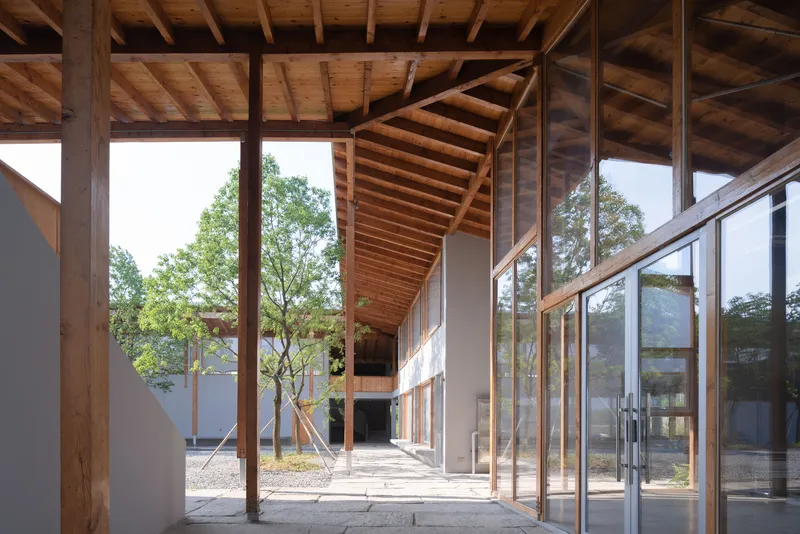
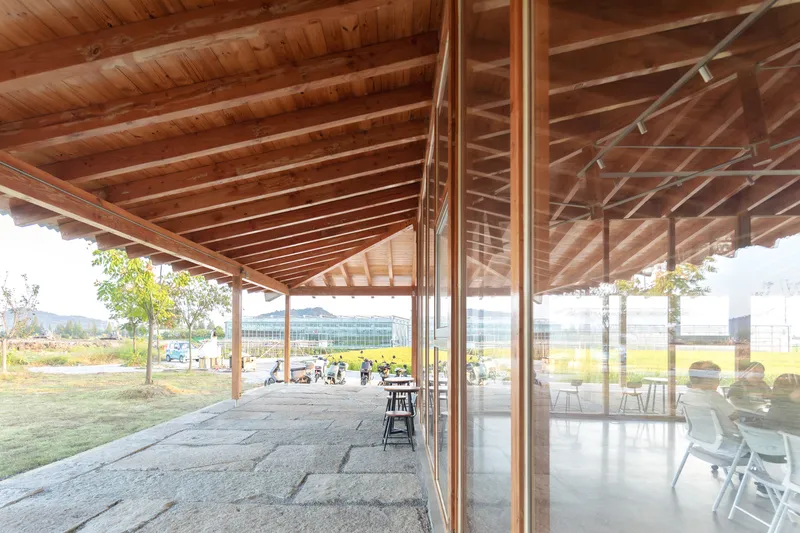
The structural system, engineered by LuAnLu Partner Structure Consulting, uses an orthogonal timber framework that does most of the visual work in the building. Exposed rafters, purlins, and posts are arranged in a regular rhythm that simplifies the roof's apparent complexity. Shear walls are concealed within partitions, so the timber reads as the sole load-bearing element even where it is not. The result is a ceiling plane that feels light and legible, almost diagrammatic in its clarity.
Key details reinforce this lightness. Mortise-and-tenon joints replace conventional beam connections at critical intersections, reducing structural depth and eliminating the bulky hardware that typically clutters exposed wood construction. Steel column bases, shaped to recall standing roosters, lift the timber posts off the ground with a playful flourish that keeps the columns looking slender. Metal tension rods at the ridge handle lateral forces discreetly, threading through the timber like tendons rather than competing with it.
The Colonnade as Public Interface


The deep covered colonnade along the building's long facade is the most socially active element of the design. Rather than treating the perimeter as a sealed envelope, the architects lined it with timber posts and continuous glazing that dissolve the boundary between inside and outside. Benches are integrated into the base of the facade, turning the edge of the building into a resting place for farmworkers, cyclists, and visitors passing along the adjacent path.
Public amenities, including restrooms and concrete trough sinks for washing farm tools, are distributed along the perimeter rather than concentrated in a single service block. The effect is generous without being programmatic. People drift through the covered spaces and courtyards as they would through a village street, and the building gains its civic presence not from scale or signage but from simple, repeated acts of openness.
Interior Spaces Between Field and Courtyard

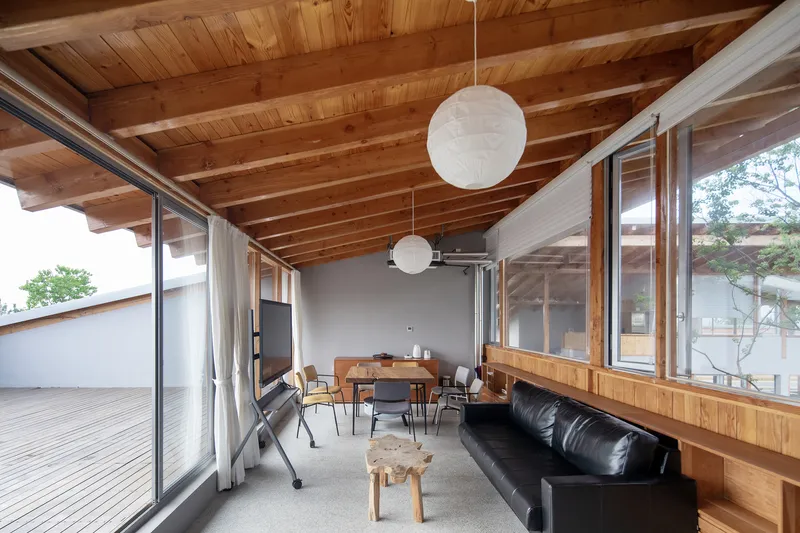
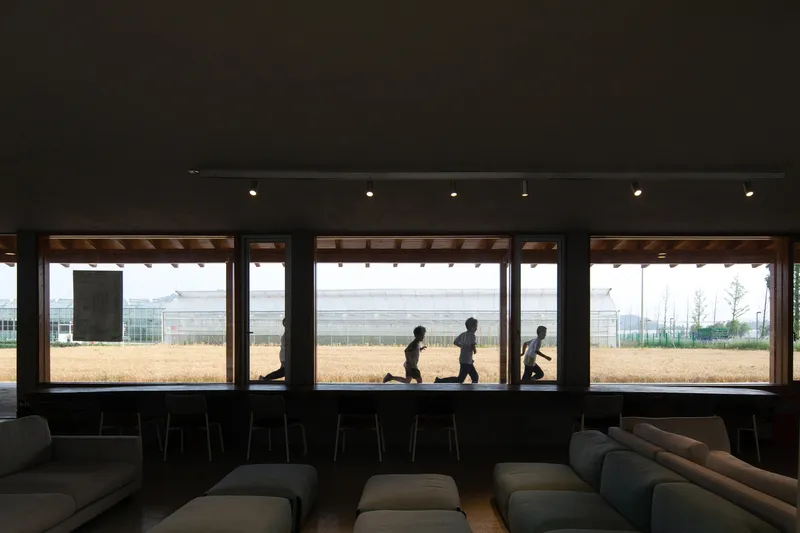
Inside, the program splits between operational offices, R&D spaces, and communal areas that borrow character from both the rice fields and the courtyards. Floor-to-ceiling glazing on the south side frames panoramic views of the paddies, and on sunny days, cyclists and visitors become silhouettes moving across a landscape painting. On the courtyard side, the views are more intimate: gravel, young trees, the rhythm of timber columns.
A lounge on the upper level overlooks a playing field where children run in the midday light, collapsing the distance between a corporate headquarters and a neighborhood park. Spherical pendant lights in the living spaces echo the soft, rounded forms of the landscape, while the relentless timber grid overhead provides enough visual structure to prevent the interiors from feeling vague. Stone and wood dominate the material palette, keeping finishes consistent with the rural vocabulary outside.
Thresholds and Passages


Some of the most compelling spaces in the building are the narrow passages between white stucco walls where young trees push through gaps in the timber overhangs. These in-between zones, neither fully interior nor fully exterior, manage transitions between the building's public corridors and its more private program. Planted beds soften the geometry, and the compressed proportions make the expansive roof feel momentarily intimate before you emerge into a courtyard or the open field.
An open-air bathroom with concrete trough sinks beneath a timber roof, overlooking an interior courtyard, captures the project's ethos in a single detail. Nothing is hermetically sealed. Water, air, and light circulate through every room, and the distinction between service space and architectural space dissolves.
Aerial Reading and Landscape Integration


From above, the building's strategy becomes fully legible. The corrugated metal roof, punctured by a square courtyard opening, sits among the orthogonal geometry of agricultural plots, greenhouses, and bicycle paths like a piece of farm infrastructure that happens to contain offices. The white rectangular footprint at dusk blends into the pattern of terraced hillside development and irrigated fields, reinforcing the architects' intent that the building should never dominate its context.
A triangular opening in the roof canopy frames a view from the covered terrace toward the greenhouses and misty mountains, creating a carefully choreographed moment of landscape framing within an otherwise restrained composition. The building was designed to be dismantled and returned to farmland if necessary, and this sense of impermanence gives the architecture an unusual ethical weight. It exists provisionally, by permission of the land it occupies.
Plans and Drawings


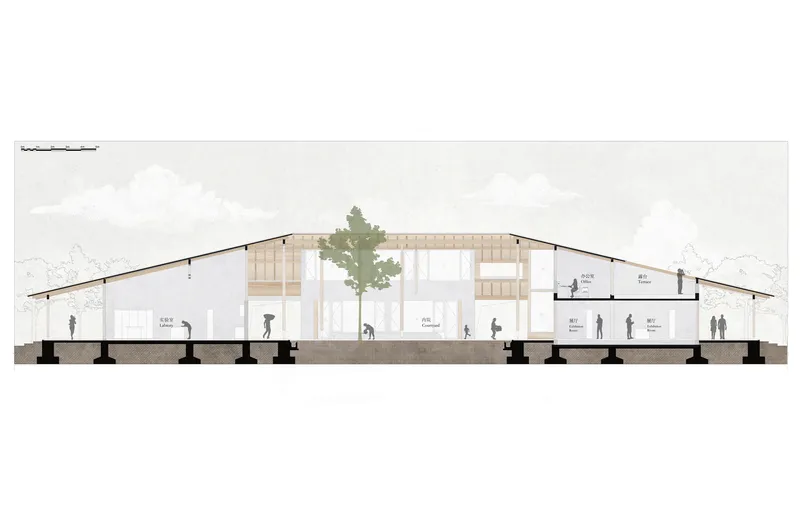


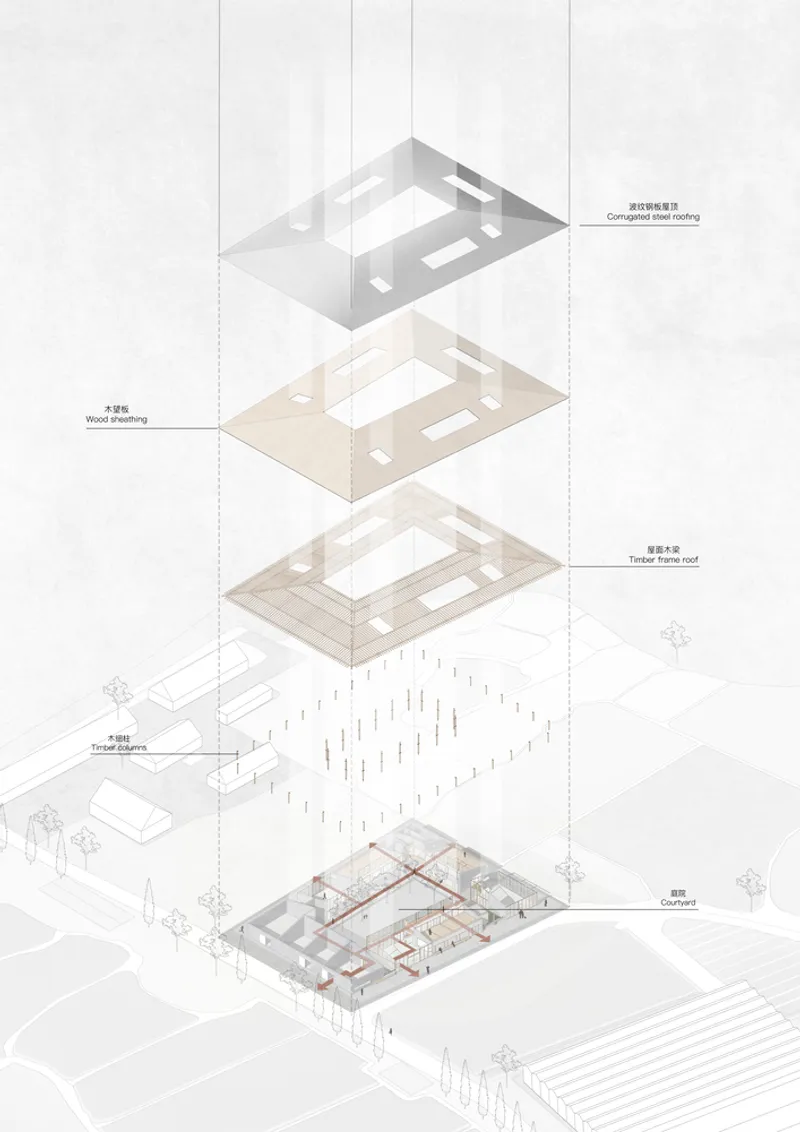

The floor plans confirm the courtyard-centric organization: rooms cluster around a central void scattered with trees, while the second floor distributes three timber-floored volumes around the open space below. Sectional drawings reveal how the sloped roof structure spans over varied interior conditions, from double-height halls to low-ceilinged workspaces, using a consistent structural module. Detailed sections annotate the foundation-to-ridge assembly, showing how the timber frame meets its concrete base and metal cladding. The exploded axonometric drawing is particularly instructive, layering the roof assembly, timber structure, and column grid above the courtyard plan to make the construction logic fully transparent.
Why This Project Matters
Agricultural buildings rarely receive serious architectural attention. They are typically engineered for efficiency and left to weather. The Hangzhou Digital Farm Operation Center proposes a different model, one where a working farm headquarters is also a community gathering space, a climate-responsive courtyard building, and a demonstration of how contemporary timber construction can operate within traditional rural vocabularies without nostalgia. The fact that it is designed for eventual disassembly means the architecture carries its own exit strategy, a rare act of humility in a profession that tends to build for permanence.
Studio Dali's project matters because it demonstrates that the most interesting site for architectural experimentation today may not be the city center or the cultural institution but the edge condition where urban development meets agricultural land. In Penggong Township, that edge is negotiated through deep eaves, shared courtyards, and a roof that knows its place. The building does not solve the tensions between modernization and rural life, but it holds them in productive balance, and that is more than most projects of this type even attempt.
Hangzhou Digital Farm Operation Center by Studio Dali Architects. Penggong Township, Yuhang District, Hangzhou, China. 2,265 m². Completed 2022. Photography by Arch-Exist Photography.
About the Studio
Share Your Own Work on uni.xyz
If projects like this are the kind of work you want to make, uni.xyz is a place to publish your own, find collaborators, and enter design competitions.




Popular Articles
Popular articles from the community


Hill & Cross Opera: Sculptural Opera House Architecture Shaped by Tallinn’s Landscape and Identity
Hill & Cross Opera reimagines opera house architecture in Tallinn through its sculptural hill, civic plaza, glass wave and a luminous cross.

The Earth Pod: 3D Printed Homes for Resilient Refugee Communities
The Earth Pod reimagines refugee housing through 3D printed homes made from clay, combining resilience, self-sufficiency, and rapid shelter.

The Musturak Paradise: Senior Living Architecture for a Connected Future in Temara, Morocco
The Musturak Paradise reimagines senior living architecture in Temara via private homes, social spaces, culture, community, and shared care.

Co-Life: Senior Housing Design That Reconnects Older Adults With the City
Co-Life reimagines senior housing design through healing gardens, shared streets, workshops, and a sustainable community across generations.


Similar Reads
You might also enjoy these articles


Hodi-Mandai Geram
Project Function: Preservation and revitalization of the Intangible heritage and socio-spatial identity of the Hodi by Housing, Cultural Memory Center, Sacred Grove, landscape, local tourism economy


Olio Towers: A Mid-Rise for Performers That Fuses Housing, Rehearsal, and Stage
Located blocks from Houston's Theater District, this modular tower stacks living units around a central performance atrium.

Oasis: Modular Green Housing Carved into Dhaka's Urban Fabric
A shortlisted Plugin Housing entry reclaims unauthorized settlements in Dhaka with stepped concrete volumes, green roofs, and ventilation-driven design.

Black Hole: A Floating Megastructure for the Post-Physical Era
Emiliano Mazzarotto envisions a spherical, self-scaling arena where e-sports, digital hotels, and holographic stadiums replace traditional public space.

Explore Sustainable Farm Competitions
Discover active competitions in this discipline



Challenge to reimagine the Iron Throne


Photograph architecture without architects


Illustrate the lost glory of Angkor Wat - Render Challenge


Design challenge to reuse E-waste
Comments (0)
Please login or sign up to add comments
No comments yet. Be the first to comment!