
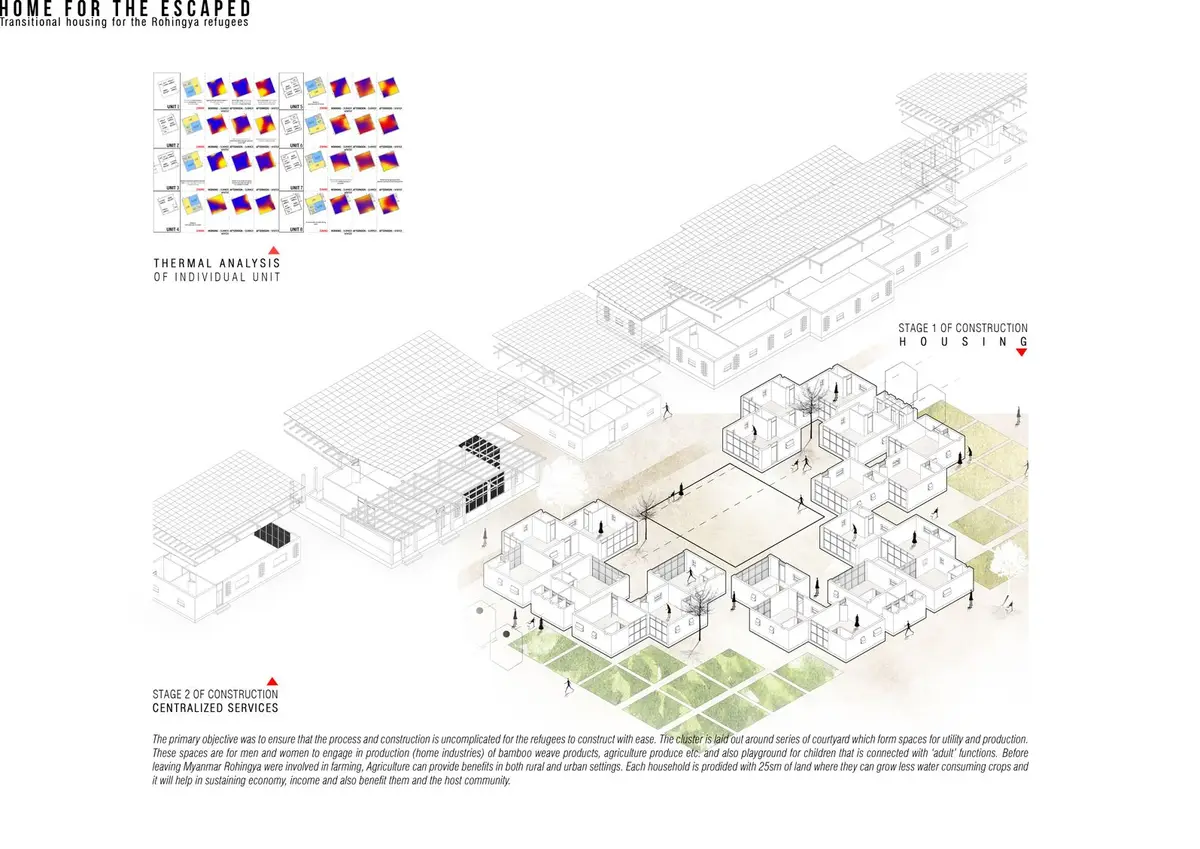
Home for the Escaped: Rohingya Transitional Housing Built by the Refugees Who Will Live in It
A UnIATA 2018 winning thesis that turns Rohingya stilt-house vernacular into a self-build housing system for the Kanchan Kunj settlement in New Delhi.


Refugee shelters are designed to be temporary, yet the people living in them often stay for decades. Home for the Escaped starts from that contradiction. Instead of drawing a better tent, it asks who should build the home, what it should remember, and how it can grow from a provisional structure into a permanent one. Its answer is a refugee-built housing system rooted in Rohingya vernacular construction. Materials, tools and training replace the handed-down shelter, so that construction itself becomes a source of income, skill and ownership.
Developed by Denis Raj as a thesis project, the proposal was named Winner of UnIATA 2018. The site is Kanchan Kunj in Madanpur Khadar, New Delhi, one of the few officially recognised Rohingya settlements in the city. Here, families displaced from Myanmar live without a formal legal framework for protection, in clusters of shelters built from scrap and temporary materials. Clean water, sanitation and electricity are scarce. The settlement sits close to urban infrastructure, yet remains cut off from it socially and economically.
The Raised Plinth as Cultural Memory
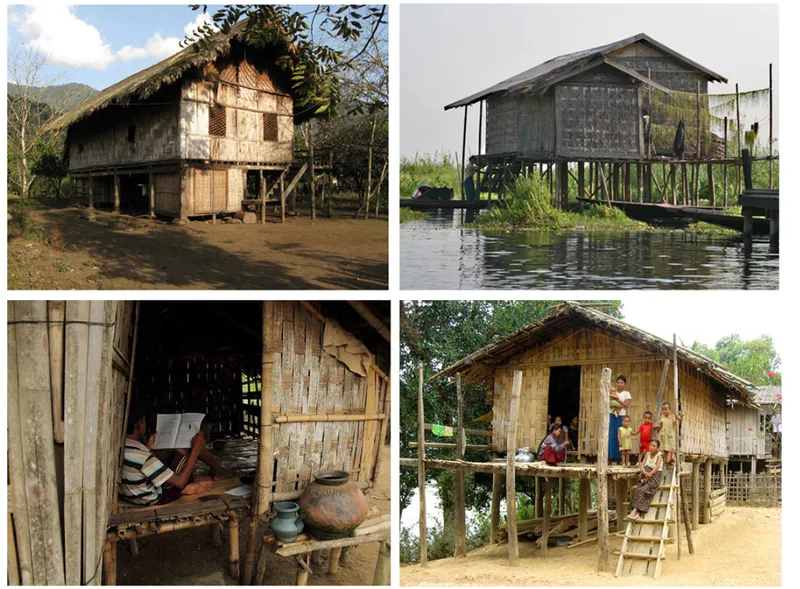
The project's design vocabulary comes from the village, not the camp. The collage traces the traditional Rohingya house through its variations, from a thatched hut on dry ground to a lakeside dwelling standing over water. Each version is elevated on bamboo or timber posts and reached by a ladder. Raj reads these houses as technical intelligence rather than nostalgia. The raised floor protects against flooding, lightweight bamboo, wood and thatch allow easy repair and extension, and the open construction keeps air moving through the interior.
The research also reaches beyond the single house. Traditional settlements gather around water bodies and shared spaces, and their interiors hold several uses at once: daily life, prayer, cooking and storage. Carrying these patterns into a peri-urban Delhi site is a quiet but important move. It allows a displaced community to recognise itself in its surroundings rather than adapt to a generic relief template.
Kanchan Kunj: An Informal City Already at Work


The site documentation resists the usual image of refugees as passive recipients of aid. In the first photograph, an unpaved lane in morning haze serves as a social room: women sit together, children move through, and an auto-rickshaw waits at the edge. In the second, a roadside kiosk with hanging snack packets, candy jars and black tarp walls shows that a small economy already runs on almost nothing. A child sits on a red chair beside it, and a bicycle leans nearby.
These images underpin the strategy. Raj's site analysis aims to improve spatial organisation, circulation and access to shared amenities, while respecting the social networks that already hold the settlement together. The lane and the kiosk are not problems to be cleared away. They are evidence of the self-reliance the proposal intends to formalise.
Inside the Tarp: Making Do Under Plastic
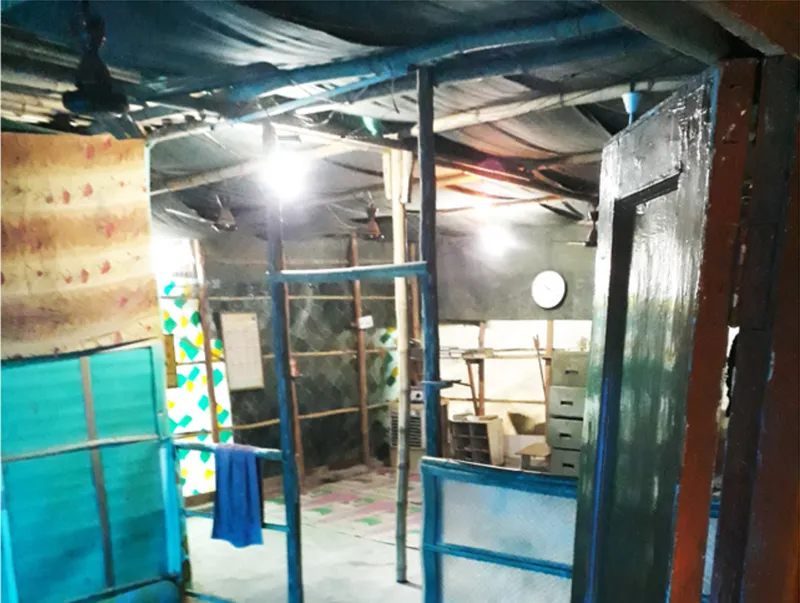
The interior photograph is the most revealing piece of the documentation. A tarp roof stretches over bamboo framing that someone has painted blue. Ceiling fans, bright bulbs, a wall clock and a stack of drawers turn a makeshift enclosure into a home. The care is obvious, and so are the limits: plastic sheeting traps heat, wears out quickly and offers little security. This image justifies the project's central claim. The residents already have the will and the craft to build. What they lack are durable materials, technical support and the security of tenure that would make investing in a home worthwhile.
A Stilt House Designed to Be Built by Its Owners

The axonometric brings the research into a single buildable unit: a stilted bamboo house with a veranda, an external stair and a corrugated roof. The annotations explain its logic. Materials are chosen for self-construction, the raised floor answers flood risk, and the ground level beneath the house is left open for use. That freed ground plane is a sharp piece of thinking. In a dense settlement, the space under the house can hold work, storage or a small trade, giving the kiosk economy seen in the site photographs a permanent place to grow.
The house matters most as a framework rather than a finished object. Under Raj's model, government and humanitarian organisations provide raw materials and tools, refugees are trained in construction techniques, and families build their own homes. Each unit can then evolve incrementally from a temporary shelter into a permanent dwelling. The veranda and stair recall the ladders and porches of the vernacular collage, so the new home reads as a continuation of an old one rather than a replacement.
Why This Project Matters
Most humanitarian architecture still focuses on the shelter as a product: how quickly it can be shipped, assembled and replaced. Home for the Escaped shifts attention to process. By treating construction as skill development and income, it addresses dependency, which is the deeper failure of the camp model, alongside the physical problem of poor housing. Its reading of the Rohingya stilt house is precise enough to produce real design decisions instead of decorative references.
The proposal is also honest about time. It accepts that displacement often lasts for years and designs for that reality, with a structure meant to be upgraded rather than discarded. For a community living without legal protection on the edge of a major city, a home that can grow with its residents offers more than shelter. It offers a stake in the future, which is what made this thesis a deserving UnIATA 2018 winner.
View the Full Project
About the Designers
Designer: Denis Raj
Enter a Design Competition on uni.xyz
uni.xyz runs architecture and design competitions year-round that reward proposals with spatial conviction and real site intelligence.
Project credits: HOME FOR THE ESCAPED - Transitional Housing for the Rohingya refugees" by Denis Raj UnIATA 2018 (uni.xyz).


Popular Articles
Popular articles from the community


The Amber Palace Opera: A Geological Fiction Surfaces on Tallinn's Baltic Waterfront
Pierre Brillard reimagines a Baltic legend as a public landscape, opera house, and waterfront promenade rooted in Tallinn's coastal identity.

Temporary Home for Dogs: A Reversed Zoo Rethinks Animal Shelter Architecture
In Bucharest, a sinuous corridor and freed landscape flip the logic of containment, designing a shelter that works to make itself unnecessary.

Singing Woman: An Opera House That Performs Before the Curtain Rises
Ovidiu Cristian Pavel's conceptual opera house translates Estonia's choral identity into a sculpted waterfront landmark facing the Baltic Sea.

Opera on the Sea: Driftwood Logic Shapes a Timber Opera House on Estonia's Coast
Trevor Orgill's opera house translates the entangled drift of floating timber into a civic building where wood, water, and music converge.

Similar Reads
You might also enjoy these articles

Maya Harvest: A Cacao Resort Village Rooted in Mayan Tradition and Local Craft
Situated within a Tabasco cacao plantation, this shortlisted resort proposal merges vernacular materials with hands-on cultural immersion.
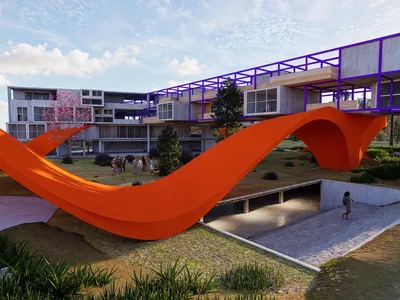
Harmonia: A River-Shaped Community That Grows Over Decades in Boa Vista
Curved pathways and modular grid structures along the Branco River create a phased settlement designed to evolve from 2030 to 2050.
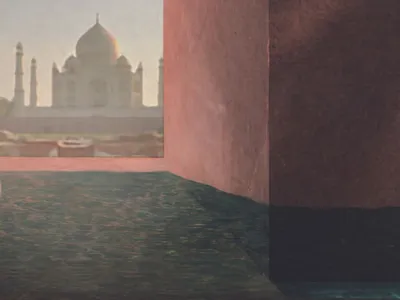
The Architecture of Bathing: A Mughal Hammam Reimagined Across the Yamuna
Charlotte May's honorable mention entry for The Black Taj reinterprets Agra's bathing rituals through red sandstone, water, and framed views of the Taj Mah
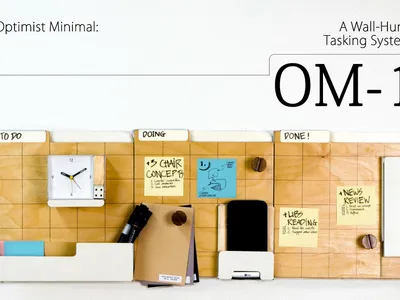
Om-1: A Wall-Hung System That Moves Your Workspace Off the Desk
Modular plywood boards, magnetic pegs, and utility elements migrate clutter from the horizontal surface to the vertical plane.

Explore Refugee Camp Competitions
Discover active competitions in this discipline

Challenge to reimagine the Iron Throne

Photograph architecture without architects

Illustrate the lost glory of Angkor Wat - Render Challenge

Design challenge to reuse E-waste
Comments (0)
Please login or sign up to add comments
No comments yet. Be the first to comment!