

Pablo Muñoz Payá Arquitectos Sinks a Living Room Three Steps to Open Up an Old Farmhouse near Alicante
Near Alicante, a 196 m² farmhouse renovation trades extension for excavation, using oak, dry stone and a faceted roof to pull Mediterranean light inside.


Among the olive groves outside Alicante, Pablo Muñoz Payá Arquitectos has reworked an old rural farmhouse for a family that chose to leave the city for the countryside. The house runs to 196 m², and regulations would not let it grow beyond its original footprint. That rules out the usual renovation playbook of adding a glazed box or a new wing, and it leaves you with thick masonry walls, low ceilings and the problem of getting light into a building designed to keep it out.
What we find interesting is how the studio worked around the footprint limit. Since the house could not go outward, it went down and up. The living room floor drops three steps to gain height, and a faceted timber roof opening widens toward the sky to roughly double the daylight entering the main space. The palette stays narrow: oak inside, dry stone outside, white render and clay tile left alone where they still work. The result is a renovation that reads as a careful edit of the existing house more than a new design laid over it.
A Farmhouse That Keeps Its Silhouette
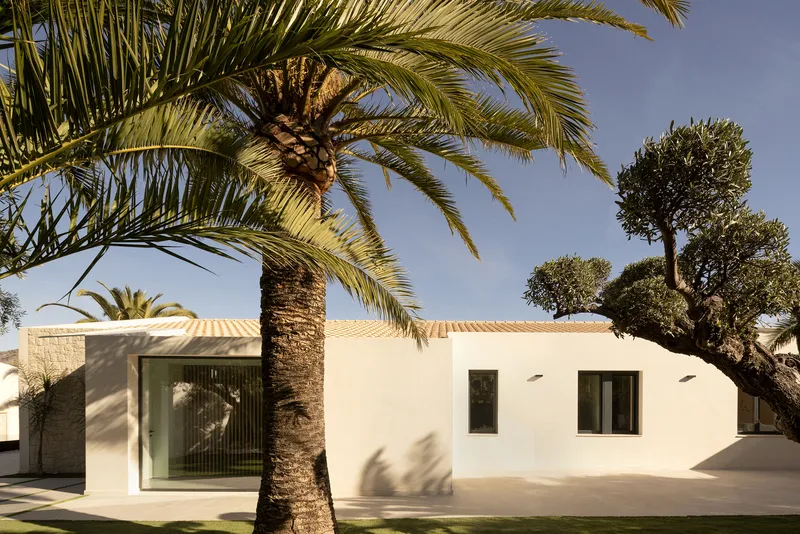
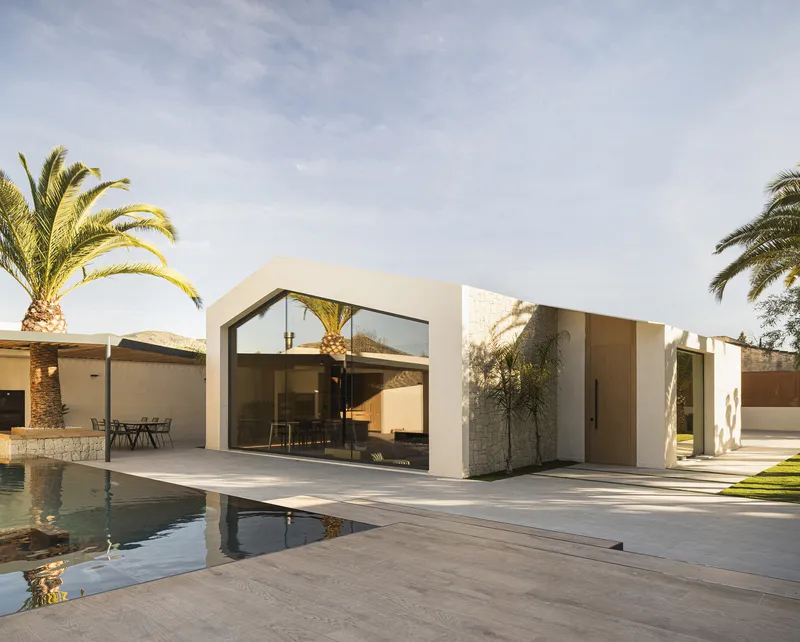
From the approach, the house is still recognisably what it was: a low white volume under a ceramic gable roof, framed by a palm and a pruned olive tree. The studio kept the existing tiled roof and extended it over a former storage area, so the outline of the farmhouse barely changes while the volume beneath it gains a double-height space.
The intervention only becomes legible on the garden side, where a large glazed gable faces the pool and a stone wall runs along the flank. Glass sits inside a traditional profile, so the new opening borrows the logic of the old roof. That restraint is the right call for a building surrounded by working agricultural land.
Three Steps Down
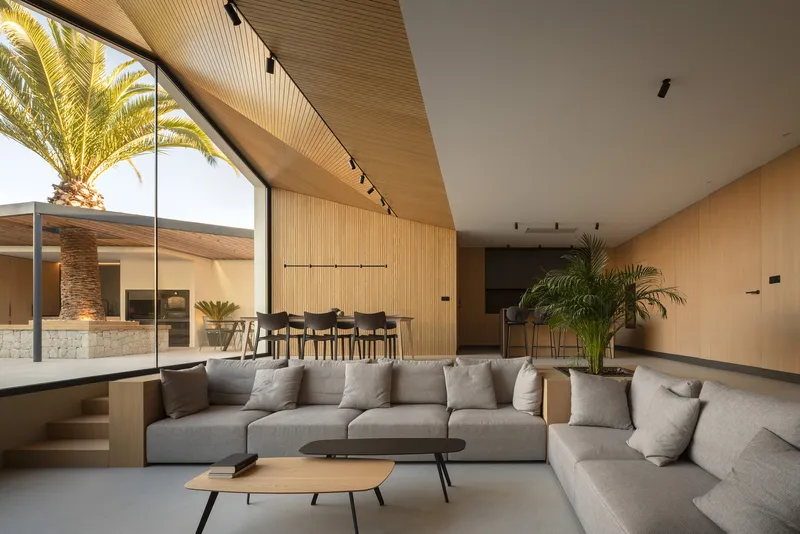
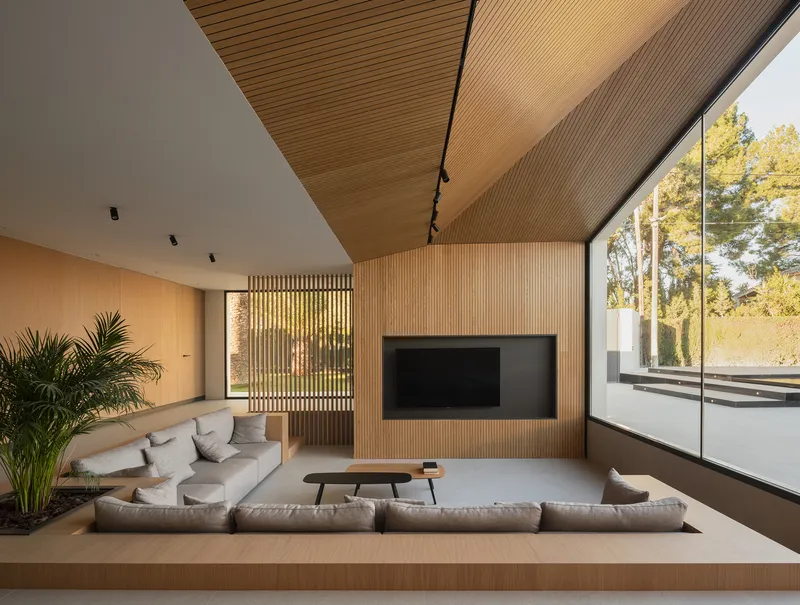
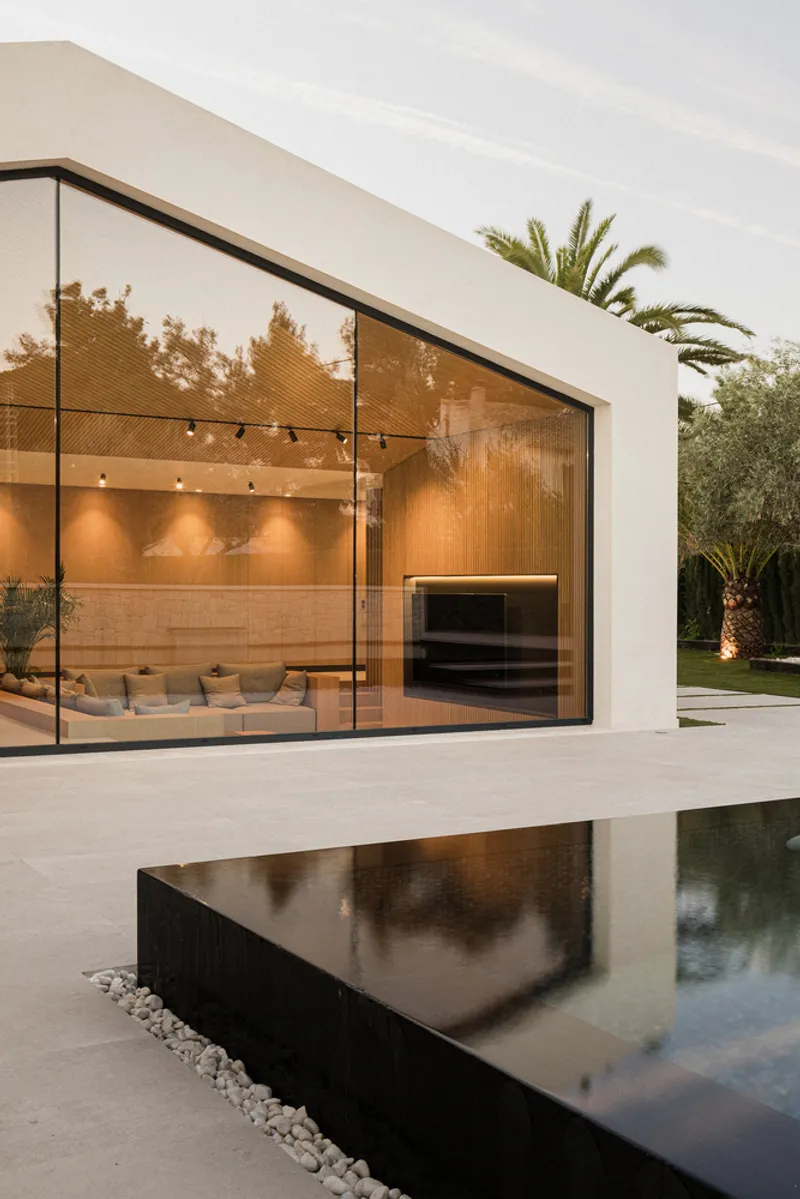
The central move is modest in plan and large in effect. Lowering the living room by three steps solves the low-ceiling problem common to old rural houses without touching the roofline, and it creates a sunken lounge that feels sheltered within an otherwise open plan. The grey sofas sit in what is effectively a pit, with oak slatting on the ceiling and walls wrapping the space.
The level change also does sightline work. From the dining table and the kitchen you look over the lounge toward the large window and the pines and terrace steps beyond, instead of into the backs of furniture. At dusk the glazed gable turns the sunken room into a lit stage seen from the pool, which shows how much the section, more than the plan, defines this house.
A Faceted Roof That Doubles the Light
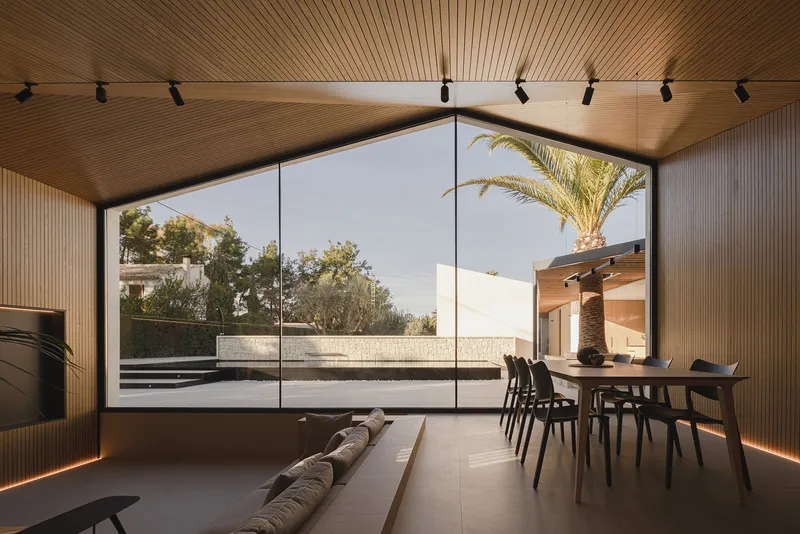
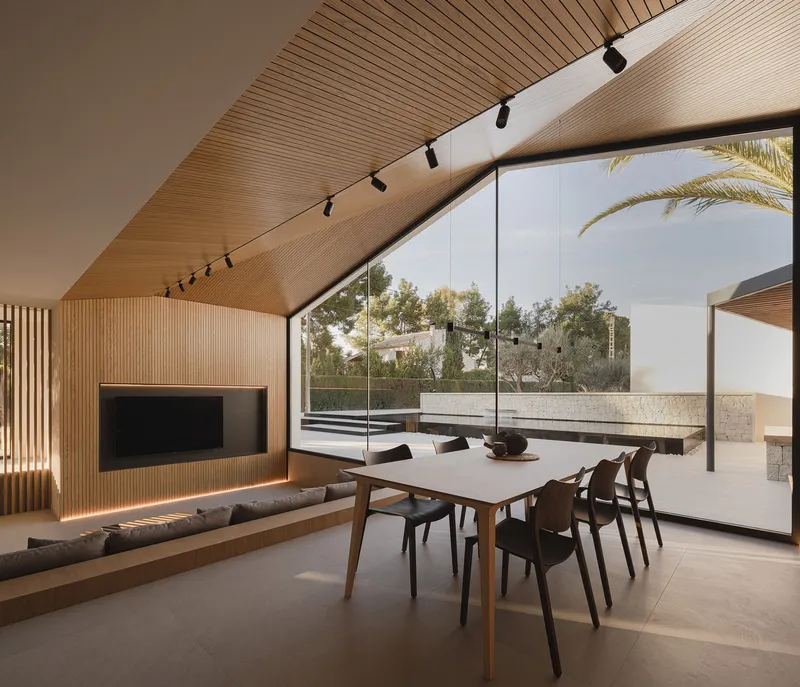
Above the living and dining areas, the architects extended the old false ceiling into a new roof opening shaped in triangular facets that widen toward the top. The geometry works like a funnel, catching the strong Mediterranean light high up and spreading it down across the timber surfaces. According to the architects, the natural light entering the space roughly doubles.
The panelling is not purely decorative. The wood on the ceiling is acoustic, which matters in a large open room with hard stone outside and glass on several sides. In the dining area, the gable-shaped opening frames the palm, the pool terrace and the stone wall in sequence, so you register the landscape every time you sit down to eat.
Oak as Connective Tissue
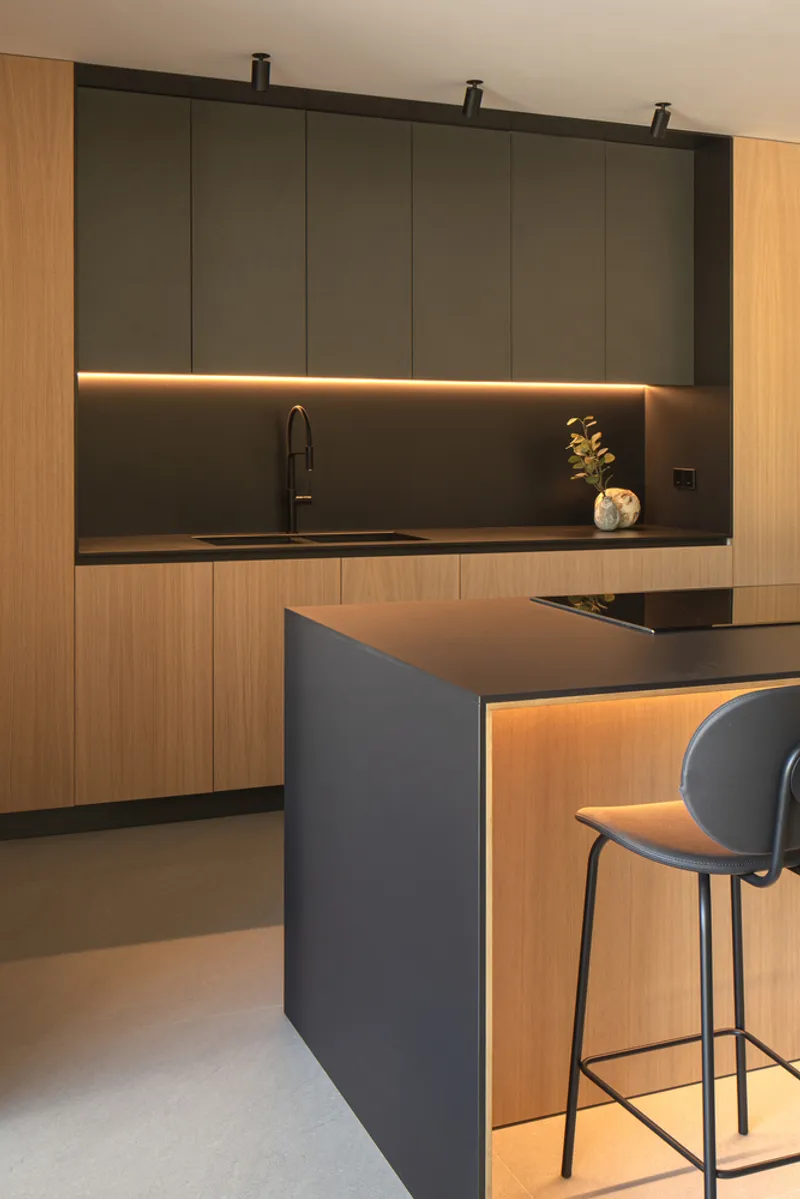
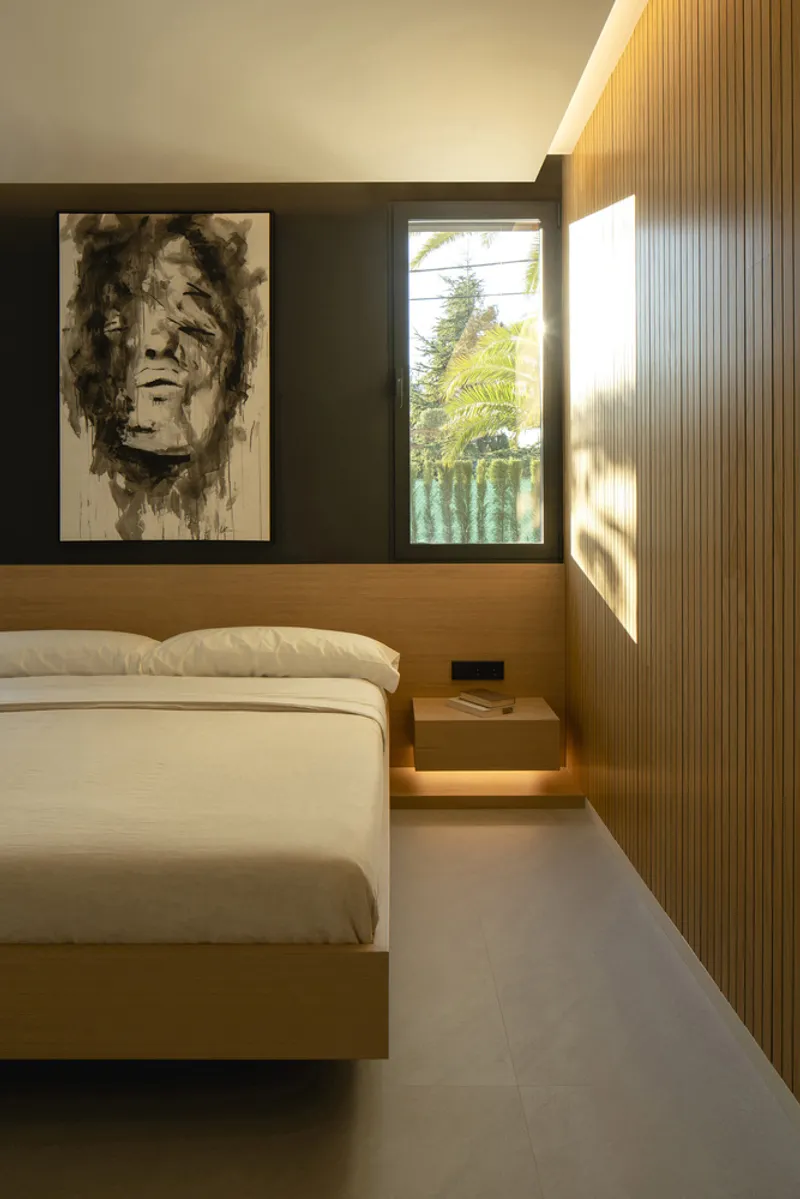
Oak carries the interior from kitchen joinery to ceiling slats to bedroom wall panelling. In the kitchen it is paired with dark matte upper units and a warm LED strip under the island, a small contrast that keeps the timber from becoming monotonous. The bedroom repeats the slatted wall and adds a floating timber bed, a quieter version of the same language.
Committing to one wood throughout is a disciplined choice. It lets the varied ceiling heights and the faceted roof read clearly, because the material does not change when the geometry does.
Dry Stone and Moving Water
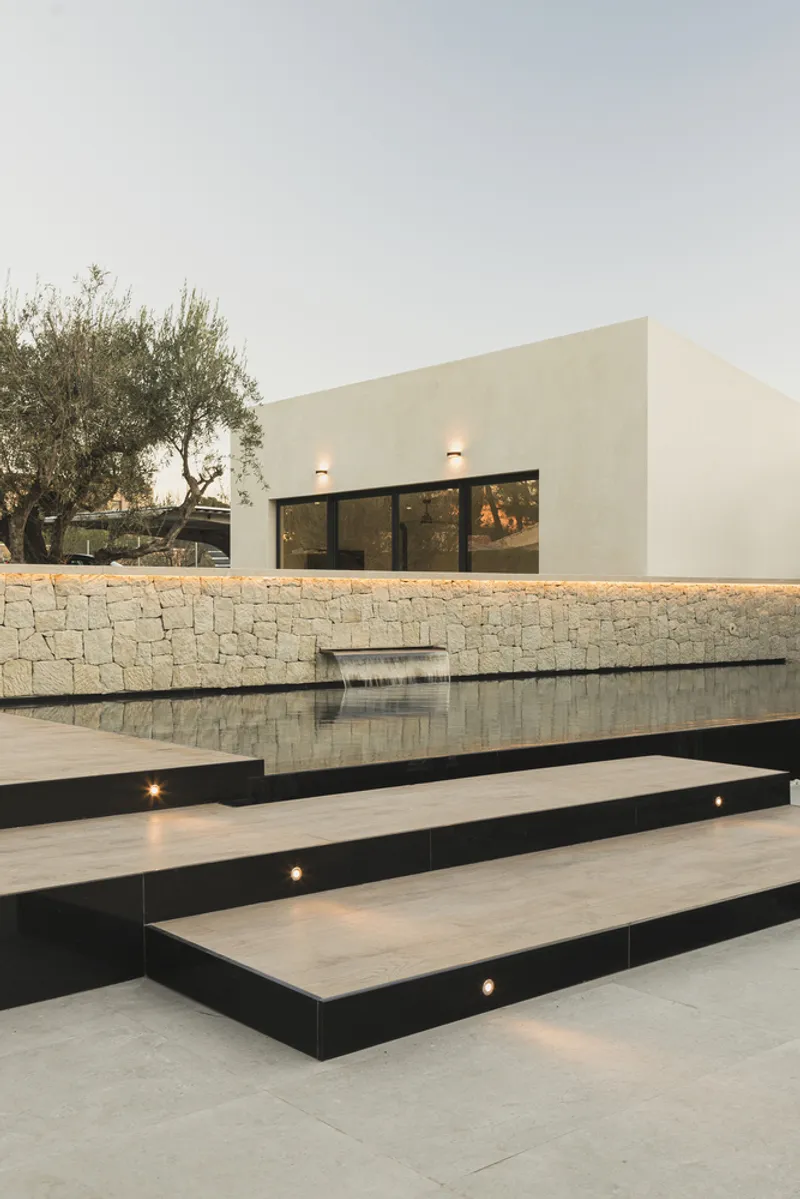
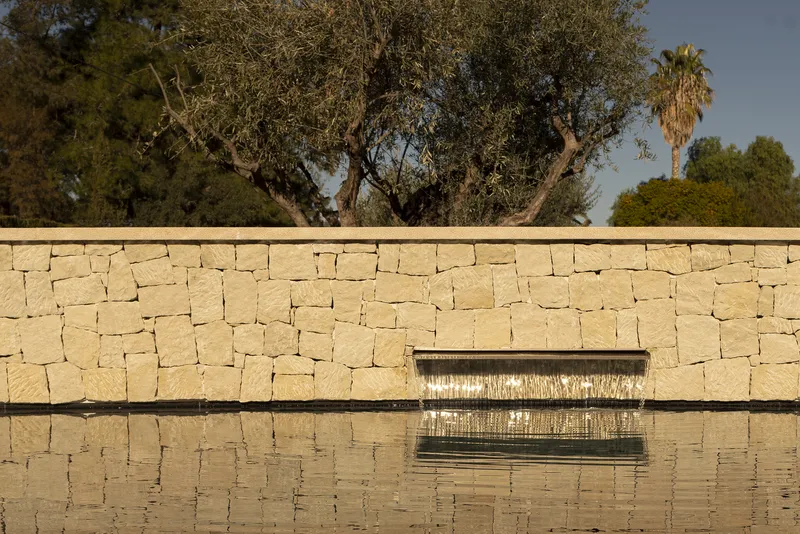
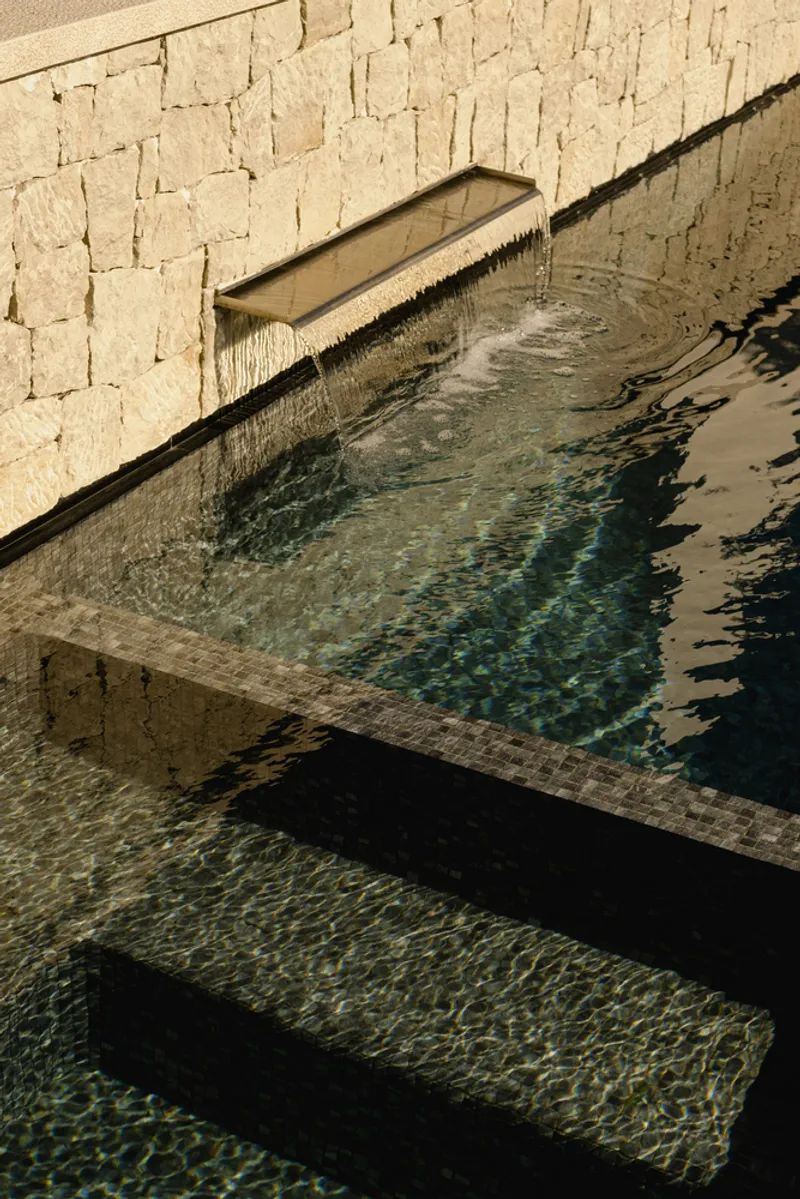
Outside, the studio uses dry-stone masonry laid with the traditional regional technique, on parts of the façade and on the wall rising above the swimming pool. The rough-cut stone sits directly against a dark mosaic-tiled pool, and a thin steel spout pours water from the wall into the basin. The pool is raised and overflows like a fountain, so it is heard as much as seen.
Black-edged stone steps lead down into the water next to an olive tree, and a series of raised platforms guides you toward the pool and its curtain of water. Stone, water and olive are the oldest materials on this site, and the design lets them do most of the talking.
Outdoor Rooms Under Timber Slats
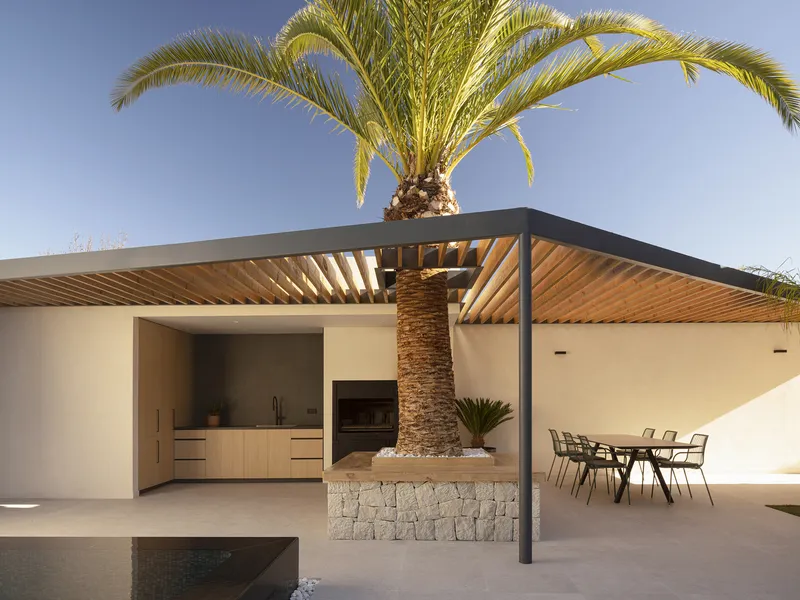
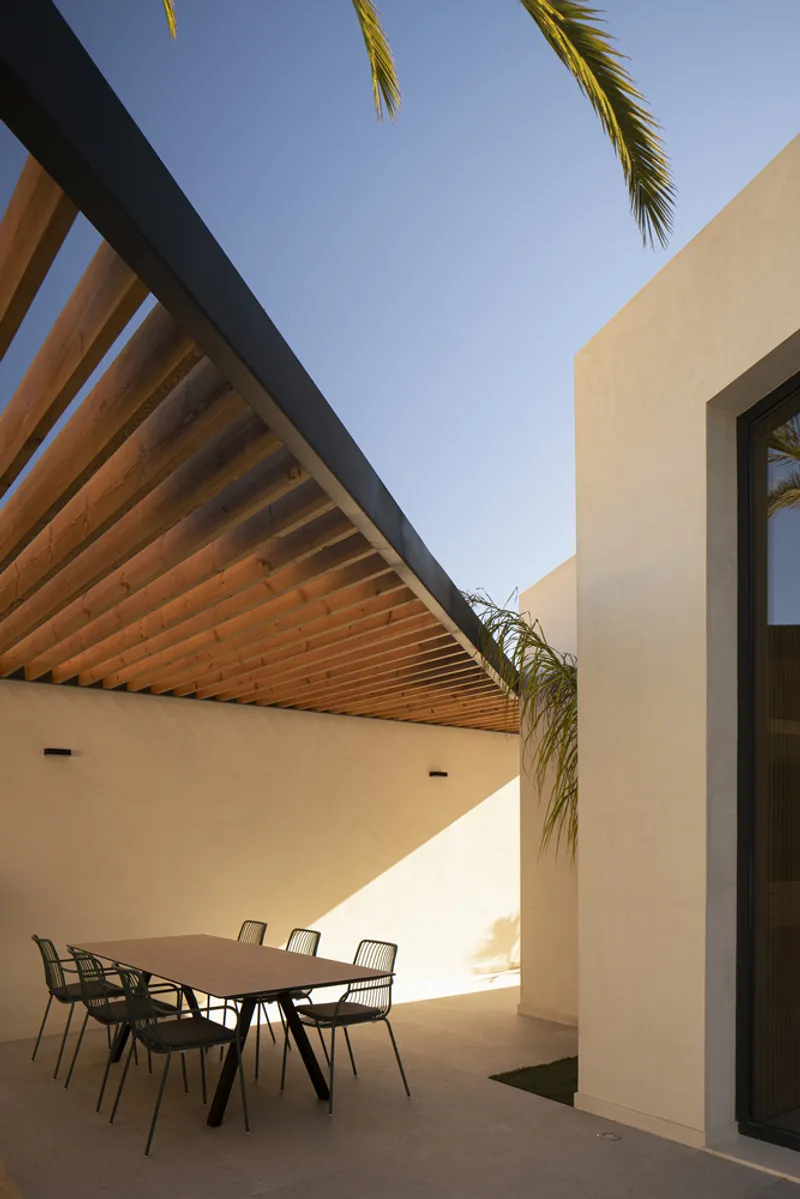
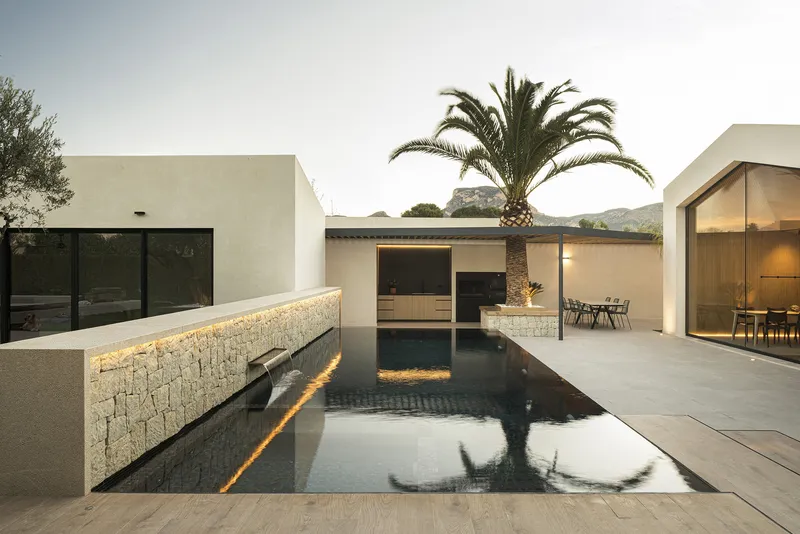
The surrounding rural outbuildings, previously run down, have been restored and tied together by a new timber porch. Its solid slats on a steel frame organise the route from the entrance to the main living space, and in one spot the pergola wraps around a palm trunk planted in a stone bed. Under it sit an outdoor kitchen and a dining table, effectively extra rooms the footprint rules could not otherwise allow.
The slats cast sharp lines of shadow across the pale render in the afternoon, turning harsh sun into something you can live under. At night the lit stone wall and the outdoor kitchen give the courtyard the depth of a second living room.
Why This Project Matters
Many rural renovations in Spain face the same constraint: a protected or regulated footprint, thick walls and a client who wants more space and more light. This house shows that the answer can lie in section rather than plan. Three steps down, a faceted opening up and a covered porch outside add up to a house that feels considerably larger than its 196 m² without an extra square metre of enclosed floor.
It also makes a quiet case for continuity. Keeping the clay roof, using dry stone with local technique and limiting the interior to oak means the farmhouse still belongs among its olive trees. The contemporary moves are real, but they fit inside the existing house, and that is why the renovation works.
Home Refurbishment for Alejandro and Inma by Pablo Muñoz Payá Arquitectos (design team: Sonia García Pérez, Pablo Marcos Vila, Raquel Miralles Pérez, Gemma Rincón del Río). Location: Alicante, Spain. Area: 196 m². Year: 2022. Photography: David Zarzoso.
About the Studio
Share Your Own Work on uni.xyz
If projects like this are the kind of work you want to make, uni.xyz is a place to publish your own, find collaborators, and enter design competitions.


Popular Articles
Popular articles from the community


Bokey Grant Wedges a Brick Lookout Tower into a Flame Zone Escarpment in the Southern Highlands
A double brick family home in New South Wales's Southern Highlands, reached by an 18 metre bridge and built to read as both watchtower and bunker.


The Student Center As A Modular Space: A Timber Grid That Behaves Like a Street in Amsterdam
Shortlisted at Overseas Oasis 2020, a stacked wooden frame holds cafés, shops, studios and terraces in parts that can serve shifting demands.

REAL Architects and Challenge Design Plant a Timber Gridshell Seed at the Heart of Shanghai's West Bund
On Shanghai's Xuhui Waterfront, a 230 m² glazed timber lattice dome anchors a terraced garden and lets its structure do all the talking.

andblack design studio Wraps a Three-Generation Ahmedabad Home Around a Planted, Skylit Central Courtyard
In Ahmedabad, a 9,910 sq ft house uses exposed concrete, brick jali and a skylit green court to give three generations both distance and closeness.

Similar Reads
You might also enjoy these articles

Bamboo Housing Challenge 2026: Design Affordable, Sustainable Homes Using Bamboo
An international design competition by Bamboo U and IBUKU inviting architects and designers to reimagine affordable housing using bamboo — with the winning design built full-scale in Bali.

Computational Design & Education: Beegraphy Design Awards Introduces 7th Category (Featuring Jiyun's Innovative Approach)
Dive into Beegraphy’s 7th Design Awards category, where computational design meets education to create immersive, interactive learning tools, inspired by Jiyun’s work.

From Parametric Lighting to Urban Furniture: Join the 2nd Workshop in Beegraphy’s Computational Design Series
Dive into Cutting-Edge Design Techniques and Practical Applications with Industry Experts

Last Call: Unleash Your Architectural Genius in SHAK's Kindergarten Design Competition
Urgent call for architects to join SHAK's kindergarten design competition before the looming deadline

Explore Architecture Competitions
Discover active competitions in this discipline

The International Standard for Design Portfolios

The Global Benchmark for Architecture Dissertation Awards

The Global Benchmark for Graduation Excellence

Challenge to reimagine the Iron Throne
Comments (0)
Please login or sign up to add comments
No comments yet. Be the first to comment!