
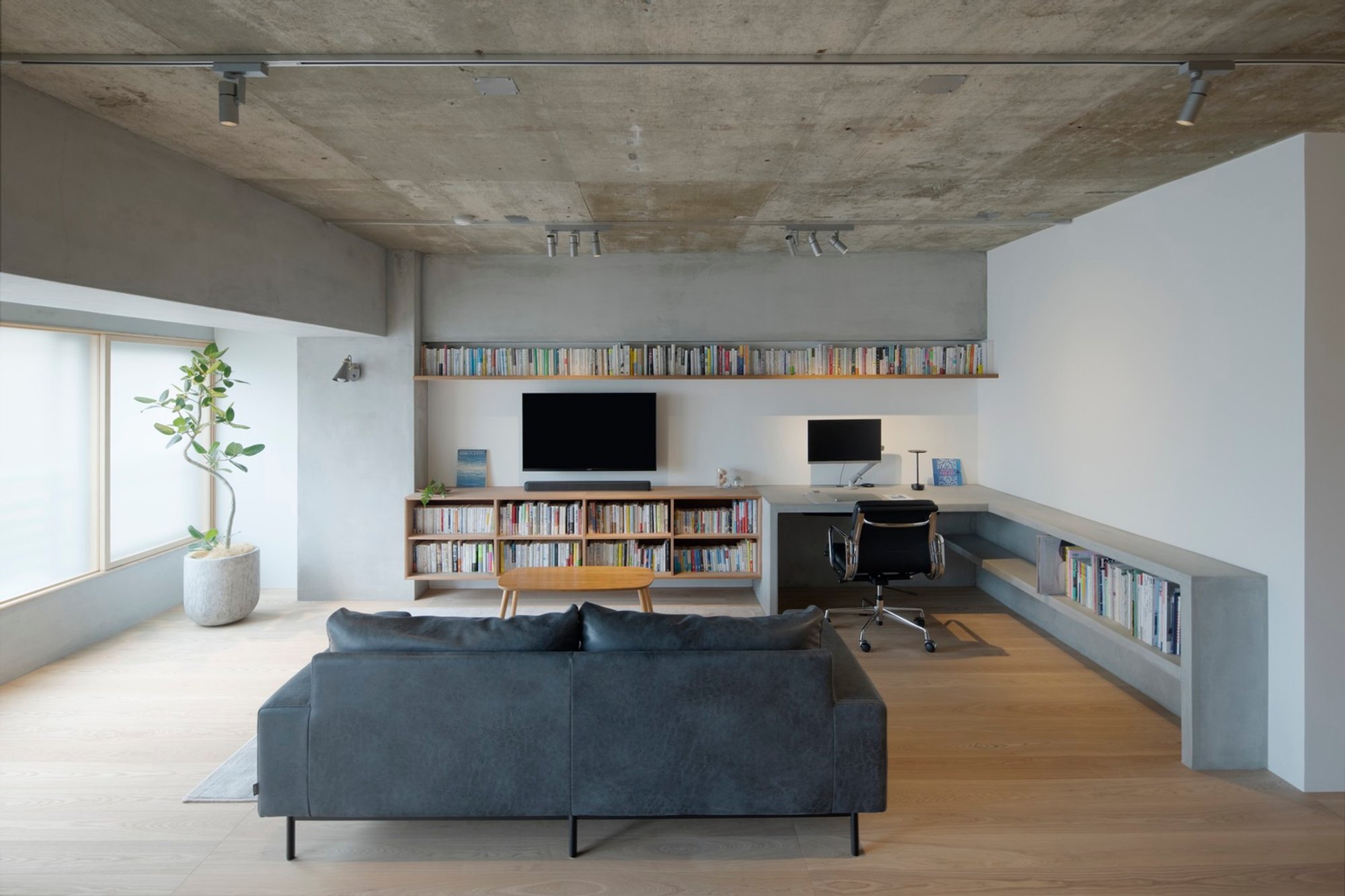
House in Demachiyanagi Area 02 by Koyori
A tranquil Kyoto apartment renovation where books organize soft, light-filled spaces, seamlessly blending living, working, and reading into daily life.

A Book-Centered Apartment Renovation in Kyoto, Japan
Located near Demachiyanagi Station in Sakyo-ku, Kyoto, House in Demachiyanagi Area 02 is a carefully crafted apartment renovation designed by Koyori for a young couple whose lives revolve around books. Set within a vintage apartment building, the 80-square-meter residence reimagines contemporary domestic space through quiet spatial continuity, material softness, and an intimate relationship between living, working, and reading.
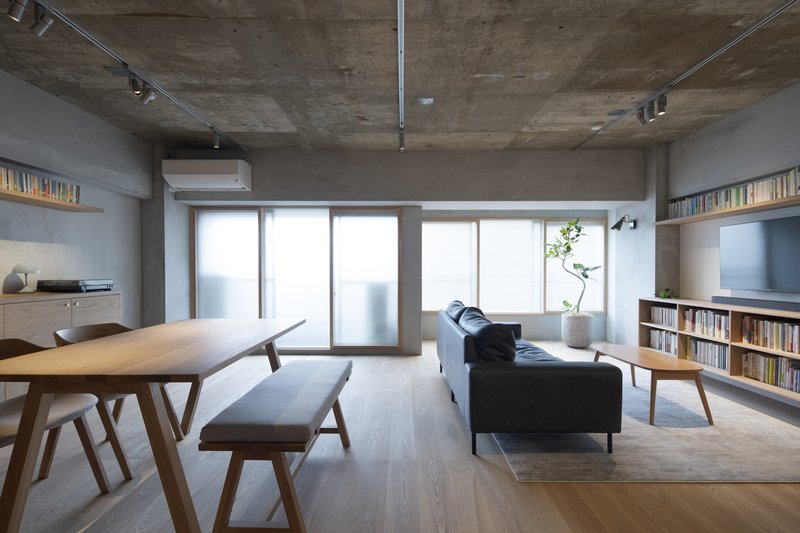
Completed in 2024, the project responds directly to the evolving live + work paradigm accelerated by the COVID-19 pandemic. Rather than dividing functions into rigid rooms, the architects propose a fluid living environment where everyday activities—reading, working, cooking, resting—coexist seamlessly. The result is a home that prioritizes tranquility, concentration, and the gentle passage of time, offering refuge from the visual and acoustic noise of the city.
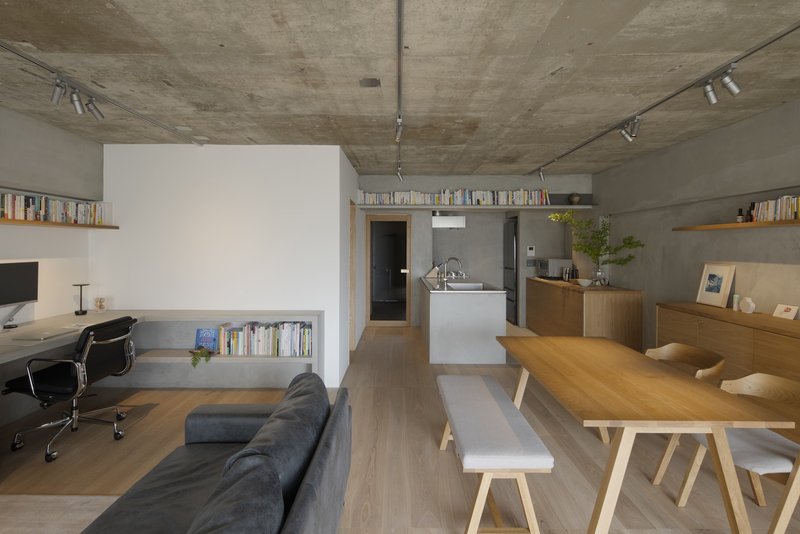
At the heart of the design is the couple’s shared relationship with books. More than objects or storage elements, books become spatial organizers and emotional anchors. Bookshelves are distributed strategically throughout the apartment, subtly defining zones while maintaining openness and visual continuity. This approach transforms the collection into a connective infrastructure, linking spaces without the need for partitions or stark boundaries.
The main living area, organized as a continuous LDK (living, dining, kitchen), integrates multiple functions aligned with both the residents’ lifestyle and the constraints of the existing structure. The kitchen, dining table, living space, walk-in closet, and workspace are carefully positioned to allow effortless transitions between activities. Each zone maintains its own identity while contributing to a cohesive whole, reinforcing the idea of living as a layered, adaptive experience.
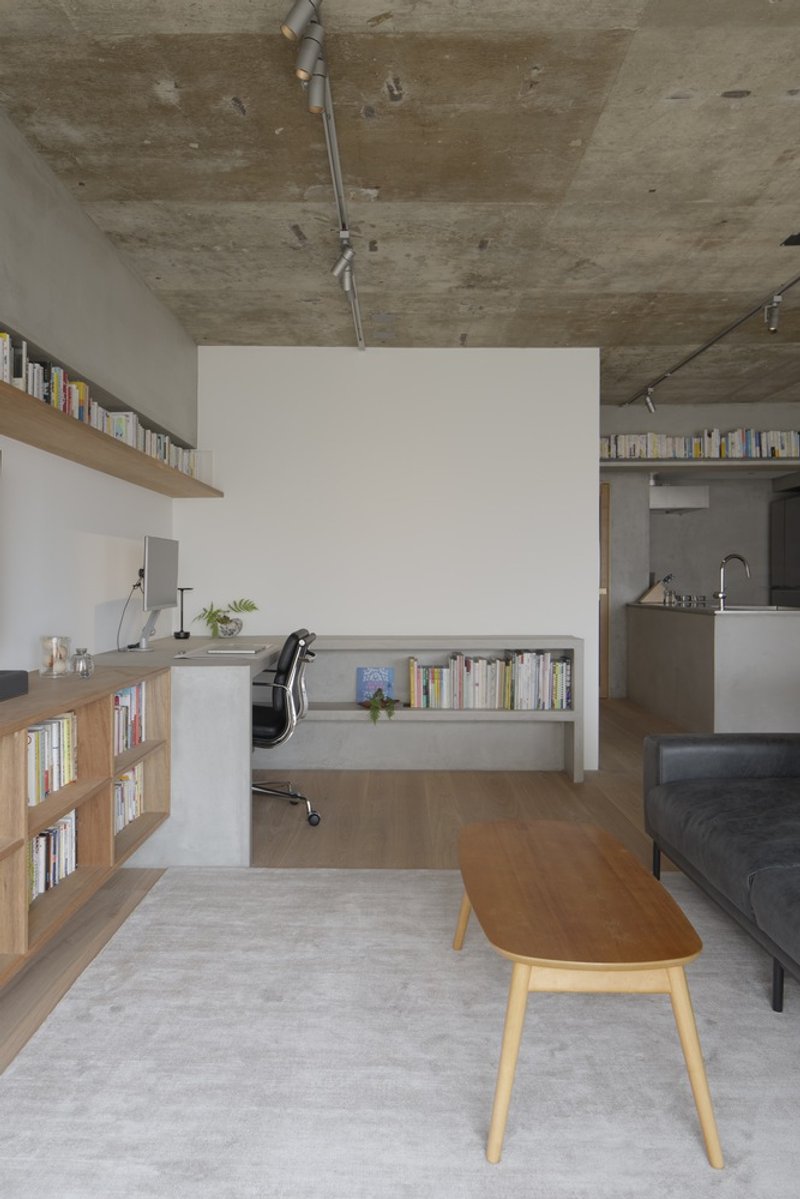
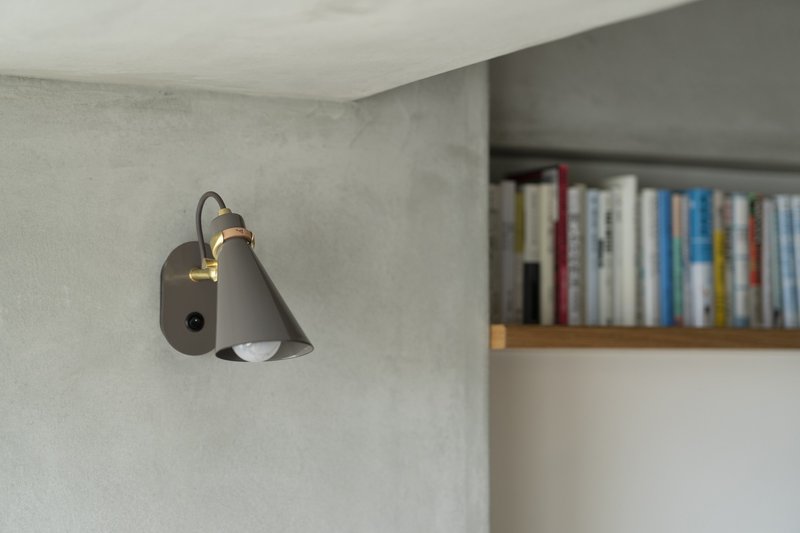
Furniture and built-in elements are designed under a unified rule, emphasizing consistency in scale, proportion, and detailing. While a variety of materials is employed—wood, textured surfaces, and soft finishes—the overall palette remains subdued and low-contrast. This deliberate restraint allows the books, light, and daily rituals of the occupants to take visual precedence, reinforcing the calm and introspective atmosphere.
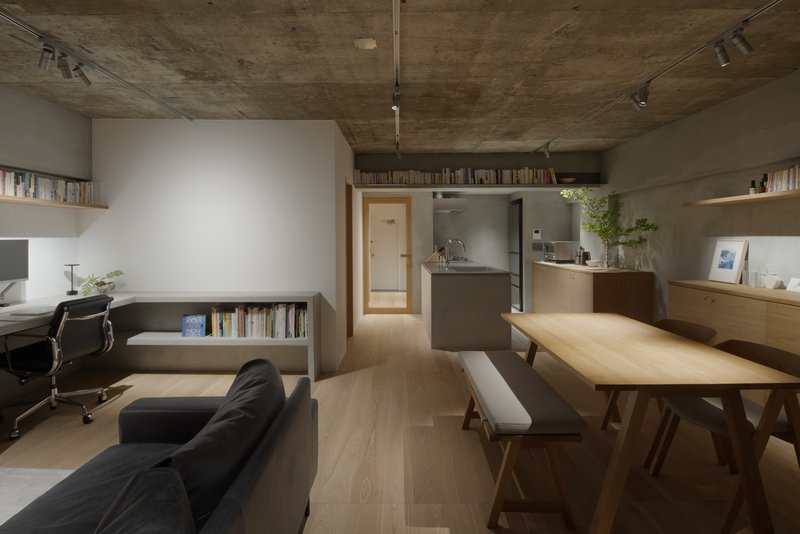
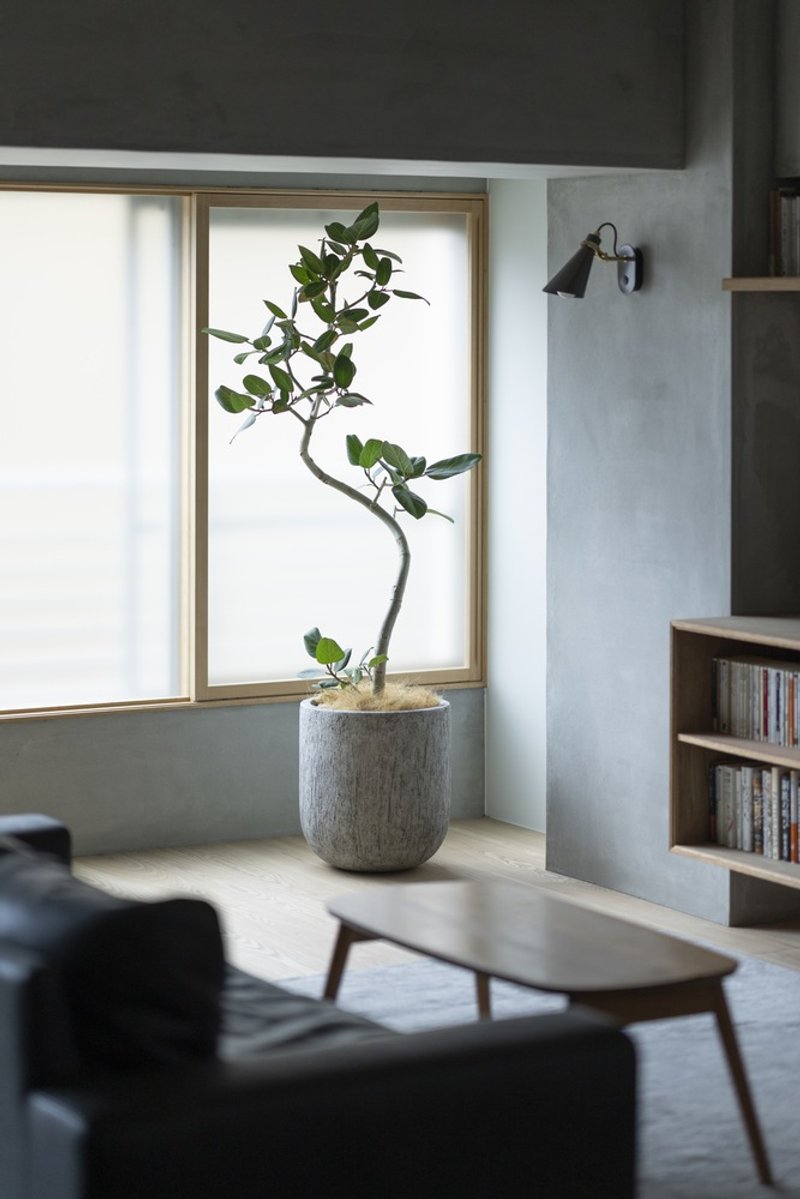
Natural light plays a crucial role in shaping the interior experience. Large openings along the façade are fitted with frosted glass, filtering sunlight into the apartment while obscuring direct views from outside. This design decision balances openness with privacy, allowing the interior to remain connected to the rhythm of daylight without absorbing unnecessary external information. The softened light enhances material textures and creates a serene backdrop conducive to reading and focused work.
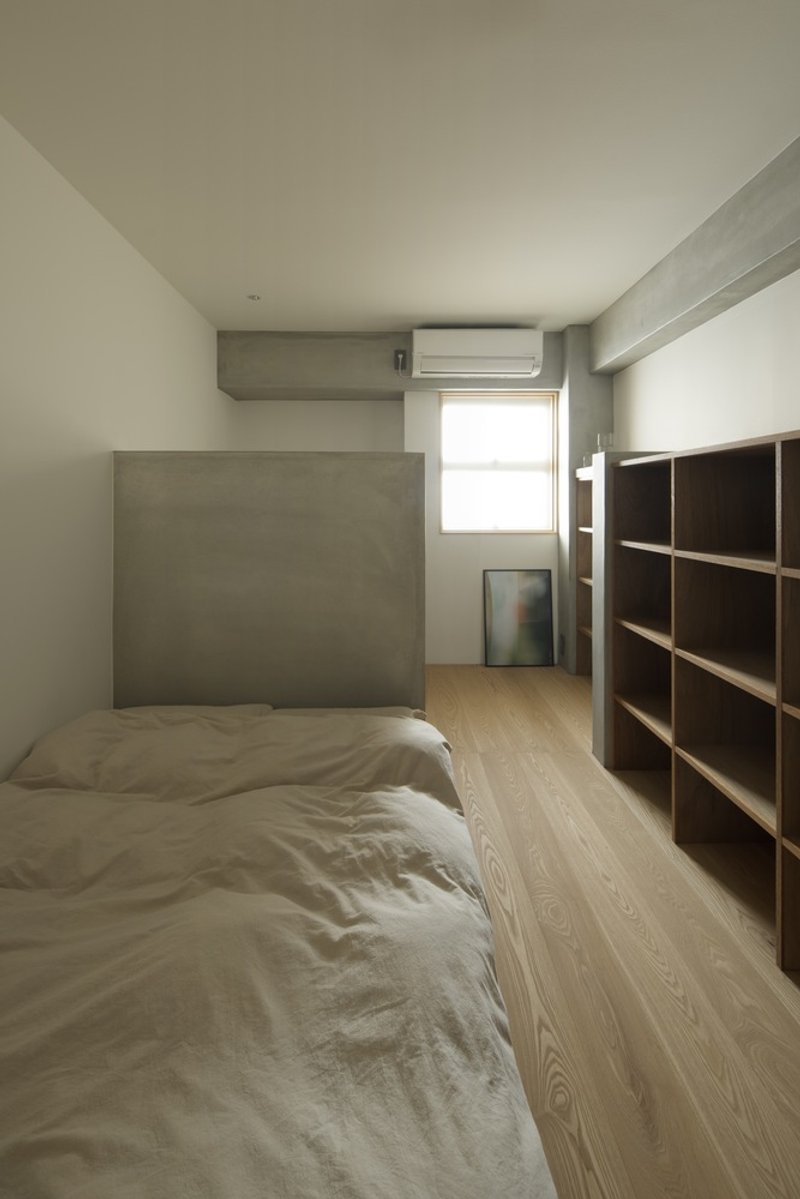
The bedroom continues this philosophy of quiet integration. Shelving wraps gently around the sleeping area, extending the presence of books into more intimate spaces. Rather than separating rest from intellectual activity, the design embraces their coexistence, acknowledging the fluid nature of contemporary lifestyles. The result is a bedroom that feels both restful and intellectually alive, supporting moments of retreat without isolation.
Throughout the apartment, circulation is intuitive and unobtrusive. Movement flows naturally from one function to another, guided by furniture placement, shelving, and subtle changes in spatial density rather than walls or corridors. This openness allows the home to adapt over time, accommodating shifts in work habits, routines, and personal needs without requiring structural change.
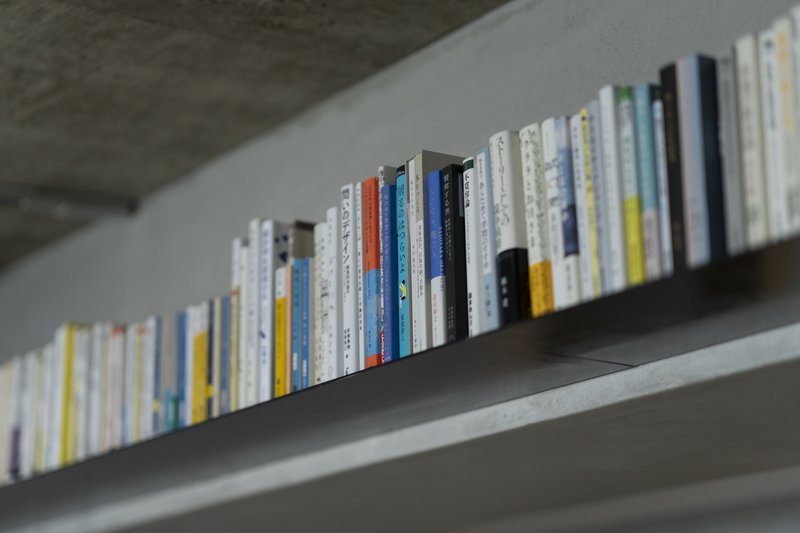
Construction was carried out by Takagishi Construction, with photography by Junichi Usui capturing the project’s understated materiality and nuanced use of light. The images emphasize the softness of the interiors, the tactile quality of surfaces, and the way books animate the space, reinforcing the architects’ intention to create a home defined more by atmosphere than form.
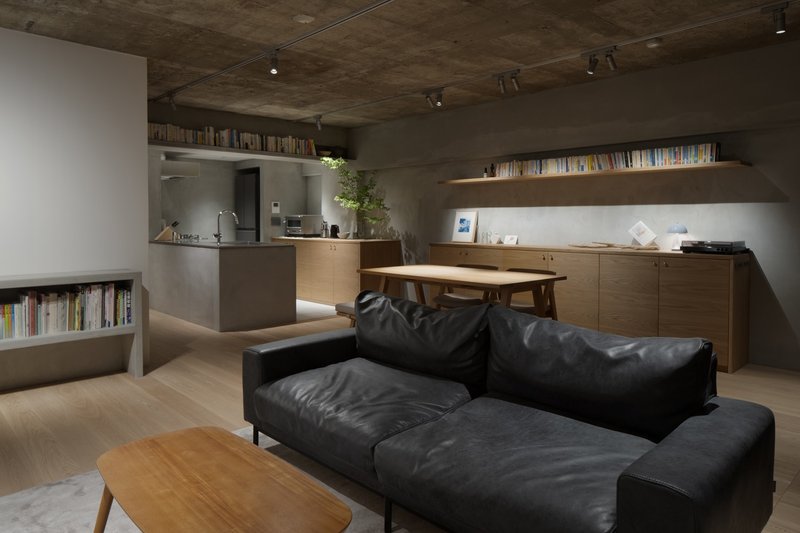
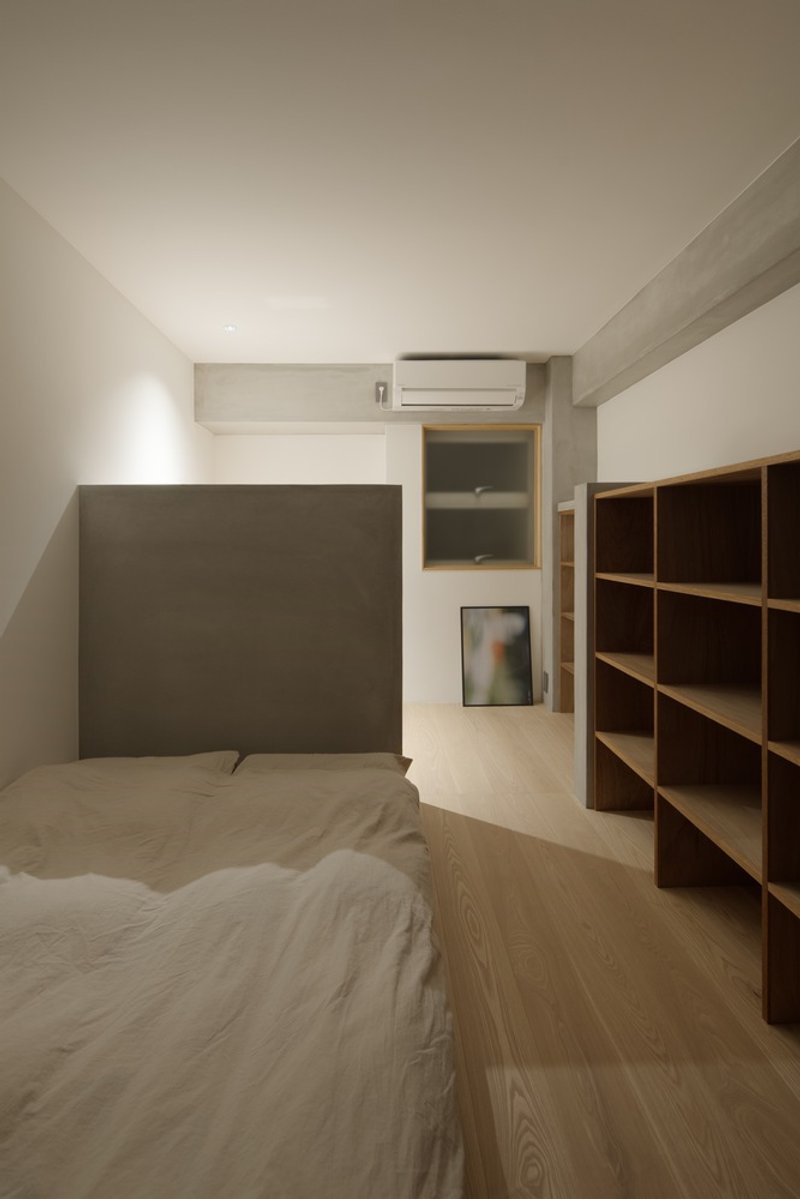
Ultimately, House in Demachiyanagi Area 02 is an exploration of how architecture can support a gentle, introspective way of living. By centering the design around books and minimizing visual noise, Koyori has crafted a residence that allows its inhabitants to slow down, focus, and live in tune with the subtle flow of time. It is a contemporary Kyoto apartment that quietly redefines domestic space—not through bold gestures, but through thoughtful restraint and deep empathy for everyday life.
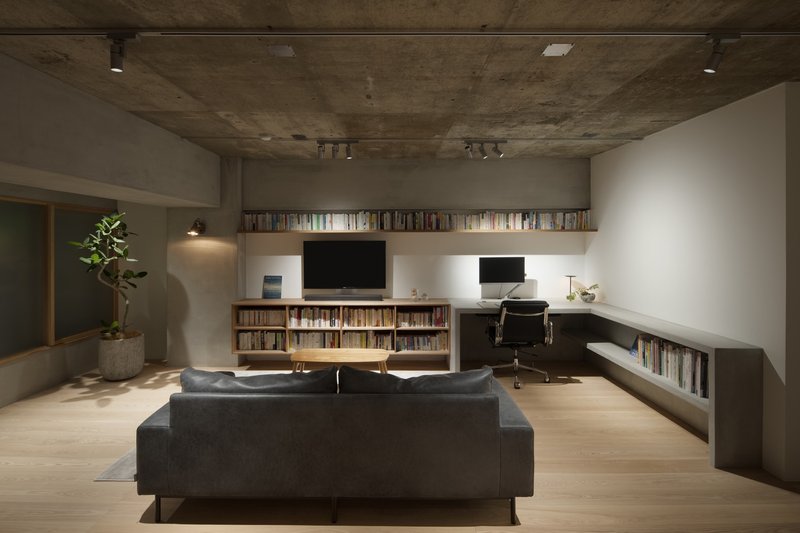
All photographs are works of Junichi Usui



Popular Articles
Popular articles from the community

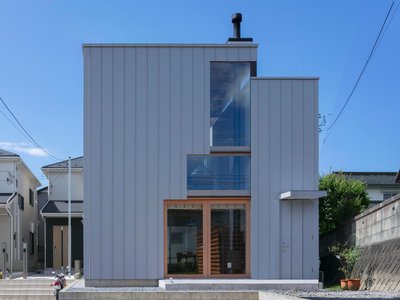
Split House: A Compact Urban Home Blending Privacy, Light, and Flexible Living in Japan
Compact Japanese home featuring DOMA space, flexible café potential, passive lighting, privacy zoning, and sustainable urban living design.

Solar Steam: A Climate-Responsive Architecture That Redefines the Monument
A climate-responsive memorial architecture that transforms heat, decay, and time into a living system reflecting humanity’s ecological impact.

Free Architecture Competitions You Can Enter Right Now
No entry fees, real prizes. Here are the best free architecture competitions open for submissions in 2026.
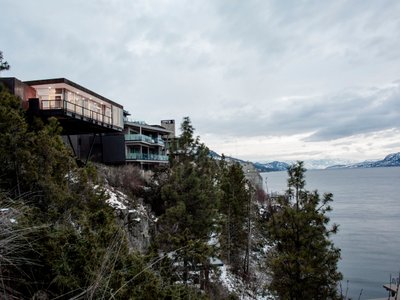
Alton Cliff House: A Harmonious Retreat by f2a Architecture in Lake Country, Canada
Alton Cliff House blends corten steel, prefabrication, and sustainable design, creating a luxurious, energy-efficient retreat perched on Canadian cliffs.


Similar Reads
You might also enjoy these articles


The Ken Roberts Memorial Delineation Competition (Krob)
As the most senior architectural drawing competition currently in operation anywhere in the world, it draws hundreds of entries each year, awarding the very best submissions in a series of medium-based categories.

Waterfront Redevelopment and Urban Revitalization in Mumbai: Forging a New Dawn for Darukhana
A transformative waterfront redevelopment project reimagining Darukhana’s shipbreaking heritage into an inclusive urban future.

OUT-OF-MAP: A Call for Postcards on Feminist Narratives of Public Space
Rhizoma Design and Research Lab invites artists, designers, architects, researchers, and students to reflect on how feminist perspectives can reshape public space. Selected works will be exhibited in Barcelona, October 2026. Submissions open until 15 April 2026.


Documentation Work on Buddhist Wooden Temple
Architectural syncretism and cultural hybridity: A comparative study of the Buddhist temples in Chattogram Hill tracks


Explore Architecture Competitions
Discover active competitions in this discipline




The International Standard for Design Portfolios


The Global Benchmark for Architecture Dissertation Awards


The Global Benchmark for Graduation Excellence


Challenge to reimagine the Iron Throne
Comments (0)
Please login or sign up to add comments
No comments yet. Be the first to comment!