
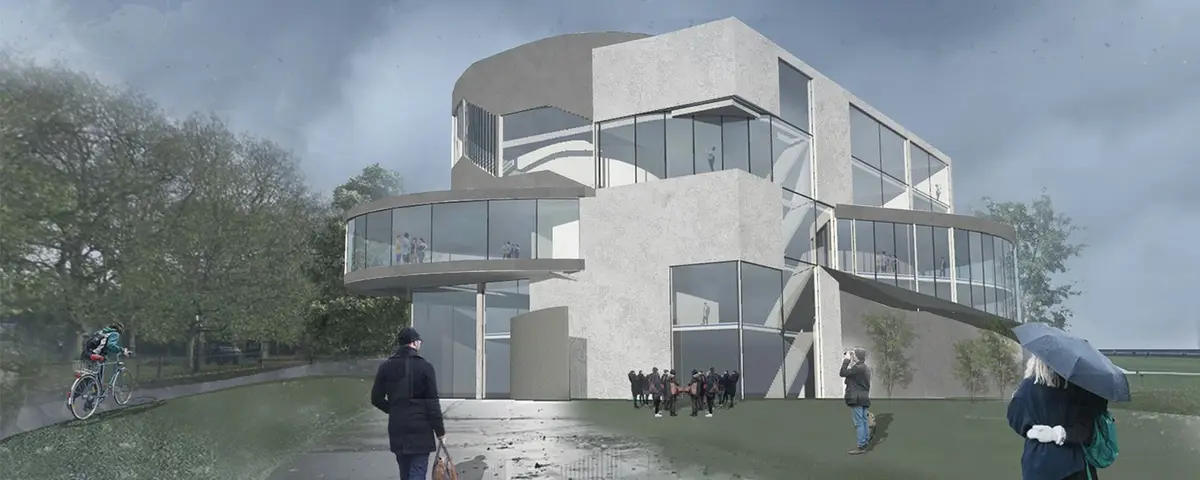
INTER-ACTIONS: Ramps, Not Corridors, as the Engine of Design Education
A London-sited school of design replaces classrooms with continuous ramp circulation, weaving students, professionals, and the public into one learning net


What if the most important architectural element in a school were not the classroom but the ramp? INTER-ACTIONS takes that provocation seriously, proposing a design school where fluid, continuous circulation paths replace static corridors, turning every movement through the building into a potential encounter between disciplines, between students and professionals, between the institution and the city. The ramp is not a convenience here; it is the thesis.
Designed by Marine Sirieys and Sarah Hirtz, this shortlisted entry for the Bauhaus Neue competition reimagines design education through the spatial logic of interaction. Sited in London near Hyde Park and Mayfair, the project draws on Bauhaus principles of interdisciplinary making while projecting them into a contemporary framework of open access, co-learning, and urban integration.
Three Lobes, One Continuous Interior
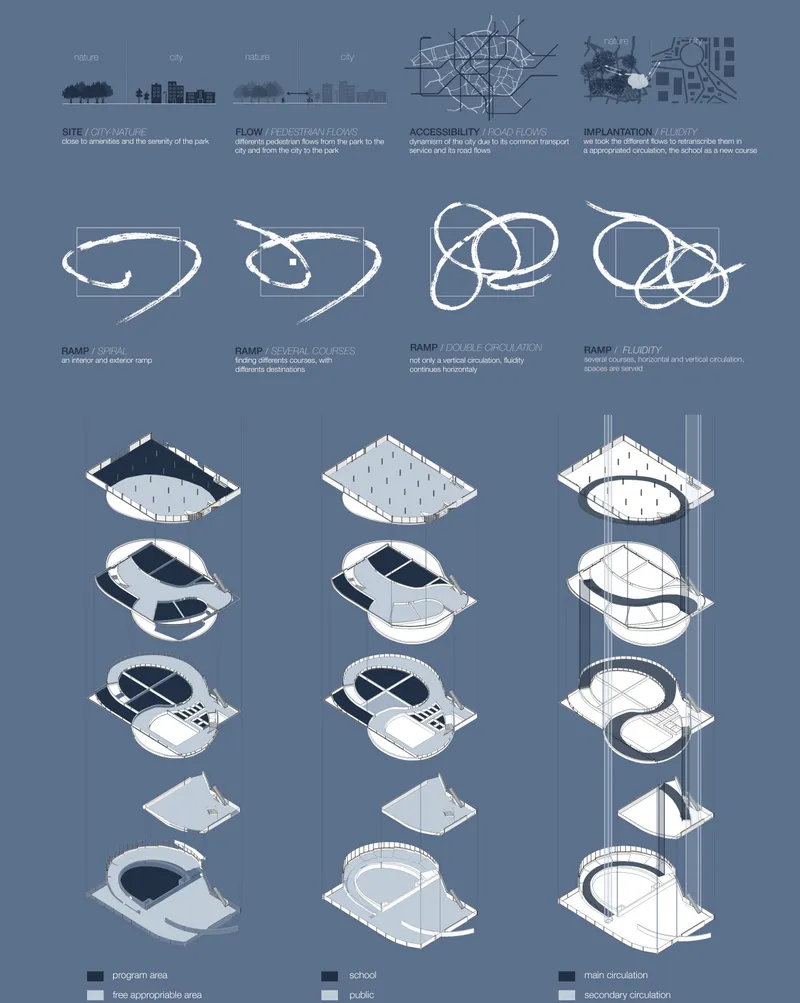
The building's plan resolves into a distinctive three-lobed form, each lobe hosting one of the school's core disciplines: product design, graphic design, and textile design. The conceptual sketches and axonometric studies shown here reveal how this tripartite geometry emerged, not from arbitrary formal play, but from a pedagogical diagram. Each discipline occupies its own spatial territory while remaining physically linked to the others through shared spaces and common lesson areas. The resulting plan is compact yet porous, a form that makes isolation between departments spatially impossible.
Multiple ramp typologies organize the interior: spiral ramps connecting interior and exterior conditions, double-circulation paths enabling both vertical and horizontal movement, and what the designers call "fluent pathways" that allow occupants to reach diverse destinations without being funneled through a single route. The effect is a building where you cannot walk from one studio to another without passing through zones of overlap, where unexpected encounters are not incidental but engineered.
An Urban Campus Between Hyde Park and Mayfair

The site plan positions the school at a charged intersection of London's urban fabric. To one side, Hyde Park provides a green anchor; to the other, the commercial and social energy of Oxford Street and Mayfair. The designers read the site through pedestrian flow analysis, identifying connections to Speaker's Corner and the Serpentine Gallery as cultural reference points that align with the school's ambition to be a space of free expression and public engagement. The curving three-lobed footprint nestles among existing trees, treating the landscape not as a backdrop but as an active participant in the school's daily life.
Rather than walling off the institution, the project opens its ground floor to the city. Amphitheater seating, cafés, and open interaction zones occupy the base, inviting the public in. The school becomes a pedagogical landmark where urban life and learning share the same threshold, not a gated campus but a node in London's cultural infrastructure.
Section as Pedagogy: Mezzanines, Studios, and Exposition
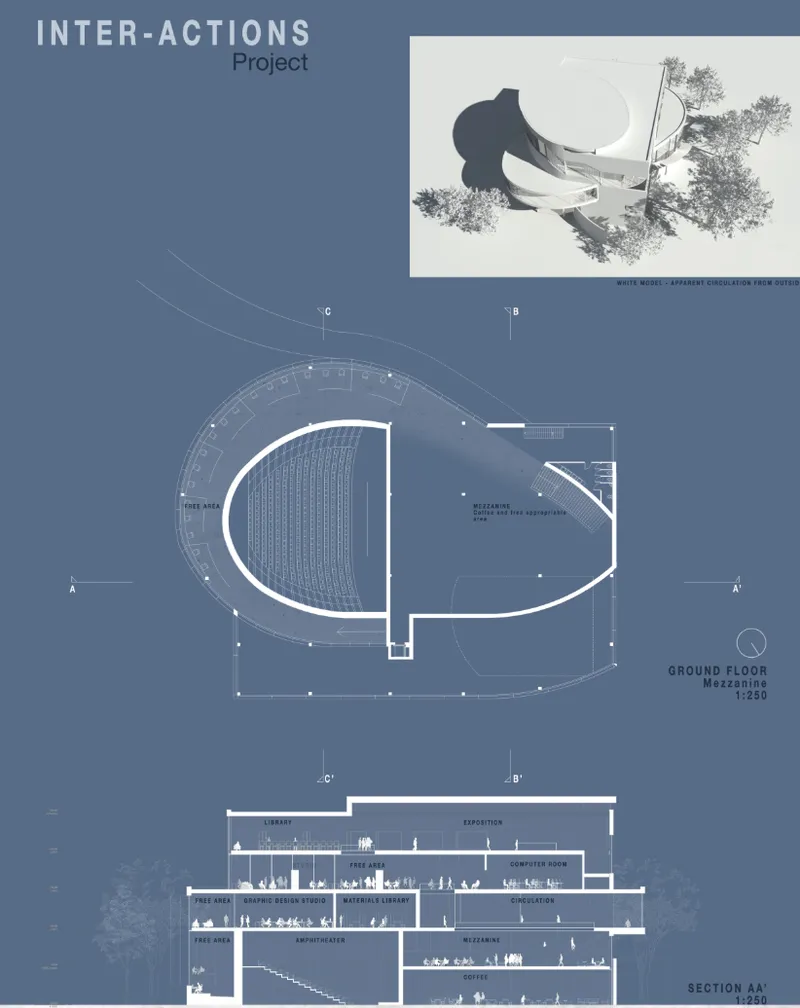
The ground floor plan and cross-section reveal a layered interior that distributes programme vertically with clear intent. The ground level hosts the most public functions: amphitheater, cafés, and open zones designed for spontaneous interaction. The first and second floors contain the working heart of the school, with graphic, textile, and product studios alongside material libraries. Upper levels are reserved for exposition areas and quieter relaxation nooks, giving the building a gradient from collective intensity at the base to reflective calm at the top.
Materiality reinforces this layered reading. Light grey concrete provides the primary structural expression, while darker tones mark zones the designers describe as "appropriable," spaces intended to be claimed, rearranged, and personalized by their users. Transparent glazing dissolves the boundary between interior and exterior, ensuring that activity inside the building remains visible to the city and that natural light penetrates deep into studio spaces. The section is not just structural; it is a diagram of how open, shared, and responsive education can be organized in three dimensions.
A Multi-Nodal Knowledge Ecosystem
INTER-ACTIONS decentralizes the act of teaching. The traditional model, where knowledge flows from a single instructor to passive recipients in a fixed room, is replaced by a multi-nodal ecosystem. External interventions from practicing professionals, student-teacher collaborations, and open public access create overlapping circuits of knowledge exchange. The school does not merely accommodate interdisciplinary work; its spatial logic makes disciplinary silos structurally impossible. Graphic designers share material libraries with textile students. Product design studios open onto common critique spaces. The architecture physically embodies the Bauhaus conviction that everybody can learn from everyone.
Why This Project Matters
Design education has long struggled with the gap between its collaborative rhetoric and its spatial reality: individual desks, departmental floors, locked studios. Sirieys and Hirtz confront that contradiction directly, proposing a building whose primary architectural gesture, the continuous ramp, makes isolation physically difficult and encounter architecturally inevitable. The project does not just reference the Bauhaus; it tests whether its core pedagogical idea, that art, craft, and technology belong in one conversation, can be given a convincing spatial form in a contemporary urban context.
What makes INTER-ACTIONS compelling is its refusal to treat circulation as neutral infrastructure. The ramp here is the curriculum made spatial: fluid, non-hierarchical, open to deviation. In a field where school design too often defaults to flexible partitions and branded atriums, this project argues that the deepest flexibility comes not from movable walls but from the paths people take through a building and the people they meet along the way.
View the Full Project
About the Designers
Designers: Marine Sirieys, Sarah HIRTZ
Enter a Design Competition on uni.xyz
uni.xyz runs architecture and design competitions year-round that reward proposals with spatial conviction and real site intelligence.
Project credits: INTER-ACTIONS by Marine Sirieys, Sarah HIRTZ Bauhaus Neue (uni.xyz).


Popular Articles
Popular articles from the community


Opera on the Sea: Driftwood Logic Shapes a Timber Opera House on Estonia's Coast
Trevor Orgill's opera house translates the entangled drift of floating timber into a civic building where wood, water, and music converge.

Singing Woman: Contemporary Architecture Inspired by Estonia’s Voice and the Sea
Singing Woman turns Estonia’s song culture into flowing opera house architecture, blending public life, landscape, sea, and national memory.

The Amber Palace Opera: A Geological Fiction Surfaces on Tallinn's Baltic Waterfront
Pierre Brillard reimagines a Baltic legend as a public landscape, opera house, and waterfront promenade rooted in Tallinn's coastal identity.
Cloaked Colonization: A Mobile Underwater Habitat That Moves Like a Fish
Micah Abaya's shortlisted EHC Pacific entry reimagines ocean settlement as a dispersed network of self-sustaining architectural organisms.

Similar Reads
You might also enjoy these articles

Bao Huynh Watercolor Atelier: A Serene Art Retreat in Hội An
Bao Huynh Watercolor Atelier in Hội An blends multifunctional art spaces, sustainable design, local materials, and family-friendly living in a serene environment.

Atelier Macri Concept Store Interior Design by CASE-REAL
Atelier Macri store features a "ko" counter, walnut wood details, cork displays, blending retail, gallery, and seamless customer experiences.

Manuel Vargas Izquierdo Stadium and High-Performance Sports Center: Architectural Excellence in Jalpa de Méndez
The Manuel Vargas Izquierdo Stadium blends sustainable design, inclusive sports facilities, and cultural-inspired architecture, revitalizing Jalpa de Méndez’s public spaces.

KAKR Buluh Awar Hall: Revitalizing Community and Ecology Through Bamboo Architecture
Community built bamboo hall revitalizes Buluh Awar village, empowering youth, restoring ecology, celebrating vernacular craftsmanship through sustainable architecture and culture.

Explore Interactive Architecture Competitions
Discover active competitions in this discipline

Challenge to design public laboratory

Design challenge to equip cities with modern furniture

Packaging challenge - Design meets sustainability
Comments (0)
Please login or sign up to add comments
No comments yet. Be the first to comment!